


Coming to Mr. Kirk
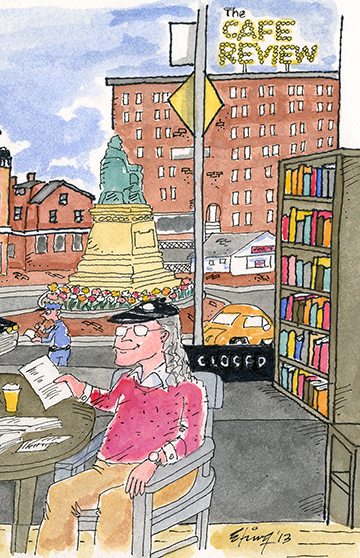
by Richard Taylor
Before the crowd arrives I’ll find shelter
among the thick trees and stand
very still.
The noise of them, the noise
bends the tall grass, though there is
no wind.
It’s more than the advance of mice
in a meadow, unseen and many, or crows
opposing the morning’s high opinion
of its clouds.
It’s the rowdy tongues inside that drum
of unattended loves, chorus the day’s alarms,
the prospect of sorrow, then chase their syllables
to dust in a chill sky that makes tears of them
for the rattle of rain.
The noise of them, the noise
offends a man standing in the simple shelter
of himself. I slip away to quiet
by a solitary man who fishes
the old way.
At the meadow’s brook I know it’s Mister Kirk
by the breadth of the britches high in the hitch of his galluses
and much above his boots.
Nor would I disturb the hat nesting in his gray hair
like a comfortable bird, for he stands very still, doesn’t know
how the fishing is, and it won’t likely improve, he says,
with a brass band close by.
There is but one of me, but the grass stirs, and he
with the wind’s ear has heard it and enough, for he wears
a fill of years the crowd no longer counts, voices
the riffles have drowned out.
The water’s tug is in his eye, and he cares to finish
with his fishing in a pool a ways downstream, smooth
and full of sky, where fish are leaping from their shadows
into the afternoon sun.
Cold Knowing
by Richard Taylor
Water from the well in its corner of our barn and house
can straighten a person up pink and suddenly
with cold astringent lacings up the eyelets of a spine.
First myself then he, we pitch the chill baptismal bucket
that binds a father to a son, blind to any firmament except
our private ivory galaxy with its few dark stars.
The soap rubs up to infant clouds around his ears,
his armpits, lathers his substantial manliness, while I
shiver in my smile, having none such to compare.
I am the altar boy to fetch the cup from the water’s table
at the bottom of the dark where I see myself at a rope’s length
looking back and fear to dip less than from the coldest knowing.
The bucket dropping from both hands, mouth down,
fills full, and the windlass likes its reeling up the water
clean and terrible for father in the tatters of his suds.
At a stroke redemption pure and puritanical pours
ice along his spine, sucks in his breath as every pore
slams shut, screams to a deity with no charity or name
for the cut it spends on tender flesh. I had thought
our local recompense distilled below of old
and ever since came up more mercifully parceled
in its bucket sized to a naked boy who ministers
what yet abounds of innocence, until I stand
on the other side and father comes toward me with his pail,
overfull and licking. Half my mother watches
from the window curtain, and she smiles as if uncertain
how her one becoming old will teach her other
not yet finished being young until we leap
and laugh past all proportion but exactly as a bucket
of cold knowing from the well makes naked men.
Artaud in Mexico
by John Macker
He tells the dubious Tarahumara
Rimbaud never met a French poet he
didn’t disdain.
Eats peyote by the handful
from a painted gourd,
has a vision of the nativity of Hieronymus Bosch,
dances the night away with
peyote sorcerers,
intuits the last words Sam Peckinpah
spoke to god,
reads A Season in Hell
by firelight
next to a graveyard
with its
lyrical colored metal crosses
and plastic
flowers;
chants, one must be absolutely
modern
as the incantatory clouds climb like
smoking gun blossoms high over
the Sierra Madre.
The Indians have mercy on this
tattered schizoid soul, install his
junkie ass upright on a drunken mule
for the long road home.
They recognize a kindred spirit
when they see one,
his garish, provocative nature not
at all at odds with
the fellaheen.
They dig his otherworldliness,
his seer’s heart.
For Ted Berrigan
by John Macker
Your “code of the west” is not the same as mine.
You are all Manhattan via Oklahoma party Pepsi cowboy true
rumbling gut on the Apollinaire streets. Codes are like
sonnets: the truth is so elusive it takes pills every morning just
to be seen. Great seeing you, Ted. You aren’t dead, you’re
hibernating while every winter your poems paw through
the snow looking for berries. My Code of the West is as follows:
1. Every saloon girl is fair game unless she’s your sister.
2. hair shirts are for sissies
3. guns are to be belittled and then planted every spring
4. a saddle is as good as a sonnet to a blind horse.
5. “When you ask death for his credentials, you are dead.”
— William S. Burroughs
6. By 1918, 20,000 British men of military age refused the draft.
Hence, more bodies for World War II.
7. Riding alone across the desert on a blind horse, if you encounter
an angel wearing chaps, it’ll be Ted Berrigan
8. A sonnet is as good as a junior sheriff ’s posse badge to a
blind cowboy.
9. Calamity Jane is a sympathetic muse.
10. Hands up!
11. “If they move, kill ’em!”