


brandenburg
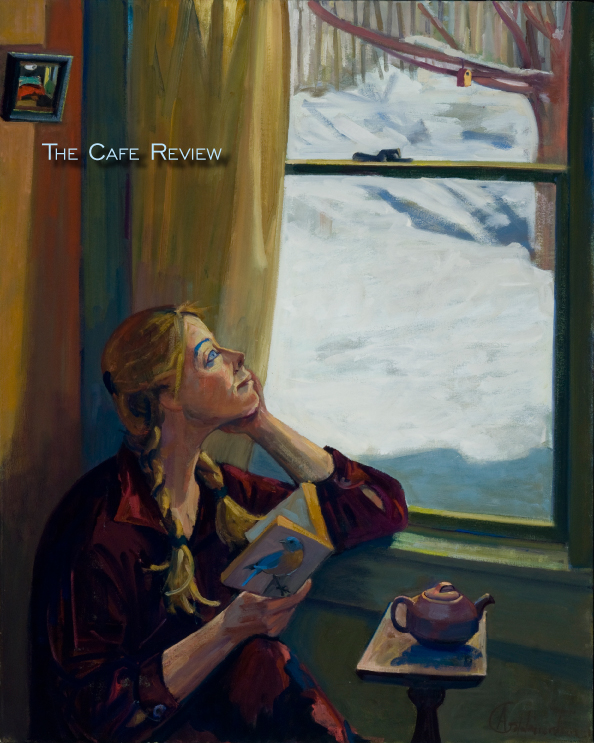
by Ulrike Almut Sandig
translated from German by Bradley Schmidt
all routes leading here were quick
and blue. on signs were warnings of deer,
the green of the trees caught the eye,
every animal in the branches stayed visible
and still. we threw our heads back
towards the fleeing tree tops, buds flew
in droves into the light, the trunks were
marked with glistening paint, behind
the curves the crosses. here NATURE was
the goal of the youth here, i tell you.
forget me not, you answer me, remember
the tree tops from another year, think
of our stride, the roar of the leaves,
the waves on the gravel pit, the backhoe,
the lake
After a Stroke, My Mother Speaks to a Stuffed Pheasant in Her Son-in-Law’s Living Room
by Tom Daley
Pheasant, I promised my sons
I will only leave them
to climb the hill to the long sleep
if you dare to fan your wings
in this room. Tell them my feet are
stirring in my black boots.
Tell them that my fists
have rubbed my eyes weary
keeping watch.
This room is cold, Pheasant.
Why do you roost here,
ruddy and betrayed?
In your indifferent pose,
your wing feathers are soft as Irish setter hair,
your neck green as a pigeon’s.
Your glass eye is weak.
You cannot take it out.
Do not let it cloud.
My dugs have failed, Pheasant.
They were nuzzle and buoy
and braver than cartilage.
Feather my breasts with your prayers, Pheasant,
for they have been hurt.
You have been hurt, too, Pheasant.
You were shot to please
a woman, and preserved.
Pheasant, it is wintry in my heart.
This winter starves me. The hill roads
near this house are crowned
with impassable ice.
Give me back my girl’s ministrations.
Yes, her husband’s backbone is maimed,
but let her attend to my squalor,
my blatant and durable envy.
If her man is courteous,
his pockets are bulging with buckshot.
His hands are forever tying tiny lures.
His hunt fills my girl’s need.
He fishes her and fills her.
Pheasant, where will you fly to?
If I walk in your wake, will your turbulence warm me?
Even the fires in this house are futile.
Their smoke makes my sons cough.
Late at night I hear their gasping.
Pheasant, your cordovan coat
is splotched by their hacking.
They unlace my boots
and lie on the floor beside my bed
so that I will not follow you
and clamber to sleep
when you summon your wings.
Normal, Illinois
by Richard Spilman
Because home is the one place you cannot escape;
because it sat in the middle of the county, in the middle
of the state, in the middle of the country, surrounded
by corn rows like a second–grade sun; because Sugar
Creek was a storm ditch you nearly drowned in;
because Adlai grew up there and everyone voted for Ike;
because Chicago was “up” and St. Louis “down,”
as if the town were perched halfway up a cliff;
because you drank whiskey and Coke in a graveyard,
and once in a joyful abandon, after weeks of almosting,
parked on a berm and like Christmas tore the bright
wrappings from each other. Then a cop pulled up,
red light circling, hitched his belt and rapped the butt
of his flash on the hood and, sighing like God
at your sudden modesty, told you to get the damned
wheels off the road or a truck would give you a real taste
of Heaven. You angled the car to the edge of the ditch,
and were entwined before he left, his siren a celebration
of the absurdity of love. You did not look beneath
the Catholic tartan, nor did she at you as she helped you
find the way. Your bliss needed a shroud of ignorance,
for this was theft: you two in the dead of night breaking
into the great mansion to take by stealth, by force
all that the owner had withheld from you. The moon
a torch painting her face chiaroscuro, every breath eternity,
the gear shift in your side to remind you love is pain,
you soughed her name, and the car slid into the ditch.
The Sadness of Hats
by Richard Spilman
He had been taught like many men his age
not to look at himself, even in mirrors. Shaving
saw only what he had to. So it was on a hot Sunday
at a track meet in Berkeley, watching Mary Decker
win the mile, that, after fainting in his seat,
he discovered he was bald.
(Okay, I lie. He knew, but not in the way you know,
when you pull out too late or come home early
to find a pickup in your drive, that life
has caught up with you.)
Now, he goes nowhere, even on morning walks
or trips to the grocery, without a wide–brimmed hat,
wears long–sleeved shirts in the heat of summer.
Even so, to every physical his doctor brings a cup
of steaming nitrogen and burns the tiny scales
that threaten his life.
He feels as if he’s hiding from the man he was once,
head bared to the sun. He remembers Mary Decker
that day in Berkeley, arms spread like Nike’s wings,
and later in Los Angeles writhing on the grass
after Zola Budd cut in.