

Angela Rona Estavillo
Angela Rona Estavillo: ( goes by “Angel” ) is a Filipino American poet and writer. Her work has also appeared in Cagibi, Cordite Poetry Review, and boats against the current. Previously, she was a Writing Fellow at Towson University and served as an assistant nonfiction editor for volume 71 of Grub Street. A dual U.S. / New Zealand citizen, she is currently based in Virginia’s Shenandoah Valley, where she is pursuing her M.A. in English at James Madison University.
Jim Daniels
Jim Daniels: a previous contributor to The Café Review, his latest book, The Luck of the Fall, was published by Michigan State University Press. Recent poetry collections include The Human Engine at Dawn, Wolfson Press, Gun / Shy, Wayne State University Press, andComment Card, Carnegie Mellon University Press. A native of Detroit, he currently lives in Pittsburgh and teaches in the Alma College low–residency MFA program.
Anthology of Awe & Wonder
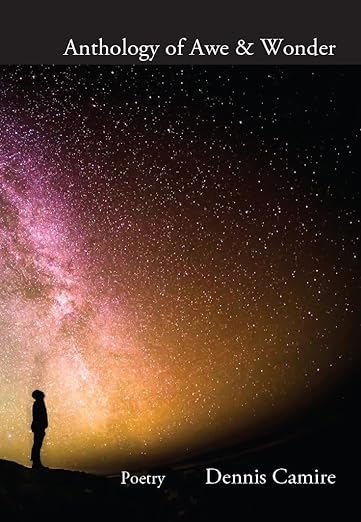
Anthology of Awe & Wonder, by Dennis Camire.
Deerbrook Editions, 2024,
116 pages, paper, $20.95,
ISBN: 979–8–9903529–1–9
In his third collection of poetry, aptly titled Anthology of Awe & Wonder, Dennis Camire engages the reader with his keen observation of and appreciation for the natural world. Threaded throughout the poems is a gentle undercurrent of humor through the playful use of words and Camire’s unique world perspective. In “Some Words on Birds and Borders,” the speaker writes,
Let’s praise all the world’s birds
Unconcerned with shots and passports
As they cross disputed borders
Then refuse to seek permission to
Touch down on the river’s moonlit landing strip.
There’s a delightful musicality to the poems in this collection, such as, “Where flocks of hopeful thoughts / are flushed from the single thrush” or “that dandelion seed the winds waft / from park to inner city sidewalk. . . .” Camire’s style weaves a web between seemingly disparate things and pushes the limits of language in a playful way. For example, in “Observations on the Garden, Fourth of July,” our speaker gushes about his garden while drawing comparisons about our divided nation on a such a momentous day in history,
As pole beans bottle rocket bursting buds
Into the horizon of chicken wire, suddenly
I marvel at the fireworks of my beloved veggies
Celebrating this great, green diverse nation
Where Southern collards abide neighboring
Yankee broccoli — while raspy, sweet corn aids
Humble pole beans seeking like Wall Street
Heights.
The collection is divided into four sections focusing on topics such as birds, gardens, the stars and cosmos, and other natural wonders. In addition to nature–based poems, there’s a compassionate humanity delivered. In “Upon Learning Her Husband Only Has a Few Months to Live,” a woman recalls how the birds used to carry off her husband’s freshly cut locks for their nests. Upon her husband’s passing she finds some solace in the birds at her feeder, knowing they have lined their nests with his hair, “all these soft, gathered thoughts / woven in their last words together / would soothe . . . / even more than the pillows’ / warm, down breast feathers.”
Throughout the collection, the lives of its characters are inextricably intertwined with the natural world, as in “The Fire Tower Lookout in the Wake of a Separation” where the tower becomes “the wise place for his own bull moose–like brooding / And lonesome coyote croons under grief’s waxing moon.” Also, in “The Hatchery Worker in The Wake of His Broken Engagement,” the speaker observes that “the schools of fingerlings — slipping / Through his net — become her lost affections.”
Though humor can be found throughout these poems, Camire occasionally takes a meditative approach, as in the poem, “Atop Peaked Mountain.” The speaker observes that he’s “come to admire the lichen / colonizing the barren rock planets / and making them fertile for moss / then blueberries inside the cracks.” The poem ends with a sense of wonder at this tiny life and the importance of its role, when the speaker recognizes “these galaxies in granite / I’ve overlooked my whole life.”
For readers who have grown tired of elegiac poems that seem to focus on humanity’s darkest hours, this collection may be a balm as it tends towards odes that celebrate the Maine seasons and landscape. The poems shine a beam of light on the natural world that makes you see them with new appreciation. As the book’s first epigraph, by Jack Gilbert, declares, “We must risk delight.”
— Sara Lynn Eastler
Something So Good It Can Never Be Enough
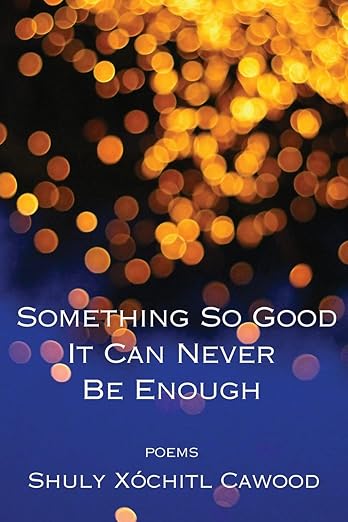
Something So Good It Can Never Be Enough, Shuly Xóchitil Cawood.
2023, 72 pages, paper, $17.95,
ISBN: 978–1–950913–66–9
Ostensibly, the “something so good” referenced in the title is buttermilk rolls. In the poem “My Mother’s One Request,” the speaker (presumably the author) started making them from a recipe at age 15. Her mother loved those rolls, couldn’t get enough, asked her daughter to make them many times, though the process was slow. The daughter, now busy, “tired of the recipe and its need // for each long rise” eventually stops making her mother’s favorite bread. Whether the author feels a twinge of guilt about stopping the flow of rolls is not clear, but the poem comes across as a warning that whenever you create an insatiable demand for something, cutting off the supply can have unfortunate consequences.
The poem is one of several in this collection about cooking and mother–daughter relationships. Another is the prose poem, “My Mother Says She Does Not Know How to Cook,” which begins:
“How did you make this?” she always asks. “A recipe,” I tell
her. No magic trick. No
skill. Just buying ingredients, following directions, not varying
from what I’m supposed
to do. My mother looks in her fridge and pulls out vegetables,
slices them, Even keeps
the stems, sautés them, adds an egg, adds some rice, and what
about that can of water
chestnuts, that might be good, and is there a tomato in the
garden? Oh there’s cilantro out
there, let’s try that.
The notion never occurred to me, until now, that one’s cooking habits might warrant more attention from behavioral scientists. Is the practice of following or not following a recipe predictive of one’s need for structure, variety, lists, schedules, or even love? We don’t know yet. But this poem does something else. It segues into a daughter’s praise for her mother, irrespective of their personality differences. The mother was an immigrant from Mexico, overcame many obstacles and “measured people by their honesty and kindness, not their good or money, not their empty promises. . . .”
A multi–genre writer with published short stories and essay collections, Cawood does not stick to a particular poetic form or style. Some of the poems are prose poems. Most are lineated. Some have short lines, others long expansive lines. Her style is closer to Whitman than Dickinson. She works in conversational language and illuminates nuances of tension and conflict between people. Open about her life, problems, and struggles, she encourages us to ruminate on her own.
Cawood ranges over many subjects, including love, marriage, divorce, beauty, and friendship. My favorite piece in this book is “A Working Definition of Yes,” a poem that makes me want to make a list of all the things I want to say yes to. Here are a few representative lines:
It’s your ruffled red dress. . . .
It’s an investment in hope, expecting more over less . . .
It’s the arrest of a villain. . . .
It’s the hatching of eggs and the mess of dirty dishes
you leave in a heap. . . .
The poem wraps up beautifully with
Yes, is everywhere —
Like fireflies and silver leaves and dogs that chase the rain.
Like dandelion seeds blowing in summer backyard. Like all
those stars behind every cloud you ever saw. Yes is without
regret,
without regard.
— Richard Allen Taylor