


On Steep Himalayan Roads
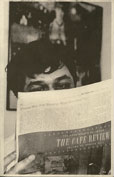
by Zilka Joseph
I read the warning:
It is better to be late, Mr. Driver
than to be the late Mr. Driver
and wondered who heeded
these words, these big red letters
painted on grey boulders near dangerous
curves in the mountains. The bus
drivers scoffed, laughed,
and reckless as gods
hurtled us down the slopes, and I, child
of the seashore and delta, quaked
at the sheer drop, feared the next
turn, the small rolling stones
that could start a landslide. I did
not know your words then,
but when I did, I wept for the elephant
forced off the cliff
by the Hun who so loved the sound of its scream
that he sent his soldiers to drive more
over the edge. How their mothers
still search! These mountains
birthed you. Your footprints
appear. Veiled, your dream
recurs. You wrote about falling
even as you fell. Departures.
Delays. Crossings. Arrivals.
I am ready. The trail begins here.
Tonight
by Agha Shahid Ali
Pale hands I loved beside the Shalimar
— Laurence Hope
Where are you now? Who lies beneath your spell tonight?
Whom else from rapture’s road will you expel tonight?
Those “Fabrics of Cashmere — ” “to make Me beautiful — ”
“Trinket” — to gem — “Me to adorn — How tell” — tonight?
I beg for haven: Prisons, let open your gates —
A refugee from Belief seeks a cell tonight.
God’s vintage loneliness has turned to vinegar —
All the archangels — their wings frozen — fell tonight.
Lord, cried out the idols, Don’t let us be broken;
Only we can convert the infidel tonight.
Mughul ceilings, let your mirrored convexities
multiply me at once under your spell tonight.
He’s freed some fire from ice in pity for Heaven.
He’s left open — for God — the doors of Hell tonight.
In the heart’s veined temple, all statues have been smashed.
No priest in saffron’s left to toll its knell tonight.
God, limit these punishments, there’s still Judgment Day —
I’m a mere sinner, I’m no infidel tonight.
Executioners near the woman at the window.
Damn you, Elijah, I’ll bless Jezebel tonight.
The hunt is over, and I hear the Call to Prayer
fade into that of the wounded gazelle tonight.
My rivals for your love — you’ve invited them all?
This is mere insult, this is no farewell tonight.
And I, Shahid, only am escaped to tell thee —
God sobs in my arms. Call me Ishmael tonight.
2. Zainab’s Lament in Damascus
by Agha Shahid Ali
A segment of the narrative poem
“From Amherst to Kashmir”
Over Hussain’s mansion what night has fallen?
Look at me, O people of Shaam,* the Prophet’s
only daughter’s daughter, his only child’s child.
Over my brother’s
bleeding mansion dawn rose — at such forever
cost?
So weep now, you who of passion never
made a holocaust, for I saw his children
slain in the desert,
crying for water.
Hear me. Remember Hussain,
what he gave in Karbala, he the severed
heart, the very heart of Muhammad, left there
bleeding, unburied.
Deaf Damascus, here in your Caliph’s dungeons
where they mock the blood of your Prophet, I’m an
orphan, Hussain’s sister, a tyrant’s prisoner.
Father of Clay, he
cried, forgive me. Syria triumphs, orphans
all your children. Farewell.
And then he wore his
shroud of words and left us alone forever.
Paradise, hear me —
On my brother’s body what night has fallen?
Let the rooms of Heaven be deafened, Angels,
with my unheard cry in the Caliph’s palace:
Syria hear me
Over Hussain’s mansion what night has fallen
I alone am left to tell my brother’s story
On my brother’s body what dawn has risen
Weep far my brother
World, weep for Hussain
* Shaam: Arabic word for Syria.
A History of Paisley for Anuradha Dingwaney
by Agha Shahid Ali
Their footsteps formed the paisley when Parvati, angry after a
quarrel, ran away from Shiva. He eventually caught up with her.
To commemorate their reunion, he carved the Jhelum River, as it
moves through the Vale of Kashmir, in the shape of paisley.
You who will find the dark fossils of paisleys
one afternoon on the peaks of Zabarvan —
Trader from an ancient market of the future,
alibi of chronology, that vain
collaborator of time — won’t know that these
are her footprints from the day the world began
when land rushed, from the ocean, toward Kashmir.
And above the rising Himalayas? The air
chainstitched itself till the sky hung its bluest
tapestry. But already — as she ran
away — refugee from her Lord — the ruins
of the sea froze, in glaciers, cast in amber.
And there, in the valley below, the river
beguiled its banks into petrified longing:
(O see, it is still the day the world begins:
and the city rises, holding its remains,
its wooden beams already their own fire’s prophets.)
And you, now touching sky, deaf to her anklets
still echoing in the valley, deaf to men
fleeing from soldiers into dead – end lanes
(Look! Their feet bleed; they leave footprints on the street
which will give up its fabric, at dusk, a carpet) —
you have found — you’ll think — the first teardrop, gem
that was enticed for a Moghul diadem
into design. For you, blind to all defeat
up there in pure sunlight, your gauze of cloud thrown
off your shoulders over the Vale, do not hear
bullets drowning out the bells of her anklets.
This is her relic, but for you the first tear,
drop that you hold as you descend past flowstone,
past dried springs, on the first day of the world.
The street is rolled up, ready for southern ports.
Your ships wait there. What other cargo is yours?
What cables have you sent to tomorrow’s bazaars?
What does that past await: the future unfurled
like flags? news from the last day of the world?
You descend quickly, to a garden – café:
At a table by a bed of tzigane
roses, three men are discussing, between
sips of tea, undiscovered routes on emerald
seas, ships with almonds, with shawls bound for Egypt.
It is dusk. The gauze is torn. A weaver kneels,
gathers falling threads. Soon he will stitch the air.
But what has made you turn? Do you hear her bells?
O, alibi of chronology, in what script
in your ledger will this narrative be lost?
In that café, where they discuss the promise
of the world, her cry returns from its abyss
where it hides, by the river. They don’t hear it.
The city burns; the dusk has darkened to rust
by the roses. They don’t see it. O Trader,
what news will you bring to your ancient market?
I saw her. A city was razed. In its debris
her bells echoed, I turned. They didn’t see me
turn to see her — on the peaks — in rapid flight forever.