


The Swimming Pool at Villa Grimaldi
Martín Espada
The Swimming Pool at Villa Grimaldi
Santiago, Chile
Beyond the gate where the convoys spilled their cargo
of blindfolded prisoners, and the cells too narrow to lie down,
and the rooms where electricity convulsed the body
strapped across the grill until the bones would break,
and the parking lot where interrogators rolled pickup trucks
over the legs of subversives who would not talk,
and the tower where the condemned listened through the wall
for the song of another inmate on the morning of execution,
there is a swimming pool at Villa Grimaldi.
Here the guards and officers would gather families
for barbeques. The interrogator coached his son:
Kick your feet. Turn your head to breathe.
The torturer’s hands braced the belly of his daughter,
learning to float, flailing at her lesson.
Here the splash of children, eyes red
from too much chlorine, would rise to reach
the inmates in the tower. The secret police
paraded women from the cells at poolside,
saying to them: Dance for me. Here the host
served chocolate cookies and Coke on ice
to the prisoner who let the names of comrades
bleed down his chin, and the lungs of the prisoner
who refused to speak a word ballooned
with water, face down at the end of a rope.
When a dissident pulled by the hair from a vat
of urine and feces cried out for God, and the cry
pelted the leaves, the swimmers plunged below the surface,
touching the bottom of a soundless blue world.
From the ladder at the edge of the pool they could watch
the prisoners marching blindfolded across the landscape,
one hand on the shoulder of the next, on their way
to the afternoon meal and back again. The neighbors
hung bedsheets on the windows to keep the ghosts away.
There is a swimming pool at the heart of Villa Grimaldi,
white steps, white tiles, where human beings
would dive and paddle till what was human in them
had dissolved forever, vanished like the prisoners
thrown from helicopters into the ocean by the secret police,
their bellies slit so the bodies could not float.
DISAPPEARED/DESAPARECIDO
George Evans
DISAPPEARED/DESAPARECIDO
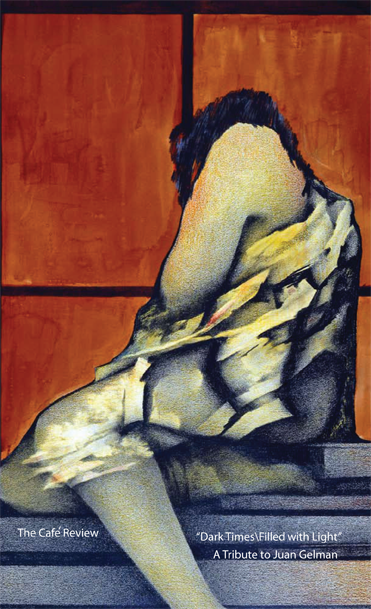
for Juan Gelman
Anticipating someone might
claim him one day
the gravediggers left their ropes
around the coffin
DESAPARECIDO/ DISAPPEARED
Anticipando que alguien pudiera
reclamarlo un día
los enterradores dejaron las cuerdas
en torno al cajón
para Juan Gelman
— tr. Daisy Zamora
No-Man’s-Land
Daisy Zamora
No–Man’s–Land
to the poets I love
We are a minefield of clarity,
and whoever crosses the barbed wire comes back to life.
But who’s interested in crawling through undergrowth?
Who dares sail a tempest?
Who wants to come face to face with purity?
0That’s why we’re fenced off in this no-man’s-land,
under permanent crossfire.
from The Violent Foam
— tr. George Evans, Curbstone Press
A Photograph of Juan Gelman Dressed to the Nines
Sergio Ramírez
A Photograph of Juan Gelman Dressed to the Nines
I have seen the figure of Juan Gelman in formal attire bowing gracefully over a power that can be nothing other than the sacred power of poetry. Calm and barely smiling, he expresses a hint of the supreme disdain he has always had for titles, honors and other vanities in response to which, if provoked, he will burst out laughing. I ask myself, what is he doing, a tango singer who has plucked the lyre of misfortune, so elegantly dressed, as if he were a Godfather at someone else’s wedding, a Spanish lord, for example, but a man with a face so scored by pain doesn’t dress so elegantly if it weren’t for his own wedding with language: he has lived all his life in carnal conversation with words — a life of domestic disturbances, papers strewn on a bed of ink stained sheets.
The photo was taken in the cloisters at the University of Alcala the day he received the Cervantes Prize from Spain’s King Juan Carlos. It was the first time Juan bowed to anyone even if ever so slightly and with so much grace that it did not reduce him, he who has lived erect all of his life, and no one can boast about making him bow, no one or nothing, neither terror, nor insidiousness, nor misfortune. He has stayed upright before such sorrows — no guitar dares to play that milonga — his son thrown into the depths of a river by hit men who appear to be still at large, a river of dead bodies in cement blocks, an ocean of dead bodies thrown out of military aircraft, a vast and dark landscape of the disappeared, and his daughter-in-law kidnapped with a child in her womb, taken secretly to Uruguay, where they made her give birth then killed her. Who is there to mark her grave and to find his disappeared granddaughter but Juan, thanks to his tenacity, without ever bowing to the cruel winds of misfortune that score his face.
Barely bowing in the photo, a slight smile suggesting irony, and the dignity of a poet dressed in a jacket to receive the award for his lifelong love affair with poetry, so passionate, fierce and carnal, making love all night long, eyes wide open. So much has come from it leading to this moment that he says he never intended, but to which he bows today in this photo, his passion to bring to light the suffering of others, as well as his own, in words that can only be written in the blood that runs in the veins of tangos and boleros, and what I feel now contemplating this article in the Managua newspaper is a light tremor in my body and soul, before I also bow reverently to the figure bowing in the photo, he to poetry and I to the poet
— tr. Robert Arnold