


Beloit Poetry Review

Quickening the Senses
— Lee Sharkey
Quick Note about this issue: This Editor’s Issue of The Café Review is different from our normal published reviews. We have asked 14 editors of poetry journals from across the United States two complex question: Why do some poems stand out from others? And what is he state of poetry in America today? Their answers will surprise you. We hope this issue will give poets a better sense of what editors look for in poems. You will get the inside scoop about why different journals accept different types of poems. For teachers, this issue will answer questions students have about the dos and don’ts in submitting poems as well as the perennial question of why poetry matter.
A poem that excites me will quicken my senses, insinuate itself inside my head and rearrange the furniture there. Within the first two or three lines, I know if this is likely to happen. Predictability of language, hackneyed approaches to overworked subjects, navel–gazing, sentimentality, sloppy line breaks, and anything else that indicates the author isn’t in control of her or his craft short–circuits the process of giving myself over to the poem.
That said, I’ve learned in my 22 years with the Beloit Poetry Journal that poems in a wide range of styles and genres can and do move me. Over its nearly 60–year history, Beloit has been known for the catholicity of its taste. In the early years, the journal published a chapbook paying tribute to William Carlos Williams and another with Langston Hughes’s translations of Gabriel García Lorca’s Gypsy Ballads. In 1958, it published a chapbook of the West Coast “Movement” poets (including Charles Bukowski, Gil Orlovitz, and Judson Crews) alongside the English “Underground” poets poets (including Donald Davie, Elizabeth Jennings, and Philip Larkin). Both groups were in open revolt against the strictures of Modernism, but the contrast in styles could not have been more pronounced. Today, too, we resist getting trapped in the comfy pocket of our preferences.
The diversity of aesthetics among the editorial board members certainly helps in this effort; we talk through poems — sometimes at length — to clarify their intention and argue our points of view in order to bring the group to consensus.
Of course, our responses to poems we’re considering can’t be reduced to a formula, but here are some of the questions we ask about poems we’re considering: Is the language fresh? Will the poem stand up under a second reading, and a third? Does it make music in the mouth (not any particular music, but a music that announces itself clearly)? Does it resonate beyond its immediate context? Does it pass the “so what” test?
One short lyric we published recently, William Wright’s Peach Trees, Suffused with Pesticides, illustrates the qualities I’ve been describing:
Hummingbirds stop
to bathe in the creases of leaves
where each grass spider
has left the husk of its body.
The sky ravels in the throat
when ends of limbs tremble,
unlatch their petals
to a distant sea of hands:
the body
cannot scrub it out, this lack
of stain, emptiness gathering.
Contrast the quiet music of Wright’s poem (if painted, it would surely be a watercolor), the slow, additive procession from image to image that pauses at the end of each line, with Matthew Gavin Frank’s Little Mouse, which appears in our Winter 2008/2009 issue:
Cobbled–together roustabout makes dilophosaurus
dioramas with pegboard and stiletto shoeboxes.
Hoping for an A–plus, pastes pennies for their eyes,
Abraham Lincoln inward, green paint, this imagined
stand–off with the walnut brains, your mother’s extra–
long toes that once, before you, choked your father.
Do this to avoid the holy horror of weightlifting,
your father’s fourth eagle tattoo, the muscular
world shoving peacocks beneath our armskin. Even
the Romans would have slandered them in Latin,
called their biceps little wriggling mice. But still
you hear it, how boys belong on soccer fields.
So many big decisions: to use the rubber cement,
to go extinct.
Frank’s poem pops and crackles in the mouth as it bulldozes from line to line, clustering consonants and compressing syntax. The delicious sounds made us willing to put in the effort it took to parse the poem, an antic family scene, sketched in the expressionist mode, in which gender constructions threaten the survival of the poem’s unnamed principal, and the species as well — the same issue, ultimately, that’s laid before us in Peach Trees. Little Mouse had us laughing ‘til we wept; Peach Trees stilled us so we could see and feel the desolation of a not so distantly, barren planet Earth. These are political poems — though clearly not in the didactic mode — and we’re hungry for poems that help define, through whatever strategy, the current political moment.
C. D. Wright asks in Cooling Time, “Can poetry survive? Is it mutable, profound, sentient, resplendent, intense, stalwart, brave, alluring, exploratory, piercing, skillful, percipient, risky, exacting, purposeful, nubile, mirth–provoking, affective, restive, trenchant, sybaritic, nuts enough? Can it still enkindle, prod, or enlarge us?” Much of contemporary poetry sets lower standards for itself. Largely as a result of the proliferation of creative writing programs, the population of poets (if not readers) is mushrooming, and inevitably, the majority of what is written will be unremarkable.
Most of what comes in over our transom is reasonably skilled — not much of the Hallmark verse that used to constitute half of our submissions — but has little to distinguish itself from dozens of other poems that we read in the course of our screening process. Too much of it dwells on the untransformed emotional life or consciousness of the writer, as if that were an end in and of itself. There’s a lot of verbal cleverness without consequence and narratives with language flat as the Plains. That said, a great deal of original, consequential poetry is being written at this historical moment by poets old and young who bring an exhilarating range of cultural backgrounds and concerns (political and aesthetic) to their work. My job as an editor is to ferret out those poems for our readers, poems that stand, to quote Muriel Rukeyser, “against the idea of the fallen world.”
The Asheville Poetry Review
The Final Frontier: Honoring The Condensery
— Keith Flynn
Quick Note about this issue: This Editor’s Issue of The Café Review is different from our normal published reviews. We have asked 14 editors of poetry journals from across the United States two complex question: Why do some poems stand out from others? And what is he state of poetry in America today? Their answers will surprise you. We hope this issue will give poets a better sense of what editors look for in poems. You will get the inside scoop about why different journals accept different types of poems. For teachers, this issue will answer questions students have about the dos and don’ts in submitting poems as well as the perennial question of why poetry matter.
Trying to teach someone how to write poetry is like assembling an instruction manual for a sunset. What the reader of poetry craves are surprise and astonishment, doors opening to true vistas for the first time, radioactive poetry; the right words in the right order, lending light, beautiful accidents. These accidents enter our writing because of our ability to listen and to be open to the possibilities of any influence, to be one of those people on whom nothing is lost and all will be possible. “I want to be with those who know secret things or else alone,” said Rainer Maria Rilke. The best poems stop us in our tracks, shut us up, make us read the poem again and again because it has opened another room in our brain that was hidden to us before. But how?
“All art,” said Pablo Picasso, “is the elimination of the unnecessary.” Condensation is the final frontier for the poet, after the pulses of the syllables, the break of the lines, the word choices, punctuation, and stanza order. Learning what to take away is one of the hardest things for a poet to practice. One poet whose lifelong commitment to concision yielded some of the most beautiful poems in American letters was Lorine Niedecker:
How white the gulls
in grey weather
Soon April
the little
yellows
Niedecker’s commitment to pare away all but the essence allows each poem its own identity and power, letting the color nudge up at the end like flowers in the underbrush. Niedecker’s boundaries are firm, but there is a bounty in her discipline.
Remember my little granite pail?
The handle of it was blue.
Think what’s got away in my life —
Was enough to carry me thru.
Ezra Pound believed that each line of the poem was a component to be tested for its authority. He advocated a line–by–line examination: Move to the top of the poem and remove the first line. If the music or meaning of the poem is not altered, then that line has no place and must be deleted. Then the weight of the second line is judged, and line by line, the poem is trimmed, its essence distilled.
While a foggy or repetitive tone can become a caul over the head of the poem, the beats and arpeggios of breath inside the poem can rescue it from monotony. If we think of each word as a note, then the language becomes an enormous piano with the poet at the keyboard. A poem should be a long, angular, hungry momentum, a flow with no impediments. Over the course of several stanzas this momentum picks up more and more lines. Rhythm is the entire movement of the poem, the recurrence of stress and unstressed syllables as they relate to the pitch and texture of the sentences, one against the next. It is important to acknowledge inspiration’s worth here: We have to give our emotions free rein at the outset. Most writing impediments are either technical problems obstructing the poem’s flow or psychological problems blocking the writer from recognizing the true impulse — not the first impulse, mind you; first thought, best thought is a worthless conceit, and a lazy writer is like a desperate salesman; neither one can close the deal.
If a poem is dynamic, its rhythm headlong, then the turbines of this momentum are the verbs. As space yields to nouns, time and pace are controlled by the verbs with their various tenses and energy, and it is valuable to try and replace those verbs that lack heft or dynamism. Action verbs muscle up a sentence and help its propulsion. They create astonishment. We should examine every verb for a more powerful alternative. Another method to make the sentence livelier is to turn a noun into a verb. Look at the surprise at the end of Stephen Roberts’ poem, Sex, when the noun “maple” becomes a verb:
Each love creates
its own final cause.
Crimson, orange,
pink and violet
wisps arch behind
the oak and pine
draped mountain’s
distant, unseen slope.
The gray, creaky,
board–warped dock
projects from the reed
rimmed shore into
the spectral lake.
Leaves sink surface
to sediment while
unending, wind
driven waves maple
out into darkness.
We see the waves curling down along the shoreline like branches and receding out against the darker surf. “Maple,” turned to a verb, brings a moment of quiet surprise that also provides the sentence’s motion. The poem turns in on itself and follows the motion of the waves. It takes a single verb, cleverly chosen, to set a poem on the tip of a pin. See how Niedecker makes the cold come alive in this untitled poem, animating it by her choice of a verb usually thought of as a noun:
Popcorn–can cover
screwed to the wall
over a hole
so the cold
can’t mouse in
The choice of “mouse” in the last line almost makes us see the cold as it sticks its nose into every crevice of the house. A mouse is insistent, and the cold is a pervasive foe. It’s a liberating choice, allowing the poem a final motion as the lines nestle and resonate inside the reader.
When we place our work in the hands of editors, no amount of background, biography, or back–slapping will help them decide to publish or reject a poem. There is only the poem in front of them and any decision an editor makes in those moments is arbitrary and dependent upon his or her mood, the weather, the themes of the issue, conscious and unconscious stylistic bias, their digestion, the time it took to read the mountain of poems, their child’s piano lesson, the lack of a title, the length of the title, the worth of the first line, the color of the paper stock, the unmitigated gall
to send a multi–page biography, it’s another damned sonnet, it’s the perfect damn sonnet, the lack of a shower, bravado, pitch, vocabulary, humility, sweep, vision, humor, shape, rhetoric, form, diction. We can only hope that the action of a good editor, however quixotic, is riveted with love and bears the quality of tenderness.
Martín Espada Interview
conducted by Kevin Sweeney,
Martín Espada teaches at the University of Massachusetts,
Amherst. He has received the Shelley Memorial Award and a Guggenheim Fellowship as well as the 2012 International Latino Book Award and the Milt Kessler Award for his collection The Trouble Ball. His latest book is Vivas To Those Who Have Failed.
Kevin: Let’s start with a simple question: What kind of shoes are you wearing? I trust they’re not Nike. I cite your name when I argue with my 13 year old grandnephew about why I don’t buy that brand. I’m referring to that letter you wrote them in 1997 and why you wouldn’t write a poem celebrating a female Olympic athlete.
Martín: I’m wearing rather worn-out Rockport shoes. They’re very reliable, which is important, since my left foot is more of a flipper than anything else. As for Nike, I should be clear that I didn’t refuse to write a poem celebrating female Olympic athletes, per se. I refused to write a poem for a Nike commercial that would feature these Olympic athletes. And here is what I said:
This is a letter in response to your correspondence
concerning the Nike Poetry Slam and my proposed
participation.
I could reject your offer based on the fact that
your deadline is ludicrous (i.e. ten days from the above date).
A poem is not a pop tart.
I could reject your offer based on the fact that I would not
be free to write whatever I want, notwithstanding your
assurances to the contrary, since I must “keep in mind TV
network standards and practices regarding content and
language.” You clearly have no idea what the word
“censorship” means. Where, as you put it, “the mechanics of
commerce outweigh the demands of art,” then de facto
censorship will flourish.
I could reject your offer based on the fact that, to make this
offer to me in the first place, you must be totally and
insultingly ignorant of my work as a poet, which strives to
stand against all that you and your client represent.
Whoever referred me to you did you a grave disservice.
I could reject your offer based on the fact that your client,
Nike, has through commercials such as these outrageously
manipulated the youth market, so that even low-income
adolescents are compelled to buy products they do not need at
prices they cannot afford.
Ultimately, however, I am rejecting your offer as a protest
against the brutal labor practices of Nike. I will not associate
myself with a company that engages in the well-documented
exploitation of workers in sweatshops. Please spare me the
usual corporate response: there’s no problem, and besides,
we’re working on it. I suggest, instead, that you take the $2500
you now dangle before me and distribute that money equally
among the laborers in an Asian sweatshop doing business with
Nike. The funds would be much more useful to them than to me.
Thank you.
Sincerely,
Martín Espada
Kevin: So, second easy question: Have you had any good Brie lately? I’m remembering your essay Zapata’s Disciple and Perfect Brie. What you said there seems even more relevant since I read that poem in your book The Trouble Ball about a job which once required you to “remove a perfect turd from a urinal.” Do you ever feel awkward at a poetry reading when someone rolls out the wine and cheese?
Martín: I’d feel more awkward if someone rolled out the wine and turds. I don’t drink anyway.
Kevin: What’s Umass /Amherst like these days? You once took issue with people using the term “political correctness” pejoratively. Still, a lot of people would probably see UMass as a politically correct place, Amherst itself for that matter, or what I remember people calling the “Happy Valley.” What’s your take?
Martín: What I object to about the term “political correctness” is that it’s loaded. It’s judgmental. It’s akin to the old question-that- contains-the-answer-trick: “How many times have you shat in the public square?” (Answer: Zero.) Having said that, I will also say that UMass displays fewer characteristics of so-called political
correctness than you might think. I believe there should be more actual diversity and less talk about diversity. I also believe that we may need a new word to replace the word “diversity.” Too many people use it without knowing what it means, or without meaning it.
Kevin: Do you ever miss being amid the fray back in Chelsea, especially since as you’ve written, you spent your early childhood years in public housing in East New York?
Martín: No, I don’t miss my days as a tenant lawyer in Chelsea. There is the burnout factor, for one thing. (See below.) For another, I have continued my advocacy work as a poet. Poetry and the law, of course, are very different, yet, for me, the common ground is advocacy, in the tradition of Whitman and Neruda. While I don’t miss the courthouse, once in a while I need to have a good argument. That’s the lawyer in me.
Kevin: I sometimes read to students your poem “City of Coughing and Dead Radiators” about the trials and tribulations of being a legal defense attorney. I say that’s the ultimate poem about burnout. Am I overstating that at all?
Martín: That’s an accurate reading of the poem. I should add here, though, that I wrote the poem well before I left the law.
Kevin: I also tell them that my all-time favorite poem title is “Do Not Put Dead Monkeys in the Freezer.” Have you heard from other readers about that? I think that poem emphasizes how routinely human cruelty and callousness is shown towards those considered lesser beings. Is that true, or am I just the kind of liberal people love to hate?
Martín: Yes, that is true. And yes, you are probably the kind of liberal people love to hate. Good for you.
Kevin: Donald Trump: asshole, giant ball-buster, racist demagogue, or just a regular guy from Queens who used to be a Democrat?
Martín: Demagogue, racist.
Kevin: Bernie Sanders: your kind of guy? He’s a fellow native New Yorker, and I remember from your essays that your mother was Jewish.
Martín: I voted for him. What I appreciate, among other things, is that he’s reclaiming the word “socialist.” That was a dirty word in the political discourse of this country till a short while ago; witness all the times it’s been hurled in the direction of President Obama who, whatever else he may be, is not a socialist. Poets should try to reclaim the language too.
Kevin: “My Native Costume” is a pretty funny poem despite its serious content. Any chance you’d tell us which “suburban school” had the teacher who wanted you to wear a Guayabera shirt when you came to visit? By the way, my students love that poem
Martín: It was, I believe, a high school in Waltham, Massachusetts. I’m not sure anymore.
Kevin: I wonder if people who haven’t read your work thoroughly know how funny you can be. You have plenty of serious, polemical poems, but I’ve had more than a couple of chuckles reading your work. I’m thinking “DSS Dream,” “Revolutionary Spanish Lesson,” and titles like, “I Apologize for Giving You Poison Ivy by Smacking You in the Eye with the Crayfish at the End of My Fishing Line.” Then there’s “Instructions on the Disposal of My Remains” in which you write:
I want to be stuffed and mounted at the White Castle
in East Harlem. I want to welcome everyone, with glass eyes
and cotton in my head, to buy tiny steam-grilled burgers by the sack.
I want to stand in the doorway like a grizzly bear
at the museum of Natural History, his mouth frozen
in a roar for all eternity, as if to tell the world:
That imperialist bastard Teddy Roosevelt shot me.
Am I way off-base here, or is this hysterical? Isn’t it true you can read Martín Espada and have a couple of laughs along the way?
Martín: I hope you have a couple of laughs along the way. In fact, I must resist the impulse to write nothing but funny poems. I have to resist the impulse to turn every reading into a stand-up routine. It’s too easy for me. That trend continues with my most recent work. Consider:
Once Thundering Penguin Herds Darkened the Prairie
I. Poetry for Tourists
The poets bring poetry to the Coney Island Aquarium,
around the corner from the wooden rollercoaster
creaking since 1927, tourists staggering away queasy,
yet hungry for a hot dog on the boardwalk. We will
tempt them to taste the steamed tofu dog of poetry instead.
II. Poetry for Jellyfish
Tonight we declaim poems at the jellyfish exhibit,
creatures that plummet like parachutes of light,
illuminated mushrooms zooming sideways, amusing
themselves, oblivious to the nuances of alliteration
and assonance, silently refusing to clap after the last poem.
III. Poetry for Penguins
The voice of a poet on a loop, installed in the penguin
exhibit, booms out poetry in praise of penguins:
Once thundering penguin herds darkened the prairie.
Once flocks of flapping penguins blocked out the sun.
Now they cower behind a rock, peeking, ducking down,
listening to poetry for penguins, hearing only the rumble
of the Almighty Orca opening his jaws on Judgment Day.
IV. No Poetry for the Octopus or the Security Guard
The Coney Island Aquarium is closed. We are locked in.
The octopus glares at us with one huge eye. No one fed
him today. No one read him any poems. We panic and flap
like flightless birds. We rattle the gate, wailing in chorus:
We are the poets. Let us out. The security guard glares
at us with one huge eye. No one fed him today. No one
read him any poems. He unlocks the gate anyway.
Kevin: What does it mean to be Puerto Rican in 2016? I trust you’d be less likely to get arrested in Mississippi or need to integrate a diner in San Antonio like your dad? Maybe today he could even play for the Yankees. I’m remembering that poem, “Tato Hates the New York Yankees.”
It was the spring of 1947.
There were no brownskinned boys
in the American League.
And the New York Yankees
gave no more tryouts;
they broadcast the message sent
by overdue bills
and losing lottery tickets.
Certainly the Yankees have employed a few Latinos more recently. Is “the Puerto Rican Dummy” in your essay of the same title a no-longer extant stereotype?
Martín: Being Puerto Rican in 2016 means that we’ve come a long way, and we’ve a long way to go. No, Puerto Ricans no longer suffer the kind of racist oppression suffered by my father’s generation — thanks, in great part, to my father’s generation. At my father’s memorial, I said this:
How do we carry on the legacy of the generation now passing
before our eyes? We’ve heard about “The Greatest
Generation,” mostly referring to white men who fought in
World War II. For the Puerto Rican community, this was our
Greatest Generation. They marched. They picketed. They
organized rent strikes. They staged hunger strikes. They staged
sit-ins. They went to jail. They went to jail again. They built
schools and community centers. They took photographs, wrote
poems and plays, painted and sang — but their activism was
inseparable from their art.
This was my father’s advice to Los Seis del Sur, a group of
Puerto Rican photographers documenting the South Bronx:
“We need to raise some holy Hell, for we have landed at the
bottom and stayed there.” For my father, raising hell was holy.
His generation raised holy hell for us, for everyone in this room.
In the introduction to the new edition of Zapata’s Disciple, the book of essays that was banned in Tucson as part of the Mexican-Studies program outlawed by the state of Arizona, and will be reissued by Northwestern University Press, I said this:
“The Puerto Rican Dummy and the Merciful Son,” published
eighteen years ago, is still relevant. The essay cites Governor
Pete Wilson of California, “being seriously considered for the
presidency on the strength of his support for Proposition 187,
the most blatantly anti-Latino, anti-immigrant initiative in
recent memory.” Now comes Donald Trump, Republican
candidate for the presidency, bellowing sock puppet for bigots
everywhere, trying to ride yet another wave of anti-Latino,
anti-immigrant demagoguery all the way to the White House.
The essay addresses the stereotype of Latino males as violent
predators. Trump has slandered Mexican immigrants, saying,
“They’re bringing drugs. They’re bringing crime. They’re
rapists.” With this utterance, his poll numbers skyrocketed
and he became the frontrunner.
As this essay noted eighteen years ago, this perception of
Latinos is dangerous. According to an article in the Boston
Globe on August 19, 2015, two South Boston brothers, Scott
and Steve Leader, came across a homeless Mexican man on
their way back from a Red Sox game, woke him up by
urinating in his face and then beat him severely, breaking his
nose. Scott Leader was quoted as saying, “Donald Trump is
right. All these illegals need to be deported.” Trump, upon
hearing the news, responded that his supporters were
“passionate.” Only later did he issue the requisite
denunciation of violence.
Kevin: As a guy who went from the projects to being physically and mentally abused in a Long Island suburb to one day busting his hand as a bouncer, do you ever shake your head at all this college campus stuff about “micro–aggressions” and “trigger warnings?” Does a guy who once had “racial obscenities” spray painted on his locker feel some of these students have been overindulged?
Martín: I don’t recommend having racial obscenities spray painted on your locker or breaking your hand on a drunk’s skull as pathways to character development. Speaking of trigger warnings: I had a guy stick a gun in my face once. I wish he had given me a trigger warning. I’ll have the overindulgence with extra cheese, please.
Kevin: I know James Tate passed away not long ago. When I first heard you were teaching at UMass, I wondered whether the two of you might chat about poetry or whether your aesthetics were just too different so you’d be polite but go your separate ways. It’s hard to picture him having read much Daisy Zamora or Roque Dalton. It’s hard to picture you curled up with a volume of John Ashbery. Your thoughts?
Martín: Jim and I never exchanged a harsh word, despite the aesthetic gulf between us. He was invariably polite. We served on some MFA thesis committees together, although I am not a member of the MFA faculty at Umass. Having said that, I will also say that I didn’t really know him. And no, I wouldn’t curl up with a volume of Ashbery. It would be more stimulating to watch a volume of Ashbery curl up.
Kevin: I’ve been assigning your book Alabanza to my poetry class. However, the conspicuously missing poem is “Another Nameless Prostitute Says The Man is Innocent,” so I give them the online link, and I generally read it aloud. Up here in mostly white Maine, they are pretty fascinated by this gap between people who celebrate Mumia Abu-Jamal and those who call him a murderer. Why did you leave it out of Alabanza?
Martín: I left it out because it’s my second-best poem about Mumia Abu-Jamal. The first poem, as you know, was first solicited and then censored by National Public Radio in 1997. As a result of the ensuing controversy, I ended up meeting Mumia on death row in 1998. That personal encounter resulted in a poem called, “Prisoner AM-8335 and His Library of Lions.” The library in question was the one confiscated from his cell shortly before our visit. He discussed his possible execution very calmly; when he got to the subject of the books taken away from him, he cried. The poem was so much more immediate, visceral, and emotional than the poem censored by NPR that I included it in my Selected Poems instead of the first poem. Why not include both? A Selected Poems, I discovered, must be selective. I left out many a poem I liked.
Kevin: Given the predominant themes in your work, would it surprise you that one of my favorite Martín Espada poems is “The Mexican Cabdriver’s Poem for His Wife, Who Has Left Him?” Despite a couple of forays through my bookcase, I can’t find A Mayan Astronomer in Hell’s Kitchen, the volume in which it appears. Although I can’t, therefore, quote from it, I have always thought it a wonderfully lyrical poem about heartbreak.
Martín: You mean this poem?
The Mexican Cabdriver’s Poem for His Wife, Who Has Left Him
We were sitting in traffic
on the Brooklyn Bridge,
so I asked the poets
in the back seat of my cab
to write a poem for you.
They asked
if you are like the moon
or the trees.
I said no,
she is like the bridge
when there is so much traffic
I have time
to watch the boats
on the river.
. . . That actually happened. I guess I’m a sensitive brute after all.
Kim Addonizio Interview
“Kim Addonizio: Poetry . . . Made Me Feel Less Alone”
conducted by Kevin Sweeney
Born in 1954, Kim Addonizio lived for most of her adult life in California, but is currently based in New York City. Her poetry books include: The Philosopher’s Club (1994); Jimmy & Rita (1997), a novel-in-verse; Tell Me (2000); What Is This Thing Called Love (2004); Lucifer at the Starlite (2009); My Black Angel: Blues Poems and Portraits (2014), a collaboration with woodcut artist Charles D. Jones; and, last October, her first U.K. publication, Wild Nights: New & Selected Poems from Bloodaxe Books. She has also published fiction, notably the novels Little Beauties (2005) and My Dreams Out in the Street (2007), as well as a short story collection, The Palace of Illusions (2014). Addonizio’s honors include a Guggenheim Fellowship, two National Endowment for the Arts Fellowships, and Pushcart Prizes for both poetry and the essay. Commenting on Tell Me, a National Book Award Finalist, former U.S. poet laureate Billy Collins remarked, “Kim Addonizio’s poems are stark mirrors of self-examination, and she looks into them without blinking.”
KS: When I assign your poems to young women in my classes, they practically thank me for making this important introduction. Some imply that reading you has changed their lives. Some even tell me to be sure to keep you on the syllabus next semester. What’s that all about?
KA: I don’t know, exactly, but my work really does seem to strike a chord for young women. I’m happy about that. It’s tough to be female in a patriarchal world, and I think we are all looking for someone who gets that and is living through it, struggling with it. Still. I’m more pissed off now about the situation of women than I have been for many years. I don’t mean to say that we are all stuck in some sort of negative “situation.” Just that we are trying to find ourselves, to empower ourselves, and it’s fucked up, and I’m glad if my writing that experience can help a girl or young woman find her own way.
KS: Do you think if poets like Sylvia Plath — or especially Anne Sexton — had been able to read a poet like you when they were growing up and finding their way as artists — and as women in this country — that they might not have committed suicide?
KA: That’s pretty funny. Plath was a poet I read who helped me find my way. No, I think suicide’s more complex and deeper. There are so many factors. But I do think that the less alone you feel, the less likely you are to be depressed or despairing, to feel like there’s no reason to live. Poetry did that for me — made me feel less alone. If my work does that for somebody else, I’m really glad if it did, or can. We need each other. We can connect.
KS: Not to get too personal, but are you — or were you once — a Catholic? There’s a Catholic sense of sin, I think, in poems like “Bad Girl,” “’Round Midnight,” “Ha,” and “Fuck,” just to cite some examples. Also, you sound like a guilty Catholic school girl
in “Garbage” (“don’t think now of all the food you’ve wasted . . . /
you meant to save everyone /the children /especially”). Also, in “What Do Women Want?” don’t we hear a bad Catholic girl (or just a bad girl) longing for that red dress?
KA: Yeah, I was raised Roman Catholic. I think of it more as a kind of scaffolding, a world-view that I can use when I need to. If I had any true Catholic guilt, I outgrew it a long time ago. But using it — I can use it all day long, to talk about guilt, to argue with God (and I don’t believe in any Christian, Muslim, Jewish, etc. conception of God).
KS: To this reader, Catholic writers have a sense of death. There’s certainly a sense of death in your work. I love your poem “Noir” and the way you keep citing that line from the movie “Body and Soul”: “Everybody dies.” You say it outright in this poem, but you bring up death in others such as “Eating Together” about your
friend with cancer. You even appear to throw in a little Catholic theology about dead babies in Limbo in “The Burning.” Do you think about death a lot?
KA: All poets have a sense of death. All artists. And a great many other people. So I don’t see that as especially or essentially Catholic; it’s just the nature of life. We die. What do you make of that? Everybody has to confront it at some point. Writing is a great tool to do just that, and to explore, and freak out, and try to accept it.
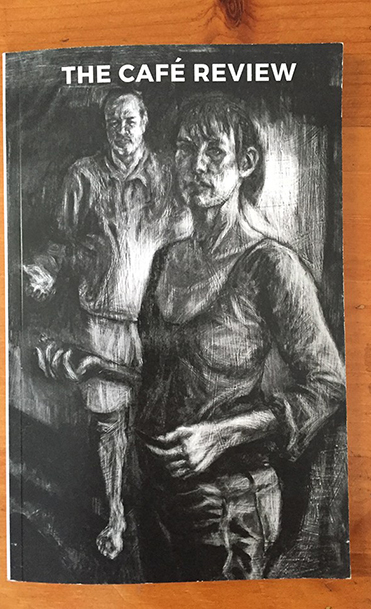
KS: Were you ever a Schopenhauer reader? He thought desire was the itch you can never scratch enough to make it go away. Some of your poems seem to take up that idea. Is desire painful, even agonizing? People experience plenty of pleasure in Kim Addonizio poems, but it doesn’t always make them feel better. I’m picturing you sitting at the bar on the cover of Tell Me.
KA: I never read Schopenhauer except in a college philosophy survey course, most of which I’ve forgotten. I did write that poem, “It,” and afterward I came across some Schopenhauer that just nailed exactly what I was saying in that poem — the impersonal force that just takes you over, that has nothing to do with you. And he called it — guess what? — the It. So we were thinking the same things. I agree with him about desire. Think about Buddhism, too: desire as the cause of suffering. I hope if people take pleasure in my poems, it does make them feel better to know somebody else has had similar thoughts and feelings.
KS: Is there a spiritual side to your work? I’m thinking of your poem also titled “Body and Soul” in which you give us such striking images:
is the soul up late in the kitchen, sleepless
standing before the open refrigerator
And then this:
Sometimes the body
gets so quiet
It can hear the soul
scratching like something trapped
Inside the walls.
Is there a little Plato going on here?
KA: I hope the spiritual side is apparent in my work. I’ve pulled a few fragments from Plato in other poems, but I wasn’t aware of it here. As I said, I don’t believe in God, at least as constructed by organized religion. But I do feel something. That the universe is conscious. That we’re a part of it.
KS: In your poem “Ha,” you pose a question that sounds like something from Dostoevsky:
If God is good, how is it that the weed of evil
takes root everywhere, and what is there to keep us
from murdering each other in despair?
Have you come up with any answers to that question lately?
KA: Not really. Only I’d amend it to murdering each other out of pain and ignorance. It’s certainly one of my obsessions, trying to understand why we are so fucked up and why we hurt each other so much.
KS: That poem makes me think of your poem “Dead Girls,” which I’ve passed out to a few introductory literature classes.
Is there a connection, or have I just randomly free-associated the wrong way?
KA: I’m not really clear on what you’re asking. . . . It [the poem] came out of watching yet another movie that opens with the trope of some girl’s dead body being found.
KS: Is it true that, in your poems, that “weed of evil” more often and in more ways affects women? There’s nothing I can find in your poems that is anti-male, but the loss of youth in “31-Year- Old Lover” and the vulnerability to assault in “Dead Girls” seem to make the case that women are particularly exposed to suffering. (“Ex-Boyfriends” also mentions some problems).
KA: As for women being more affected, it’s pretty clear that one of the big problems in the world is male violence against women. And against other men, for that matter. So, male violence, period.
KS: Has Camille Paglia ever commented upon your poems? I’m recalling something she said once about Mediterranean religion and the visual intensity of it. Your poems seem particularly visual, which is possibly what I enjoy most about them. Is that a fair description?
KA: I’ve never heard of her commenting on or reviewing my work. I’m glad to hear you enjoy the visual imagery.
KS: In your poem “God Ode” you refer to the deity as:
. . . You demented, You disapproving
or possibly AWOL Higher Power.
That poem makes me think of Jim Holt’s book Why Does The World Exist? in which he posits the notion “that the universe was created by a being that is 100 percent malevolent but only 80 percent effective.” It seems that if one were to read enough Kim
Addonizio poems, one might arrive at a similar conclusion. But then some of your most despairing poems somehow manage to also sound like prayers.
KA: Maybe I should refer you to Frost’s “Design,” a poem I love, which ends:
What but design of darkness to appall? —
If design govern in a thing so small.
KS: I read recently about some women protesting a performance of The Vagina Monologues. Eve Ensler is faulted for excluding women who don’t have vaginas. Is that weird or just the new normal?
KA: It’s weird to me. But I don’t really understand the gender /
sex /identity thing very well. I’m all for more dialogue and less
hate around the whole issue, but Eve Ensler? First, it’s an important piece from a particular time period. Second, she has championed women’s rights around the world. If you’re going after a target, you could certainly choose a better one.
KS: At the end of my poetry class I have students read a favorite poem by one of the poets we have studied. Once a young woman stood and told us she was still a virgin due to her religious beliefs then proceeded to read “What Do Women Want?” We all loved it, but what connection was she making with your work?
KA: No clue. But you never know who is going to respond to your work, or how. That’s not my job, anyway; I’m just trying to make poems. What happens after that belongs to whoever reads them.
KS: I’ll be honest; I love your poems but haven’t read your fiction. What am I missing?
KA: Thanks, I appreciate that. Not sure what I can tell you about the fiction. Whatever there is, it’s in the work itself. My latest is a story collection, The Palace of Illusions. There is definitely a lot there a young woman could connect to (but I hope guys too) . . . And there are certainly some similar themes around sex and empowerment. Here’s an interesting thing: When I first started writing stories, a fiction writer who had read both the stories and the poetry said it seemed as though I was writing poetry with one hand and fiction with the other. He meant that I got to something in my poetry that my stories didn’t have. I think I figured out how to write them both with the same hand. Check out The Palace of Illusions, and then you tell me.