

Earth School
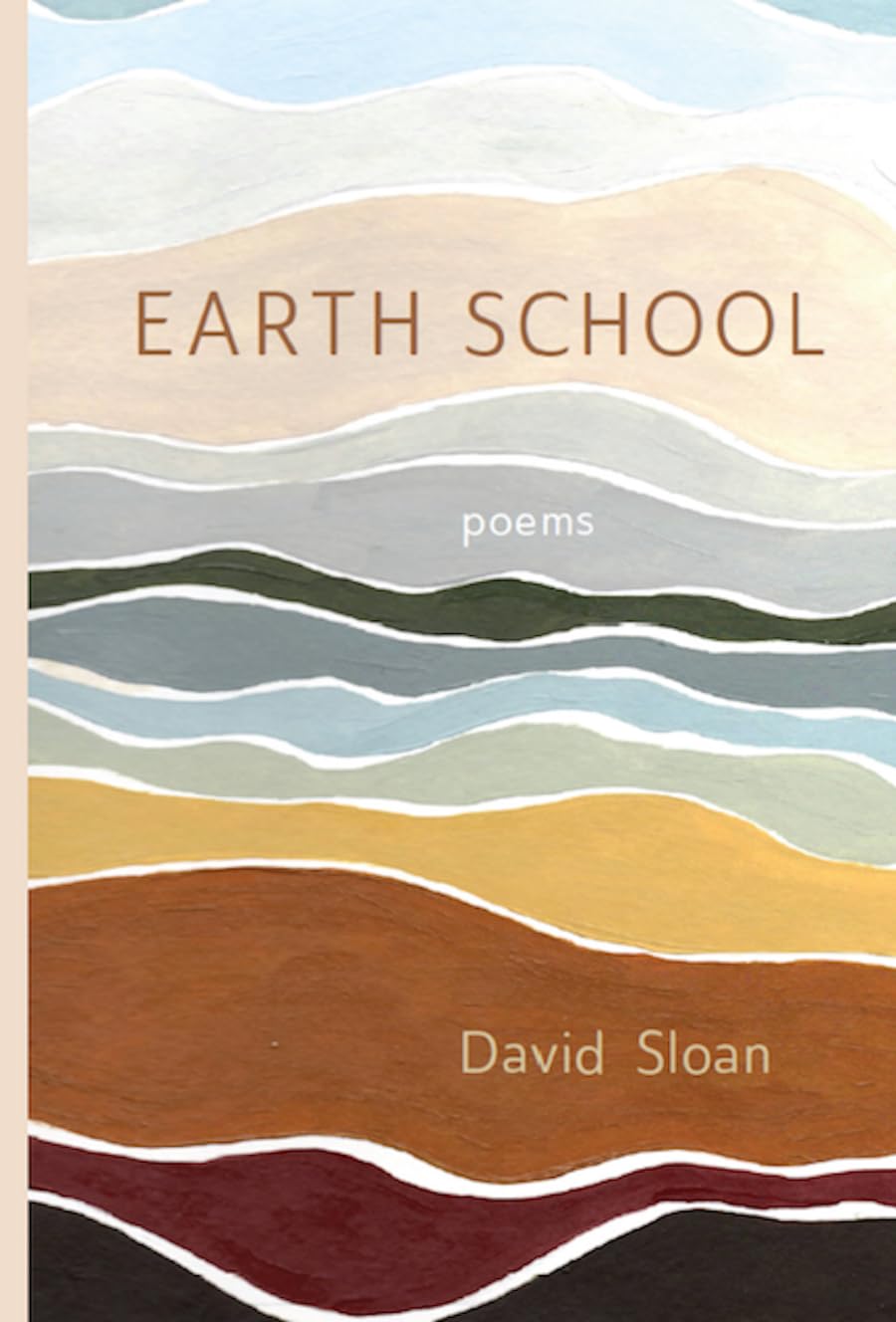
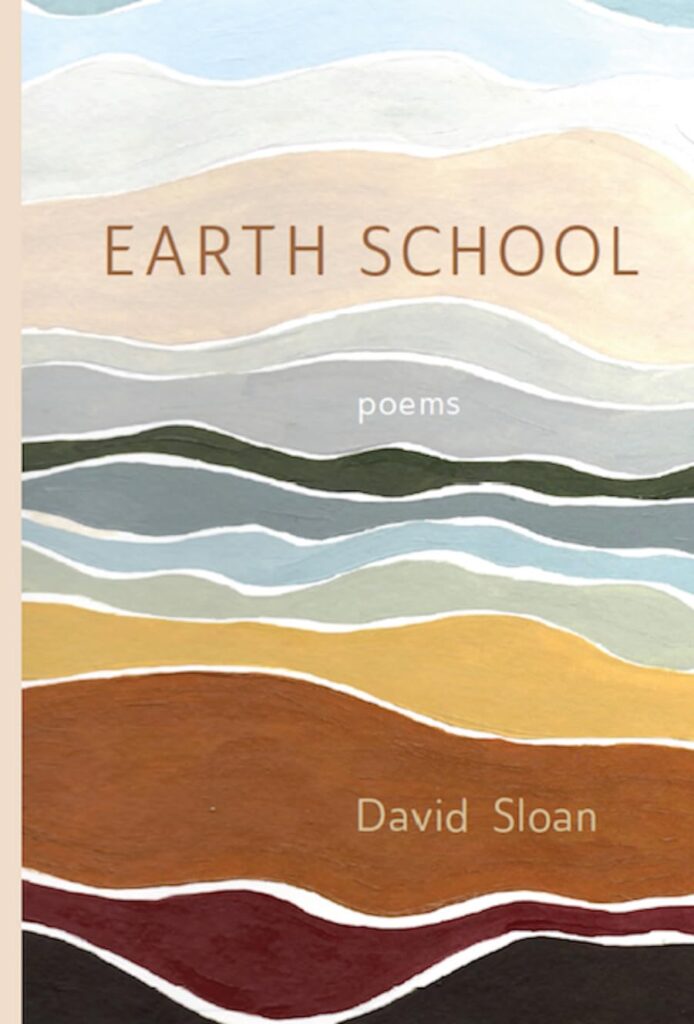
Earth School, by David Sloan.
Deerbrook Editions, 2024,
83 pages, paper, $18.95,
ISBN 979–8–9903529–0–2
Fire — its fundamental power is transformation, whether mythological, like the phoenix, a test, as in trial by fire, cold to warmth, love, or simply food. Imagine the difference between a steaming baked potato and one pulled from the fridge the next morning for breakfast, butter congealed on top.
Sloan’s third and latest collection of poetry summons flame in its every form to highlight, to cajole, to sorrow, to reminisce. The collection oozes a sort of melancholy triumph at being alive and momentarily recognizing that fact.
In “Sea–Through,” written after Hanna Berta’s “Seaheart,” Sloan spins his poem through the prism of another artwork, a process the Greeks called ekphrasis, in one of several ekphrastic poems in the collection.
I have scoured Maine’s shorelines,
seeking everyday miracles,
portents, maybe absolution
Which might well stand as an indicator of Sloan’s inspiration and writing process, often returning to the natural world. The poems drift from home to memory to imagination, exploring ordinary moments that are in fact nodes, just how, in “Popham,” “a mittenless woman holds a sand dollar / up to the anemic light almost as an offering.”
The poems are collected in four numbered sections, though the themes move fluidly throughout the book: family, marriage, aging, nostalgia, death. Sloan’s cadence runs something like an irregular anapest, by which he presents a couple of poignantly reflective poems followed by one wrapped in a sparkly bow marked “humor.”
Even when “Leaning In” for his first kiss, contemplating “18 Ways of Looking at a Golf Ball” or reveling in publication with “Man Gives Birth . . . To Book!” Sloan’s work points to our everydays and how we can see them afresh. And that is the fire at the core of the book, an insistent perseverance of spirit, and persistence on seeing the world in all its technicolor, like
a diver who glimpses treasure
and momentarily grasps the gold
before the currents rip it away.”
That theme appears elsewhere on the surface as it lingers everywhere, a sense of urgency not so much that we take life by the horns, but that we recognize what we have. On one page “The Point” when a granddaughter asks, “What needs mending?” the next page’s “After–School Storm” seems to answer:
Curled up in Grandpa’s arms, listening to his worried heart,
even with the thunder growling like a rolling trash can,
and rain rattling against the roof and windows,
I felt safer in that storm than I have ever felt since.
We’re all in need of mending, as we watch the world burning away, gather our treasures, and wonder later why we saved the coasters (“Before the House Burned Down”). Fire is the end, the beginning of something yet unknown, and a marvelous display in the moment, calling us to a
. . . savoring,
to tether us all to this moment.
And that is ultimately what these poems accomplish. They are eminently re–readable, accessible yet not simple, well–balanced between reading aloud to someone else and savoring in solitude.
— John Reinhart
Door
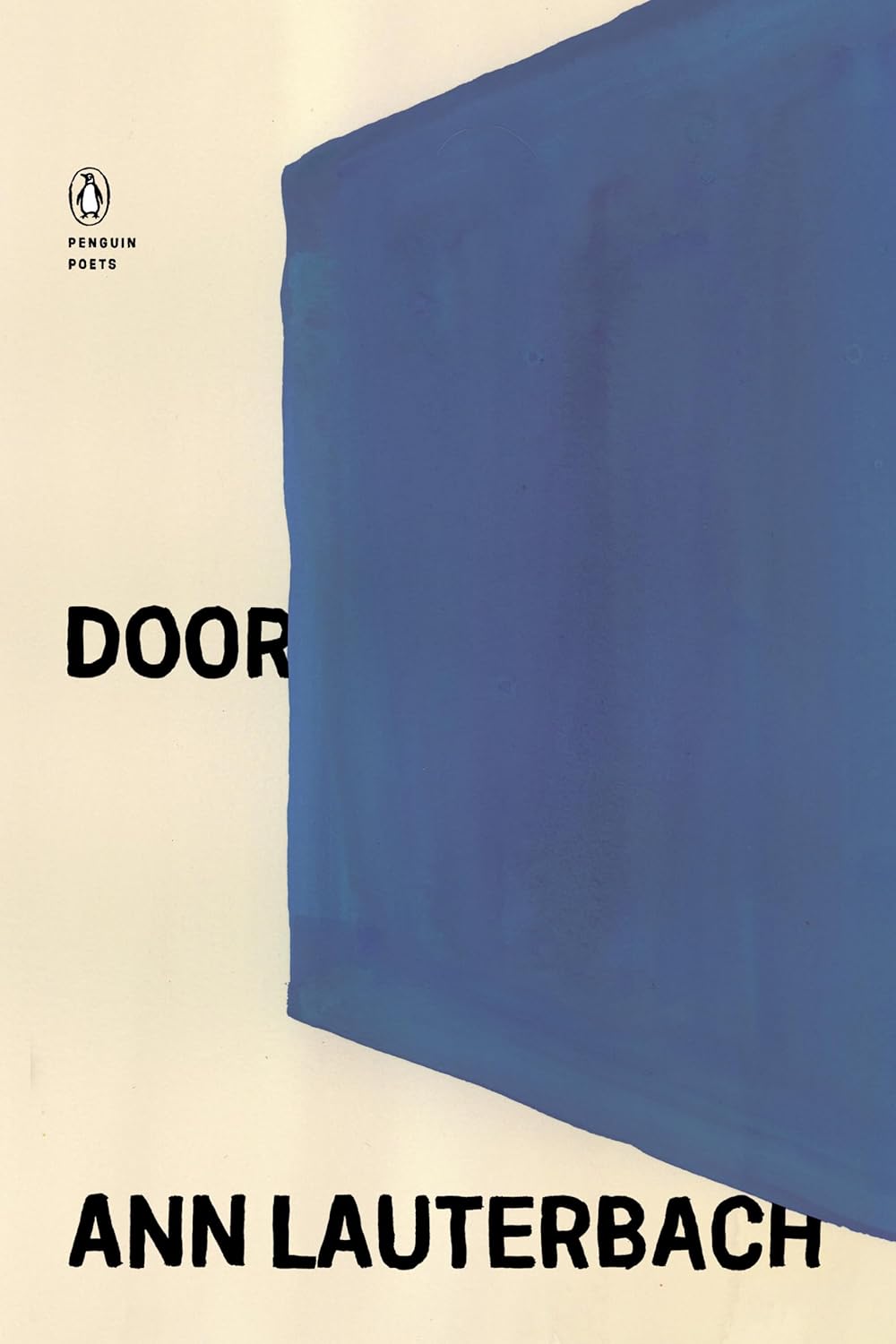
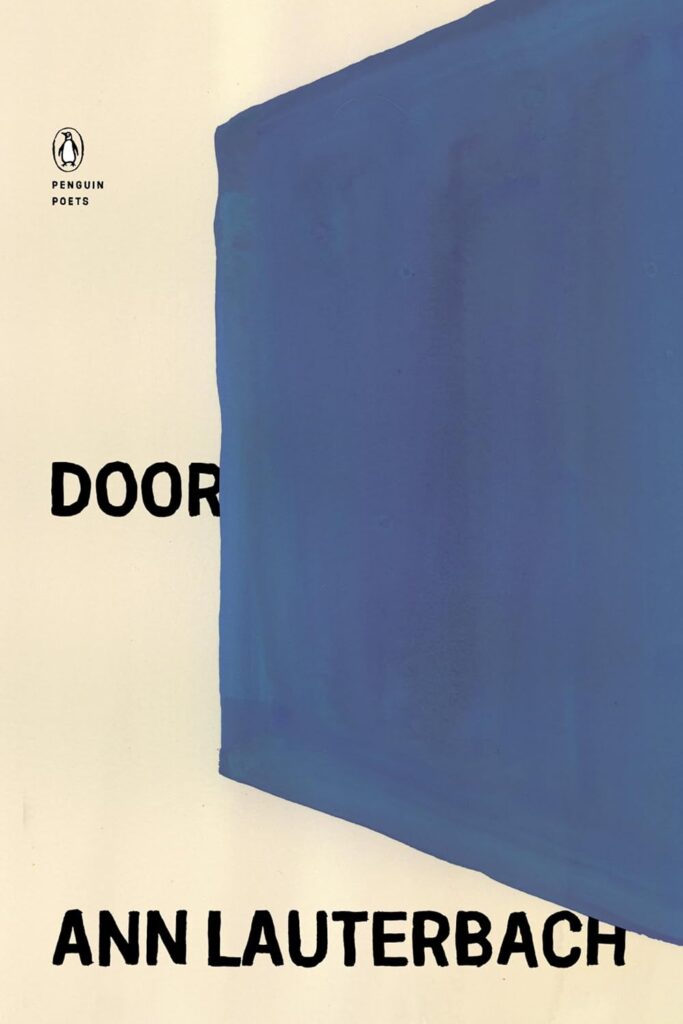
Door, by Ann Lauterbach.
Penguin Books, 2023,
94 pages, paper, $20.00,
ISBN: 978–0–14–313737–5
Poet and essayist Ann Lauterbach has published more than thirteen books of poetry and prose. In her newest volume, Door (2023), what is notable is the way Lauterbach has extended her capacity for suspending the reader in a feeling that eludes language. By unraveling syntax and playfully juggling language, by crafting fragments of text that accrue and build on the page, Lauterbach delays, or even perennially defers, the arrival of concrete meaning.
Replete with artfully crafted, jewel–like passages, the poems offer the mysteries of praxis, the complexities of opacity, and places where readers might arrive, and yet — the poet forestalling desire — do not arrive. This new collection contains eight poems titled “Door,” and many more of the poems explore thresholds and crossings, state changes between one place and another, psychological, physical or spiritual. Often these openings and closings are connected to the flow of thoughts, and often the crossing is provisional, a not yet that involves doubt, hesitation and fear, and that retains all possibility, allowing for vital reader participation in meaning–making.
In the very first poem, “Door,” the “world fills up” at an “imperious pace.” Here, an inventory — in other places, an accounting — is reflected by an excess in language and in things, the too–much–ness of life, where meaning seems to overflow and run off:
the ravenous real
flowering
above torsion of waves
unexpected
threshold
thrown open crossed.
Despite its fullness, the poem is a scant sixteen lines, and in this spare beginning we are introduced to Lauterbach’s linguistic leaps and layered images within this volume.
In the beautiful poem “An Interior,” the speaker turns her back on the outside world — one imagines her closing a door — on the mountains, the sun, and the river, to stare at the spines of books: “The spines of books hold a chorus / singing from the dead to the living, / and from the living back to the dead.” Books communicate across seemingly impenetrable thresholds and offer the speaker a means to connect with those who are gone. Here, and in other poems in this collection, an underlying current of grief and loss surfaces; words themselves are tools that both connect and foreclose connection.
The spines’ address is inward and outward,
the once and never more recurring, binding
there into here, like the quick shadow of that bird.
But words don’t care about you, the poet reminds us in another poem, (“On Relation”), “Words are indifferent to how you are feeling about // your feelings.” Words “congregate among themselves” safe from your “desire / to have them meet you exactly where or as meaning // is.” It is this hinged understanding of language that inflects the provisionality of meaning in the poems; language connects — it crosses a threshold between thing and meaning, between self and other — but it also can close things off, create a kind of death or define a limitation.
The eleven–page poem that inhabits the center of the book, titled “Door,” reflects on this power of language to limit and close off meaning, and the slipperiness of our choice in the matter: “The Said closes, is closing, has closed the door.” And:
There is nothing behind the door; there is only
door, a condition, a prospect, a
perception in which a gap occurs, or might
occur, and you can step into or across, you
can leap or fall, you can turn away, go back,
It’s an open–and–shut choice; it’s a dare.
And then, in “Nights in the Asyntactical World,” words pile up and language falls apart:
After lens doubt formidable recess pulse drawing matter
sign of curtain trigger namesake token permanent closure
aching for rhythm literal extension dusted power permission
came lately drawn callow predicate Latin tarnished flickering
ball.
Could this falling apart be a door? Can words thus disordered keep the world in suspension and keep the reader there too, where experience isn’t closed off or shut down? Can we, through language, inhabit the perpetual, unfolding now? “What undergirds / these words? What might be found?” she asks the reader in one of the final poems in the collection, “Blue Door”:
In this atmosphere, nothing is shut, and so motion is the rule, motion without time . . .
— Julie Poitras–Santos
Self–Portrait as NOPE
By Gretchen Rockwell
Self–Portrait as NOPE
after Jordan Peele
What’s a bad miracle ? The dictionary suggests
whatever is the opposite of wonder. Words so often
fail us. I would like for this to not be a bad miracle
but I can’t control what the eye sees, or who is watching.
I am the scream of a terrified horse, the winding down
of a record player, a blooded fist, something arching up
in unexpected motion. I am the observer & the observed,
an animal body trying to survive each night — alien
& new. There is no way to avoid being swallowed whole by
memory, nothing familiar to grasp as it pulls you down.
I tell myself: make something out of your ghosts. If you can
you’ll survive. Probably. The world around me is so wide, sky
open & ominous, the craggy mountains bracketing a place
where miracles — even bad ones — happen. Anything could be
up there waiting, & it is. We can find beauty in the body
& its rebecoming something strange & fierce, the unrippling
into billowing oscillations. I move towards what I fear
will change me as I try to capture this form for all to see.
Don’t look what I am in the eye. Or maybe, finally, do.
Sad Girls
By Michael Colbert
Bri asked why I let myself get to this Sad Girls space
which is different from sad girl space
because here I watch women
and men who I love to hate be miserable
couple and uncouple
agitated magnets like we’re at the fucking north pole
and every show–ending song “hits”
because it’s about unrequited love
it’s I’m over you wink wink
it’s that Someday you’ll want me to want you
so I cry every episode
because someone’s always not
getting who they want
or someone’s getting back together maybe
even if it’s bad
and all this is good because
maybe I’m learning loving kindness
not judging feelings but letting them
be and it’s nice to break
from Lana Del Rey.
That album plays all day in my apartment, my car
I watch the music video on TV. Sometimes her tears
make me try to cry too