
With Little Light and Sometimes None at All
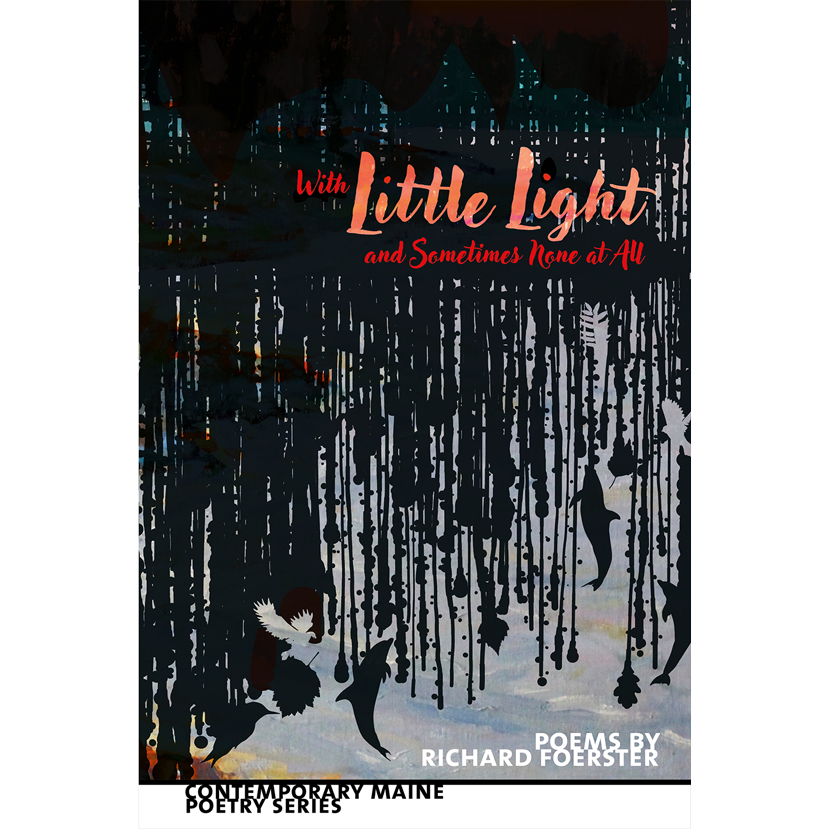
With Little Light and Sometimes None at All, by Richard Foerster.
Littoral Books, 2023,
82 pages, paper, $20,
ISBN: 9798987805725
Starting with the collection’s title, and making inferences from Douglas Taylor’s hauntingly spare and muted cover painting, we can sense that the scene is already set, the light already low. It’s through this darkness that Richard Foerster pulls some of his most arresting, contrasting images, like a poet Caravaggio. As an example, take this excerpt from “Dumbwaiter. Bronx. 1953”: “And I could hear the flywheel spin / in its heaven . . . /. . . as I stretched / on tiptoes to ring the highest / buzzers and announce // the expected calls, and waited / for each tiny door to open / onto a lozenge of light.” These are the kinds of painterly cinematic moments that Forester orchestrates.
A reader might wonder, how does Foerster create these striking reveals? This is hard to put a finger on. But part of the glimmer of the language comes from a carefully measured, almost sculpted diction. Take, for instance, the description of a train in “Bijoux Box” that “gasped in a final fit / of steam, the platform / rose like a wave / that swept me toward / a further judgement / I was ill–prepared to face.” The language manages to be rhythmically percussive, with all its one and two–syllable words, even as it rolls like the wave of steam that sweeps toward the speaker.
Foerster also skillfully depicts the wonders of the animal realm. A friendly bumblebee clamors onto the speaker’s finger while a squadron of cormorants dive, in “On the Afternoon of my 72nd Birthday.” When, at the end of the poem, the speaker shuts his book, we discover the bee is gone. And we miss it. Into its absence, we strain for its presence. But it’s birds that most fly in and out of these poems. A bird corpse, perhaps a crow or pigeon, lies on Portland’s downtown “that weeks of drought / and August sun unfleshed, / here on Free Street, untrodden, / ignored, unswept by wind or lazy / merchants, is perfectly displayed / in the blunt reality of decay.” It’s a disturbing image made even more resonant by all the “un”s layered into the line, as if Foerster is trying to pry us from our comfort in order that we might let our imagination rest on death’s evidence.
In another poem, “At Uluru,” it’s a sparrow that perches on the tip of the speaker’s shoe. “I bobbed my foot. / It would not go. A half hour I pondered that flicking / semaphore, its flare and twitches.” The speaker wonders, at the end of the poem, “Why am I writing this, twenty years on? Oh, envoy / of bewilderment, what is it you have to say?” In both these poems, there’s a sense that the birds, in both life and in death, are trying to tell the poet something, but the poet can’t quite figure out what that message is. Still, he hangs on, wondering, listening, trying to stay in the beauty of bewilderment.
In “I Watched from My Adirondack Chair,” it’s an osprey prowling a lake that steers the poem. The osprey circles “like a mind / circling, then looping back to hover / over some dimly perceptible idea.” The poem opens into an ars poetica for human thought, or more pointedly, a poet’s work, ending with the drenched osprey / poet emerging from the lake, struggling “to reclaim any least gust of air, / too stubborn to let go a lashing burden.” As a poet, I strongly felt this analogy — poets dive for their poems, and the experience isn’t pleasant; it takes a lot out of a body, but it feeds us too.
Minus a bird, this tribute to a life in poetry concludes with the masterful “Ode to My Left Hand,” in which the poet gives thanks to his southpaw appendage, which has begun to tremor, “though I laugh at your seismic / clatter with a teacup on a saucer.” The poem pays loving tribute to “new / mottlings on a sea of inelastic skin.” It’s tender, but quietly powerful, and even thrilling to read. By the end, I could almost hear the roar of a crowd when the poet urges the left hand to “Take up your pen. / It is the tiller.”
— Jefferson Navicky
Cove
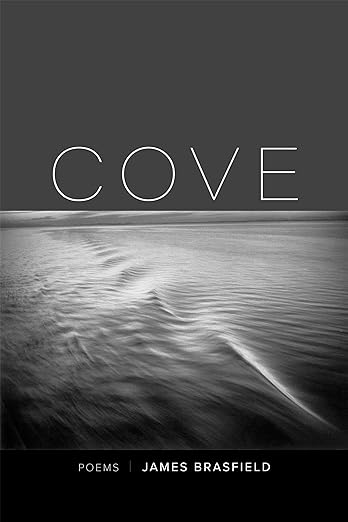
Cove, poems by James Brasfield.
LSU Press, 2023,
66 pages, paper, $17.95,
ISBN: 9780807176603
James Brasfield’s new collection, his third with LSU Press, confirms the eloquence and conviction of his language and the accuracy of his eye. Put another way, the 30 works in Cove: Poems reflect an intensity of observation wedded to lyric delivery.
Take “Late Summer”: in 12 well–wrought couplets, Brasfield takes us from “Now cosmos in bloom and snow–in–summer / opening along the garden’s stone borders” to toasting “a spring in summer, as once each May / a shot of vodka is poured on bare dirt // among gravestones to quench the dead, / among the first stars of this new evening.”
When it appeared on poets.org’s “Poem–a–Day,” Brasfield explained how “Late Summer” moves from “a garden path in the Blue Ridge to a public cemetery and a ritual in Kiev, Ukraine, where, on the first Sunday after Orthodox Easter, families gather to picnic in cemeteries in remembrance of their dead relatives.” You don’t need this background to appreciate the poem, but it certainly enhances the stunning image at the end.
In this and other poems in the collection, Brasfield draws on his long–time connection to Ukraine where he was twice a Senior Fulbright Fellow in the 1990s (The Selected Poems of Oleh Lysheha won him the PEN Award for Translation in 2000). “Tysmenytsia,” which is divided into two parts, “Reprieve” and “Carpathians,” consists of seven connected poems that call up that city in western Ukraine. The poem pays homage to “emblems of endurance,” among them, Lilia Lysheha, Oleh’s widow, recovering from cancer, and a leaf of the zelkova tree holding on. Here’s the final stanza of the second poem, “Winter Precipice”:
How, I wondered, did the leaf
maintain its hold to branch,
or branch its catch of stem, or both,
as someone over a precipice
shares a grip of hands.
Elsewhere in the book Brasfield, who is featured in the anthology Angel’s Wing: Poems Inspired by the Paintings of Piero della Francesca, 2016, continues his dialogue with the Renaissance painter and muralist. More than simple ekphrastic response, his four–part “Piero and the Spider” reflects the composed humanism of the artist. The poem begins with Piero in the act of painting:
Window, piazza, cobbles,
fountain and the ripple unbreaking,
brush in hand unfolding oils, tempera on panel
or pigment to wet walls . . .
And the poem ends with the aged painter remembering “his translations of light, as if / Plato had been // a fisherman sewing his net // for the deep gold and vermillion / spots of a Tiber trout.”
Not long after retiring as Senior Lecturer Emeritus at Penn State in 2017, Brasfield moved to Belfast, Maine, a geographic shift whose impact is most apparent in the title poem, inspired by a visit to Morse Cove on the Penobscot River, near Castine. In 43 five–line stanzas, he leads us non–stop through a landscape of trees and waves, “the new / orientation of where you are,” to places further afield, including Paleolithic caves with “ocher birds ascending upon a wall” and war–torn Syria, “the sounds of velocities / closing in from above / the incoming, incoming, / incoming, incoming . . . ” The currents of Brasfield’s verse are mesmerizing.
Other praiseworthy poems include “Palladium,” which inspired a piece for piano and soprano by composer Edward Jacobs; “The Blue Ceiling” and “Founding Cities,” which involve the poet’s son; “At St. John the Divine, Thinking of Melville,” which harks back to Brasfield’s M.F.A. days at Columbia; “The Erstwhile Forests,” a nifty riff on smoking a pipe; and “Piero: The Resurrection of 1467,” which reminded this reader of Randall Jarrell’s response to Albrecht Dürer’s etching Knight, Death, and the Devil.
In appraising Brasfield’ last collection, Infinite Altars, 2016, author Vivian Gornick noted how his narrative verse “brings to remarkable life the smallest moment, the oldest myth, the acuteness of time.” Those qualities remain in play in Cove. These poems require that you take your time, to savor — and then succumb.
— Carl Little
Travel Brochure
by David Wyatt
The power structure has a sore tooth, an enflamed elbow,
A weal under its eye — annoying as hell, it had been reported
In the World–Herald. So good to hear, however,
That institutions suffer also, in a real sense. This doesn’t stop
My nose from bleeding or my chest aching, a tree falling
Against the house, which will provide good wood
For the fireplace when my wife someday learns to use a chainsaw.
I have an enormous instruction book and a hundred sturdy
Candles to read it by, before winter. But we were talking about
The world at large and, perhaps now, the sinking of Nebraska
Under the weight of its cattle population. I see no ready ties
To socialism yet it seems possible there may be some affect
On the one steakhouse, the only standing building, in Monowi.
I read Lincoln for his axe–throwing proclivities —
Which he possibly still shares with Kentuckians, through
A medium — but I drive to Lincoln for the Rabbit Hole Bakery.
I know, it sounds too easy. I remember the warning the poet
Has given: “Old men with hernias are writing now
In the trembling world of the pre–nursing–home malaise.”
Therefore, I welcome any response to the above stupefaction.
Yes, it has been a miracle I got as far as Omaha. You could say
I have the foggiest view of the Mighty Mo, if that hamstring
Ever relaxes.
Random Act
by Maria Surricchio
Imagine you can’t leave it behind.
You mean to leave, but you can’t.
You try to cast your lot into the blue
beyond the window —
and your soul doesn’t plummet
or soar. It snags on the edge
and you’re stuck, flutter there
for days or more, transparent
above the glow of street lights,
while everyone comes and goes.
It might take a hook buried deep
in flesh to pull you off the ledge:
a mortification, the ritual of a stranger
thousands of miles away
who drags a chariot brimming with
blossoms through ecstatic crowds
as ropes tug at the hooks.
They dance and spin, shed
the weight of blood and bone–
nerves sing, tissues swell
dense with praise, the leathery
heart stretched open.
A random act. They’re not out
to save your skin.
Still, you’re stitched together,
one dislodged by another’s
untethered grace.
Imagine if this is how it works.
Someone has to love life this much
before you’re allowed to go.