
Transitional Objects: Poems
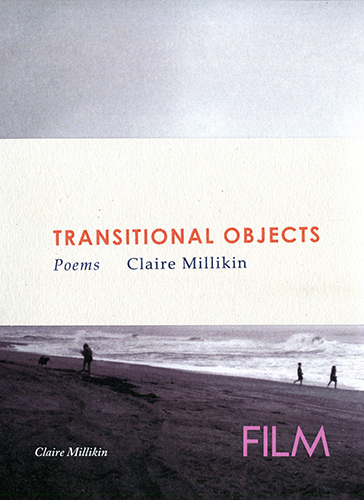
Transitional Objects: Poems
by Claire Millikin, Unicorn Press,
2022, four volumes, 132 pp. total,
paper, $18,
ISBN: 978–0–87775–080–2
Any one of the four 36–page–long booklets that make up Claire Millikin’s Transitional Objects deserves a full–fledged appraisal. Each of the collections, titled Straight Line, Fakes, Film, and Vanishing Point, has its own distinct thematic through line, but there are recurring images that provide connective tissue from one to the next.
In Straight Line, the central motif, if you will, is the mother. She comes and goes, a complex figure, giving and taking away. “On my shoulder my mother’s hand, softly unforgiving, / that’s what I remember of inherited china,” Millikin writes in “Vintage Plates.” In “Carolina Potters” the mother destroys a child’s small animals molded from red earth out of fear they held “magic properties.”
Millikin’s poems are equal parts confident and questioning. They take on reality but will twist and turn to wind up in another place altogether. Take the poem “Straight Line,” which starts with advice — “To manage grief, cut your hair each evening” — and twists and turns to consider the meaning of lies, failing to sell Girl Scout cookies, Jim Crow theaters, and familial inheritance.
A number of poems in Film fittingly relate to movies and photographs — and mirrors. “Blur in Photographs” riffs on what blurring means, “someone moved too fast” or “something unproposed took place.” In the end, “ghost / of blur in images shows a lack of skill, / or more simply hard choices.” Elsewhere, two poems about Polaroids similarly consider the promise and deception of the camera and its offspring.
Some of Milliken’s poems read like stories, accounts of goings–on, family happenings. The opening line of “Whipping Boy,” the first poem in Vanishing Point, leads us into painful history: “When he was a child, my father was whipped. Principally by his father / but also by other boys.” The father in turn threatens to whip his daughter but never follows through, “his way of not hitting me / when he longed to.” The poem ends with the image of “the willows’ switching length.”
A sense of brooding and portent infuses some of the poems in Fakes. In “Selfie as Live Oak Leaves in the Attic,” the poet muses on “too potent memory / that you cannot bear to speak.” The poem “Motel America” considers the way we treat immigrants — “America offers a concrete slab floor” — and concludes: “I’m telling you, this motel / is no place for a child.”
Millikin offers several ekphrastic pieces. In “Barbie Doll as Tutelary Spirit for the Too-Early Dead,” a circa 350 BCE grave stele for a young girl from Sounion, Greece, serves as prompt for a memory of a father’s gift/bribe of the iconic toy woman after church one Sunday. “Showman with Performing Bear in the Westerwald, 1929” uses a photograph by the German photographer August Sander to express empathy for the fate of ursine captives. “The bear—desolate innocent—I cannot stop thinking of its mouth, / how it feels to hold a bit.” The poem brings to mind Thalia Field’s Personhood, which focused on cruelty to animals.
A number of poems open with a startling proposition/revelation. A couple of examples: “In experiments, scientists have learned / that mothers cannot be replaced with wires” (“My Mother’s Letters, After Hart Crane”); “It took a month for people to notice the moon was gone” (“After the Moon”); “Offices should be celibate, but some are not” (“Office Hours”); “All-night grocery stores are almost like oceans” (“All-Night Grocery Stores”); “The stillness of forgery relates to safety” (“Fakes”).
If the promise of these sometimes surreal, always engaging overtures is not always kept—and those are rare instances—they always lead the reader into explorations of place and time. Millikin is brilliant at drawing us into her universe where doors open and close, where family members comfort and deceive, where, to quote the final couplet of “Aperture,” “Dreams are ruins that return, / the backyard a swamp after storm.”
— Carl Little
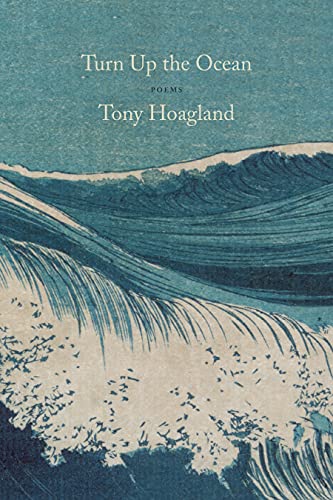
Turn Up the Ocean
Turn Up the Ocean
by Tony Hoagland,
Graywolf Press, 80 pages,
paper, $16,
ISBN: 978–1–64445–092–5
“The poem is a house thrown open for ghosts. It wants to be haunted”
— Tony Hoagland, Chautauqua, New York, 2014
I had the fortune of taking a workshop lead by Tony Hoagland at Chautauqua in the summer of 2014. It was intense. Everything that came out of his mouth was quotable. I think I drained two pens of ink over those four days. When I was contemplating this review, I went back to those notes, and the quote above jumped out at me in reflection upon this present collection.
Tony Hoagland died at age 64 on October 23, 2018. Turn Up the Ocean was completed and published posthumously by his wife Kathleen Lee in 2022. She describes the process in the Afterword of the book:
Over the spring and summer before he died, Tony gathered a group of poems — recent and older — into what he imagined as a chapbook, titled Turn Up the Ocean, his final collection . . . . It wasn’t until spring 2020, when I spent a lot of time at home as a consequence of the pandemic, that I felt ready to address his papers — stacks of typed poems, margins crowded with scribbles, and the thickets of drafts in his computer . . . Possibly, a few of the newer poems that I chose to add he would have considered not yet polished enough for a book. But to my mind, the roughness of these poems lends them their luminous intensity.
And it is that roughness of his diagnosis, and his grapple with the certainty of its sentence, that brings the luminous quality to this collection. Of course, his signature, wry sense of humor still shines through, but in a darker light, as in the opening poem “Bible All Out Of Order”:
When my doctor asks what my symptoms are, I tell her
self–pity and a desire to apologize.
She says my insurance policy covers self–pity
but not, unfortunately, remorse.
In the poem “Disclosure Agreement,” Hoagland reveals that
[b]efore I came to work on this planet
I signed a nondisclosure agreement with god
that I would not publicly discuss
what goes on around this place. . . that most angels have bad breath;
the low statistical success rate
of the surgery for transplanting souls.
This a book about dealing with it: end of life, and the world going on, quite a turn from the author of what is, most likely, my favorite book title, What Narcissism Means to Me (2003). There, Hoagland obsessed about the dirty world, and his dirty, semi–compliant place in it. But perspective arrives quite differently in the current book’s title poem “Turn Up the Ocean”
Again and again my heart has been broken
by people who didn’t have what I want;
whom I then accused of refusingto give me all that they had.
When their only fault, I now see,
was not being the trees or the wind or the rain
It is the rough luminosity that haunts this posthumous collection, especially near its end when the ghosts of his fate appear in shifting images and allegories. In the poem “Siberia,” he is a Russian poet exiled in the frozen wasteland. In “Reading While Sick in the Middle of the Night,” he is a medieval knight in a trashy historical novel in which
I hold my mind up like a bundle
out of reach of the pain — as I walk through
the chest–high wash of these waves that push
and tug at my life.
In “The Interfaith Chapel is in The South Terminal,” he becomes a broken traveler:
I will surrender all my frequent–flyer milers
if you will help meto find my tears and drink them.
If you will help me to reach that placewhere I am already
awaiting my arrival.
The journey is a refulgent row across a dark river to the other side, which is only dimly seen. But a sense of acceptance does appear in the book’s final entry — “Peaceful Transition” — where the house is not so haunted, where he contemplates the end of himself, and our species:
It is one thing to think of buffalo on Divisadero Street
of the Golden Gate Bridge overgrown in a tangle of vinesIt is another to open the door of your own house to the waves.
I would end this review with another notation from that 2014
workshop —
There is more danger in the present tense. Insurance has
already been taken out on the past.
— Craig Sipe
In a Moment
by Royal Rhodes
It takes time to be still,
to see and hear the things
that are there and never there —
the sounds and fragrances,
the light’s agonized gaze —
as a guide to a damaged life;
My, mind is an empty mirror,
a landscape of nothingness —
treeless, airless, deathless.
In the beat that my breath skipped
I learned to embrace being lonely,
a war with love over love —
hallucinations and fits
at night, a heaving heart
that stops in ecstasy.
All I have ceased to be
is a final offering
to erase myself with these lines.
The Night Kitchen
by Royal Rhodes
The kitchen began talking during the storm
in the corrugated metal roof that tugged
at the anchoring nails in wounds of old wood;
and the double–hung windows shook in their tracks.
The house, hollowed and spoilt by the ancient worm,
dormant in the wild things that understood
a place of eating, being eaten, drugged
with a blood feast, drew these invisible packs.
The tearful faucet yellowed the empty sink;
its throat opened, drowning in wet gasps.
Appliances — appliances — strummed a breath
as loud as fluorescent tubes that glowed and shattered,
telling us in light what to feel and think.
The stove’s porcelain skin, dark where it clasps
the edge of its yawning door, hides where death
crouched, consuming all that really mattered.
And plates, racked to dry, had fingerprints
of countless meals, and scratches from forks and knives,
cutting, over and over, into meat,
while the toaster’s split mouth opened for soft
things to enclose; and inside a hot spring glints
in a final convulsion that expels our spent lives.
In the window the speechless trees gesture aloft,
where clouds mushroom in patterns that never repeat.