


Deke Dangle Dive: Poems
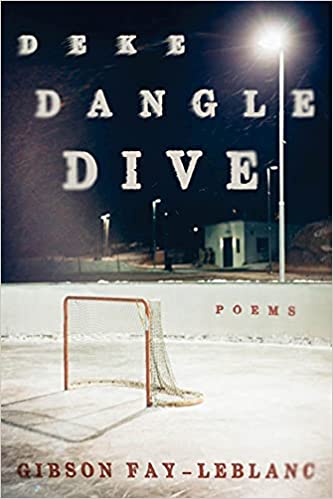
Deke Dangle Dive: Poems
by Gibson Fay–LeBlanc
CavanKerry Press, 2021, paper
94 pages, $18
ISBN: 978–1–933880–86–0
In an act of title foreshadowing, Gibson Fay–LeBlanc reveals a significant thematic thread in his second book of poems: hockey. Deke and dangle are strategic moves by a player to fake out an opponent while a dive is dramatically falling to convince the refs a foul was committed. At the same time, in an extraordinary poetic performance, deke, dangle, and dive characterize the verse’s delivery, its feints and face–offs, as well as the disposition of the author, who, throughout the 40 or so poems, questions his life maneuvers.
Fay–LeBlanc’s self–interrogation begins in the opening poem, “Wing and a Prayer,” a kind of overture. Among other things, he considers his “shallow root system,” a thundering universe, and a dying brother:
I’m supposed to let whatever
happens be what I want
but I still want, I want, I want
my brother’s cells to stop their war
on each other.
More than half the poems include references to hockey, some of them central, some made in passing. The poet accepts his obsession — he loves the game for all of its sometimes brutal elements — and makes of it a medium for considering existence.
“Hockey Poem” takes place in the locker room where literary talk is frowned upon; the players “roar” with laughter when a novel or poem is mentioned. Here and elsewhere, Fay–LeBlanc shares his mistrust of poetry even as he’s setting down his lines and exploring his priorities: “Dear Committees, keep your fucking medals // for reading poems or writing them — someday / I’ll deke that goalie. . . .”
Elsewhere, in “How to Deke,” Fay–LeBlanc might be describing his poetic practice, the “twitch, pivot, push, spring” that marks much of his verse. He is expert at messing with expectations from line to line, pulling off a variety of neat moves, sometimes linguistic, that leave one smiling with admiration, even wonder.
Many of the hockey–related poems involve the author’s brother, Leland Fay, who fights — and succumbs — to cancer. In “Unwritten,” the poet describes a loving brotherhood of shooting pucks and roughhousing, of run–down apartments and nicknames (“even / G–string”). The ending finds the poet on his knees, praying
to all I barely believe, because how else
will there be decades ahead to be brothers
in this poem I don’t write, then don’t write more.
In several poems, Fay–LeBlanc practices a more formal prosody, using full and half rhymes as part of the stitching (he also pulls off a stunning sestina, “Self–Portrait, with Dish–Rag,” using another poet, Emily Hollyday’s end words). “Stay” features three–line stanzas with first and third lines subtly echoing. Here’s a stanza from toward the end where he muses on his shortcomings:
I can’t give my love the river,
a trail, a coal–black wood where we
never walk without the other.
That “love” comes to the forefront in the affecting and apologetic “To My Wife.” After admitting he hasn’t called the plumber yet and the “fridge keeps blinking / its quiet death: 8–8,” the poet highlights their teamwork: “We know how not to fight and how to run a year– / long camp for two good boys // who keep breaking windows in a garage that may never / not be falling down.”
Those two sons are another recurring motif, the poet celebrating their individuality while ruing his inability to protect them. “Early October” describes Halloween with one boy dressed as a “bloody Coca–Cola,” the other, an outlaw with pistol. “I’m the dad who turns / off the third school shooting / this month — police found / five guns on him, still / to be fired” though he realizes his boys know it all, “sure as they know I’ll smile / and don a mask with dark fangs.”
Fay–LeBlanc returns to his kids in “Fields, Roadsides, Throughout,” a multi–part poem that revolves around a run the poet takes to help screw his head on straight. While observing his bucolic surroundings, he reflects on his family, including the “little men” — his boys — who read to each other one minute, claw each other’s eyes out the next.
The poem is dedicated to James Foley, the American journalist who was beheaded by ISIS in 2014. Fay–LeBlanc had met him once and feels his own unworthiness in the face of Foley’s dedication to his job — that he returned to Syria to report even after being imprisoned there. The poet on his run tries to forget the ugly news of the day: “collapsing / skyscraper icebergs, / whale–bleeding sonar, / brick dust left / by extra large / remote control toys / roaming actual skies.”
Which leads to a final observation: Fay–LeBlanc’s kinship with the Wordsworth of “The World Is Too Much with Us.” In the opening lines of “Self–Help” the poet advises, “Resist the urge to start the day / with what other people think,” while in “The Latest in Nanotechnology” he points out the flaws of hand–held devices while saluting words “so old they’re new and known / and felt.”
Deke Dangle Dive is a splendid creation, from the arrangement / order of the poems to their individual brilliance (my copy ended up with post–it notes on nearly every page). Other stand–outs to mention: “At Sea,” “The Varieties of Moss on Deer Isle,” “Mother,” “Words with Friends,” “Low,” and “Going to Church.” The lastnamed merits special attention: a dazzling 22–line invocation of the holy places and objects that surround us.
In the aforementioned “Fields, Roadsides, Throughout,” the poet writes that he’s tired of “poems / puffed, spit shined, / and ultimately / unable to tell / us how to be.” Ultimately, his own poems, so handsomely crafted, tell us how we might exist in an unjust world. There’s consolation there, grace, and beauty.
— Carl Little
Ballast

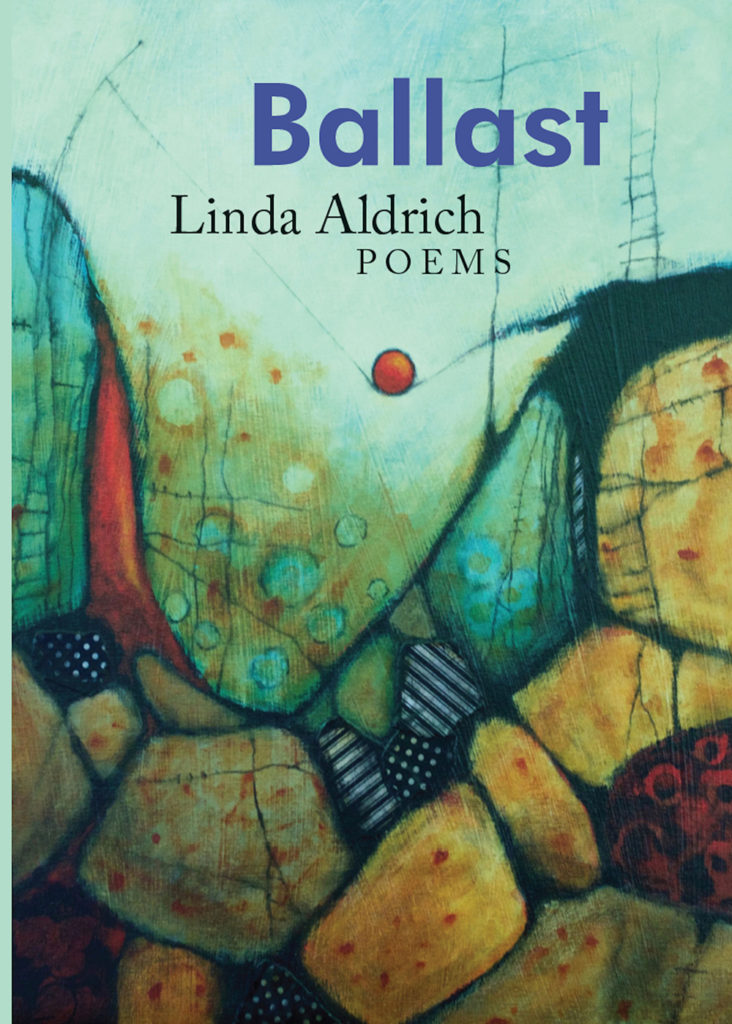
Ballast
by Linda Aldrich,
Deerbrook Editions, 2021, paper
99 pages, $18.50
ISBN: 978–1–73438–849–7
What’s beneath a poem? Beneath form and metaphor, image and syntax? These questions emerge when reading Ballast, the latest collection by current Portland Poet Laureate Linda Aldrich. For her, part of the answer is: people and their stories. Stories of the poet in various stages of life. Stories of ship captains and accused heretics, of mothers and aunts, unsung women engaged in daily heroics. College students, Vietnam vets, actors. And Amelia Earhart:
I think of you often Amelia Earhart,
never earthbound,
freer
than other women, you went farther, feathering
our imagination with your rare
and fearless heart.
These are poems of people doing and thinking all manner of things, working the fiber of life the best they know how. Some soar like Earhart. Others want to, like the girl at the center of Wherewithal:
[. . .] That summer the girl cut off her braids
with garden shears and felt light and free because of it,
snuck out to ride her bike at night to feed her dreams on
moonlit wind,
riding so fierce and fast, she came to know the heat
her barefoot self could make regardless of the family still
asleep to who she was.
Ballast is filled with bravery, individuals searching for and finding affirmation outside of the expectations of family and community. To read these poems is to watch people change, come to know themselves, and learn to move with grace and agility both within and beyond their surroundings.
That grace and agility extends to Aldrich’s range as a poet, shifting comfortably between forms with precision. Ballast features free verse, sonnet, villanelle, ekphrasis, prose, and more. The poem “Notes from the Library Lecture” even offers just that, notes, with a playful transparency that thrills as it reveals both process and product:
48 warblers weigh the one pound of coffee we drink a week to
wake up
we wake up do we wake up
our earth is the tiniest blue eye sleepless and unblinking
The poems in Ballast move so artfully from form to form that the book as a whole calls to mind a dance step diagram: a wide spread of silhouetted footprints strung together with arrows and numbered directions that is anything but scattershot, an intricate arrangement of slides and pivots through which Aldrich deftly guides the reader. We become fascinated with the accomplishment of these poems, both in subject and formal range.
Maybe the most striking example of this is the presentation of a single poem divided in seven pieces to introduce each of the book’s seven sections. The poem, “Seven Scenes from a Single Life, 1985,” follows the speaker through layers of uncertainty, and the sections are immediately followed on a subsequent page by a duplicate, with one important change: each duplicate is a ghost, reprinted in a pale shade of gray with only specific words or phrases in black. The effect is immediate and gripping. The page between the two becomes a veil the reader can lift, pulling back the scrim to see a new version of the poem underneath. From there the mind reels, contemplating all the thin places between this world and the other, between twilight and dusk, between knowing and unknowing. The landscape is unchanged, but our view of it is different, layered, our perspective shifted. What Aldrich does with this single technique unifies all of the poems in Ballast, and it pleasantly haunts us long after we’ve finished reading. It’s simple. It’s deep. It’s just so cool. As a reader, it’s near impossible to read a book and not consider its title. Here, that consideration brings back the question we began with: what’s beneath a poem? For Aldrich, what’s beneath a poem is a grounding force, the same as what’s beneath the deck of a sturdy ship: ballast. Also, more poems. Always more poems.
— Mike Bove
Human Love

by Kifah Abdulla
In the city of Portland
The light was robust
In the window of the small space.
The nectarine wall
Radiating heat
The clock on the wall
Like the heart
Pulsing a beat
A picture of a white cat
Roaming in feline society
I was telling a tale of memory.
A woman was listening to me
With devotion, a queen of dreams
Her smile is a poem
And a melody
A song of hope
Light and its shadow color the matter
Behind and before her.
The crimson chair.
The carpet, the color of blue air.
A shadowy plant dreams of water
Her purse is on the floor
Scatter across her table, paper
And a lamp stands beside her
I sat before her
Surrounding by pure white walls
And a painting of a rose
The light and its shadow darting
To capture everything
Contending over even her eyes
I was telling my story
A woman was listening to me
Her possessions listened alongside
Even her coat, black and hanging on the wall
Was for me, listening.
Our differences and similarities unit
In the substance of the room.
Our souls and our bodies know
Human love, and hearts deepen
The butterfly of light colors our lives.
There was a gleam of hope in her eyes
Sparking to my eye, like a lighthouse.
At the last moment
As my boat was sinking
In the sea of my psyche
Her hand pulled me, smoothly, into port
The harbor of life
There in the city of Portland
Is a woman, who I called the ship of salvation.
No Thru Traffic
by Ted Kooser
The county has closed off the one road
into and out of what we living here
on the plains would all call a valley,
a wide, marshy shallow with a flicker
of meandering creek in a long trough
of willows and cattails, and the road crew
is replacing an old iron bridge —
girders, rivets and rust under flaking
aluminum paint — with a huge concrete
culvert, the first thing with an echo
that’s ever been placed here, the whole
system altered in that wink of an eye
that’s one summer in hundreds. Then
the crew with their roaring equipment
will go, leaving the grass by the road
to spring back from the truck tracks,
and behind them a shadowy hollow
with an amplified trickle and the first
red–winged blackbird to ever fly through
toward a distant, bright circle of prairie,
hearing its sharp territorial cry
flap back at it from every direction.