
Reem Fayyad Abdel-Samad
Reem Fayyad Abdel-Samad: is a Lebanese–Canadian writer. She holds a Masters of Sciences in Environmental Health and worked in Beirut and Dubai before she moved to Moncton in 2010, where she currently is Executive Director, Performance Measurement with the New Brunswick Health Council.
Field Music
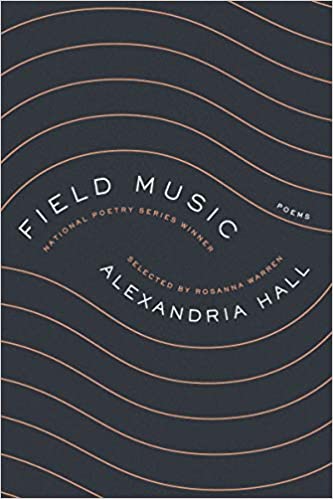
Field Music, by Alexandria Hall.
Ecco (HarperCollins), 2020,
96 pages, paper, $16.99,
ISBN: 978–0063008380.
Field Music is not a symphony centered on what’s lush or luxurious, but on a longing to uncover the stark garden speaking right in front of us: open land the color of grass that’s been hit with life. What’s left is ravenous singing, ready to challenge any starving ditch with its own story. As one of the 2019 National Poetry Series Winners, Alexandria Hall leaves even empty spaces breathless in her debut, providing a lens toward Vermont landscapes, animals, the body, planting, hunger, desire, and aging. One poem after another, Hall peels back the gauze shrouding the shared ground we walk on and work on.
Hall’s use of Northeast dialect is electric: “Awful nice a ya, wheezes Pa . . . How’s the new beau, he coughs.” Or how about when the speaker’s mother says “ancient / like ank–shint.” We’re immediately transported to a space where language is anchored by its unapologetic roughness, its origin of gritty knuckles, propane, trailers, and cockcrows.
Expertly painting Vermont in its realistic sigh of a working land, Hall does not lean toward majestic mountains; she describes every weed in its blistered glory. As she writes about a fishing trip, “Out of the water I lifted an already dead thing, / pale white with an old hook and line sprouting out of the gills. At / the end of the string hung a horrible ornament. No gasping, no / writhing, just the sagging weight.” Or in the first stanza of Field Music: “Nothing ever stays / where it ought: runoff dragged into the river / by summer rains from shit–covered fields.” In each instance we’re told to uncover the “wasps in the attic” and not be afraid of matching their sound with more intimacy and honesty.
Hall continues to unravel the deeply embedded shame many artists face when depicting nature’s ugliness. In “On Art,” her multiple apologies for pushing “words like marshmallows, words like clogged pores” actually underscore our human need to understand what’s muddy, murky, mistaken, and misused. Hall allows us to see the beauty in the bruised earth, not the beauty in a construct of being beautiful. Instead of scenic postcards from Vermont with hair whipping down a highway, we witness the perspective of what lingers but isn’t lost, like the speaker’s grandmother: “lips opened like a chicken with a broken beak.” Determined to describe the moments that brush our bones in their rawest form, Hall asks us this ultimate question: Have we been looking at the “rash goldenrod” with rose–colored glasses all along?
Furthering these complicated connections, Hall layers past and current lovers with an unshakeable velocity that simultaneously slows and sharpens our senses: “There was too much moon over the night in Middlebury / so I put a man’s face in front of it, and then I loved / that man.” Other poems hold familial memories, such as a grandmother’s crocheted owl or a mechanical bull ride just after hearing of a father’s illness. Just like “night sweat on the back of winter,” Hall argues that we’re always engaging with the after–sting of textured stillness that surrounds every relationship within the physical and personal world. The landscape is not used as a backdrop but as a moving force outlining the shoulders of each relationship’s shadows. Hall rocks us between these splayed, open–toed histories and their uncertainty hereafter: “My mother said the softest things / get torn into.”
With nods to Keats, Whitman, Rilke, Bishop, and Wordsworth, Hall’s Field Music is the rallying cry for what endures, what’s been ripped like a dandelion in a raised fist but still sings in silhouette. In “People Fall All the Time,” Hall reminds us of all that is not afraid to lie here, truthfully awake, beaming —
what stays are the song and the crash
of the tractor, the trash compactor, the machines
full of love and the fields full of breaking,
the fields where the light slips out.
— Amanda Dettmann
Until They Catch Fire
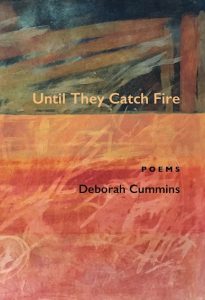
Until They Catch Fire, Poems, by Deborah Cummins.
Deerbrook Editions, 2020,
82 pages, paper, $18,
ISBN: 978–1–7343884–5–9.
Deborah Cummins’ third book of poems opens with a stunner. “So It Happens” offers a re–imagining of Eve in Eden in which the first woman falls into rather than from desire, “Not succumbing / but choosing.” The writing is superlative; here’s a stanza describing the pre–classified garden world:
No name yet for summer rain,
shadows among the clamoring leaves,
the plunge of bees purposeful in the lilies.
The rest of Until They Catch Fire is equally engaging and well-wrought — and emotionally charged. Nearly half the poems are devoted to the poet’s reflections on the deaths of her brother and mother, each the occasion for remembrance and regret, but also bittersweet celebration.
The grief is approached from a variety of angles, with poems prompted by a last photo, a medical examiner’s report, cleaning out a closet and dresser. Cummins covers the emotional spectrum, from anger to despair and dread. In “After, I might’ve said,” she reflects on how she might have reacted to death, by giving up on her gardening, letting everything go, “Applaud nits, aphids, cutworms, borers.” Another poem offers a “griever’s reference manual” with such bits of wisdom as “Vow never to tell anyone, ‘Time will heal.’”
Some poems are just plain beautiful in their carriage. “Where’s Your Hammer, Dad?” is an extended plea to a widowed father who has given up his daily projects to sit and stare. “For God’s sake,” the speaker says at the end, “doesn’t something need to be fixed?” And “Breakfast Geometry” belongs in an anthology of best grandchild poems. These lines resonate:
She’s years away from knowing
that it helps to lie down in the darkness
with someone who knows how to love
and laugh.
The language throughout is fresh and precise. A couple of flora related examples: “shrubs so clipped they threatened the notion of severe” (“14938 Oakdale Avenue”); “Dogwoods merely stutter / with a few final berries” (“Mid–November”); “the frothed collapse / of a flowering crabapple” (“The Dead”).
And there’s humor, at times of an edgy sort. In “Hair Rollers,” Cummins describes her mother’s curling tools: “Rigid, bristled, held with numerous / pins and clips, they looked like a means of torture / awaiting an electrical switch.” In the madcap “At the Grocery Store,” a couple strategically attacks the aisles, the wife at one point maneuvering into “regiments of whole grain cereals, / of couscous and quinoa, new heroes / despite their stunning resemblance to birdseed.”
Echoes of poets past enrich the verse. W. H. Auden’s “Musée des Beaux–Arts” is the source for the intense “On the Morning Of ” in which the brother being wheeled to the crematorium becomes Icarus falling into the sea. “Illumination,” an account of visiting Sant’ Eufemia in Rome, brings to mind Larkin’s “Church Going” while these lines from the love poem “Trying to Tell Us” recall Yeats’s image of the heart “fastened to a dying animal”:
For those of us discovering late
who and what we love, there is no reprieve
from how the body betrays us.
Cummins occasionally slips into a descriptive, prosy mode, as in “On an Encore Trip to Rome” or the ambitious five–part “Windows” where narrative takes over. A couple of poems stretch an analogy or conceit: “If a House Had Eyes” gets a little too anthropomorphic for this reader.
These are minor gripes. Until They Catch Fire is overall a brilliant collection, in turn intimate and universal, full of insight and intelligence. Open it and be moved.
— Carl Little
Between Lakes
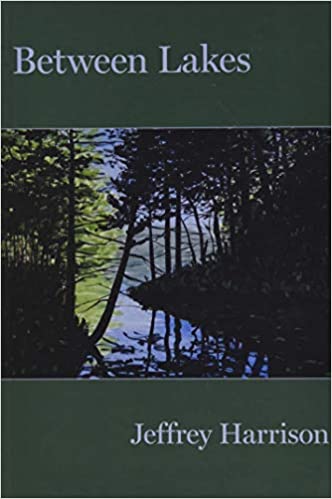
Between Lakes, by Jeffrey Harrison.
Four Way Books, 2020,
150 pages, paper, $16.95,
ISBN: 978–1–945588–53–2.
I want to give Jeffrey Harrison a hug. We’ve never met, but the poems in Between Lakes thrum with intimacy. Many of them deal with the final days of his father’s life and the aftermath of his death. My own father died last year, and a thoughtful friend gave me a copy of Between Lakes as a recent gift. How grateful I am to have read these poems.
These are not poems meant to comfort the grieving, and yet they do. Maybe that’s what I appreciated most about them. Harrison succeeds in communicating the vast complexities that exist between parents and children. Consider the opening lines of “Gratitude”:
My father and I got along best
during his last year and a half
when he had cancer. Saying that
feels wrong: one cannot be grateful
for a brain tumor.
And yet he did say it. It’s refreshing to read honest admissions of the challenge in navigating the loss of a parent even before they’re lost, navigating shared history, real and fraught, and ultimately resting in acceptance: “I’m grateful for / that year and a half, for those two springs [. . .] and for that new, / gentle father who kept telling me / how grateful he was that I was there.”
Despite the intricacy of their subjects, the poems in Between Lakes are not tangled. They’re not talky. Harrison’s tight lines are simple in the best sense of the word. Simplicity does not imply ease or laziness. Strong writing happens when the poet, after years of practice, engages the machinery of flow to achieve something that appears to have been effortless. The reader, of course, doesn’t see how long it took to build the machine. This is evident in a poem like “Last Advice”:
The night before my father died
I dreamed he was back home,
and I in my old room
on the third floor, and he
was calling up to me
from the bottom of the stairs
some advice I couldn’t hear
or recall the next day when,
standing over him
back in the ICU
full of the chirping of machines
we had decided to unplug,
I remembered the dream
and heard him call my name.
The uninterrupted tumble of those lines feels natural, as if the poem unfurled on its own. It’s beautiful, truly, and it doesn’t matter that neither the poet nor the reader ever get that last advice. Hearing a lost parent call your name is so much better.
Between Lakes is not just a book about Harrison’s father’s death. Though somehow, even the poems that don’t mention him still gesture at the complexity of what we inherit from those who raised us. In “Laocoön,” Harrison invokes the ancient Greek statue of Laocoön and his sons overcome by snakes in descriptions of a wisteria that has grown over part of his yard, “its thick vines twisting like serpents / around the invisible figure / I imagine struggling as in the famous / sculpture at the Vatican.” This is evocative on its own, but Harrison ups the ante with an abrupt turn, indicative of how the mind pivots in anticipation of unknown threats: “Or maybe I’m the figure, grappling / to cut the tentacles back / so they don’t engulf the house.” Personal struggles are often mythic struggles, however commonplace, and the metaphor is apt. One does not forget the challenges of childhood, of being a child and then becoming a parent. In his case, Harrison’s children have “escaped / by growing up and moving away.” But there’s no escape for the poet, left to contend with
this writhing monster of a plant
sent by some god as punishment
for a crime that’s different in each version
of the story and no one, including me,
remembers for sure, though I know
I must be guilty, I always feel guilty.
It’s true, Between Lakes brought me comfort in the wake of my own father’s death. It’s also true that it’s reassuring to see one’s daily family and parental dramas wrought so masterfully in poems that require little and give so wholeheartedly, that open themselves to the reader’s embrace knowing that in turbulent times we all could use a hug.
— Mike Bove