Christian Barter
Christian Barter: was born and raised in Maine. He received a BA in music composition from Bates College in 1990 and an MFA in poetry from the Vermont College of Fine Arts in 1997. He is the author of In Someone Else’s House (BkMk Press, 2013), winner of the 2014 Maine Literary Award for Poetry; and The Singers I Prefer(CavanKerry Press, 2005), which was a finalist for the 2006 Lenore Marshall Prize given by the Academy of American Poets. In 2016, he was named poet laureate of Acadia National Park in Mount Desert, Maine. He lives in Bar Harbor, Maine.
Raquel Balboni
Raquel Balboni: is the author of a collection, XXX Poems, to be published by Art & Letters in February 2020. Her poems have appeared in The Brooklyn Rail, and are forthcoming in the anthology Boston (Dostoevsky Wannabe, 2020). She lives in Cambridge, Massachusetts.
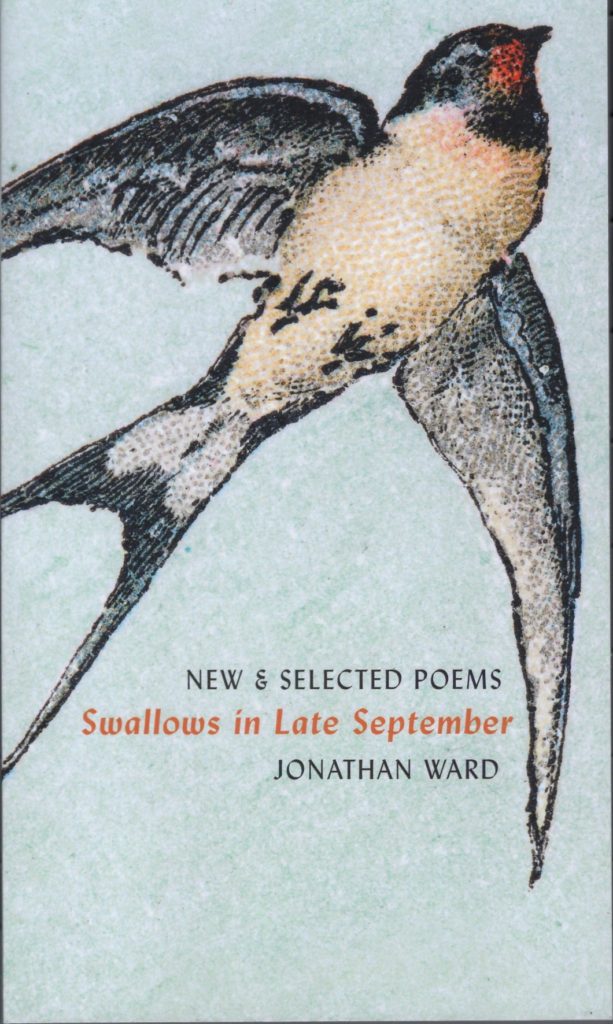
Swallows in Late September: New & Selected Poems

Swallows in Late September: New & Selected Poems
by Jonathan Ward,
Harwood & Elwood, 2018,
88 pages, paper, $15,
Limited Edition.
On the evidence of the 40 or so poems in his first book-length collection, the British poet Jonathan Ward is a close observer of nature, especially birds, and an aficionado of weather, through which he walks with some regularity. The poems, which are mostly short, lyric, and sometimes quite slim in shape, often relate roamings in specific spots on the coast and in the countryside of England, mostly around Cornwall and Ward’s home in Edgefield in North Norfolk.
The first two sections of the book feature poems from two chapbooks, Turning Leaves (2004) and Crossings(2008) (both published by writer Joshua Bodwell’s Clamp Down Press, Cape Rosier, Maine). The lead-off piece, “Crabbing,” is a finely- wrought memory of the “banjo pier” in Looe, a small coastal town in southeast Cornwall, where the speaker reeled in crabs “clinging to bait-heads / like plums from a pie.” While his parents grumble about the changes to the village since the summer days when they’d left their son there to fish, the quay remains the same “through the dark, / brimming, petrol-marbled years.”
The titles of many of the poems reference a particular place: “At Prinknash Abbey,” “On Peckham Rye,” “Winter Visit to Edgefield Churchyard,” etc. These visit poems are often occasions to record items in the landscape, as in these lines from “At Studland Bay”:
Mermaids’ purses burst and spurt
underfoot; razor shells; one crab
whole, belly-up on a platter
of plastic, shells and stones
the white flayed head of a dogfish.
The simplicity of a poem like “In Winter” recalls Gary Snyder. The verse begins with these lovely lines: “Two grey herons, / ragged coats, / collars up, / yellow bills / like quills / dipped / in shadow.” And the revelatory final lines of “Today As I Walk” call back the pared-down observations of William Carlos Williams: “i see / suddenly/ that this moment / is as good / as life / can ever be.”
Ward’s poems often reflect on personal existence. Among the darkest is “Forest Flame,” in which the speaker despairs at a day with “no prospect of work or gardening or love.” After contemplating thoughts of self-destruction, he finds solace in a clearing sky, the blood-red blooms of the Forest Flame pieris shrub, and a collection of Raymond Carver poems.
Many of the poems evoke family: the poet’s parents and his wife and daughters. In “Patience,” Ward thanks his father for teaching him how to see “the seasons / change in the hedgerows, / learning to name, to love / small places and their ways.” Elsewhere, the tender “At Vale Brook” recounts an outing with a daughter during which they see, and follow, a kingfisher. The sighting leads the poet to consider a fleeting life and child, “as if she were the bird / dazzling, so quickly seen / and so quickly gone.”
Other favorites here include the riddle-like “When I Lay Beside You,” “In Earshot of River Water” (whose title is taken from a Seamus Heaney poem), “Home,” “Field Notes,” and “The Roofer’s Tale.” The final poem, “A Gift,” is a comely summing up, the poet back from another walk where a friend has taught him a new word, netherbackwashes:
just randomly following lanes or tracks
and seeing where you end up.
Like writing.
Ward is a retired professor of English at Gresham’s School in Holt (where, by the by, Oscar-winning actor Olivia Colman went to school); prior to that he taught at Dulwich College in South London. With more time to write, he is proving through his poetry that he has a wonderful way with words.
- Carl Little
Apocalypse
by James Sutherland-Smith
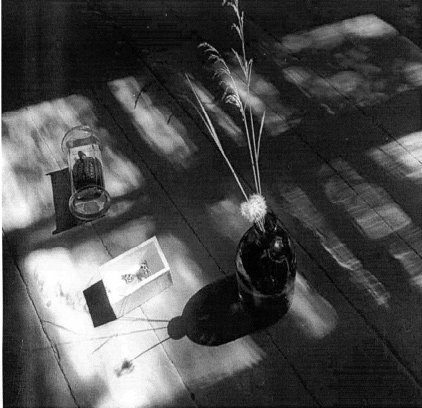
A trinity of stalks of wheatgrass,
An unblown dandelion head
Lean from a bottle of darkly seen through glass.
A butterfly — a sort of Admiral,
White, Poplar or even Red
Quivers in a box reserved for rare mineral.
An adder folded like a necklace
For the throats of the better bred
Stirs in a jar that stored long grain rice.
These are manifested on planks of deal
In a pattern of light and shade.
The keeper of these signs reveals
Perfection in the blankness of his face
While he dreams of last things foretold by a maid
Unkissed, but through whom all things shall come to pass.