
Quarry
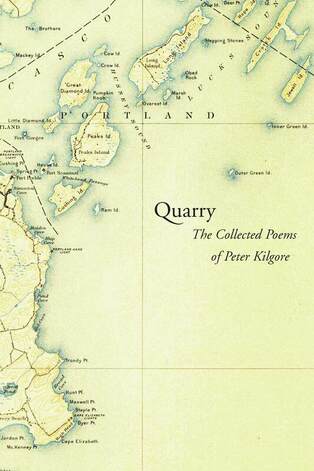
Quarry, by Peter Kilgore,
North Country Press,
2019, 296 pages, paper,
$19.95, ISBN: 978-1-943424-46-7
I knew Peter Kilgore in Portland, Maine in the early ‘70s, when he was collaborating with Bruce Holsapple and David Empfield, co-editing Contraband magazine. But until the recent publication of Quarry, I was unaware of the extent and scope of Peter’s own work. Kudos to Bruce and to Dana Wilde for compiling and co-editing this comprehensive collection, clearly a labor of love on their part, and to Michael Alpert for his elegant book design.
There are many ways to read this book — one of them is NOT fast. Start anywhere — read backwards, read forwards, skip around — but please, gentle reader, do . . . take . . . your . . . time. The power of Peter’s work lies in its ability to extract from a moment the right-now of its conjunction with the received world — to translate somehow from that stilled meeting place, its mystery, its power, and, to use a phrase Peter uses advisedly, its awe. I’m instructed again and again, reading these poems, of the power of that achieved stillness to invite the numinous. Beyond sheer witness, the poems arise from a place of beholding. An achievement, less Promethean — as in stealing fire from the gods — than regaining the immediacy of childhood. And calling on an earned wisdom, to translate into language the beheld.
I find myself reading Quarry as ripples in a stream of (American) haiku, demanding a stillness and attention commensurate with the poet’s. A meditative space, not so easy of access in our harried moment, nor any less so when Peter stilled himself into that location — his place of true receptivity and power:
I like to lie inside the western cusp watching seabirds ride the winds.
I draw strength here I have power.
Still laughing with crows I crest the northwest rim stop to gawk as
two hawks shot from rocks like puffs of dust in this gale wind. My
power! My joy! My place on earth!
And further:
this day’s
wine
is mine
rake of wind
earaches
of wind
i’ll be
this day’s
monk
“This day’s monk” — I’m struck by the exactness of that phrase, and how it captures a kind of almost monastic exile I feel throughout the work. The poet’s discomfort with the spiritual poverty of the daily grind — his deeply felt need to return (retreat?) into the vitality and solace of the natural world. So many poems attest to just that tidal pull, as in these lines, echoing, and pointedly inverting, the naked beseechings of 17th-century metaphysical poets such as John Donne (“Batter my heart, three-person’d God”) and George Herbert:
whip me
wind
lick me
dry
wet in
the arms
of Overset
i accept
ocean
as my
savior
Of course, knowing of Peter’s later descent into depression and his imponderable, self-inflicted end, there is always that felt undertow:
i have scanned
the charts
i too
carry
something
of the black
cargo in
my hold
gems and ashes
alone on
the sea
of any man’s
being
Gems and ashes. And in this vibrant collection the gems of Peter’s cargo survive the ashes of our common heritage. An authentic power resonates throughout these pages that revitalizes — brings us to. I’ll be revisiting Quarry often for that very jolt — maybe the wrong word for it, but something like a sandal to the head of the drifting acolyte — and we waken, come alive. I feel an undercurrent of sadness reading his words now, almost as testament, but beyond that, the privilege of accompanying a spirit so capable of opening himself to the sheer wonder of creation, and willing us the words for it. Thank you, Peter, for that gift.
— Jim Bishop
Boy on a Doorstep: New and Selected Poems
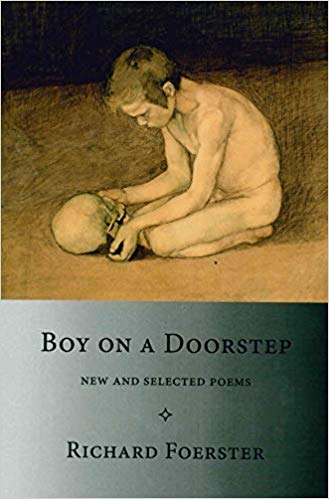
Boy on a Doorstep: New and Selected Poems, by Richard Foerster,
Tiger Bark Press,
264 pages, paper, $18.95,
ISBN: 978-1-7329012-1-6
Two things stand out about Richard Foerster’s poetry: his sense of rhythm and his storytelling. His collection Boy on a Doorstep offers illuminating retrospective and new looks into both.
Foerster, who is the recipient of NEA and Maine Arts Commission fellowships and has won Discovery / The Nation and Maine Literary Awards, writes in a strand of American poetry that grew from the modernist idea that the diction of poetry can match the diction of natural speech, but elevate it. By the postmodern 1990s, the emphasis was on the elevation, from which a diversity of skillfully crafted poetry emerged featuring fairly natural-sounding syntax cast in sentences that no English-speaking human being, however, would ever, in either the heat or the absence of any emotion, actually say. No one piles three, four, five dependent clauses onto the back end of a spoken sentence, even in informal lectures.
In this strand, one of Foerster’s special skills is coaxing normal speech rhythms into elevated poetic lines. This is oft attempted, but ne’er so well accomplished by most poets, at least not consistently. Foerster’s rhythms, though, have throughout his writing life been beautiful and natural. “I thought divorcing was an art worth perfecting /over time, like a vintage coaxed through fermentation,” opens “To Someone Somewhere After All These Years.” The first line is a sentence any English-speaker might say, the second slightly elevated in syntax but not unspeakable. At the same time, the rhythms in these lines are not bouncing meters, but they’re so finely given they might as well be. This skill is apparent pretty much throughout Boy on a Doorstep, selected from his books Sudden Harbor (1992) through River Road (2015), and several dozen pieces in a section titled “New Poems.”
Foerster’s many narrative poems are particularly forceful because the stories are so well told. Even the simplest recountings have a well-balanced sense of forward movement, or profluence, in their plots. In “Watercress,” the speaker of the poem while checking out at the grocery store is asked by the young cashier, “Did you find everything you were looking for? / . . . No, I said, looking deep into his earnest face,” and goes on to complain that the market does not seem to stock watercress. “What’s watercress?” the cashier replies, and this propels the narrator into an evocative, bittersweet reverie on youth and naiveté, ending on an everyday-language figure of speech cleverly used: “I knew to hold my tongue.”
An exemplary narrative is the elegiac “Tenure,” recollecting a love affair in France. The themes are memory, alcoholism, literature, regret, sex, and (a preoccupation, maybe) the dimensions of health. In this poem neither the profluence nor the flare of the language flags even in discursive asides:
If history’s an ever-swelling cyst that memory
must lancet open, I stitch it up repeatedly
each time I think of the pack-laden burro I was,
shambling through that sabbatical spring, up cobbled streets,
and I find myself cast within a slowly hardening past . . .
This is beautiful writing whose sense is not swamped by its sound. In fact, it’s enhanced. Form here arises from content, instead of hoping to create it by accident. This is the work of a master, and Boy on a Doorstep is the definitive entryway to his skill.
— Dana Wilde
Big Little City
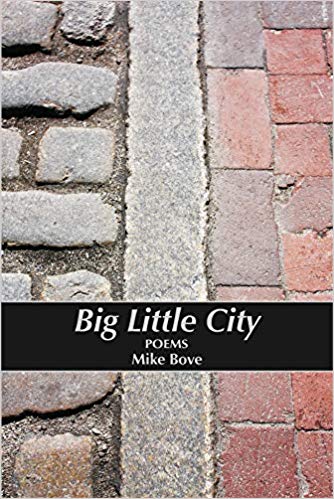
Big Little City, by Mike Bove,
Moon Pie Press, 2018,
71 pages, paper, $15.00,
ISBN: 9781732362420
Mike Bove’s Big Little City offers a heartfelt and detailed portrait of Portland, Maine, the author’s city of origin. The speaker of these detailed poems excavates personal memory and history as he struggles to chart his own path. Bove’s repeated map-making metaphor and his contemplative diction help create the sense of exploration — a meditative walk through the city he loves.
Each of the four sections opens with a short poem titled “Cartography in Retrospect,” marking four steps in the narrator’s coming of age. In the first cartography poem, the speaker uses his “father’s cracked map to walk a line” but gets lost when a marsh comes up in the dark. He curses his father, but continues on his difficult way. Bove’s ruminative style is evident in this first poem: “I can think of several wrong ways to draw a map. / All it takes is one slack stride for regret (bitter muse) / to set down coordinates with pinprick precision.”
In “Cartography in Retrospect II” the narrator wonders how he ended up “so far from self.” He has to learn the legend “and learn it again.” In “Cartography in Retrospect III” he must make his own map, and finally, in “Cartography in Retrospect IV” the speaker has so mastered his direction, he no longer needs the map he learned to draw. Instead, he watches the stars and “counts out paces.” In the end he comes home to “take up my pen and put it all down.”
As he continues to find his way, the speaker of these poems weaves present experience with excavated bits of the past. He contemplates the history of “The Old City Landfill,” soon to become a solar farm, as just another “sum / in the equation of layered land.” He also digs into the soil of Deering Oaks Park, superimposing the 2018 farmer’s market on the “dirt-red crimson” battlefield of 1689 (“Farmer’s Market”).
Bove’s layered phrases and lush verbal constructions suggest his contemplation of the city’s archeology, as in his remarkably titled poem “There is a Rumor That During Construction of one of Portland’s Prominent Thoroughfares in the 1850s, Some Workers Died in a Freak Accident and the Road was Built Atop Their Bodies.” As the workers weave “in and out,” so do the phrases of this sentence:
some nights I lie awake
and think about those men, imagine them
sitting up to wipe their eyes and climb, glowing,
out of the muck to stalk the street they almost built,
weaving in and out of hotels.
That these long-ago builders remain a part of the modern city, just as the 1689 battle still exists in the bedrock of Deering Oaks Park, is part of the central theme of Big Little City.
The book’s title poem concludes the collection, bringing the narrator home to become a literal part of the city he loves, thus accomplishing the goal set out in his cartography poems. He sees himself “lodged / between the stones . . . / so many small pieces . . . to collect and build / a new me.” His grandfather’s name “hangs in the church downtown” and his father’s “gauzy footprints appear in the cobblestones / he spirited away from Bramhall Street.” Even the unusual cover photo — an extreme close-up of a Portland street taken by the author’s son — suggests the close relationship of the narrator to the physical city. Anyone who has witnessed street work done on intown Portland thoroughfares has seen the careful layering of gravel and sand to stabilize the bricks or cobblestones. This is an apt metaphor for Bove’s meditative explorations.
— Jeri Theriault
Wayne Atherton
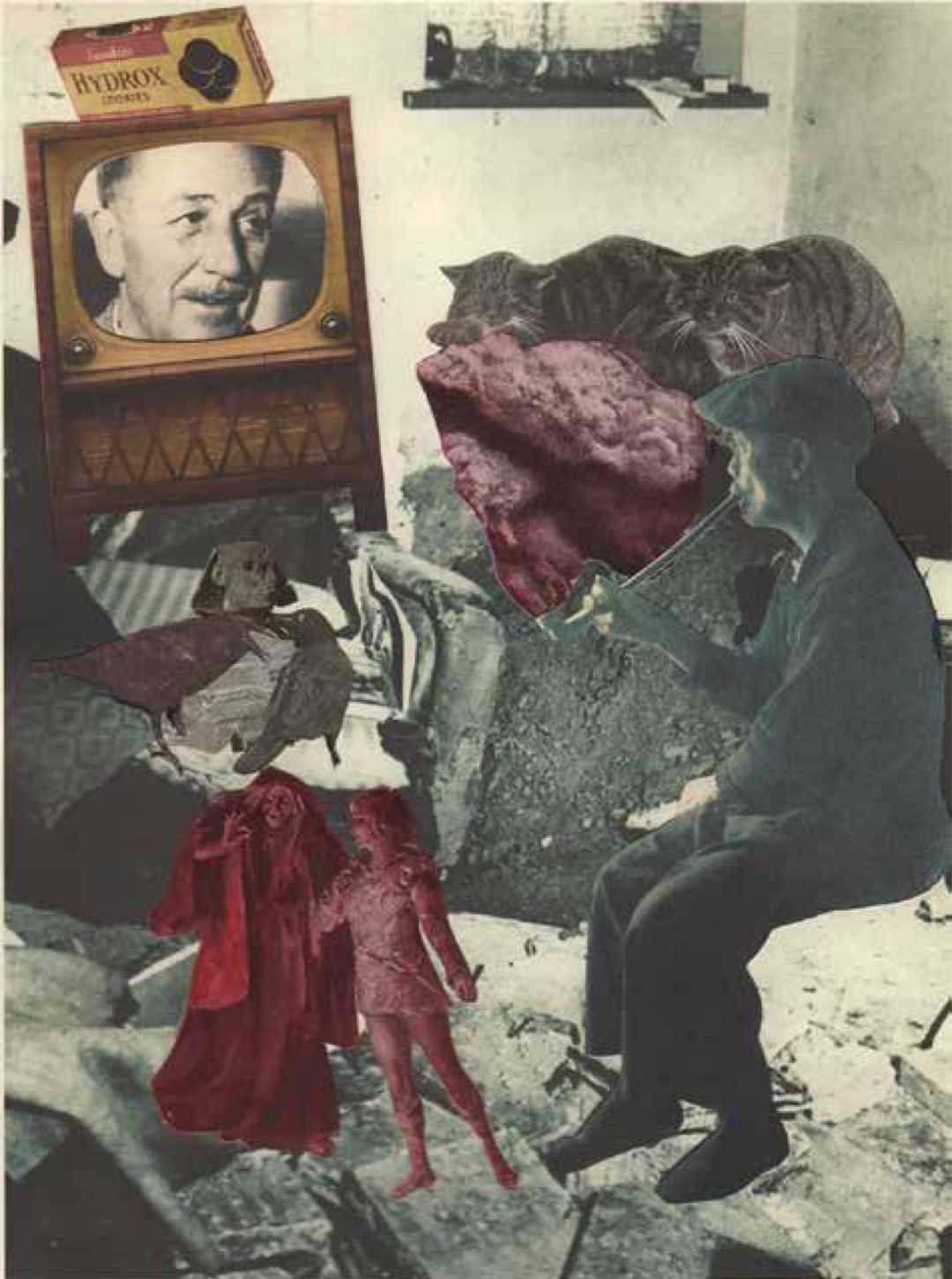
Wayne Atherton: now senior editor, started with The Café Review in 1992 as associate editor and lived in Maine for forty years. As a lifelong collage enthusiast, a recent collage of his appears in the Three Rooms Press publication Maintenant 13: A Journal of Contemporary Dada Writing & Art.