


Locked in the Nazi Dollhouse of Death
by George Wallace
in hiding for two years in the south of france the nazi murderers
breathing down her neck charlotte salomon
posed the question whether to commit suicide or ‘undertake
something wildly unusual’
and deciding the latter painted 2000 images in gouache — humming
faintly to herself all the while, and image by
image retelling in gouache the wondrous elements of her short life,
her first love, kristallnacht, stiff bearded men, f lowers in the pretty
garden on the cottage grounds in
Villefranche-sur-Mer, her grandmother in the downstairs bathroom
at dawn, hanging by the neck,
2000 images in gouache, is this life or theatre? asked charlotte and
she kept on painting until the nazis came and
put her on the train to drancy, the same place they interned all
the artists
tristan bernard the author
rene blum the choreographer
max jacob the poet
(yeah good old max, picasso’s hilarious pal, max with his colorful
language max with his prose poems max with
his big fat groucho marx cartoon poet eyes — max jacob a
surrealist’s surrealist coughing his lungs out into
pillowcases, his old i-saw-christ-now-i’m-a-catholic hoax didn’t
fool no nazis)
and all of them in drancy internment camp, way-station to death
for the lost merciful artists of france who got
caught being jews in those dark days —
poets and choreographers and painters in gouache, who suffered
in silence like the consumptive puzzled children
they were, locked in the nazi dollhouse of death —
and charlotte sat among them and watched the wintershadows
march in the courtyard day by day and stopped
humming —
until one day the nazis took her to auschwitz and gassed her
and fascism is very good at killing, isn’t it friends, very good
indeed, so literal so methodical so businesslike and
efficient and clear!
but the fascists can’t always kill people the way they like to, at least
not people who live their lives outside the
literal, in the metaphorical i mean —
take for example max jacob who got the last laugh — max jacob,
who shut his big fat groucho marx cartoon poet eyes for the last
for the very last time in drancy internment camp
before the nazis could pull him out of his pillowcases and
transport him to auschwitz
max jacob, who robbed the bastards thereby of their satisfaction
no they couldn’t
gas max
Things You Can Live Without
by George Wallace
there was a hill with a tree.
there was a house with tall windows.
there was a horse in a yellow field
and a rope swing strung from
the branch of a black walnut tree.
and a pathway made of blue slate
and water f lowing out of an old rusty pump.
there was dandelion wine and mousetraps
and a shady spot beside a garden gate to watch the clouds.
and besides that there was strips of f lypaper
and the sound of baby foxes calling out to each other.
and a hill, a hill. a hill you could sit on and listen for baby
foxes.
there was wasps nests big as paper lanterns,
and bats in the fireplace and a firepit by the pond,
and a view all the way down the valley,
and a rooster which WAS crowing before it was dawn.
shall we call it bucolic? shall we call it real?
the smokehouse door where he cured hams and drank alone.
the fence at the edge of the pasture where he wondered about
places you and him had never been.
you put the children on the school bus.
you perfected raspberry jam.
you even tried to make swiss cheese
and you fashioned christmas ornaments for the tree
from clay and paper and a little bit of string.
you made love to him in the hayloft,
and in the oldsmobile,
and in the master bedroom,
and eventually, not at all.
the furnace broke
the redbuds froze
the bills came due
and you died a little more every year.
and one day he just up and left you.
now you get up earlier than the stars
and you do your accounting alone.
mousetraps
redbuds
baby foxes
coal
him
— these are the things
you can live without.
Brenda Coultas
Brenda Coultas: her poetry can be found in the recent anthologies, Readings in Contemporary Poetry, published by the DIA art foundation, What is Poetry ( Just Kidding, I Know You Know), Interviews from the Poetry Project Newsletter, (1983–2009), and Symmetries: Three years of Art and Poetry at Dominque Lévy.
Priest Turned Therapist Treats Fear of God
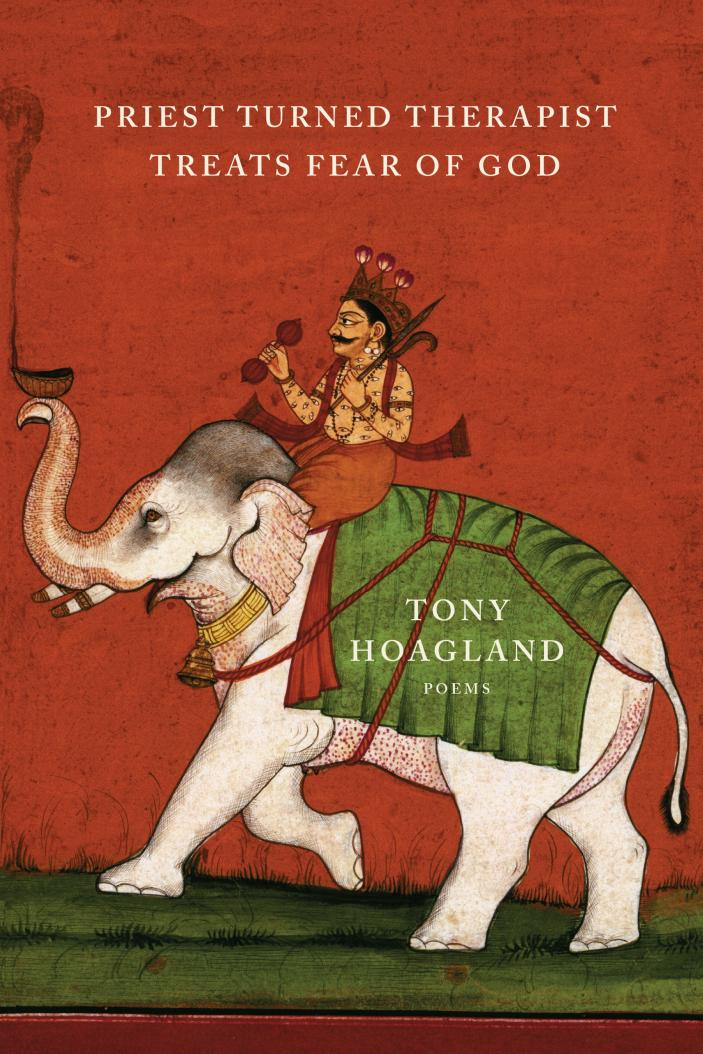
Priest Turned Therapist Treats Fear of God,
by Tony Hoagland.
Graywolf, 88 pages, paper, $16.00,
ISBN: 978-5597-807-5
Tony Hoagland’s work has always been interested in hard-won wisdom. He avoids easy aesthetics or aphoristic presentments. Over Hoagland’s six previous books, we’ve come to know him as a writer of artful and cantankerous poems that challenge pervasive political, moral, and socio-economic presumptions and interrogate the sorts of beings (both self and other) that propagate and sustain such presumptions. Hoagland’s final book of poems, Priest Turned Therapist Treats Fear of God, is a sharp, graceful collection that risks sincerity and vulnerability in order to artfully elucidate the tension between the permeable individual and the ever-invading world of nature and culture.
Like his last book, Recent Changes in the Vernacular, this one opens up space for the kinds of sentiments that mean more in the face of oblivion (Hoagland died of cancer in October of 2018) than they do when sprung from naïve surety or lazy ideology. Lines about wisdom being able to “sprout honesties / like flowers” are saccharine and difficult to pull off, but nestled in the larger context of his tempered, unapologetic style, they work The same poem, “Achilles,” notes that “we / already have chosen the strange / garments of confusion / we will die in” and that we “love / the thrill of enemies” and “. . . burn / through beauty like it was / wrapping paper.”
A sense that oblivion is close at hand pervades the book. Poems like “In the Waiting Room with Leonard Cohen” and “Achilles” are borne out in hospital gloom, cancer and its accompanying fatigues close at hand. But Hoagland stays sharp and doesn’t acquiesce to the tropes of illness. The latter poem eulogizes the plight of a patient in the hospital bay across from Hoagland: “Achilles is being carried from the field. / Three-fourths covered by a thin green gown; one / big bare shoulder sticking out.” A kind of piteous nobility carries the poem. After Achilles is wheeled into radiology, the poem concludes,“And then I am here alone / the one to weep / and it is myself I weep for.” By drawing a line between the epics of classical antiquity and the heavy succumbing of the individual to bodily plague and extinction, Hoagland reveals his high regard for the human drama; the bearing out of fate, whether it is personal, literary, or national, makes no difference. It is all the same beautiful and confounding trouble.
Other poems like “Couture” and “An Ordinary Night in Athens Ohio” are simply a seasoned poet with a good ear working well. The latter poem’s first several couplets skip briskly, a little drunk on sound, and risk going too far:
Those children in pajamas
in the big suburban houses
are not dreaming
of fireflies in jars
nor model cars,
but of fist-fighting
on Mars
in bodies not their own. . . .
The poem settles, and takes us into the kinds of wholesome quandaries of a collectively idealized past: “they are not feeding the hamster / small bits of lettuce / and changing its name / from Joe to Josephine, and back” before diving back in, “but sprinting over the rooftops / of burning Dairy Queens / and aiming shoulder-launched rockets / into shopping malls.” It’s a metaphysical requiem for a lost, albeit somewhat imagined, simplicity. It mourns not the supposed virtues of an American past, but the broader abandonment of nostalgia and the embrace of a violent, fiery future.
Priest Turns Therapist Treats Fear of God is a testament to the tenacity of Hoagland’s poetics. Illness serves to refine and clarify his vision and stretch out his big heart. This volume is at once tender and well honed. Reading it, one feels as though they’re encountering a poet vindicated by the vicissitudes of time — not exactly comfortable, but somewhat comfortable with discomfort. As I reflect on the fragile legacy of any poet, another line from “Achilles” comes to mind: “Look, don’t pity him! His imagination is not dead!” We would do well to look to Hoagland’s poems and to read and reread them. They are the record of a keen, funny, self-deprecating, imaginative, and sometimes controversial poet. Now it is up to us to see that his work endures beyond the moment.
— Luc Diggle