Meet the Maine Family Living Their Version of Vanlife, Hitting the Road for a Year

Danny Louten, one of our awesome staff members, sold his house and most of his possessions to live in a van and travel all over the country with his family. Adventure Sports Network met up with them and wrote this great article about their journey so far which you can read here: https://www.adventuresportsnetwork.com/lifestyle/vanlife/meet-the-maine-family-living-their-version-of-vanlife-hitting-the-road-for-a-year/
You can follow the Loutens adventures at @backtothevanagon.
Blue Lyre
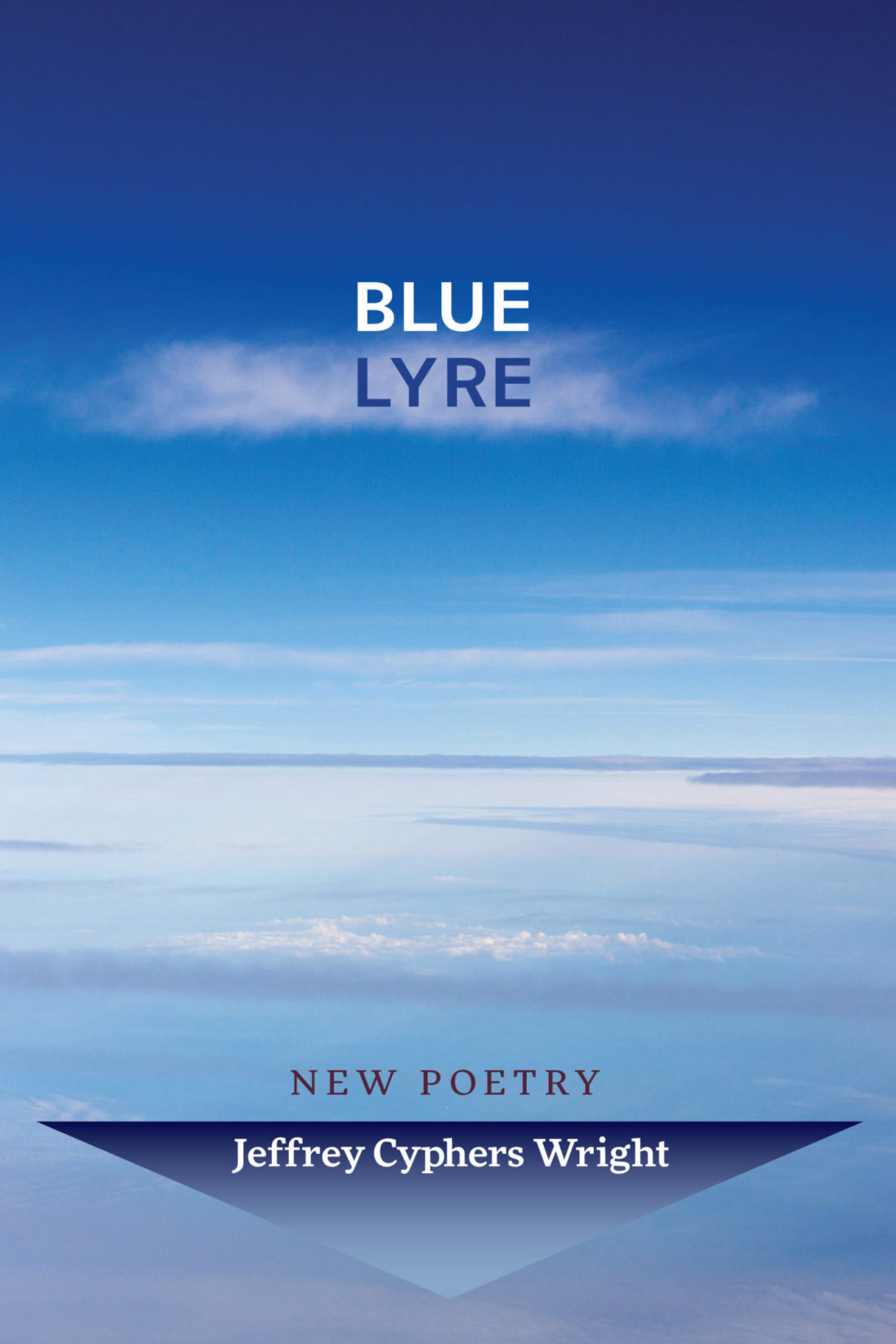
Blue Lyre, by Jeff Wright.
Dos Madres Press, 2018,
102 pages, paper, $17,
ISBN: 978-1-939929-96-9.
Early in Jeff Wright’s marvelous new book of poems, Blue Lyre, he notes his (partial) affiliation with one writing tradition:
The late Jim Brodey once instructed me
on composing a New York School poem:
“Use blue and name a couple friends”
Here he is being humorous rather than fully descriptive in that the school has many more constraints, in fact, ones so tight that, I would argue, they make it nearly impossible to write a good poem using them. Moreover, as I will explain, the few that go on creating masterful poetry within these strictures—and along with Wright, I would include Barbara Henning and Tom Savage in this crew—all have a strong political bent. I see as the most challenging constraint the rule that a poem should seem to present a series of unrelated, disconnected thoughts that, on examination, reveal an underlying affinity, which (ideally) keys the reader to seeing unexpected, not yet explored connections. I guess you could say that this is metaphor (which does the same thing) writ large.
You might guess, rightly, that few writers can pull this off. To simplify, Henning’s work “clicks” because she combines quotidian detail with (as it were) news clips, as in this sequence from “Sun Deprivation in February”: “Some become used to box-like houses. Snow plows on Avenue A. Lack of a home is a public smear.” Here is set of seemingly near random observations that, on second reading, are sharp-focused on the housing/homeless situation in New York City.
Now Wright describes himself as “an eco-activist” and is known in New York as a strong voice in the urban gardening movement. In his poems, odd, seemingly distracted comments about relationships, bar-hopping, and the creative process, are all tied, sometimes transparently, sometimes obscurely, to an ecological perspective. This is what gives the book so much unity and, dare I say it, heart.
One key element is certainly an abiding love of the outdoors, displayed in numerous lyric lines: “You want to linger a little longer //the last tooth of summer//a shy breeze cooling your brow”: “It’s raining. Crooked trees//wear the greenest moss”; “Sky, drunk on blue,//stitched by geese //Sun a bouquet//of knotted yellow,//cloud flowers//stirred in like cream.”
And it is Wright’s ecological awareness that repeatedly links poems, ones on the verge of fragmentation, into an illuminating unity. So “Meme Quarry” opens querulously and curiously:
You who have a date with Fury,
Set the record straight.
It’s not too clear whether Fury is an emotion, a goddess or something else, but the next line clarifies.
The rug is being pulled out
from under the planet.
The reference is narrowed down, suggesting Fury represents either an aggrieved Gaia or those peaceful eco warriors who are standing up in her name.
References throughout the poems to human-produced catastrophes, such as threats o mass extinction and global warming, not only contextualize stray remarks, giving each poem a strong backbone, but mean that every piece in the book adds to the sense of Wright message: that the current dangers to the natural world should not be and, indeed, cannot be far from any reflections we have as we go through our daily lives, no matter how far removed from ecology they may at first seem.
Before I overdo it, though, I should say that, as my use of the word “partial” earlier hinted not all, though quite many of his poems follow New York School parameters. Included in this volume are other, more straightforward descriptions of the beauty of gardens and the intricacies of human relations. Even so, one of the highlights of Blue Lyre is how in multiple poems, Wright takes techniques developed by the New York School and uses them to infuse poetry with a resonant, resolute ecological mind.
—Jim Feast
Where You Happen to Be
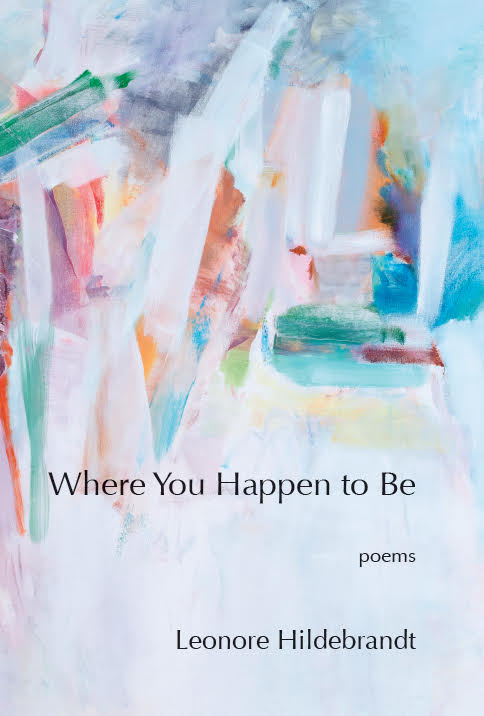
Where You Happen to Be,by Leonore Hildebrandt.
Deerbrook Editions, 2018,
94 pages, paper, $17.29,
ISBN:978-0-9991062-4-2.
In Leonore Hildebrandt’s previous collections, The Next Unknownand The Work at Hand, there is an overwhelming sense of meticulous deliberation in every line. If you want to live in her linguistic world, you have to listen very carefully. Her new collection, Where You Happen to Be, also forces you to look directly into its eyes, but there are differences. It is not gazing in the same directions.
The earlier collections tended to connect themes of personal experience, art, nature, and historical and political realities by exploring their intersections. This new book is centered on the process of centering, and true to the title, location is critical. The first of the book’s four sections sketches places apparently within geographic range of the poet’s home in Down East Maine—“Terminal Moraine,” “Milford Motel,” and “Thinking Potatoes,” for example. “After Learning” begins:
I ran to the margins bordering north
where the land ends and the sea ends.
In the quiet, I could hear my own heartbeat.
You have to pay attention to even simple diction like this: on these “margins” (plural?), the land and sea are both ending, rather than one or the other beginning. Weird. The speaker of this poem seems to be occupying, or seeking, an unlocatable location, and the poem ends “terribly” in doubt. The second section moves from the Northeast to the Southwest, and the location starts getting measured geometrically. The epigraph to “Threshold” says, “Never pitch your camp on the edge of anything,” because, as the poem’s first stanza concludes, “borderlands stir up the uncanny.” A long epigraph by Buckminster Fuller on the importance of learning the Earth’s cardinal directions opens “Where You Happen to Be”—ten nine-line lyrics on desert landscapes and the ways in which your own looking provides a cosmic center, if you can only recognize it. For example:
If Earth is divided
into latitudes and longitudes
you still find a place to sit
boulder overhung with rock
a lizard ventures into sun
your paths are crossing—
networks intersect—or cut
or lie across—and now your dome
elaborates in airy triangles.
There’s a sense that the poet has crossed paths with some elemental confluence of space, time, and consciousness, and there are ways to map it if you can just locate it. A few pages later “Sand Hour Sand,” ten blocks of prose poetry, traces dreamlike points of orientation in historical gold-rush time, e.g.: “On a grave marker we read, ‘Nothing survives except the rock—Geronimo.’” This whole effort to locate herself, history, memory, her mind’s eye, her mind, is given in language that is—if it can be believed—even more meticulous than in her previous collections. The difference is that the linguistic location from phrase to phrase, line to line, stanza to stanza is deliberately disarranged, decentered. The last poem in the book, “Collaboration,” is formed from two literary devices used to simultaneously cohere and fracture the syntax: anaphora, with each of the five stanzas beginning with the word “since,” creating five different conditional clauses; and anapodoton, with the main clause never materializing—the poem is a long fragment; it has no central thought. Even an antecedent for the pronoun “it” in the final line is unavailable:
since half-lives dissipate
and deeper cuts
accrue
the tell-tale body
bearing its abstraction
they work in octaves
interchanging keys
a solo for two hands
since elsewhere
twist and fall
dark-blistered leaves
they find themselves
a table by the window
the field outside
in raptured
slip-codes
since it is turned and open
Concrete reality, music, rapture, abstruse codes and abstractions. The effort to locate a center where the mind has a realizable grip on the depths of reality leads directly to a necessity to decenter what you long mistook for the center. Something in the range of what Robert Graves meant when he spoke of a poem as “an arrangement of thought arrived at by unreason,” and one method for which Rimbaud uncannily described as “le dérèglement de tous les senses.” Spectacular language developed from that insight.
—Dana Wilde
Jackie Lima
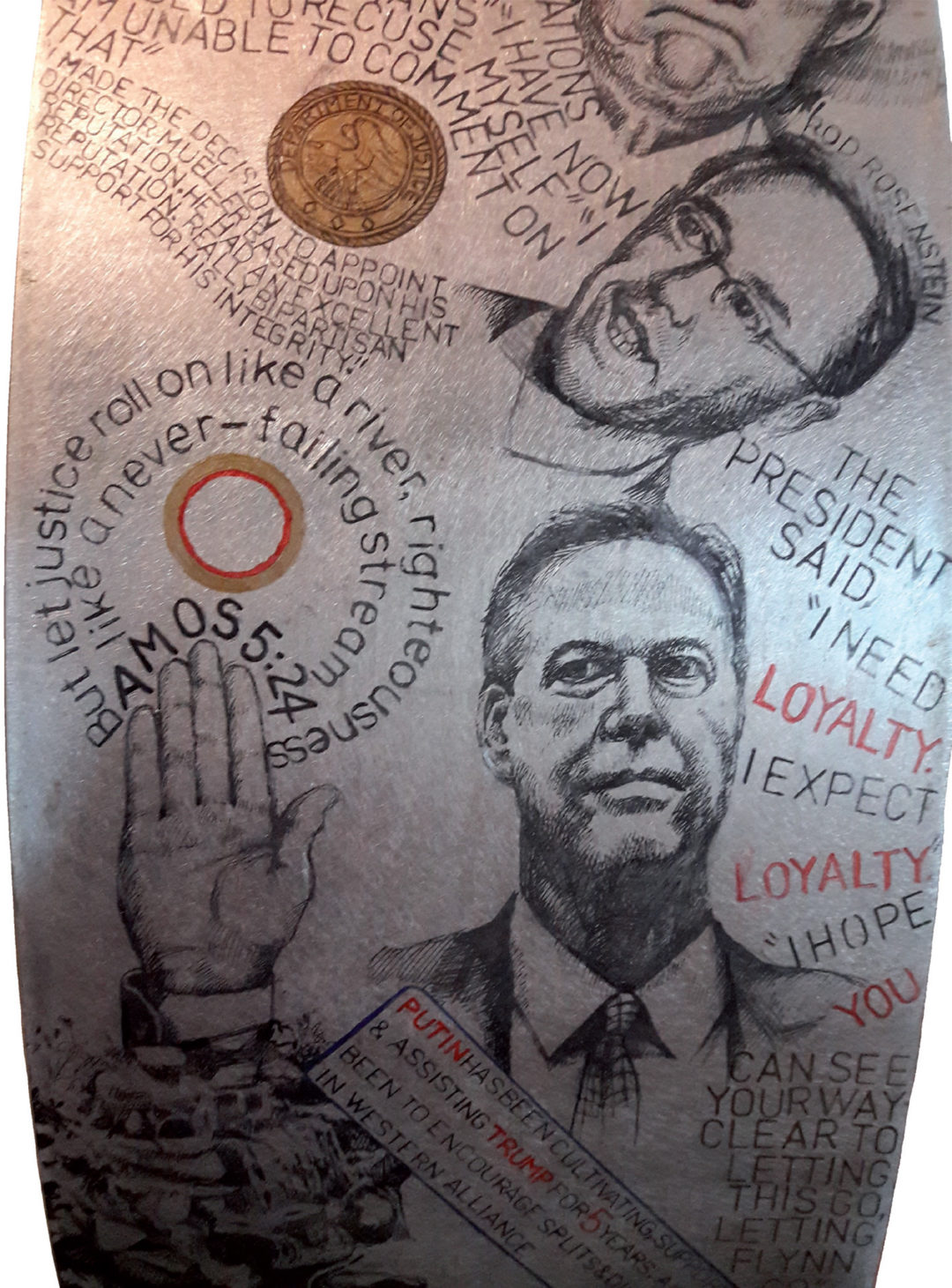
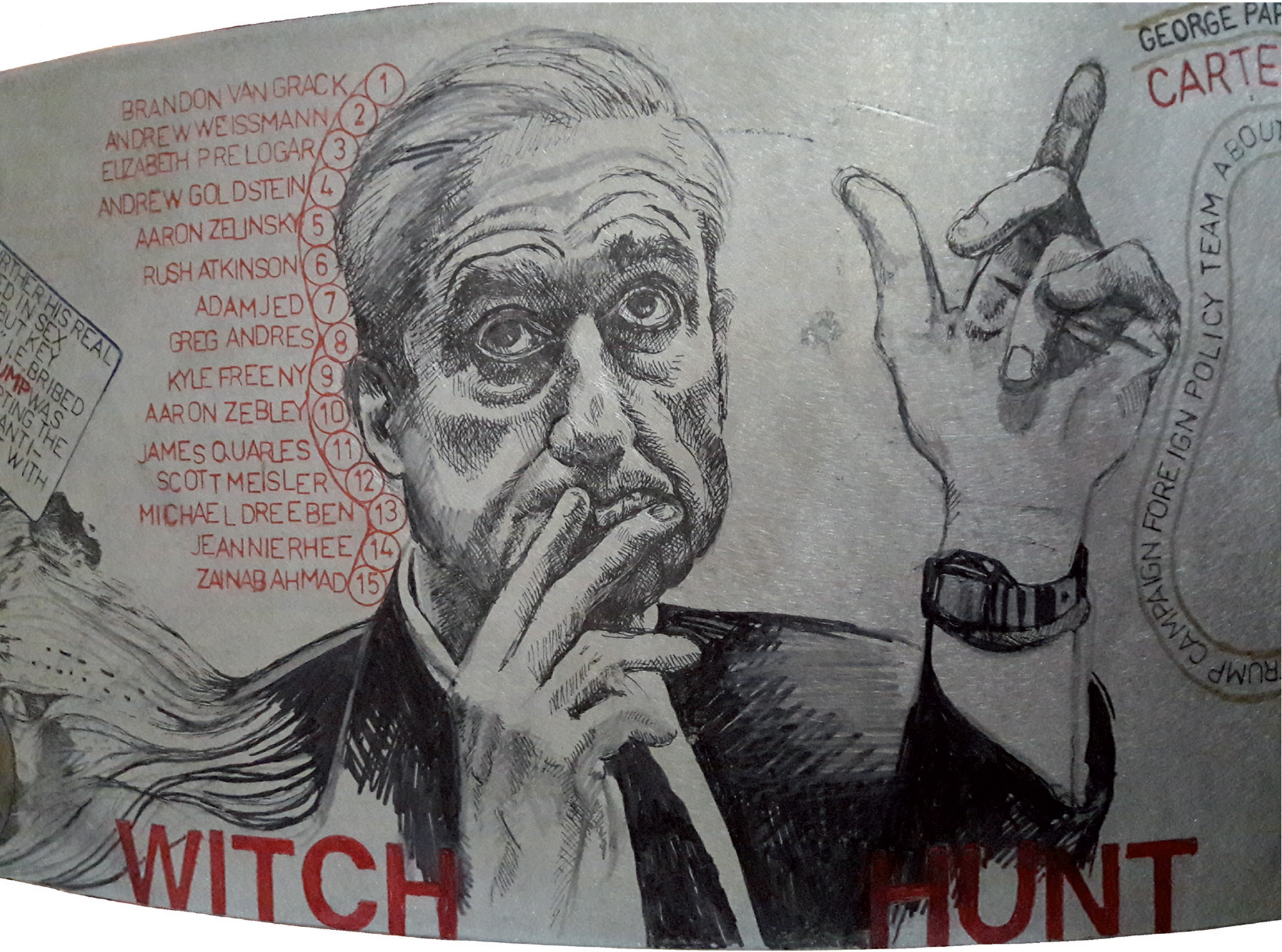
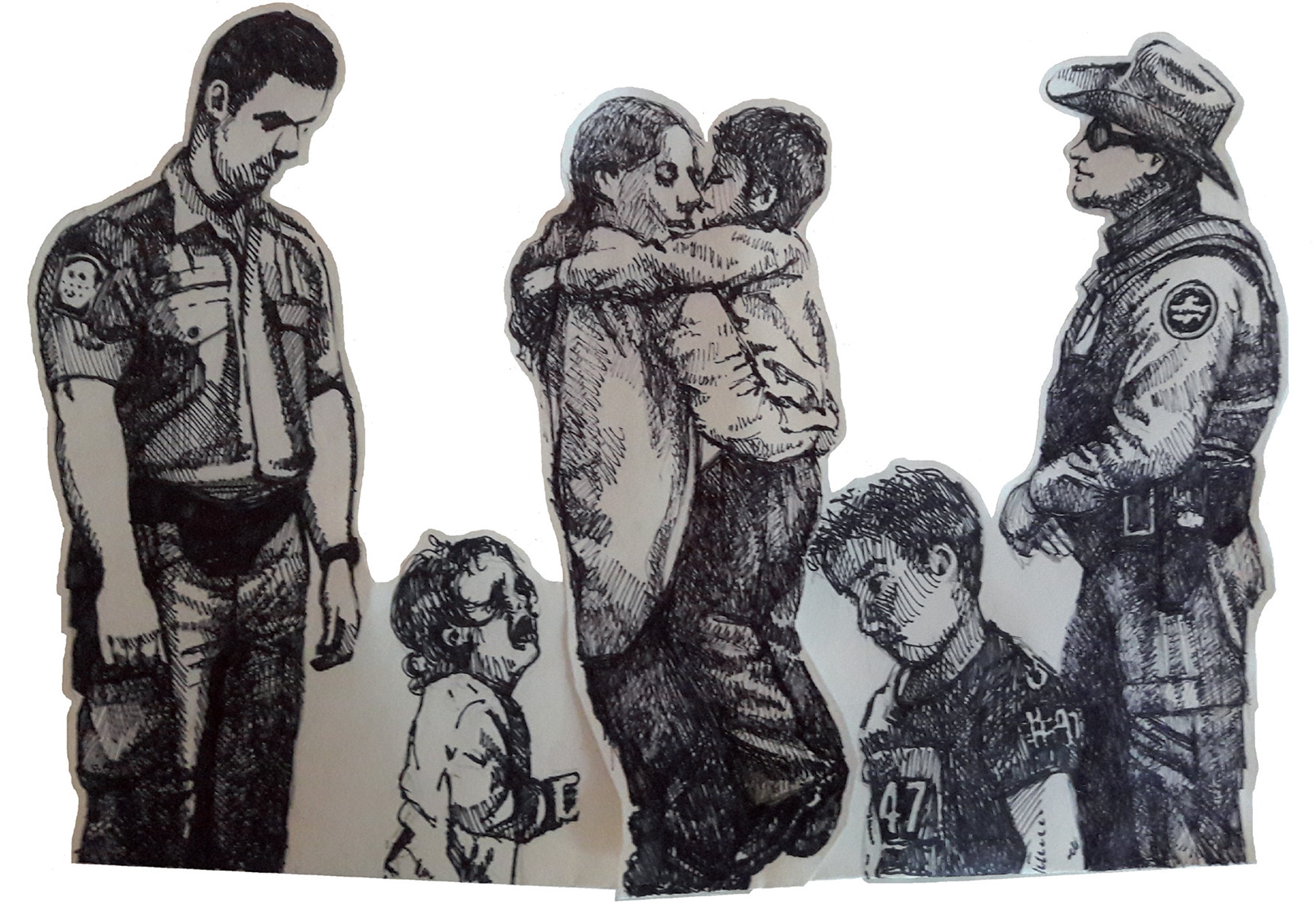
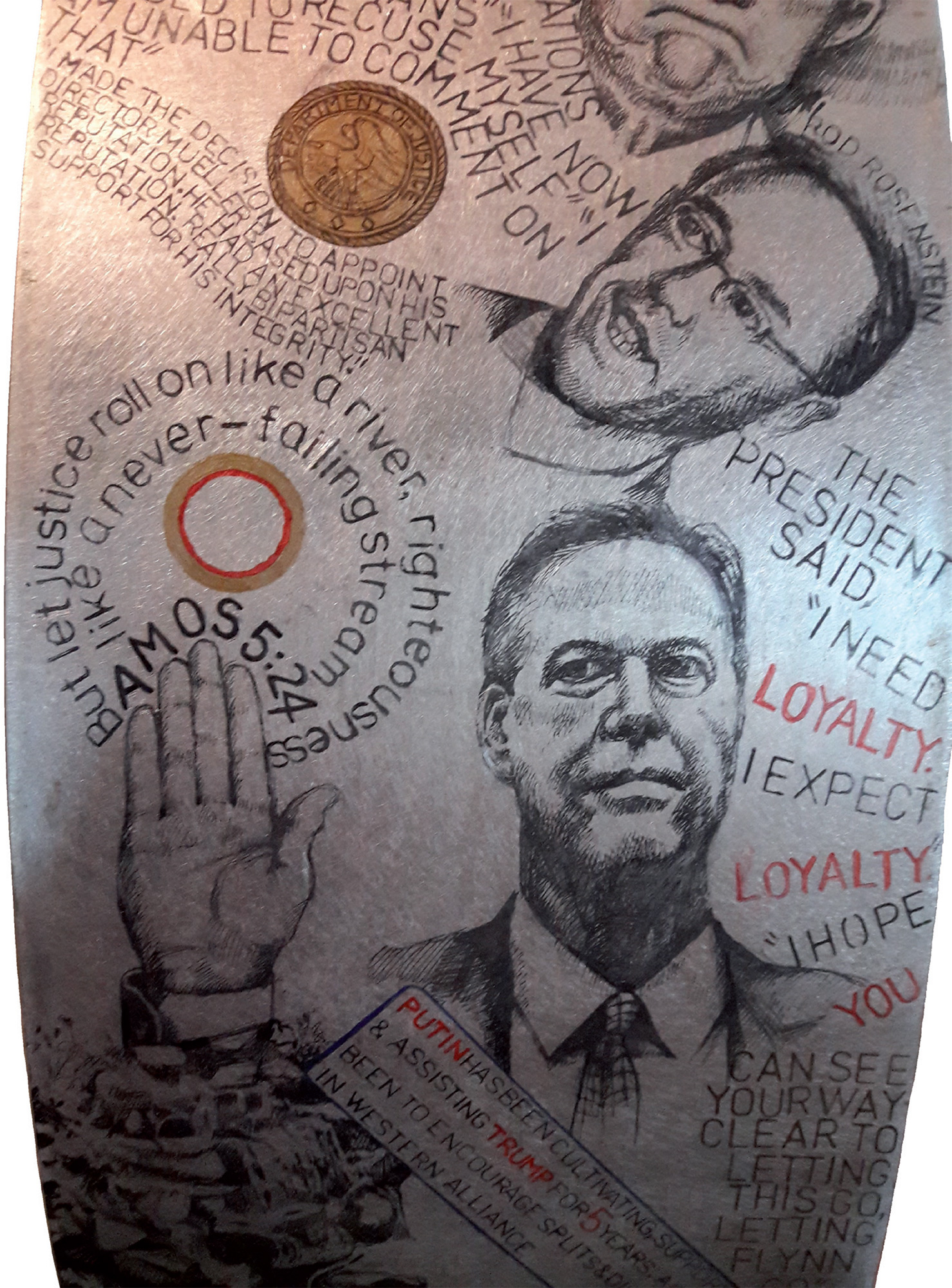
Jackie Lima: makes paintings in 3-Dimensions. Her paintings are perceptually based and the form of each work is based upon the process of that perception. She paints on spheres, hemispheres, rings, cylinders, tori, and twisted strips of metal. Drawing and Painting often exist in the same work—along with Words and Text.