

Notes of the Phantom Woman
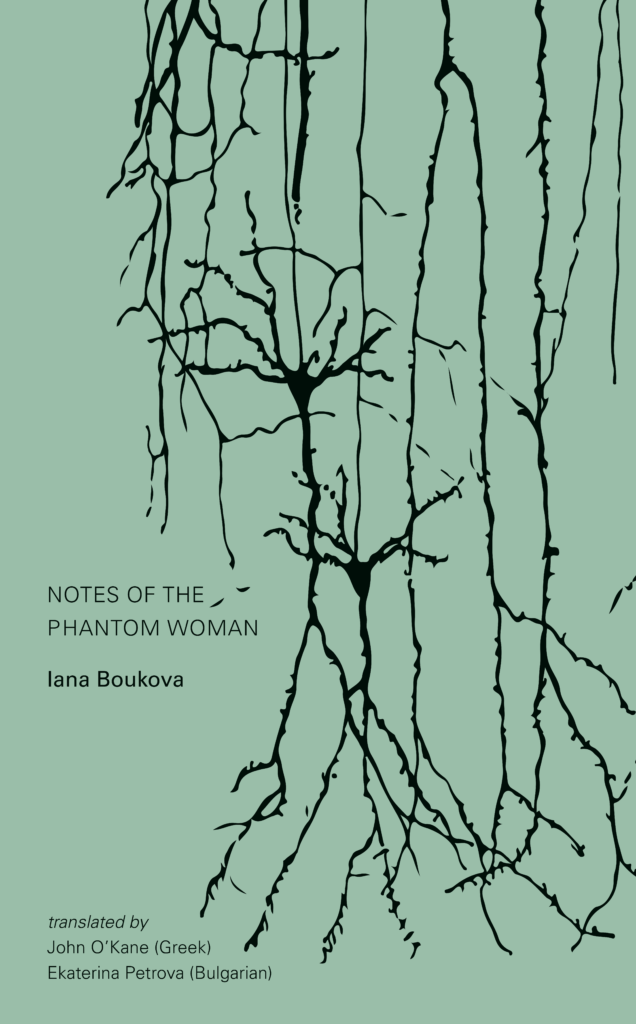
Notes of the Phantom Woman
by Iana Boukova.
Translated from the Greek by John O’Kane & from the Bulgarian by Ekaterina Petrova.
Ugly Duckling Presse, 2024, paper,
88 pages, $20, ISBN: 978-1-946433-00-8
A recurring theme in Iana Boukova’s collection Notes of the Phantom Woman is emptiness: for the emptiness that is a space, a container reserving space for something else, perhaps just waiting to be noticed, to have the same regard as spaces filled. “There are schools of architecture / that focus on the virtues of emptiness,” she writes in “Building.” Throughout the collection, Boukova includes direct references to Zen Buddhism, and the sense of embracing emptiness feels very Zen.
Boukova dances between binaries throughout most of the poems, refusing to settle on one definition as opposed to another while teasing the reader into new perspectives, much the way a Zen koan might. For instance, in the collection’s title poem she writes, “Dirt on something black is white. / Every housewife knows this.” Even the matter-of-fact short, end-stopped lines declare how obvious this statement is, though I chuckled out loud when I read it for its commonsense nature.
Boukova begins the collection with “In Nature,” a poem eminently quotable and impossible to convey its full character:
.…the most persistent question
concerns nature’s boundaries.
Because where nature ends,
another nature begins….
What am I to do with the fears surrounding me?
She drops that question at the end of ponderings that appear simple in their directness. It is the reader’s first clear indication that the poem is not just about nature, as we might assume (trees and rocks and rural spaces). And yet the poem dances between nature as philosophical concept and nature as in “we take walks in nature.” Nature is a mysterious otherness, “the nearby darkness.” The emptiness so clearly not empty.
Yet humor also traces throughout all the poems, a wry humor and particularly a kind of irreverent touch with regard to angels: “the Angel of History / flies with his backside exposed,” she writes, and “as if subterranean angels were blowing trumpets / in the ovaries of the earth….” All of this twists the traditional idea of winged angelic beings, at once referencing their physical, earthy bodily function and suggesting something divine about cosmic reproduction. Wow.
Boukova’s commentary on human society wades a similar tideline tiptoe between dry appreciation of humanity and soggy realism of our human shortcomings, as in “Dog”:
From a religious viewpoint our so-called fall
was probably denial of immobility.
That is to say,
it’s not because we ate the apple,
it’s because we didn’t become trees.
For this tiny bit of independence in space,
for a stroll down to the sea, you might say,
we got stuck with the whole education system….”
A lyrical tone carries through each of these poems, a tribute to the stated collaboration between both translators and Boukova herself. She wrote the poems in this collection in both Greek and Bulgarian, releasing separate editions in each language. This translation blended both previous versions into this new collection, a feat that surpasses mere translation. Unlike what William Learned said about translated poetry being like boiled strawberries, Boukova, Kane, and Petrova have created an “incandescent strawberr[y]” (from Boukova’s “Don’t Panic. It’s a Thought Experiment”).
Unlike movies in which the trailers clearly contain all the good scenes, I have held back on quoting from many of the poems in this collection. Boukova is a master at one-liners, almost like punchlines, yet manages to keep them relevant. She inserts them in the middle of a poem, then keeps going without losing the moment or narrative of the poem, as in “Tractatus”: “I think it is high time / that I clarify my position regarding pigeons.” And, in “Umwelt,” “Rhythm is the dialect of the masses. / Trotsky to the DJs.”
In an age where books can be mass produced and designed by anyone with a keyboard, publishers with a commitment to craft, to letterpress printing, to limited runs made with care and skill are to be treasured. Ugly Duckling Presse puts out books in a variety of formats, each made with attention to layout, construction, and materials. Their books are a joy to hold in your hand, a charm only bested by the joy in reading them. The craftsmanship is well suited to the high quality of Boukova’s work, which is worth revisiting again and again.
-—John Reinhart