
Drawings of Sightlessness
Luis Cardoza y Aragon
Drawings of Sightlessness
Between pen and paper there is a celestial space where angels, stars, and clouds go by, in which gravity loses all hope of breaking the fall of the unforeseen.
The pen is a meteor or comet, a crush of skies and millennia, guiding your hand which listens to the unknown and secret identity of things: a stalactite dripping sad and incessant light that already pierces the everlasting porphyry of the ants.
You plunge headfirst into the white page and swim toward the marvelous beaches.
You name.
Your christening flouts death and chastity belts, and Orpheus saves himself from the beasts like the sound of an echo.
— tr. Asa Zatz
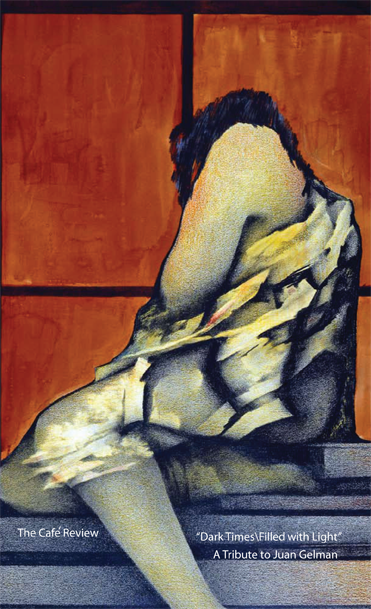
Juan Gelman: The Music of Questions
Jorge Boccanera
Juan Gelman: The Music of Questions
Gelman’s poetic breathing has the music of questions. The clincher “Qué cuestión!” (“What a Question!”) in one of his early poems sets the stage for the unexpected to coexist with the dawning of awareness. That question, added to the list of questions to be resolved, is subject to cross-examination. And since his first book, “Violín y otras cuestiones,” (Violin and Other Questions), he has done nothing but resort to questioning the imagination. Such questions are his insistent obsession: love, the city, the struggle for dignity, poetic revelation, the infancy of things, exile. Question marks are the teeth of a gear that relentlessly grinds and mixes those themes together. The succession of questions obliterates the logical supports of the “singing mania,” and sets up a pendular movement, a counterpoint between assertions-that-question and questions- that-assert. The hammering of the questions puts everything in doubt; blurs the edges of every theme, creating a feeling of emptiness. And when it seems that the question has been formulated, another one arises. This intermittent breathlessness adds a body-language to the discourse as if the body itself were also asking. For Gelman, the relation between imagination and memory is so intense that it creates another memory; imagination is the tool he uses to interrogate past, present, and future. When Gelman questions — said Julio Cortázar — “he is inciting us to turn more lucidly toward the past in order to be more lucid vis-à-vis the future.” Those questions splinter certainties off the backside of things.
— tr. Asa Zatz
The Wages of the Profane — (Paris, Geneva, Mexico, New York, 1984-1992)
Selected Poems of Juan Gelman
translated by Hardie St. Martin
Courage
to José Angel Valente
Word that is extinguished when we breathe or name its impossibles, bones that burned to give it shade, palate that ended in spittle; what had been body now burns out to let the horizon take form. A verse works its way into poetry and, around the world, the slimy dawn is a forest of blood. Or are those the footsteps of terrified Death? There are no more cities of refuge, Cedes, Arama, Asor have sweating brows, their swallows fled to the trees of the sun. Now everything is birth.
The Judgment
Selected Poems of Juan Gelman
translated by Hardie St. Martin
The Judgment
that grace time saw growing on your brow /
time will reap / and will not give it back /
and the high throne you believed so high and eternally yours /
time will lower it into the grave /
and the pain you tied me down with in your hour of victory /
time will sever with its axe and its knife /
time lowers down / time raises up /
from his no-man’s land the exile will depart
joseph tsarfati