

John Brandi
John Brandi: is poet and painter and the author of many books, including Pa–Siempre: Cuba Poems (2016), Into the Dream Maze (2015), At It Again (2015), The World, the World (2013), Seeding the Cosmos: New and Selected Haiku (2010), and Facing High Water (2008). As a poet he owes much to the West Coast beat tradition. He earned a B.A. in Art and Anthropology from California State University, Northridge, and is the co–editor of The Unswept Path: Contemporary American Haiku (2005). He lives in New Mexico.
Polly Buckingham
Polly Buckingham: is the author of one book of poetry, The River People (Lost Horse Press), and two books of fiction, The Expense of a View (UNT Press) and A Year of Silence (Florida Review Press). She teaches creative writing at Eastern Washington University and is the editor of Willow Springs magazine and Series Editor for The Katherine Anne Porter Award. Her work appears in The Gettysburg Review, Threepenny Review, and The Poetry Review.
Paul Balfe
Paul Balfe: a child of the 60s, he grew up in Dublin, Ireland. He studied Medicine at Trinity College Dublin following which he trained and practiced as a surgeon in the Irish Healthcare System. He was awarded the September 2016 Irish Times Hennessy New Irish Writing Award for Poetry. His first collection, Four Seasons, was published in 2019.
lesser case
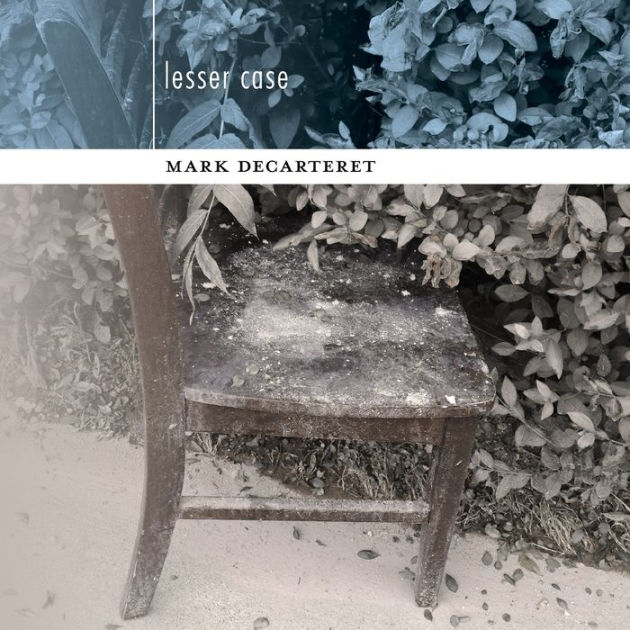
lesser case
by Mark Decarteret.
Nixes Mate Books, 86 pages,
paper, $18, ISBN: 978–1–949279–30–6
Mark Decarteret’s new book is, in many ways, about the universe of the within as it projects itself out upon that larger one that surrounds us. In the process, the poet whittles away at the veneers of life, self, and art to find or, more importantly, to reckon with, the truths found underneath.
His is a voice that beguiles through image and motif to unmask passion in brilliantly indirect ways. I cannot find a more concise example of this than the poem “helium,” which comes early on in the book:
she still keeps a balloon
he filled up his last birthday
& every year since
takes in one of his breaths
& makes this similar wish
It is an image which is at once shattering and celebratory in its restraint. It is also typical of the punctuation–free, ampersand and slash–laced rhythm that moves the language along in these poems.
Throughout the book, Mr. Decarteret peals away at several recurring themes, or worlds: the world of existence, the world of relationships, and the world of truth which he ponders may, or may not, include himself. We can see this latter refection in the poem “drift,” which he dedicates to Wallace Stevens:
at least I got the world right
if only for a minute
thought it can’t be a coincidence
it happening
while I wasn’t in it
Another recurring motif in lesser case is that of the writer and his work as it pursues this truth, a pursuit that the poet is not always delighted with, as with the poem “breath”:
what luck these words
knocked off like air
not to mention
the great measure
one needs to pull
off a good poem:
putting just one
of those moments
back in their place
From the standpoint of structure, these poems display an expert economy of language and brevity. Rarely does a poem exceed a single page, and yet each page is its own soup can of the cosmos. This does not take place without a wry sense of humor, as we see in the poem “burden”:
even the most aggrieved ghost
has grown fearful over time
of the relocated chair
Or as further reflected in “winter haiku”:
here we have five or six
different words for snow
& they all start w/fuck
But the overall tone of lesser case settles in a quiet, contemplative grace that occasionally borders upon the elegiac. In it, the poet reckons with his own end in the same inside–out fashion that infuses the whole book — soul bare, winking up/winking down, as in “elegy”:
these fingers
last touched
the skin
which last touched
the bones
which will soon
touch the last
of any dirt
he’ll lie still for
lesser case rewards repeated readings as its layering unfolds in a sort of slant–accessibility that slows the reader down, like hovering a cursor over a video for a moment before the image starts to play — as in the poem “back (scratcher)”:
your littlest
plastic hand
on a stick
this itch all
I’ve still left
of that past.
— Craig Sipe