

Antique Densities: Modern Parables & Other Experiments in Short Prose
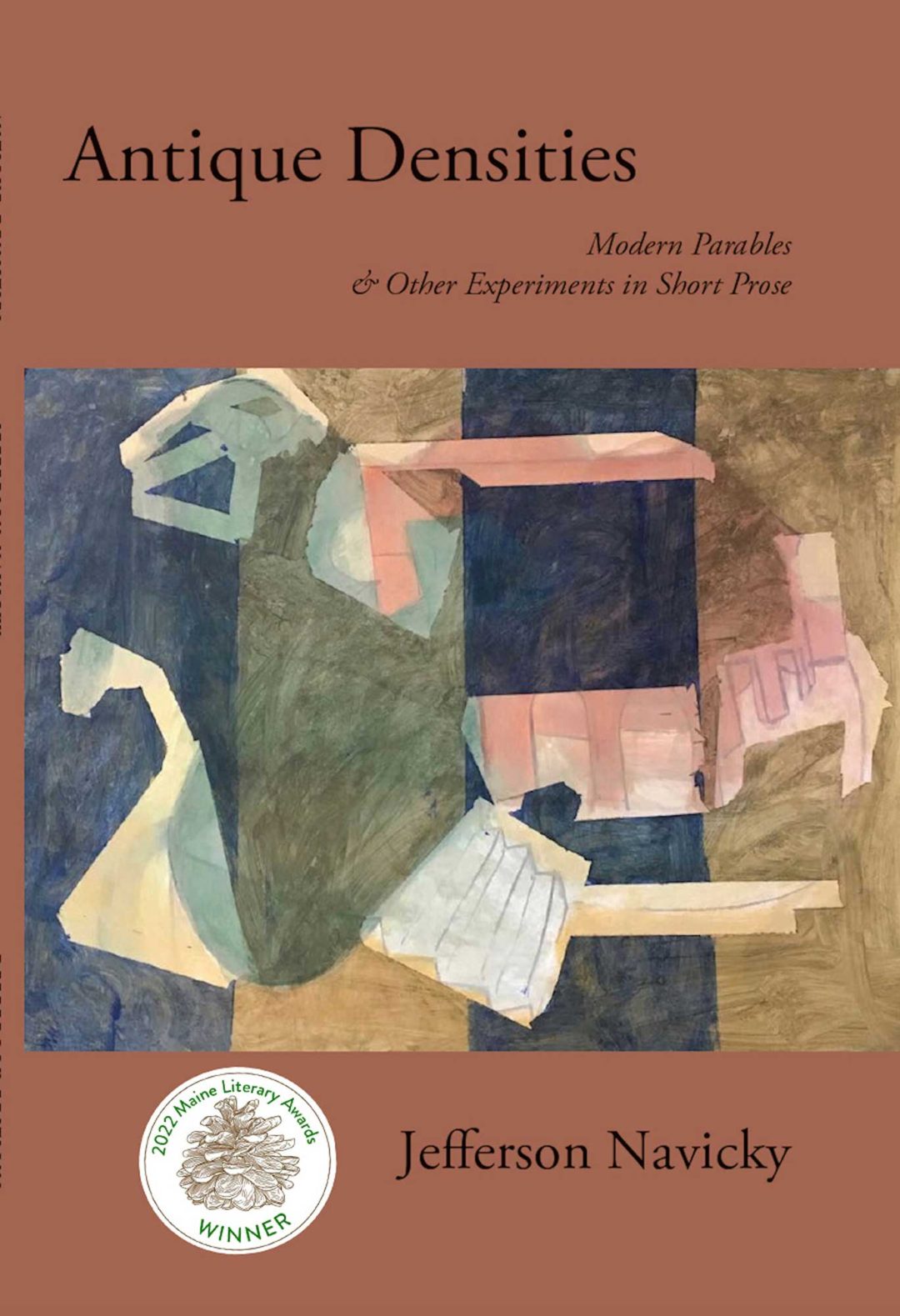
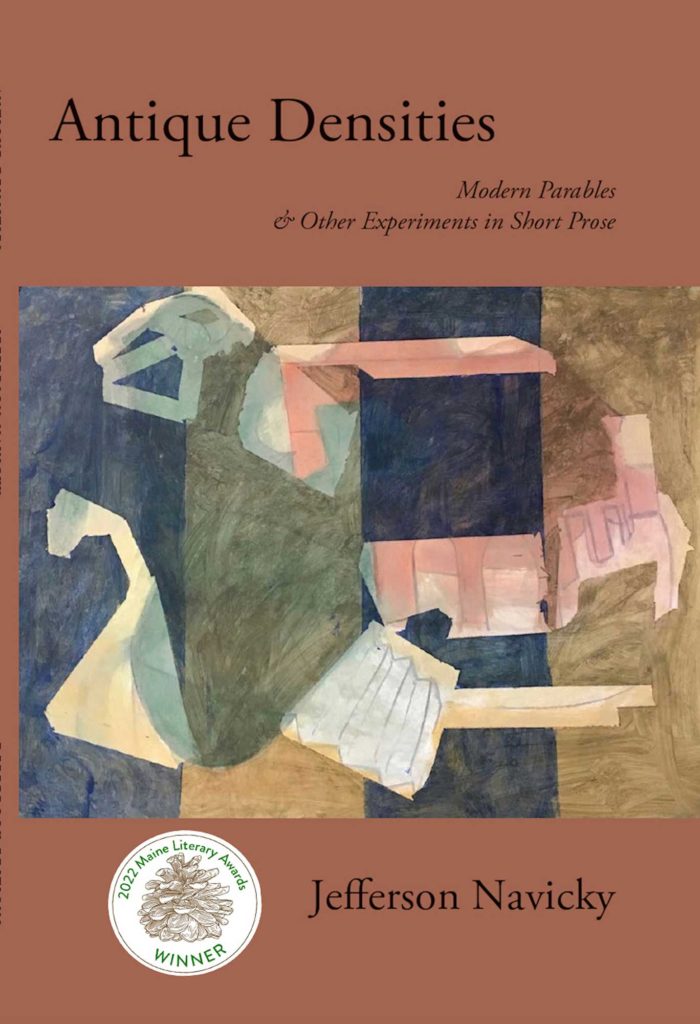
Antique Densities: Modern Parables & Other Experiments in Short Prose
by Jefferson Navicky.
Deerbrook Editions, 2021
106 pages, paper, $18.50
ISBN: 9781736847725
Imagine trees spiraling sap inside book jackets, a forest thriving through your palm of paper. Antique Densities questions our answers, stripping down the logic in our lives. Are we the spines of stories, or are stories the spines of us? If you had little doubt about existence before, Jefferson Navicky’s archive of broken rules and shoulder–stretching metaphors will increase that uncertainty even more, in the most clever ways possible. With prose poems reinventing persona poetry, the hero’s journey, and objects as muse, Navicky reminds us that disappearance doesn’t always prove fatal; once–dismissed fantasies can actually be both explosive and hopeful.
Navicky’s rich unknowing halts time. After all, he was inspired by a book called Tales of Wisdom: 100 Modern Parables, which he found at twenty–two years old in New York City. Through sections titled “Books,” “Maps,” “City Directories,” “Transcripts of Oral History,” and “Special Collections,” the past and the future shake covers off the present, “creating echoes whose souls excited the hollow places of the house.” What would these rooms of language look like unconfined, our stories bound within breasts of birds? Navicky carves space into systems of everyday order, like a “grandfather clock where we make love, wedged between the huge hanging pendulum.”
We enter every paragraph with a new body: “You do not know if the train is in front of you, but you feel relief in knowing you are writing.” Through a variety of speakers — a barber, police officer, lover as thief, visitor’s book, boy dressed in his first words, mayor who wears snowshoes around the office, and even a hunched man — Navicky redresses solitude as creative inquiry. We’re driven to examine the peculiar in the familiar down to the very last drop. Through a single malt scotch on the rocks, a squinting dog on the floor of a café, or even a map that’s rescued and reused as a letter to a brother, Navicky teaches us to carry an abundance of lives within our own metamorphic retelling. “A rib cage floats in the air” is a perfect example of the uncontained and ever–changing physicality in this book. Navicky portrays humans as earth, paper, and history, unable to tell “what was at the heart beating beneath the wings. Was it knowledge or was it pain?” Antique Densities allows settling in the unsettling, how we can feel language with all our senses but still never be able to explain an experience. Navicky describes a book as “the moment he learned to touch” with “paper and skin flapping together,” showing the minute line between book and body. Ultimately, Navicky embraces the “twinned movements of language and fragility turning into each other,” furthering untranslatable landscapes of emotion rather than ones of theory.
With close attention to oral histories and faults of memory, Navicky’s work invites us to vulnerably enter new rooms of self–recognition while speaking to human limitations. We can never read everything; we often stare at screens to ingest two seconds of a story. Navicky poses: What if we started seeing books on the floor as casualties? What if all we altered of the natural world were our dreams, fossilized in mountain sides without ownership? By paradoxically placing enduring language inside ephemerality, Navicky welcomes return, suffering, expansive holding, and an unrealized freedom surviving any sticky shelf life:
“This was not our library. We walked through a hole in the
brick wall out
onto the street. A bus passed us. Our beginnings were
everywhere.”
— Amanda Dettmann
Lockdown Letters & Other Poems,
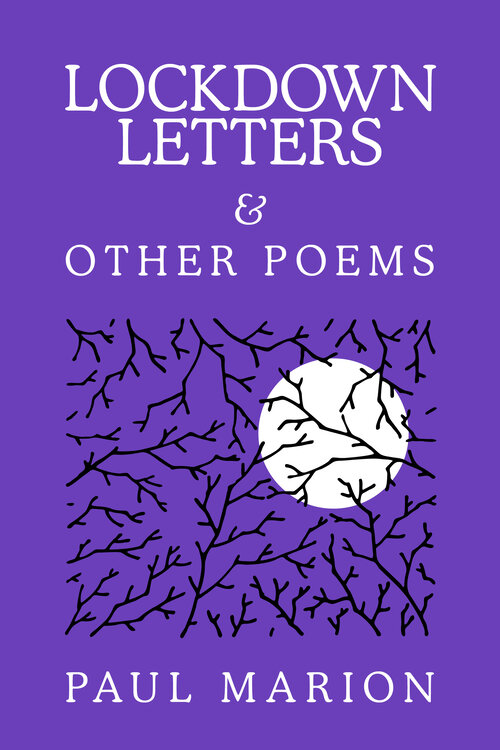
Lockdown Letters & Other Poems
by Paul Marion
Loom Press, 2021
174 pages, paper, $15
ISBN: 978–1–7351689–4–4
The pandemic’s effect on American poetry is evident across the board, from individual reflections on our daily plague to anthologies devoted to verse created in, and inspired by, this time of coronavirus. Poets have had the inclination — and the time — to respond to a world turned pretty much upside down.
In his new book, Lowell, Massachusetts–based poet Paul Marion adds to the mix with a series of 24 slant–sonnets he calls “lockdown letters.” They’re based on email exchanges with family and friends in the early days (March 7 to April 8, 2020) of the pandemic.
While colloquial and reportorial, these 14–liners contain their own formal crafted grace as Marion deftly converts the news of the day into verse. Here are the opening lines of “March 7 (Marie and Dick)”:
Turn the clock ahead. Tomorrow, with Ree.
I’ll see Chath and Ken at their farm in Bolton
For a walk in the orchard and a Thai meal.
Near the end of the poem, after sundry updates and goings–on, the tone changes: Marion disses the president, the way he “bullshits / His way through the crisis and spins info / As if this disease is simply bad ink for him.” As he writes elsewhere, “This emergency feels vastly consequential.”
The lockdown poems cover a range of current topics, from Tom Brady’s move to Florida to Heather Cox Richardson’s “Letters from an American.” There are accounts of shopping, more criticism of the Commander–in–Chief, news of the poetry world, notes on recent films and reupholstering dining–room chairs, and concern about a son in New York City. The last letter–poem ends with a note of determination:
From the clearing atop our ancient tribal hill,
I look at the line where the Atlantic Ocean meets sky.
Big fat moon tonight around the world. Bounced light.
We must reflect each other’s light to outshine the darkness.
Several sections of the book feature poems and prose poems inspired by travel. In “Grand Tour,” the poet reports on a European sojourn that includes stops in Alsace, Paris, Rome, and Milan. The ten–part “Paris Glass” takes us from place to place in the City of Light, commenting on the sights. Neither Baudelaire’s Paris Spleen nor a Rick Steves episode, this diary provides on–the–spot observations, from an Eiffel Tower “tan as a desert rat” to “baguette sandwiches in hashtag stacks.”
“The Last Supper” begins with this nifty line: “We arrived in a group twice the size of the Apostles.” The poem faintly echoes Auden’s “Musée des Beaux Arts” as Marion considers how the world goes on while he stands in front of Leonardo’s masterpiece and “looked and looked / And took phone–photos before exiting to the sidewalk, weaving / Between residents with loved pets and bags of supper food.”
Marion weaves in a couple of found poems, each of them a tribute to language. “Wool Grades: My Father’s Notebook,” sub–titled “Marcel Marion, Stockton, California, 1967,” consists of listings, almost musical in their syncopation: “Tags, Cotts / Super Choice / Crutchings.” Another poem, “Common Ground,” offers a Jack Kerouac–worthy riff on a trip to the famous fair in Maine and what the poet found there in 1977. Here’s a sampling: “Shetland ponies long–maned crowds storytellers puppet / shows weathermen a girl w/ long skirt walking around on / stilts like normal strolling.”
If there is ever an anthology of best surfing poems, Marion’s “Salt Creek Beach, Monarch Bay” belongs in it. A sample couplet: “the surfers to the surfer trot on the way to the water, a jaunty run / not sprinting, hustling, small leaps in between, to the tide’s edge wash.” (You’ll need to bring your reading glasses: For some reason, the poem is printed in smaller type than the rest of the collection.)
Many more poems got tagged with post–its, including “What’s the Fog Like?,” “Other People’s Postcards,” “Nabs,” “Cool Blue,” “Camille Flammarion,” “Skating,” “The Fear of Waking History’s Monster,” and “Minor League Poet” with its wonderful final lines:
I watch baseball in the lockdown
Cannot stomach political news
Tom Seaver and Lou Brock
Died a few days apart
The virus, dementia, cancer
This short season of Covid
Sucks pickled eggs in Boston
MLB Network fills my hours
Quick Pitch & Plays–of–the–Month
Brought to me by Gillette razors.
When Marion isn’t pursuing his poetry practice, he focuses on his home city’s literary/cultural history through editing the Lowell Review and several anthologies, including French Class (1999), a collection of stories about growing up in a Franco–American subculture in the 1950s and ‘60s, and Atlantic Currents: Connecting Cork and Lowell (2020), featuring stories, poems, essays, songs, and parts of novels by 65 writers from both sides of the ocean. He offers the world a lot, as connector and composer.
— Carl Little
Cloud Pavilion
by John Brandi
Cloud Pavilion
A Kyoto Suite
Silence —
the heart of the mountain
after the clouds leave
Bowing, lifting
to the temple gong
a young bamboo
Sudden downpour
a sandal floats
from the graveyard
Crying tonight
as it did for Saigyo
a deer under Mt. Ogura
Bullet train
speeding through
these flowers of spring
April mist
moon before mountain
mountain before moon
Sakura viewing
a sea of beads cocked
to cell phones
On the Philosopher’s
Walk, answering
my own talk
Brushing aside
wild azalea . . .
rain–filled deer prints
The guide’s speech
inaudible
— croaking frogs
Pink magnolia:
in so many different languages
a pink magnolia
Mating cranes
in lacquered reeds —
bedroom of the princess
Hall of Council
worn tatami where
the master sat
Tour over —
the moss garden
begins to breathe again
Wrapped in fog
wandering mountains
sleep
Cloud Pavilion
withered grass
my hillside cushion
No wine
I let the moon
fill my glass
Fallen leaves
the abbot sweeps
around them
Study peace
watch the morning
glory fade
The Immortals too
grown old
on our wars.
Note: These poems were penned in Kyoto, Nara, and Eihei-ji, Japan.
I bring them into the world in memory of Japan’s great woman poet,
Chiyo-ni, who fully embraced Peace through the Way of Haiku.
No One
by Luis Garcia
No One
for Steve Luttrell
No one knows what’s up,
or what’s up ahead —
just what’s been left,
what’s been left behind.
Hard to seek.
Hard to find — a doorway
to those mysteries
that linger in my mind.
I’m a long and winding road,
a heavy load,
a wounded stream,
a wingless bird,
and a moth–eaten dream.
I’m a stranger
standing here alone,
a stranger who only gets
stranger and stranger.
I’m a rolling stone
trying to get back
to a place called home.