


These Few Seeds
These Few Seeds
by Meghan Sterling.
Terrapin Books, 2021,
75 pages, paper, $14,72,
ISBN: 978-1-947896-39-0
How does one justify bringing a child into a world of conflict and impending catastrophe ? This is the question Meghan Sterling takes on in her debut collection, These Few Seeds. Even knowing she can’t help but leave her daughter a troubled legacy, Sterling’s overall message is one of resilience and hope.
The poet presents the challenges both collective and individual that are likely to face any human child of the twenty-first century, “whose earth may be scorched / with flames.” She laments “the sad, slow / wash of water as it runs / toward an ocean that’s rising, rising.” Sterling enlarges this sense of foreboding with far-ranging geography and history. Helsinki, Portugal, Australia, and Syria provide the settings for some of these poems. In “The Deeper We Dig,” for example, the poet remembers, and even becomes, her grandmother in a time of conflict, confronting part of her own painful legacy:
I dream I am my grandmother, her face looking back at me
in the train car window, the train rushing into a mountain
in Ukraine, a place we fled before the first World War,
with the Anna Karenina train cars, with the Slavic language
In “Jew(ish),” Sterling claims first only “small traces” of that heritage, but then builds a connection to Jewishness with sensory details such as “a quality of air, like cigar smoke” and “the smell of hair oil.” Through these accumulated sensations the speaker convinces herself and the reader that, despite her secularity, she must own the “dust / of all the dead and the smoke like ghosts.”
As these heritage concerns and the dangers of climate change are part of the mother’s legacy, so too are her more specific human woes. “How Many Times” recalls a former lover when she hears that “the bone-white finger” of heroin “got him at last.” “The Ferryman” describes an abuser who “tried to drown me with force.” In Sterling’s deft hands these losses are part of the collective suffering of the world, and among the experiences her child may have to face.
The poet / mother counters the weight of such a legacy with an almost mythic connection to nature. In “All That I Have Is Yours,” it was the creek and the finches that urged her “to make” her daughter. In “Bliss” she describes pregnancy and the child’s birth as a geological event. The child is first a “mountain inside,” and next, a whale. Then, as though the sea is not large enough, the child becomes the night sky. Even a poem about an ordinary toddler event, “Puddle Jumping,” presents the mother as a part of the earth. When the daughter reaches for her, the mother’s “hand grew out of the earth” as if it were “tree branch, root.”
Finally, acknowledging an earth that may soon be wilting “under the heat of a too-near sun,” the mother passes on nature’s toughness to her beloved child.
to you I bequeath
all the courage
of birds and flowers,
water and stones,
to love enough,
to love with the toughness of trees.
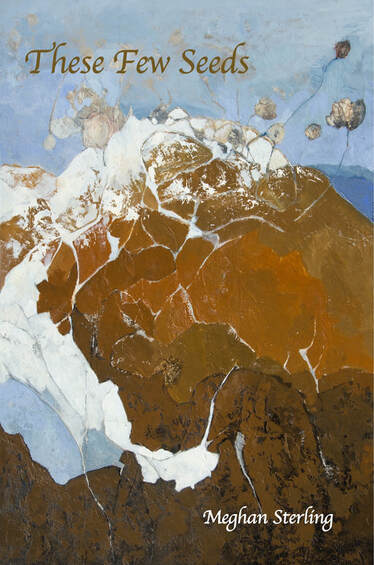
The collection closes with an echo of this inheritance. The poet also bequeaths “these few seeds” which she nudges “into flower as apology.” Seeds represent the hope of rebirth, of continuation, and refer as well to the poems in this book, memories about how much this daughter is loved and where she comes from. The cover art relates to the theme of inheritance. “Snowmelt,” by Betty Schopmeyer, a patchwork of brown, white and blue, earth and sky with clumps of snow, is a close-up of the earth in spring, more abstract than representational, but, like the poems in These Few Seeds, layered, inviting, and ultimately hopeful.
— Jeri Theriault
Be Holding
Be Holding
by Ross Gay.
University of Pittsburgh Press, 2020,
109 pages, paper, $17.00,
ISBN 978-0-8229-6623-4
When I found myself playing basketball in the basement with the basket made out of a ping pong table and the action-figure-sized wrestling ring my father made for my brother and me, I practiced The Move, the stretched out, slow-motion focal point of Ross Gay’s book-length poem: Dr. J elevating and wrapping the ball around the backboard in the 1980 NBA Finals against the Los Angeles Lakers. Granted, when I practiced The Move, I was probably using a wiff le ball instead of a basketball, and my little brother was a much less imposing version of Lakers’ center, Kareem Abdul Jabbar. But I practiced the shit out of that shot.
And I have a feeling Ross Gay did too. Gay is an incredible poet, who is also an athlete (a former college scholarship football player), and an all-around lover of sports (he founded the online sports magazine Some Call it Ballin). That far-reaching love comes across profoundly in Be Holding.
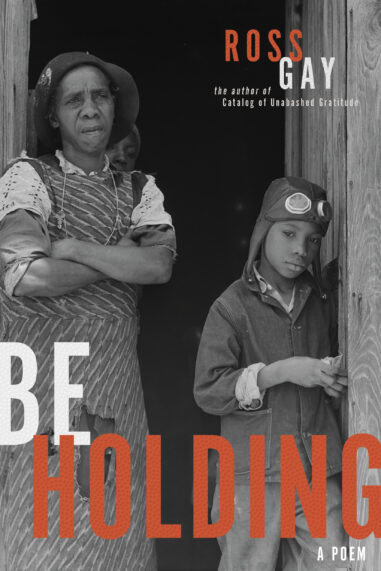
However, it’s easy to miss that this book is about basketball. Dr. J isn’t mentioned in any of the blurbs on the back of the book, and neither is basketball. Claudia Rankine makes oblique reference to “the history of a game” in her blurb. It’s only the font of the book’s title that gives the reader a faint hint, and you have to look closely to even see it. The sans-serif font is made up of the same distinctive texture of a basketball: many tiny raised dots designed to make the ball easier to grip. As a basketball fan, I wondered why The University of Pittsburgh would make the decision to almost erase basketball from the book’s cover.
And yet, from a poetry perspective, I see why they made this choice. Although the book is deeply about basketball and Dr. J and the witnessing of his gravity-defying move, it is about much, much more than basketball. It is a book that ambitiously seeks to bring serious lovers of basketball and serious lovers of poetry together. And it’s this coming together, this beholding together — that’s where Ross Gay’s miracle resides.
Fittingly, this miracle of two entities coming together is a miracle in couplets. The book-length epic poem is a prolonged moment of wonder and witness that feels like the poet (and, through the act of reading, the reader) is holding his breath throughout the entire poem, extending the couplets in a moment parallel to Dr. J’s gravity-defying flight.
I am holding my breath
with this looking
and looking
And in this long-held breath, the long hours of the night pass throughout the poem: 1:48 a.m., 2:26 a.m., 2:59 a.m., 3:11 a.m., 4:56 a.m. The poet watches and re -watches over and over again the videoclip of Dr. J while slipping in and out of other far -reaching associations:
. . . when witnessing
the unwitnessable, the way
we do so often these days,
today, witness the unwitnessable,
my own palms twisted again and again
toward the earth,
witnessing the unwitnessable,
If the poem focused solely on Dr. J, I would love the poem, but it wouldn’t feel transcendent; I would feel satisfaction at a skilled poet rendering the art of basketball on the page (no small feat!). However, Gay does more than that — he witnesses the unwitnessable by blurring and expanding our vision. It’s not only beautiful, but also slightly unsettling, as only seems right when one witnesses the unwitnessable.
There are no breaks in this book-length poem, no section markers to indicate transitions, and hardly even moments of transition. One moment Gay is talking about Dr. J and the next he’s on to the Marlborough Street Fire photograph. If a reader doesn’t pay close attention, these abrupt movements could be quite disorienting; in fact, even if a reader does pay attention, they are disorienting. And that’s where the magic happens. Like watching for a magician’s sleight of hand, readers are stunned.
As the smoke clears, they wonder, how did he do that ?
As an example, let’s return to and then extend the above quote:
witnessing the unwitnessable,
which is not unlike their motion
treading water
in a college gallery
Poof! And he’s off into the world of photographs, in this case two Black people falling from a fire escape, a famous photograph that won the Pulitzer Prize for spot photography. Only gradually, or like a gradual bolt of lightning, did I realize that once again Gay was helping us witness the unwitnessable.
Towards its end, the poem, like Dr. J’s famous move, reaches:
we in here talking
about the reaching
that makes of falling flight . . .
talking about holding
our breath . . .
of being beholden,
talking about
how might I hold
my beholden out to you
The result is a magical wind. One might not think words could fly like this, but the couplets are like samaras, those little whirly helicopters from maple trees — and the falling flight is nothing short of miraculous.
–Jefferson Navicky
Sunday Cave
by Yuko Otomo
to avoid
the world
I opt out
to be indoors
in the afternoon
shade of the day
a misanthropic hermit
in a modern cave
of the day
of the sun
I listen
to Satie’s Lent
again & again
small candles lit
in the corner
of the room sit as if
they were musical notes
BIRTH • DAY
by Yuko Otomo
BIRTH • DAY
for Steve
Life & Death
on a clear crisp September ending Sunday —
We see a saint’s back
on one street comer
& then on another
his face & rosary holding palms
Who is separating Death from Life
or vise-versa?
Not us! For g-d’s sake!
A circle circles in light
as people march
singing “Ave Maria”
on their unaccustomed tongues
standing side by side
We melt each other’s thoughts
unconsciously holding hands
almost forgetting how to talk
Autonomy for one being
autonomy for two beings
autonomy for ten thousands things & more
In praise of love (in silence)
We view & salute the world
as if it were a breeze
“moment” — ing through us
You & I —
light & shadow —
life & death —
like contrasting colors loyally
lay in the same bed at night
& wake up in the morning together
We begin to end to begin a day
to stretch every possible inch
of its festive lucidity