On the Way to the Paintings of Forest Robberies


On the Way to the Paintings of Forest Robberies,
by Jennifer Nelson.
Fence Books, 2025,
96 pages, paper, $17.99,
ISBN: 9798989978519
My confession: sometimes I buy poetry books simply because of their titles. I tell myself this is slightly better than judging a book by its cover, but if I’m honest, I know both strategies are swimming in the same shallow pool.
But then again, I’m quite often pleased with my shallow self. Such was the case with On the Way to the Paintings of Forest Robberies by Jennifer Nelson (Fence Books, 2025). First, the prepositional phrase caught me: what happened on the way to the paintings of forest robberies? Are there actually paintings of forest robberies? (a quick search yields nothing but reviews of Nelson’s book, as well as the mention of one theft in which the thief hid a statue in a lead box in a forest.) And are there robberies in the forest, or is the whole forest being robbed?
The collection’s title comes from an eponymous poem, and after the title, we get this: “raccoons rise up from nothing / into my lights / like grid modernity feralized.” So it’s raccoons that happen on the way to the paintings of forest robberies! And they’re the feral spirits of modern electricity grids! I can’t say that’s what I was expecting, but I do enjoy the surprise. A little later in the same poem: “Believing we can listen / can be the closest thing / to listening….” Such a true statement about belief. For me, believing in the forest robberies made their richness come true.
Nelson is a master of the ekphrastic poem. An art historian, Nelson’s ekphrastic poems demonstrate the supple genius of someone very comfortable and fluid in the expansive world of art. She uses her poems to get inside the world of a painting while being aware, and calling to, the world outside the painting. In that sense, she’s a double world-builder of a poet. For example, we get this from “Ovid 1.9 [non bene iunctarum Discordia semina rerum]: “Outside / the painting, scrabbling leaves / click in the trees. I would like / to end this dream. The world is dying, / and I would rather bathe in the disorganized / paint that clumps into discorded seeds / not well mixed together, a dangerous / pornography, by which I mean a form / that destroys function. Refuses return, / refuses the future. Unburns.”
In these lines, I can hear the tension between the world outside the painting and the world of the painting, and I can hear the poet’s desire to “bathe” in paint, to stay in the painted world. It’s the finality and certainty of that last word—“unburns” – that strikes me. It’s not conditional, and the poet is not posing a hope; the poem says without doubt that painting unburns the world. I admire poets who say things like that.
And yet Nelson is not always so confident. From “Carpaccio’s Ten Thousand Soldiers Betrayed by Their Generals and Sent to Asia to Die”: “I’ve never been able to tell you what kind of distance I have / when I bring you into a painting / and how much it matters what you want and what I give, / what kind of warm twilight you want to inhabit, and whether you’re next to me or with me at all.” I found Nelson’s humility and perspective surrounding her efforts to be refreshing. What she’s seeking here is connection. Any teacher knows that an audience needs to be at least a little receptive to receive anything. If you’re open to it, if you’re willing to listen, Nelson is a generous guide.
In the poem, “On First Looking into Me I Got Some Savonarola,” Nelson writes, “What does the end / even smell like.” Even without a question mark, Nelson strives to feed a reader’s senses. Her poetic eschatology is loose, scholarly, surprising, and intuitive.
What does the end smell like? It smells like this. Take a good whiff.
–Jefferson Navicky
1 “of things not well joined heaped up in that same place.”
2 A 15th century Italian friar who advocated for the destruction of secular art
Archives, Love, & Death: An Interview with Catherine Barnett
Catherine Barnett came to Maine in August 2025 as a part of the Blue Raven Poetry Series at the Blue Raven Gallery in Rockland. The series’ organizer, poet Bruce Willard, connected me with Barnett in the spring of 2025. We conducted this interview over email.
JN: I’d like to begin with a question about form. I loved how you were drawn to tercets throughout Solutions for the Problem of Bodies in Space, especially for some of my favorite longer poems in the books such as “Critique of Pure Reason” and “Nicholson Baker and I.” I was wondering if you could talk about how you came to choosing tercets for these longer poems. Is there something about tercets that supports this length of work?
CB: When I was in graduate school I looked at both Sylvia Plath’s and Elizabeth Bishop’s drafts and tried to learn as much as I could from them. In Plath’s drafts, you often see her discovering the stanzaic unit after the first flush of writing; you’ll see her bracketing out her stanzas right there in the margins of the handwritten first draft (and subsequent drafts, too). Since most of my poems start out in an amorphous form – in a block of fairly long lines – this after-the-fact strategy of discovery is a pleasure to put into practice.
To borrow the poet Ed Hirsch’s description of the unpunctuated tercet he used in his harrowing and wonderful book-length poem GABRIEL, the tercet is a “dialectic of hesitation and flow.” I hadn’t heard this description before but it captures very accurately my pleasure in (and reliance upon) the tercet.
The tercet lets you both link and leap, almost simultaneously. Each tercet has a beginning, a middle, and an end, so the form allows for shifting relationships, ongoing movement, and unpredictability, all of which I was hoping to bring to the poems you mention.
JN: I feel like if I ever get a personalized license plate, I’d love it to be some version of “link and leap” (maybe it would have to read “lnk&lp,” but I doubt anyone would understand that!). I also love thinking about your amorphous blocks of text that your poems start out as. Because of the shape reference, that reminds me of “The Specious Present,” which besides being an incredible (and quite funny) high school reunion poem, contains these lines I really enjoyed: “I still love boxes and the way a word // is a box. It holds things, / flotsam holding flotsam.” Would you be willing to elaborate on how you think a word is a box? That’s quite a lovely thought, and I’d like to hear more.
CB: Your question brings to mind Ed Hirsch’s poem “Special Orders,” which is about his father, who made and sold cardboard boxes. Here’s the poem:
SPECIAL ORDERS
Give me back my father walking the halls
of Wertheimer Box and Paper Company
with sawdust clinging to his shoes.
Give me back his tape measure and his keys,
his drafting pencil and his order forms;
give me his daydreams on lined paper.
I don’t understand this uncontainable grief.
Whatever you had that never fit,
whatever else you needed, believe me,
my father, who wanted your business,
would squat down at your side
and sketch you a container for it.
When I first heard Eddie read this, I understood him to be saying that words are a container for “this uncontainable grief,” as are all kinds of boxes – the boxes we use to cart things away, to store things we no longer need, to transport us. Also, boxes are just incredibly useful! And, like words, they come in all sizes.
JN: That is an incredible poem. As someone whose family once operated a box company in the Flats of Cleveland, Ohio, it especially strikes close to home. Yes, words as containers. I also wanted to ask you about art and ekphrastic poems. There’s a lot of art in Solutions for the Problem of Bodies in Space, both in museums and outside. One of my favorites is “Triumph of Dionysos and the Seasons” in which you write “Upstairs / Alice Neel is naked, staring out at us // from a late, unsparing self-portrait, holding a brush in her right hand. / ‘What’s that patch of blue?’ I asked the guard // who kept me from getting too close.” I particularly enjoy the sense that if that guard wasn’t there, the speaker might try to climb into that painting “to see how it was done.” Can you talk a little about your relationship to visual art and how it inspires your poetry?
CB: Thank you for this question, and for noticing the poems that think/feel their way into the world through art. I’m hoping that the ekphrastic poems offer a kind of reprieve from the elegies and other sorrows in the book. Or at least that they show the human need to make; that making is a life force, a way to counter Thanatos.
My mother is a painter, and one of my favorite places to write is in her studio, while she’s painting. I can just look up and see both a person I love and an act – the act of making – that sustains me. She and I have endless conversations about which art is better – painting or poetry – but, as you can imagine, our positions don’t change very much!
One of my very first jobs was working at an art magazine; I started as an editorial assistant and eventually became (if briefly) a senior editor and then an editor-at-large. I especially loved interviewing artists and then helping to ghostwrite their stories.
It’s always a joy when a work of art seizes you.
JN: I love thinking about you writing poems in your mother’s studio as she paints. What a profound space of creativity and love that must be. My last question involves something that I personally love: archives. I used to work as the archivist for the Maine Women Writers Collection, and I always considered it an inspiring place to both work and to serve literature at the same time. I was drawn to your poem “Restricted Fragile Materials,” which comes towards the end of your book. In the poem, you write: “To get to my archives, / my son will have to put his ear to the ground, // listen for a quiet scream. / And beneath that, like groundwater, / the endless chatter // of praise and lament. // How will I tell him the river I / feared to drink from // has come to drink from me?” As an archivist and as a poet, I really loved this poem. And I noticed in your “Notes” section that the poem “is in conversation with Nancy Kuhl, poet and curator at the Beinecke Rare Book and Manuscript Library at Yale University.” I was wondering if you could talk about how this poem is in conversation with Nancy Kuhl.
CB: For several years now I’ve had the immeasurable good fortune to visit a class that Nancy Kuhl and the equally wonderful Karin Roffman (who has written a terrific biography of John Ashbery’s early years and who’s working on his full biography) co-teach at the Beinecke. The class is called “Poetry and Objects” and each week Nancy and Karin select items from the collection – writers’ notebooks, old board games, etc. – which the students study and respond to. Before my visit, the students chose one object from my second book, The Game of Boxes, and wrote about how it functions across the collection; when I showed up, we talked about the power of specificity, the Particulars that Blake so loved, and what and how any thing can mean. Then I devised some improvisational writing exercises for them to try.
Through these visits – and because I so admire her poems, her mind, and her large spirit – Nancy Kuhl has become a friend. On one of our walks she told me about the time the Beinecke started to flood and how the curators – in their off hours – rushed into the building at all hours to rescue the items. The story moved me, and I borrowed it for the poem you mention, a poem that thinks about both love and death, which so many archives also record in deep and very human ways.
Open Reading Nov 12
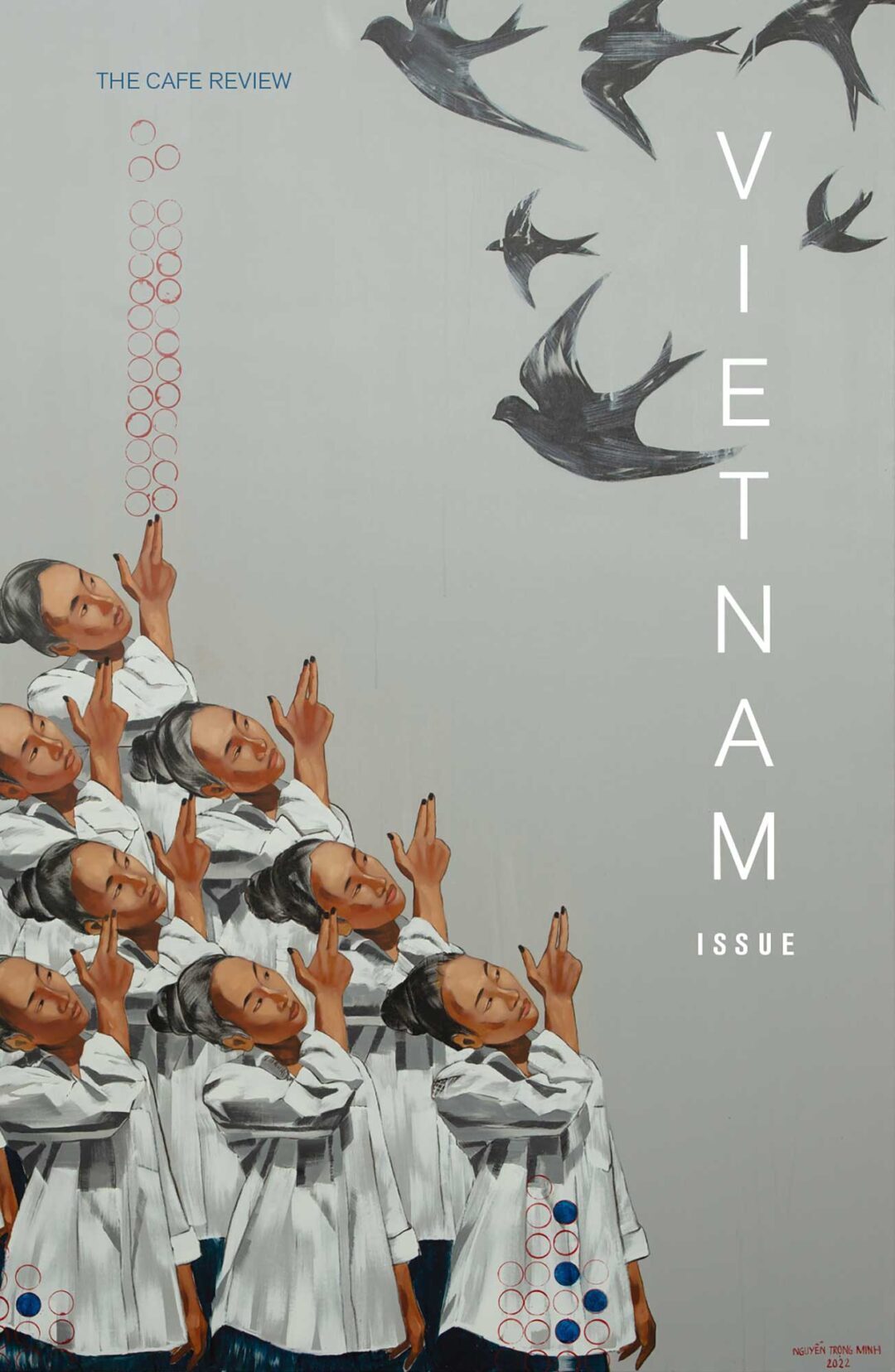
Open reading on Nov 12 at Novel at 7pm!
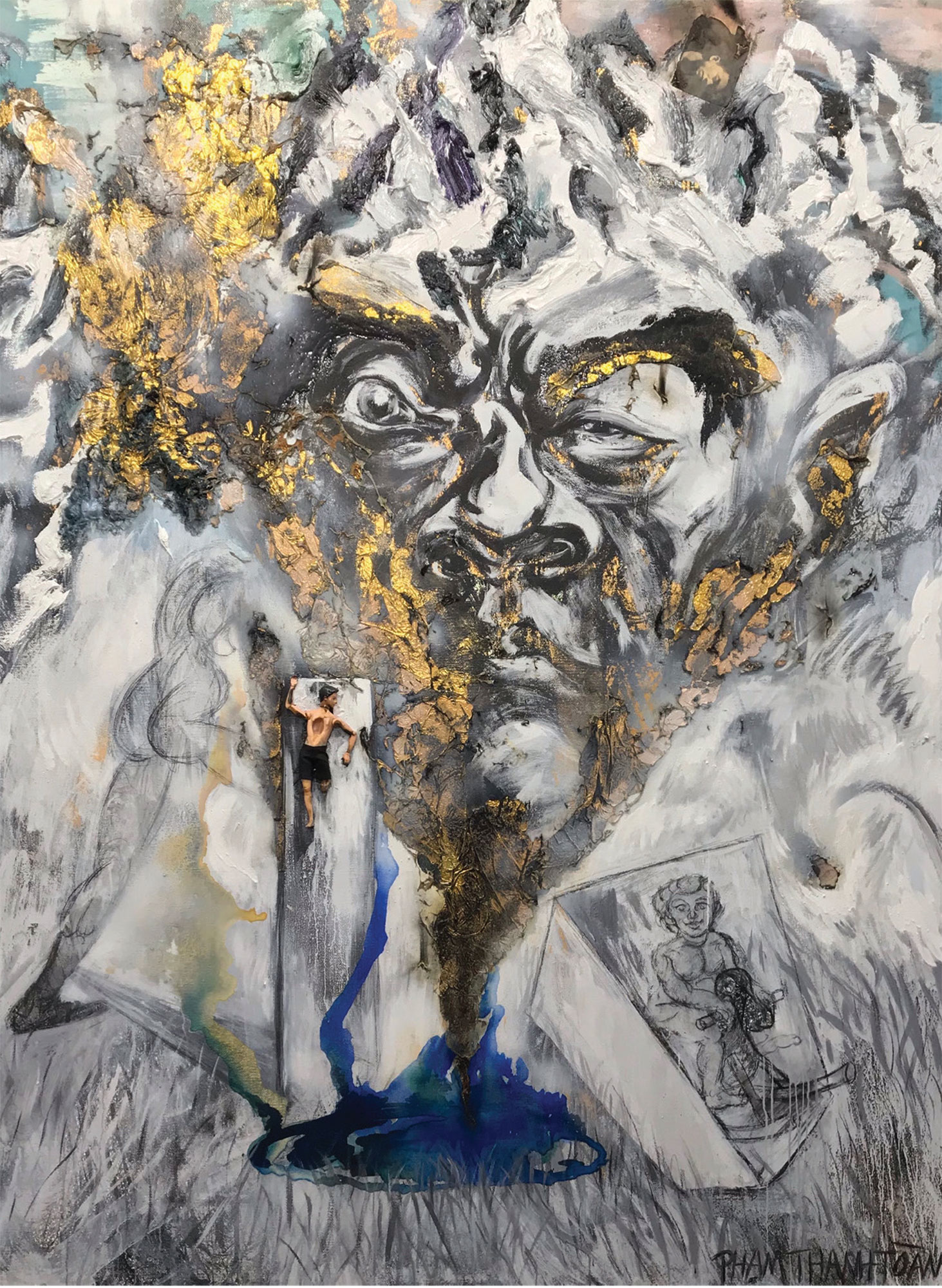
Pham Thanh Toan
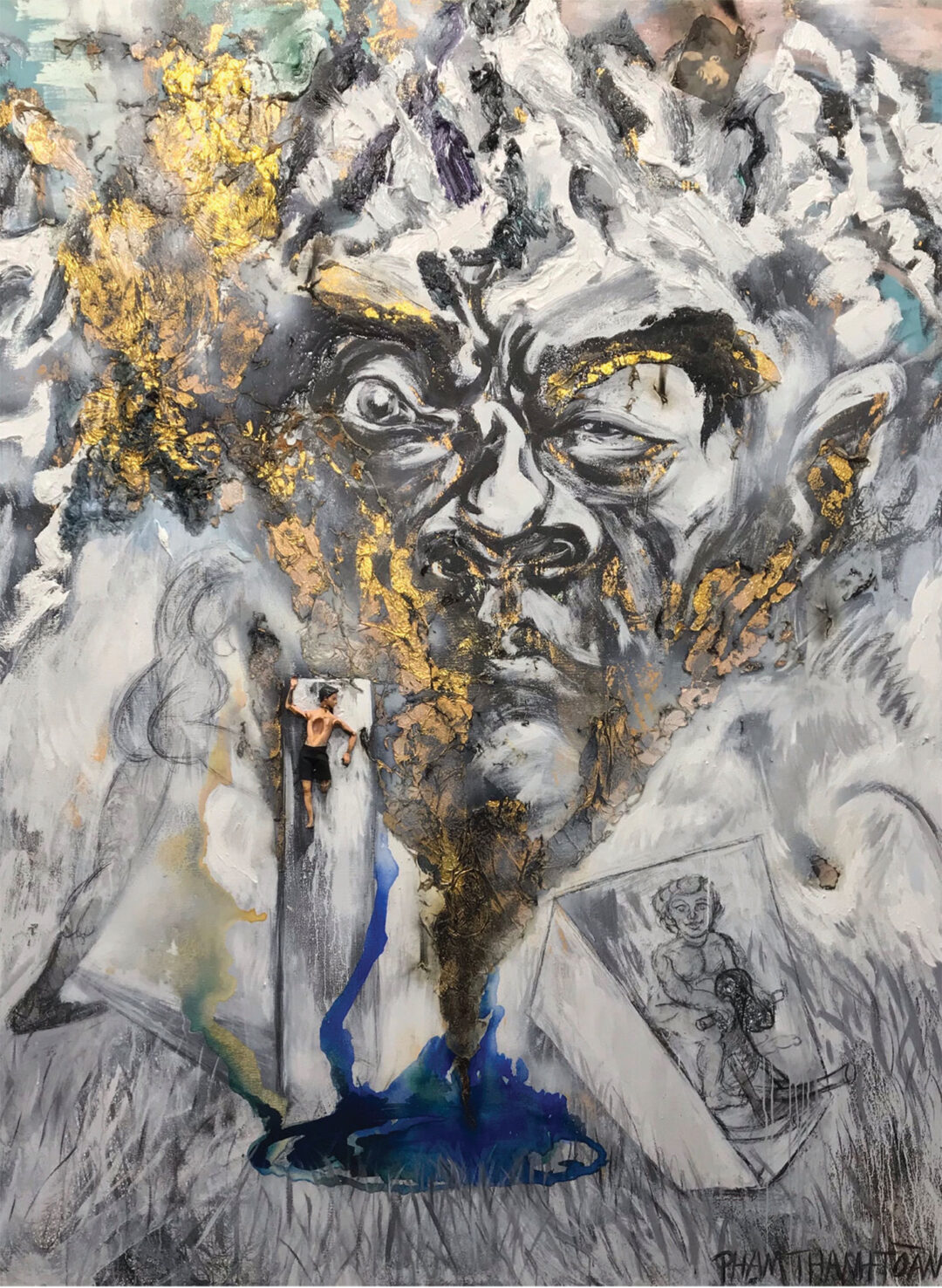
Pham Thanh Toan: was born in 1992 in Quang Bình Province. He studied at the Culture, Arts and Military University from 2010 to 2012 and graduated from Ho Chi Minh City Fine Arts University in 2017. He lives and works in Ho Chi Minh City.