

On the Way to the Paintings of Forest Robberies
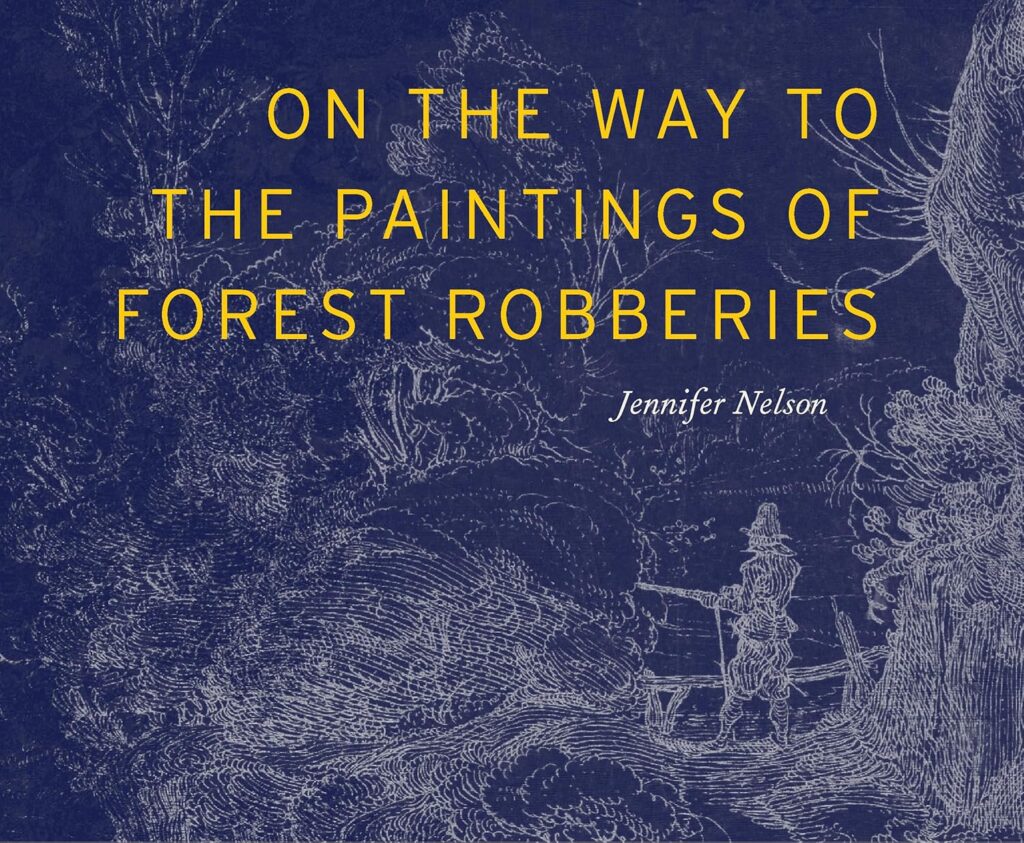
On the Way to the Paintings of Forest Robberies,
by Jennifer Nelson.
Fence Books, 2025,
96 pages, paper, $17.99,
ISBN: 9798989978519
My confession: sometimes I buy poetry books simply because of their titles. I tell myself this is slightly better than judging a book by its cover, but if I’m honest, I know both strategies are swimming in the same shallow pool.
But then again, I’m quite often pleased with my shallow self. Such was the case with On the Way to the Paintings of Forest Robberies by Jennifer Nelson (Fence Books, 2025). First, the prepositional phrase caught me: what happened on the way to the paintings of forest robberies? Are there actually paintings of forest robberies? (a quick search yields nothing but reviews of Nelson’s book, as well as the mention of one theft in which the thief hid a statue in a lead box in a forest.) And are there robberies in the forest, or is the whole forest being robbed?
The collection’s title comes from an eponymous poem, and after the title, we get this: “raccoons rise up from nothing / into my lights / like grid modernity feralized.” So it’s raccoons that happen on the way to the paintings of forest robberies! And they’re the feral spirits of modern electricity grids! I can’t say that’s what I was expecting, but I do enjoy the surprise. A little later in the same poem: “Believing we can listen / can be the closest thing / to listening….” Such a true statement about belief. For me, believing in the forest robberies made their richness come true.
Nelson is a master of the ekphrastic poem. An art historian, Nelson’s ekphrastic poems demonstrate the supple genius of someone very comfortable and fluid in the expansive world of art. She uses her poems to get inside the world of a painting while being aware, and calling to, the world outside the painting. In that sense, she’s a double world-builder of a poet. For example, we get this from “Ovid 1.9 [non bene iunctarum Discordia semina rerum]: “Outside / the painting, scrabbling leaves / click in the trees. I would like / to end this dream. The world is dying, / and I would rather bathe in the disorganized / paint that clumps into discorded seeds / not well mixed together, a dangerous / pornography, by which I mean a form / that destroys function. Refuses return, / refuses the future. Unburns.”
In these lines, I can hear the tension between the world outside the painting and the world of the painting, and I can hear the poet’s desire to “bathe” in paint, to stay in the painted world. It’s the finality and certainty of that last word—“unburns” – that strikes me. It’s not conditional, and the poet is not posing a hope; the poem says without doubt that painting unburns the world. I admire poets who say things like that.
And yet Nelson is not always so confident. From “Carpaccio’s Ten Thousand Soldiers Betrayed by Their Generals and Sent to Asia to Die”: “I’ve never been able to tell you what kind of distance I have / when I bring you into a painting / and how much it matters what you want and what I give, / what kind of warm twilight you want to inhabit, and whether you’re next to me or with me at all.” I found Nelson’s humility and perspective surrounding her efforts to be refreshing. What she’s seeking here is connection. Any teacher knows that an audience needs to be at least a little receptive to receive anything. If you’re open to it, if you’re willing to listen, Nelson is a generous guide.
In the poem, “On First Looking into Me I Got Some Savonarola,” Nelson writes, “What does the end / even smell like.” Even without a question mark, Nelson strives to feed a reader’s senses. Her poetic eschatology is loose, scholarly, surprising, and intuitive.
What does the end smell like? It smells like this. Take a good whiff.
–Jefferson Navicky
1 “of things not well joined heaped up in that same place.”
2 A 15th century Italian friar who advocated for the destruction of secular art