

Woman Looking at a Vase of Flowers
Woman Looking at a Vase of Flowers, by Elizabeth Savage.
Furniture Press Books, 2017,
34 pages, paper, $12,
handmade limited-run chapbook.
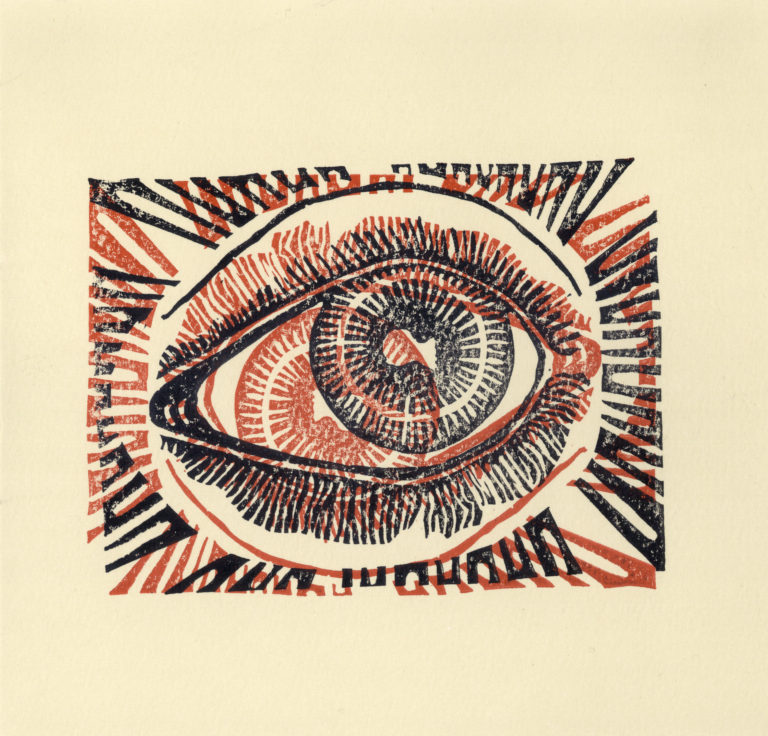
In her new chapbook, Woman Looking at a Vase of Flowers, Elizabeth Savage casts a simultaneously telescopic and microscopic eye on the act of observation itself. Each poem in the chapbook is named after a short phrase from Wallace Stevens’ poems “Woman Looking at a Vase of Flowers” and “On the Adequacy of Landscape,” both from Parts of a World. Just as the act of looking is fractured into kaleidoscopic fragments in Stevens’ original poems, Savage fractures the poems into their component parts, re-arranges them, and, in so doing, invents a new way of looking at looking—and at poetry—by moving through and within her sources.
Stevens’ poems play with the central natural elements of sun, sky, wind, and sea, as do Savage’s. The “inhuman owl” that begins the chapbook quietly wings through its entirety—an otherworldly symbol of change in motion, its hoot echoing from poem to poem. Savage calls our attention to the way the “people in the air” of Stevens’ poem gaze upon the owl. As they look, they are frightened by the owl—by how it looks back at them through its large eyes. The people in the air, Savage writes, “spy horizons//of what they are/exchanged/for worlds below.” In the end, though
“[t]hey seek this owl out in the night/to measure central things,” Savage shows us that we can never really see what we’re looking at:
When day is done
in towers tall
all birds are black
against the sun
Aesthetic grandchild of Lorine Niedecker and Gertrude Stein, Savage is tuned in to a “cosmic ear” and able to wield language with the precision of a scalpel. These gem-like little poems read like perfectly balanced equations for an experiment in language, with loving care imbued in each line. Every word is charged with its own polar magnetism, and they collide against each other in symphonic brilliance. Most poems resist narrative and syntactical completion, operating instead as pieces of sentences that twist in on themselves elliptically and start anew, like Escher paintings.
The acts of looking and listening become synesthetic experiences in these poems: “behind the iris/this fragrant song.” And as the senses meld together, Savage explores the acts of melting and
dissolution as “Jupiter/puddles/into Venus” and “her call /falls/ unbruised.” “[L]ive stillness/is flight,” Savage writes, guiding the reader through a mutable world of shifting winds and drifting night. Between all the simultaneity and mid-flight suspension is a calm balance: “Formlessness Became the Form” is the title of one poem; another ends, “strange/how change/enlightens.”
InWoman Looking at a Vase of Flowers, Savage juxtaposes that which shines against that which is foggy, that which is empty against that which is full. These poems interrogate transience versus permanence and are imbued throughout with a “barbaric softness” of contrasts and fluidity: “blue is/not blue/nor brass/ but flickering.” Savage is concerned with sound and silence, stillness: “even thunder/what wind dissolves.” Words flutter and shudder on the page with a delicate precision keenly aware of the movements of breath and mind, gazing and flight.
—Alyse Knorr
The Mays of Ventadorn
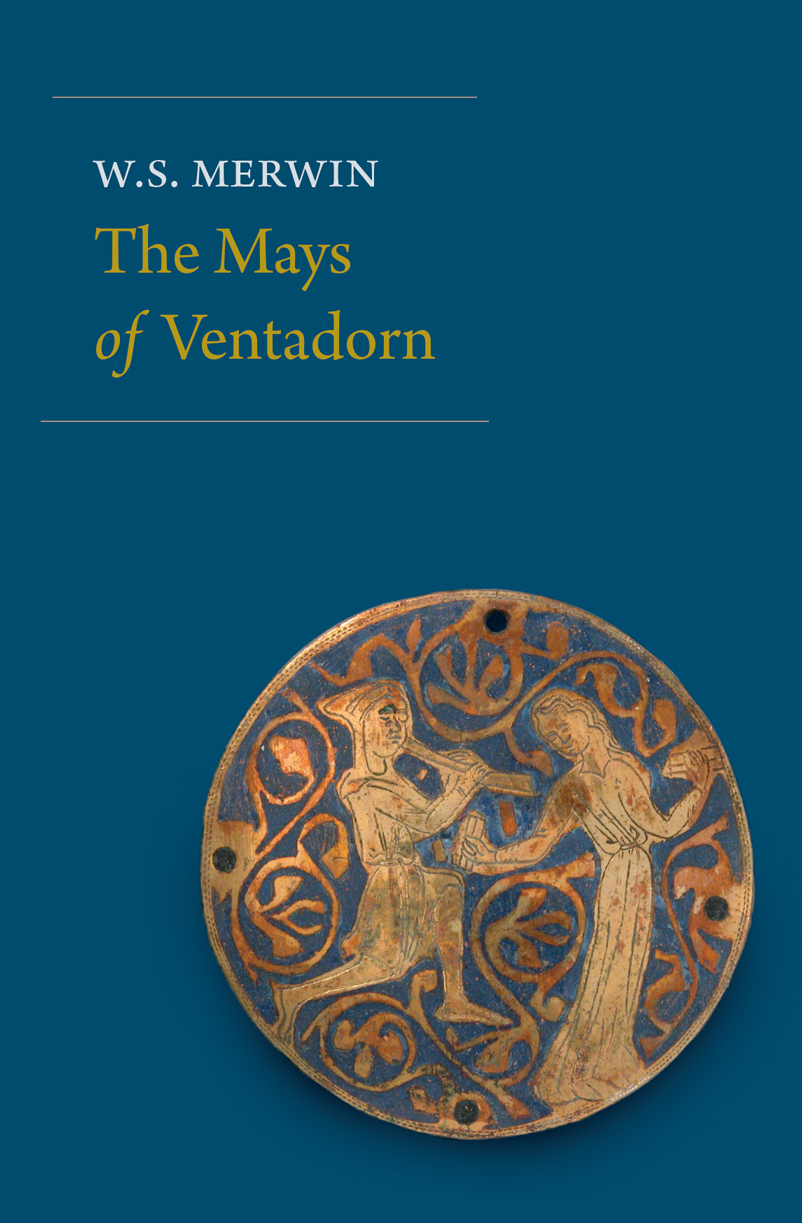
The Mays of Ventadorn, by W.S. Merwin.
Copper Canyon Press, 2019,
133 pages, paper, $16.00
ISBN: 978-1-55659-546-2
Ieu sui Arnaut, que plor e vau cantan. (I am Arnaut, who weeps and goes singing.)
—Dante Alighieri, Purgatorio, XXVI
The Mays of Ventadornby W.S. Merwin is part historical mending project and part memoir, tracing a lifetime’s passion for the landscape and brief period and work of the troubadours of the high Middle Ages, along with their antecedents and subsequent influence. The book wanders, picking up partial storylines and forgotten threads. By these methods, it also resists a historical mono-narrative, asserting both Merwin’s personal idiosyncratic journey and the extent of the historical unknown. Content with piecing together evocations from the fragments, and with a light touch, the book reveals a rich poetic history of courtly love, the nature of specific linguistic and poetic influence, and the mobility of poetic forms that travel across multiple geographies and times.
One summer in his early twenties, Merwin explored the remote region of the Quercy, in southern France. At that time—it would have been the early 1950s—the region seemed to him to have barely changed between the last of the Crusades and World War I, dotted as it was by small villages described by traditional peasant farming methods: cows yoked to hay carts ambling in lanes, chickens scratching in bare soil in the silence of noon-day yards. He was drawn to an old abandoned house, overgrown by brush at the edge of a small village; by a series of chance meetings came to buy the place, and proceeded to live within the rhythms of the small Occitan village for some years.
Drawn organically to this rural countryside, Merwin also understood he was in the region that had seen the great flowering of troubadour poetry in the late 11thcentury, but the history and poems of this wandering class of musicians remained to him only as “odd tatters of a disintegrated tapestry, single pieces surviving from a once brilliantly colored puzzle, elegant but isolated and adrift in poor light.” He had read a few rough translations of poems by Bertran de Born and Jaufre Rudel, including rather ornate translations by Ezra Pound, yet he did not speak Occitan. As a young man, Merwin had met Pound, who advised him to “read seeds not twigs,” and this advice, along with his own predispositions, led Merwin slowly along a path of discovery and affection for the work of Bernart de Ventadorn, who grew up in Moustier-Ventadour, not far from the Quercy and the ruins of the Chateau of Ventadorn.
The hawthorn or may tree, a shrub or small tree of the family Rosaceae, grows wild around the Chateau and in the entire south of France. It blooms in May, its almondy scent heralding the relief of spring, the season famous for love. In the Occitan region, the advent of spring has been celebrated with festivals of fertility since long before Christianity. Much of troubadour poetry concerns itself with this season of desire, but too of longing and distance, the unique pains of forbidden love, and the uglier repercussions of deception, jealousy, and heartbreak. Indeed, “The recurring burden of Bernart’s song is distance,” notes Merwin, “the distance between the lover and the beloved.” And like much of the world’s love poetry, this distance is physical and geographic as well as social and temporal.
Connected to his own desire to hear the “living flow of the whole poetry” of the troubadours, Merwin describes “the craving to hear it [as] what brings us back to all poetry, of our own time or any other, hoping that something has been carried across a great distance like water in the hands: the life of the original.” Often we can hear Bernart most distinctly, he recounts, in fragments such as this one:
Alas, I knew so much, I thought,
about love, and I knew so little!
For there is no way for me not
to love her who yields none at all.
She took herself and took my heart,
my self and all the world with her,
went and left only desire
and the longing of my heart.
Any lover of Rumi’s poetry will recognize the powerful desire for an inaccessible beloved. While Merwin was still in school, the Arabic roots of troubadour poetry were being revealed though the work of A.R. Nykl’s Hispano–Arabic Poetry. The introduction of rhyme and the thematic strains of individual forbidden love can be traced to the medieval Muslim territory of al-Andalus that covered most of the 2Iberian Peninsula at the time. A beacon of learning and cultural influence, the Arab-Spanish courts contributed to a great expansion of art and literature borne by a traveling class of court poets, much like the later troubadours. Followed further, we can trace this thread to Dante Alighieri’s Divine Comedy and the development of the sonnet.
At times The Mays of Ventadornseems to draw on Merwin’s own deep longing for another time and place. Why indulge in such exercises of nostalgia in the 21stcentury, whose horrors feel so very urgent and are different from that of the 20th, let alone those of eight hundred years ago, between the First and Albigensian Crusades, when the troubadours wrote? What value can the poets of courtly love and chivalry offer us today? The same questions plagued Carl Appel, another traveler of the past, who published his pioneering work on Bernart de Ventadorn in 1915. Speculating on Appel’s work, Merwin notes, “How ridiculous the tinkling of the medieval poet’s lyre sounded in the midst of the roar of modern weapons, and how ridiculous the quest…for some minute fragment of truth at a time when a storm of lies was sweeping the planet.” Certainly that fragment, the delicacy of what really matters to us, is worth saving and noting with care. And it is clearly these fragments that Merwin gathers and stitches together in The Mays of Ventadorn.
W.S. Merwin died at the beginning of this year. He leaves for us over 60 volumes of poetry, translation and prose, records of his research, and study and poetic contribution. The Mays of Ventadorn, re-issued this year by Copper Canyon Press in their efforts to keep Merwin’s vast knowledge in circulation, reveals the fluidity of his process and his fidelity to his artistic forbears. If making poems entails a stitching together of the world, Merwin has carried forward the poetic fragments that travel to us from the troubadours and made legible these histories, ensuring their survival. Through research, translation, and longing, the book stitches together not just the vidasand work of the troubadors and their influences, but the cloth of a poetic life. Merwin’s work is tied up in these histories. The Mays of Ventadorn establishes not just a history of exchange and influence, but a poet’s place in making that tapestry.
— Julie Poitras Santos
Furnace in the Shadows: Selected Poems
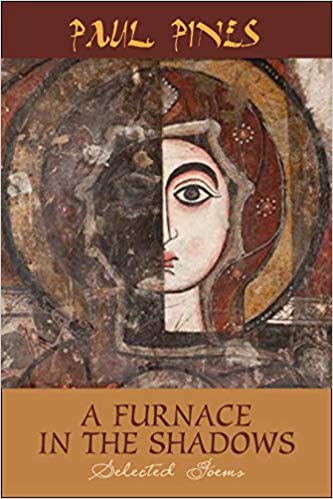
A Furnace in the Shadows: Selected Poems, by Paul Pines.
Dos Madres Press, 2018,
465 pages, paper $26.00,
ISBN: 978-1-948017-06-0
Attempting to write a reasonably short review of a book of poetry numbering 465 total printed pages is akin to condensing a grand forest of many types of trees into a single bonsai. Paul Pines, who left us on June 27, 2018 at the age of 77 after a lengthy battle with lung cancer, could have been considered something of a renaissance man. Though first and foremost a poet, he also wrote novels, memoir, and various essays. He was a psychotherapist in private practice, owned and operated a legendary Lower East Side NYC jazz club in the early 1970s, and hosted the Lake George Jazz Festival since 1986.
A Furnace in the Shadows, divided into Books One through Four, is comprised of poem selections from eighteen books of poetry written between the years 1971 through 2017. Accompanying the poems, and scattered throughout, are some 56 reproductions of various illustrative artworks. The evolution of Pines’ development as a poet draws upon myriad influences, from Carl Jung to Charles Olson to Paul Blackburn to all of recorded World Mythology to quantum physics. Poets Armand Schwerner, Ed Dorn, and Jack Spicer taught Pines about seriality, a form consistent with the idea of poetry as an ongoing conversation. From poet Robert Kelly he learned deep image. It should be noted that Pines gave special care and attention to stanza formation and line breaks, many of his poems weaving sinuously back and forth across and down the page.
From the poem “A Dream about My Father”: “I am a sluggard and a thief/I cannot love and cannot wait/I am Picus pasting indecipherable wisdom/in a public place/My head is a graveyard of forgotten names” and, from Hotel Madden Poems:“Mingus/at the Five Spot/playing for all/he can eat//Blackburn/by the coalstove/in McSorley’s/scoring pages with/his nerves…//there was/a time when poets/and jazzmen/built lines/like cities to live in.”
Paul Pines was clearly a deeply feeling and committed family man. From the poem “I Miss the Weeping”: “What is a memory/that anticipates/itself//a recollection/that becomes the ground/on which/the present/plays/but a breathless/middle aged man/chasing/his four year old/daughter//through/perforations/in the universe.” Pines always wrote about what he knew: family, friends, a myriad of places as he traveled abroad extensively, baseball, jazz, and visual art. He was simply an exemplary scholar with a vast capacity for memory retention, what I would call a “cerebral titan” but with a heart that certainly equaled his mind, as evidenced by his obvious love of humanity—however tragically flawed we may be—that can be found all through his amazing body of work.
Among the many accomplished and respected poets with whom Paul Pines was acquainted was Joel Oppenheimer. In workshops, classes, and readings, Oppenheimer defined poems as “an answer to a question I didn’t know I asked myself.” As if in reply to Oppenheimer, in the fourteen page poem, “The Serpent in the Bird,” from his book of poems Divine Madness:“thus the voices of the gods make us/ciphers for what cannot/be deciphered// who is to say why/we turn toward or away from what/we love most//as if in answer/to an unspoken/question.”
Full disclosure: this reviewer collaborated with Paul Pines, in the service of a collagist who contributed both cover and inside art, on six printed books during the twenty-plus years of our
friendship, a friendship mostly through written correspondence as he lived in upstate NY and I in Maine. Over these same many years, Paul has been a frequent contributor and twice guest editor
of The Café Review. I like to tell the story of how I was in attendance at the 1994 Lowell Celebrates Kerouac Festival. Allen Ginsberg was up on stage chanting a poem with a repetition of lines that these ears heard as, “Paul Pines! Paul Pines! Paul Pines!” In actuality, Ginsberg was chanting, “Tall Pines! Tall Pines! Tall Pines!” In any event, I went on to research information about Paul Pines, made contact with him, and the rest is serendipitous history.
Wayne Atherton
Kulikovo Field
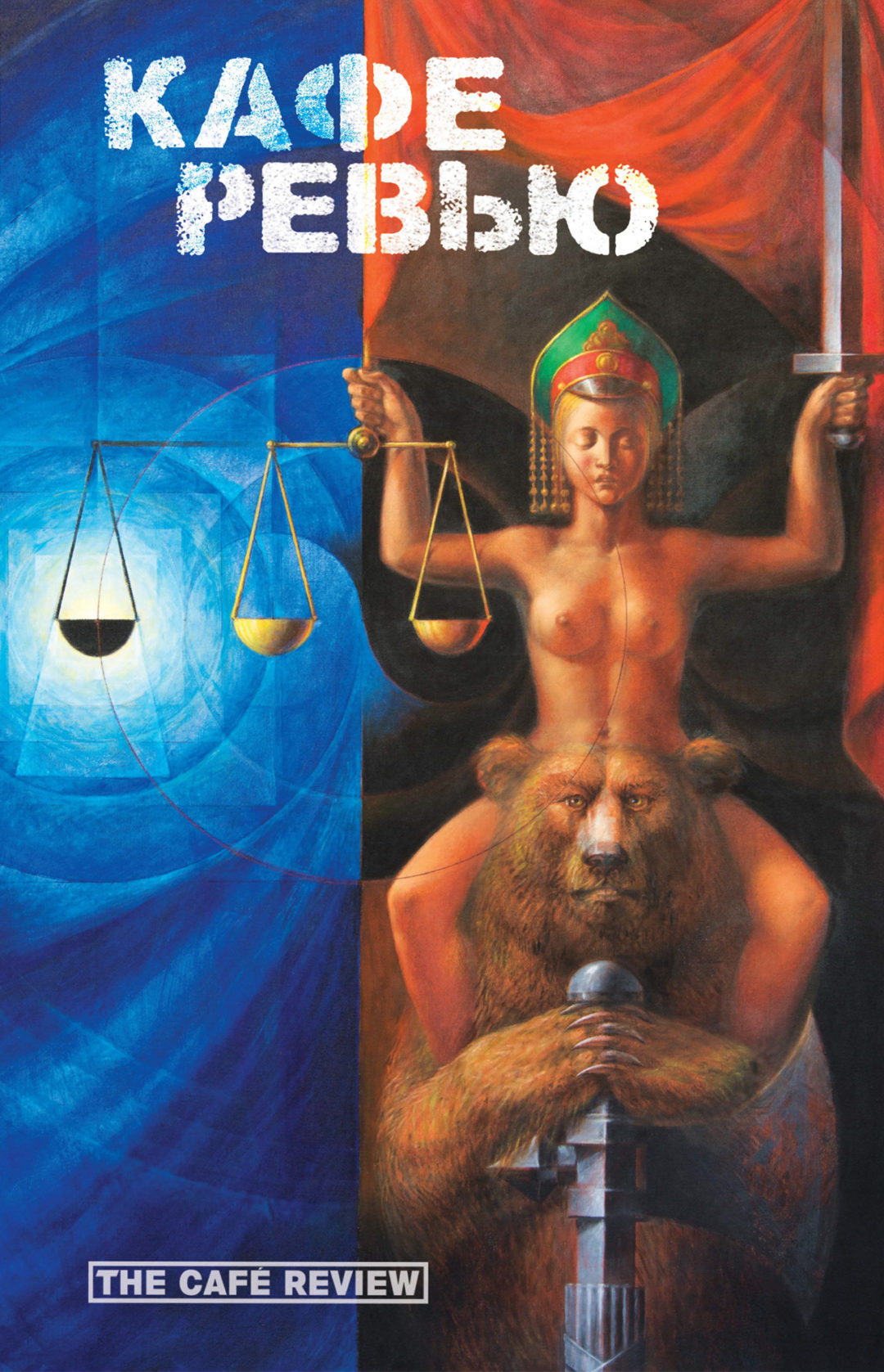
by Dmitri Prigov
translated by Sibelan Forrester
So here I’ve set them all out in their places
Those ones there I’ve put on the right
Those ones there I’ve put on the left
I’ve left all the rest to put there later
I’ve left the Poles to put there later
I’ve left the French to put there later
And the Germans to put there later
Here I’ve set out my own angels
And I’ve put ravens overhead
And I’ve put other birds above
While below I hand the field over
For a battle I’ve handed the field over
I’ve surrounded it with trees
Surrounded it with oaks, with firs
I’ve put some bushes here and there
I’ve spread a bed on the ground with soft grass
I’ve settled it with various insects
Let it all be as I’ve imagined
Let them all live as I’ve imagined
Let them all die as I’ve imagined
Let the Russians be victors today
After all the Russian guys aren’t bad
And the Russian gals aren’t bad
They’ve suffered a lot, the Russians
They suffered horrors, the non-Russians
So today the Russians will be victors
What will be here, if already now
The earth’s crumbling up already now
And the sky is dusty already now
The underground species are collapsing
And the underground waters are rushing about
And underground beasts are rushing about
And the people who live on earth are running
They run here and there on earth close to the earth
And the birds above the earth have gathered
All the birds, the ravens above the earth
But still the Tatars are rather nicer
And to me their faces are rather nicer
And to me their voices are rather nicer
And their names are rather nicer
Though the Russian ones are rather neater
But still the Tatars are rather nicer
So let the Tatars be the victors
From here I will see everything
The Tatars, that is, will be the victors
And anyway—tomorrow we’ll see