


no cue in chalk
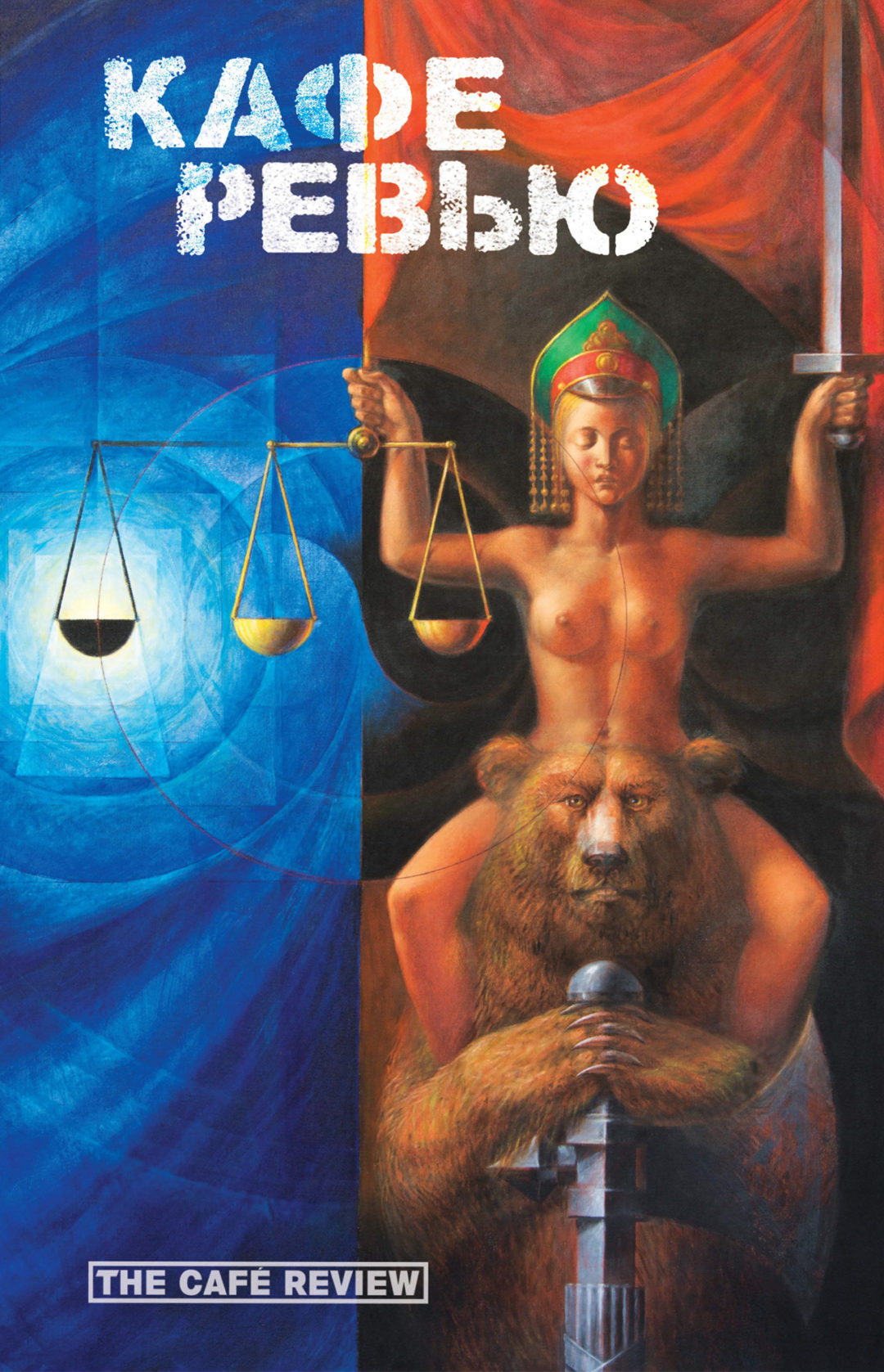
by Helga Olshvang
translated by Ainsley Morse
…no cue in chalk am I no flour in paper no pie for the morrow
no guest in the corner
no hammock I’m in no broadsheet smile no help to you
I’m neither field nor lone warrior not enemy of an enemy
no human to humans
no world to the peace
I’m an unpaired substance
god’s God
a mosquito’s mosquito, a slap to the cheek
there is no other cheek no blog to write about oneself
to record life’s variety yesteryear the distance
no bravery to make a break
That Play
by Dmitry Vedenyapin
translated by Yuri Vedenyapin
They were showing on TV:
a man in a bowler hat,
a thief,
enters a house,
which, he thought,
was empty,
but the landlady is home.
And so she—
it was probably very good acting—
falls in love with the thief.
That is to say,
soon after their chance meeting—
she begins to look at him
in a special way:
without vaudeville carnivorousness,
but in such a way that even I, an eight-year-old,
guessed
that this woman in her sundress,
with bare shoulders,
a tender neck,
and slightly silly curls,
wants this man with a moustache,
to kiss her
and help her out of her sundress and…
There my imagination stalled,
but I remember distinctly,
that the actress’s “special” glances
were promising “unspeakable delights,”
and, in fact,
not so much for the thief,
as for—there you go—myself.
It isn’t inconceivable that
according to the authorial design
the thief was first supposed
to enter the house,
then to enter the woman,
then—through the woman—
to fall into himself,
and then finally to self-destruct,
as a thief,
or, even more likely, completely,
because he could not be
anything else,
while to fall deeper—
at least, in that play—
was not an option.
Butterfly
by Dmitry Vedenyapin
translated by Yuri Vedenyapin
It must be acknowledged
that lately,
biology
from the point of view of technology,
has made great advances.
For example, scientists
studying butterflies can these days
use tiny radio transmitters,
attached to the insect’s body
and do not in any way, at least according to the inventors,
impede flight.
Of course, back in the 1960s,
something like this would’ve been completely inconceivable,
and so my uncle, an entomologist,
had no other choice but to do it the old way,
marking his “subjects”
with regular waterproof paint.
Inspired by my uncle’s example,
I once caught
a small tortoiseshell,
which had flown onto our veranda,
and I, too, marked it,
by drawing on its back
a crooked “A,”
which was the first letter in the name of the village
where my parents were renting a dacha.
According to data from entomological studies,
small tortoiseshells can live for up to half a year
(from May to October)
and, unlike other species,
which lead more or less “settled” lives,
migrate freely
all over the Holarctic.
“My” butterfly, however,
turned out to be a homebody.
That summer I saw it
a few more times:
once in the backyard
and again on the veranda:
it sat down onto our cheesecloth curtain,
and, as it seemed to me,
good-naturedly and almost conspiratorially
winked at me
with its beautiful dark orange wings.
Yesterday, forty-seven years later,
in the forest, on a sunlit path,
not far from the Estonian village of Käsmu,
one thousand two hundred kilometers away
from Moscow Oblast’s Aleksandrovka,
I once again met “my” butterfly.
Of course, it wasn’t what it used to be:
it had gone gray, and it could no longer fly as swiftly,
but there could be no mistake—
a crooked childish “A”
is hard to confuse with anything else.
I am under no illusion,
it would be foolish of me
to expect anyone
to take my words seriously.
Besides, I don’t have any proof.
I suspect, though, that even
if some form of proof
(for example, photographs)
existed,
it would still fail to convince anyone,
just because
This Cannot Be.
And yet it is the pure truth—
just not of the common
and insignificant kind,
which, frankly, is of no use to anyone,
but the real truth:
shining and unassailable,
the truth
which is impossible to believe.
Old Photographs
by Dmitry Vedenyapin
translated by Yuri Vedenyapin
Old Photographs
I want to arrive in “the other world” with a handkerchief.
I will settle for no less.
(V.V. Rozanov)
Say what you will, but it is very difficult
to imagine heaven.
Although
if you try hard,
it is possible.
To begin with,
you have to imagine
feeling absolutely wonderful,
like
you probably last
felt when you were six.
No! Even better.
Next—family.
Everyone is well.
It is written that in the Kingdom of Heaven
people don’t marry—
thank God!—
yet nothing is said about food.
It’s therefore reasonable to imagine
Grandma
at the heavenly stove
(which is, by the way, not that dissimilar
to the double-burner electric hotplate
that we had in Aleksandrovka),
stirring something heavenly
in a heavenly little pot.
Grandma Nyura has gone to the heavenly grocery.
Dad is leaving for heavenly work.
Mom is sewing a heavenly dress for Grandma…
After dinner, Mom and Grandma
are reading
under the pine trees
in a wide chaise longue.
The day is full of many other heavenly miracles.
Despite the popular belief
based
on the erroneously understood biblical verse,
in heaven, time
does exist.
Naturally, of a different kind than here.
The same is true of space.
The principle of the three unities,
restrictive
even for the earthly theater
in the heavenly theater
is fully abolished.
Our boldest notions of freedom
are disgraced.
I am saying it just in case
someone is tempted
to accuse me
of being too harsh in my directing.
What if Grandma
perhaps
has no desire to stand at the stove,
or even to be Grandma in the first place;
or Dad—to go to work,
however heavenly.
Of course, in heaven,
everyone is given the ability
to be anywhere at any moment.
Including
being in different places at the same time.
While the notion of age
does not exist there at all.
The past will happen again,
which evidently
or rather
inevidently,
means the following:
themainpast—
theonlyone
that for sure
exists here—
will become part
of what does not exist here
and cannot exist,
namely:
the future
(in the true sense of the word),
or—
sub specie aeternitatis—
the present
(in the future sense),
which is—
try imagining it all you like—
different, different, different...