

Night School
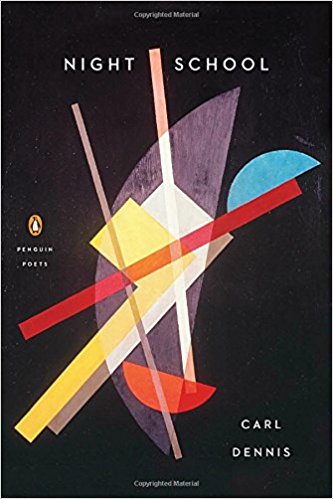
Night School,
by Carl Dennis.
Penguin Books, 2018, 112 pages,
paperback, $20,
ISBN: 0143132350
When I learned the title of Carl Dennis’s new book is Night School,I was concerned his voice might have become darker than in recent works such as Callings, Unknown Friends,and Another Reason. When interviewing him for an earlier Café Review issue, I mentioned that certain older poets wrote sadder poems. He said he “would distrust an older poet whose work isn’t gloomy now and then.” Loss, he said, is a constant in our existence, and there’s so much to lose.
One of the most moving poems in Night Schoolis “Wallace Siner.” The title refers to a soldier killed in Vietnam whose name Dennis was once charged with saying aloud at a protest outside the White House. Siner, he later learned, died at age thirty, leaving behind a wife and two sons. Dennis wonders how it’s possible to have forgotten so many names, yet he’s grateful to remember the name Wallace Siner:
Fifty years ago, I shouted it as a challenge.
Now, as I wonder how much of whoever I was
Still lives, I say it quietly to myself.
While Dennis cautioned me against too easily interpreting his poems as an “affirmation of life,” I’m not able to see him as a poet of despair. Repeatedly I find kindness in his poems, and those in Night Schoolare no exception. In “A Typescript” he sits in the office of “the only editor willing to give me an interview,” as he tries to find a publisher for a book about how to end war forever, written by a deceased friend who’d spent the last ten years of his life on it. In “Nothing,” he speaks amiably of a newly-arrived stranger in town:
…who’s delighted, after finding no room
At the inn for the likes of him, to find behind it
A field just right for resting.
In “A Friend and a Book” we meet his “great-hearted friend Louisa who does all she can” for others. She is one on whose kindness strangers can depend, which is why she’s always late for coffee.
In several poems over the years, Dennis has expressed reservations about his own capacity for altruism, yet as an avid reader of his work, I regularly encounter a voice consistently free of mean-spiritedness. His Whitman-like egalitarianism enables him to write a poem like “Joseph’s Work,” about a man who has spent decades “Overseeing the produce at the market/His brothers own.” His compassionate portrayal reminds me of several poems from his book Callings,with titles such as “A Roofer,” An English Teacher,” “A Motel Keeper.”
Part IV, the final section of Night School,has something of an Americana theme, with poems titled “Finding Thoreau,” “At Emily Dickenson’s House,” and “To Whitman.” There’s also a poem called “Mrs. Gottlieb’s Course in World Literature,” which I would call a tribute to English majors (at least those of pre-Deconstruction eras). Mrs. Gottlieb tells her students that great literature awaits and has the potential to guide them when other advice seems lacking:
So many questions to be raised and answered,
So many big decisions easy to miss
When they come disguised as small ones.
These lines I see as key to reading Carl Dennis’s poetry, which is similar to Thornton Wilder’s Our Town,a play that’s been a staple of high school theater because, at first, it may seem ordinary and traditional. However, the acclaimed production directed by David Cromer a few years ago was lauded for plumbing the depths others had missed. A cursory reading of Dennis’s work might mean missing not only the depth but, most notably, as at least one other reviewer has observed, the wisdom.
The last poem in Night School is a great example. A man recalls how his father taught him not to be afraid of the dark, having him walk at night a certain distance from the porch, where his father waits, and stop when the fear is too much. Gradually the boy extends his quest from the toolshed to the far edge of the property.
I can call the story a votive candle
The son lights to his father’s memory.
And now that the son is some twenty years
Older than his father was when he died,
I can call it another rehearsal for the night
When his own soul is compelled to leave his body
Behind forever and wander on a road
He doesn’t recognize.
There is more than one votive candle among the poems in Night School.
—Kevin Sweeney
Debths
 Debths,
by Susan Howe.
New Directions Publishing, 2017,
244 pages, paperback, $15.95,
ISBN: 978-0-8112-2685-1
An echo is also a kind of mirror, sending something back and crossing space. Susan Howe’s Debths is replete with these kinds of inflections and returns, and the ghosts that wander between them. Inspired in part by artist Paul Thek’s 2010 retrospective at the Whitney Museum of American Art, Diver,Howe’s one-month residency at the Isabella Stuart Gardner Museum, and Howe’s lifelong interest in archival materials, Debthsmines the infinite and seemingly bottomless intertextual webs of inter-connections between things.
The opening “Forward” to Debthsoperates as a kind of key to the entire book, but not explicitly; it invites you in to her very specific kind of thinking. She lets us know that “secret connections among artifacts are audible and visible and yet hidden until you take a leap” which illuminates not only her method of making, but also how we might read the work. Hers is a collagist aesthetic, cobbling together disparate parts and inviting you to take this leap, risking, as well, a fall into the rich, echoey depths between things. Each fragment reflects and resounds, effectively asking the reader to actively enter into and weave their own relationship with the text.
Isabella Stuart Gardner is famous for her injunction that all objects and works of art in the galleries remain just as she left them in death, a careful reflection of her most intimate decisions. This focus on arrangement leads Howe to consider Gardner a pioneer American installation artist. She placed objects in relationship to each other; Bellini’s portrait of Christ Carrying the Crossis placed “so that his tear-streaked face… is aimed directly at Jupiter’s savage eye” in Titian’s Rape of Europa,and Titian’s work is displayed over a swatch of fabric from her own wedding gown. In “Titian’s Air Vent,” the second section of the book, we are led by these and other material things: “Reliquary, trellis cross-grid, shoelace, comma”; “Seaweed, nets, shells, fish, feather.” Echoing some of Gardner’s collected effects, these material lists could equally be gallery tags for Paul Thek’s sculpture and installations. Howe alludes to his work—itself made of assembled fragments—throughout Debths, and in particular his bronze cast work, Effects Of The Pied Piper,moved her.
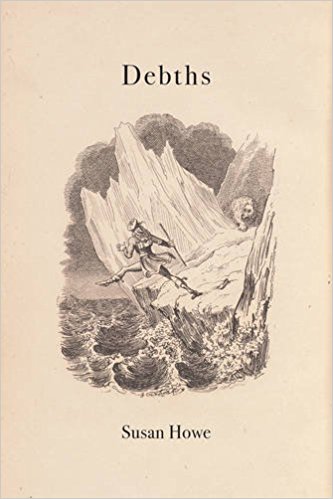
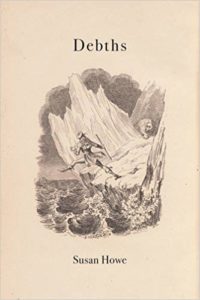
The cover of the book, with an illustration by George Cruikshank, shows a man leaping off a cliff, chased by a bear and leaving a wooden shoe behind. Cruikshank illustrated an 1877 publication of Grimm’s Goblin Tales,including fanciful drawings of Rumpelstiltskin. Howe loves mythology and folklore, and a recurrent narrative in this collection is that of the Rumpelstiltskin story, “Tim Tit Tot,”1which is the title of the third section of Debths. Howe has said that she sometimes thinks of this series of collaged poems as “collaged essays on the last poems of William Butler Yeats, the poet [she] loved first.” Yeats, too, drew from a wellspring of legends, folklore, ballads and songs to make his works, grounding his more mystical interests in the materials of the world.
If the word “debths” (borrowed from Finnegan’s Wake) rings with “debt” and “depth”—we also find an echo in the word “death.” Yeats faced death with courage fueled in part by visions of reincarnation or resurrection. Often mining the critical myths of Christianity, Paul Thek too, represented the state of uncertainty between life and death in works such as his 1967 Tomb (Death of a Hippie),and the 1970 Fishman in Excelsis,a latex cast of his body suspended swimming with fish above the viewer. In her eighties, Howe has suggested this may be her last book, and it’s hard not to feel that she too is mining this state of uncertainty. As Howe shows us here, a kind of resurrection or rebirth can be established through a deep reviewing of archival materials and these artists’ works themselves. Their ghosts wander within the gaps in the text.
The word “rumpelstilzchen” in German means “little rattle stilt,” and refers to the rattling of a post or pole that provides support for a structure. Arumpelstilzis the name of a type of goblin, or a “rattle-ghost.” In the tale, a miller’s daughter is given to a king on a boast—that she can spin threads of gold from straw. But she needs the help of the small rattle-ghost Rumpelstilskin to do so—and he extorts first her jewelry and then her future child in return.
Many shuttles many treadles
That beam was only a straw
So long as one fact stands
isolated and strange one
fact supported by no fact
Woodslippercounterclatter2
I can spin straw by myself
Who is the goblin here? Whoever it is, Howe has kicked him out. These poems—crushed conjunctions of text fragments from folklore, poetry, philosophy, art criticism, and history—continue to amplify the feeling that you are just about to take a leap that makes things clear, and then you’re held there, hovering at the cliff edge, while Howe spins threads of gold.
So many things happen by bringing to light what has long been hidden. Lilting betwixt and between. Between what? Oh everything. Take your microphone. Cross your voice with the ocean.
What is extraordinary about this book is how, if you take the time to follow its references, it drives you ever deeper into an intricate wilderness: each question fosters another one, each path leads somewhere new. This work isn’t about arrival as much as it is about wandering the complex webs of the world’s many echoing reflections. Arrival is a kind of death after all, and that is a leap we don’t want to make.
—Julie Poitras Santos
1These poems were previously published, with artwork by R.H. Quaytman, by the Library Council of the Museum of Modern Art in 2014 as Tom Tit Tot.
2woodslippercounterclatteris the title of another related work, a sound-work collaboration with composer David Grubbs.
Candling the Eggs
 Candling the Eggs,
by Wally Swist.
Shanti Arts Publishing, 2017,
132 pages, paperback, $15.95,
ISBN: 978-1-947067-07-3
Wally Swist’s eleventh book-length collection gathers about seventy poems covering everything from poignant childhood recollections to hints and guesses about mystic nature, and from ruminations on the poet’s literary life to the “entrepreneurial predator” Donald Trump. It’s hard to know exactly what to make, overall, of such a panorama of topics and rhetorics.
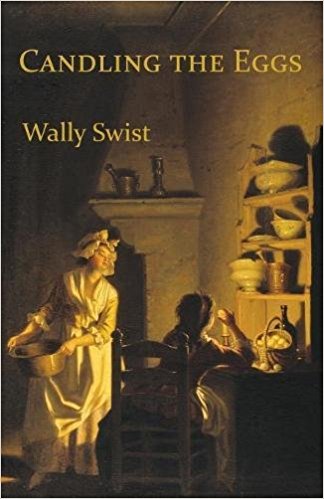
Some of Swist’s childhood recollections are quite touching, including the title poem, which recalls times when a neighbor sheltered the boy from the drunken rage inside his own house: “Mrs. Dornisch,/a septuagenarian, and myself, perhaps/aged three, candled the eggs, as two/anchorites might have applied gilt to/the letters in an illuminated manuscript.” Other metaphorical candlings of the past include two toward the end: “Grand Wizard” details a small boy’s instinctive sense of fear and loathing during a Ku Klux Klan parade, and then “Distance” seems to continue the five-year-old’s memories, until a child-mythic drive from Georgia to Connecticut turns into his mother’s sudden death from a stroke. This might be the most affecting poem in the collection, in part because of the context created by its pairing with “Grand Wizard.”
Much of the rest of the collection does not have this kind of coherence. In one sequence, for example, which the table of contents instructs us to group together, we move from “They” (a chant-like accusation of “the proponents/of shortsighted edicts/that don’t serve the republic,/since we no longer live in a democracy”), to “Angels of the Night” (a straight-up nature poem about moths), to “Imminence” (recalling the author’s fleeting sighting of Jerzy Kosinski and the mixed personal and political feelings that went with it), to “The Wood” (a mystically tinged recollection on first and last sights of a friend), to another nature poem, “The Iris,” to “Reawakening” (a wandering recounting of a mini-spiritual journey while looking at a fish pond), and onward like that. Each one a viable poem in itself, but like the compilation you made of your favorite songs that turned out to be inexplicably disjointed, it’s not really clear, to me at least, how they fit together in tenor, tone, or rhetoric.
Dropped into these groupings are mentions of famous poets, such as Galway Kinnell, Frank O’Hara (“Lunch Poem,” in memory of), and Michael McClure (“He walked into the bookstore/as if he had just been giving stage directions to/the actors who were performing in The Beard ”). The rhetoric of poems like “McClure” and some of the nature poems owes debts to Walt Whitman. Others are so prosaic they look as if they were found in journals or letters, as in “Offering Guidance”: “No artist/or writer, nor human being ever born into this/world, ever had a clear path to the mountaintop.” Made of an almost sententious kind of prose-speak, it lacks the cadences of “Lunch Poem” or “McClure.”
Scattered about are references to a number of mystical traditions, from Transcendentalism (Swist lives in Amherst, Massachusetts) to Taoism and Buddhism. The whole book wends an array of different ways. “Straying maps the path,” Rumi observed, and I guess that’s one way to meaningfully bundle this highly variegated collection in your mind.
“Candling the Eggs” is available from online book sellers and Shanti Arts of Brunswick, Maine. Two other collections by Swist, “The Treadle and the Light: Selected and New Poems” and “The Map of Eternity,” are also scheduled for publication by Shanti Arts.
—Dana Wilde
Geoff Wells
Geoff Wells: is a professor of political science at Wayland Baptist University. He has published work in Analectaand 32 Poems. He resides in Plainview, Texas.