
R.H. DeVault
R.H. DeVault: left her legal writing career of paralegal in 2023 to pursue creative writing. She has enjoyed several publications of her poetry and memoir. She intends to pursue her passion for writing in the form of a full published memoir as well as reflections on her survival of domestic violence. She lives in Gallatin, Tennessee with her husband, Michael, and her children.
Xue Di
Xue Di: was born in Beijing. He is the author of four volumes of collected works and one book of criticism on contemporary Chinese poetry in Chinese. In English translation, he has published five full length books, Across Borders, Zone, Another Kind of Tenderness, An Ordinary Day and Heart into Soil, and four chapbooks, Forgive, Cat’s Eye in a Splintered Mirror, Circumstances and Flames. His work has appeared in numerous American journals and anthologies and has been translated into several languages. Xue Di is a two-time recipient of the Hellman/Hammett Award, a recipient of the Artemis A. Joukowsky fellowship through Brown University, and a recipient of the Lannan Foundation Fellowship.
Kate Cheney
Kate Cheney: is a mixed media artist and poet whose work reflects her deep concern for the natural world. Her exhibit, “InterRelated: One Artist’s Response to Rachel Carson,” marked the 50th anniversary of Silent Spring, and opened in Pittsburgh at Chatham University in 2012. Kate’s artwork is in the collections of the Portland Museum of Art, the New York Public Library, the University of New England, Colby, Bates and Bowdoin Colleges, and the New Britain Museum of American Art. Her poems have appeared in The Beloit Poetry Journal, Chrysalis, and Emrys Journal, among others. She brought poets and artists together on Monhegan for a collaborative show, and belongs to a long-running poetry group on the island. Their anthology of poems, Island Voices II was a Finalist for the 2015 Maine Literary Awards.
Theophanies
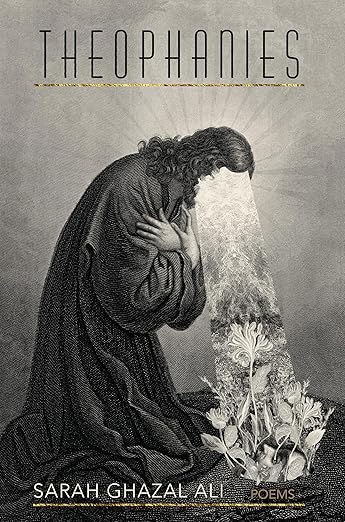
Theophanies
by Sarah Ghazal Ali.
Alice James Books, 2024,
84 pages, paper, $24.95,
ISBN: 978-1-949944-58-7
After Sarah Ghazal Ali read “Matrilineage [Umbilicus]” on Poem-a-Day in October 2023, she explained that it was part of a sequence of poems “preoccupied with the mother line.” Elsewhere, Ali has stated that she is “obsessed with motherhood, daughterhood, sisterhood and the matriarchs in the Abrahamic faiths, specifically my namesake, Sarah.” This preoccupation and/or obsession drives the 41 poems in her debut collection, as powerful an entrance on the poetry stage as any in recent memory.
The opening poem, “My Faith Gets Grime under Its Nails,” begins with an admission: “I confess to sleeping coiled on my night- / blue prayer mat // more often than standing bent in rukū.” (In rukū, Wikipedia tells us, “the body is bent over until the hands are on the knees and remaining in that position until one attains a relaxed state while glorifying God.”) The poem goes on to further reflect the tension Ali feels with her faith:
The places I’ve prayed—elevators, Victoria’s Secret
fitting room, the muck-slick meadow after rain—
will testify for or against me,
spilling through my Book of Deeds.
Ali references figures from her faith: the evil spirit Shaytan (“Story of the Cranes”); Maryam, mother of Jesus (“Tumulus”); monotheism’s matriarch Hajar (“Spectacle”); and others. In each instance, the poet makes a personal connection that contemporizes these often-dominating personages.
In another alignment, Ali draws on her middle name, and the poetic tradition attached to it, in several poems. Loss of homeland inflects “Partition Ghazal” with every couplet ending with “country”:
Your father’s father watches from the walls,
a partridge falling from its sky of no country.
Ali’s ear for the music of words is everywhere in this collection. Take the first stanza of “Parable of Flies”:
I heard them, wings beating
a din beyond the thistle, pilgrims
beckoned by the promise of carrion.
The imagery matches the lyric cadence: “their mouths roved like dogs / the breast of a sundered wren”—stunning. She ends the poem with strong alliteration:
I’m divining my body a dirtied domestic.
When it rains, devotion is the womb
I’ve hollowed to keep desire dry.
“Roadkill Elegy” opens with this statement: “In good towns, good houses mourn what dies /outside by closing windows.” The speaker deals with her reactions—guilt, nausea—to thesedaily deaths. She also reflects on an innate cruelty: “In good towns, good children collapse /snake holes, heel away ant hills for sport.”
Ali’s range is remarkable, from the persona poem “Annunciation” to one prompted by Magritte’s 1934 painting “Le viol” (“The rape”). The poems “Apotheosis” and “When Nabra Hassenen Wakes Up in Jannah” pay tribute to, respectively, Noor Muqaddam, who was murdered in Islamabad, Pakistan, in 2021 for rejecting a marriage proposal, and Hassenen, the 17-year-old victim of a hate crime in Virginia in 2017. She cannot, as she has stated about Gaza, “scroll past the dead.”
“How a pen bleeds to grant shape to speech,” Ali notes in the title poem. Her writing expresses eloquently what it is like to live under the various sieges of existence, as daughter, sister, mother.
She is a brilliant shaper of speech.
–Carl Little