


Raised by Wolves: Fifty Poets on Fifty Poems
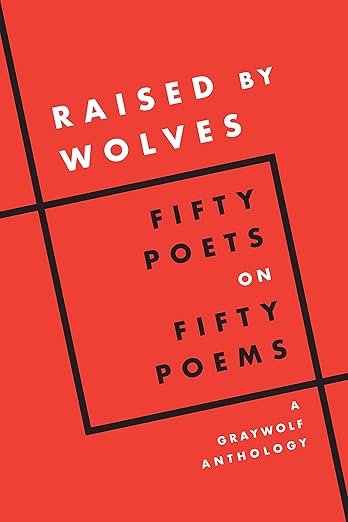
Raised by Wolves: Fifty Poets on Fifty Poems.
Edited and published by Graywolf Press,
2024, paper, 136 pages, $18,
ISBN# 978-1-64445-266-0
In How to Read a Poem, Edward Hirsch describes the lyric poem as an unsettling, intense discourse between strangers. This discursive action animates the pages of Raised by Wolves: Fifty Poets on Fifty Poems, a new anthology from Graywolf Press. Celebrating the press’s half century of poetry publishing, fifty Graywolf poets each selected a poem from the press archives and also contributed a short essay. Gaining insight into one poet’s words by way of another, these essays artfully create a communal mosaic illustrating not only the many tessera of Graywolf’s aesthetics and ethos, but also the lively dialogue at the heart of the poetic endeavor.
Mesmerizers of time, place, feeling, mood—poetry can encode messy immensities, folding worlds within words like accordion bellows. Hirsch describes poems as having “stored magic.” Many essays in Raised by Wolves reckon with this magical energy. Where does it reside in the poem? What does it evoke, how does it move through?
For example, Saskia Hamilton’s poem “Faring” creates a meandering cityscape, noting and noticing many scenes – from children playing in the neighborhood, to waves of post-pill nausea, meteorology’s changing moods, musings of an 18th century poet, and more: “In the streets below, each passersby carries time internally, it opens the mind like a flower blown in its native bed.” Claudia Rankine writes that Hamilton’s poem “builds its rooms against the ‘toomuchness’ of life, life’s actual, red-hot intensities.” Language and experience are co-constituted through poetic practice, giving expression to the difficult and often incalculable.
Ilya Kaminsky reflects on how Vénus Khoury-Ghata’s figurative language in “She Says,” where she builds new myths in the wreckage of war, “feels like a beautiful construction that might otherwise need to be expressed by a scream.”
Language is often the tool of oppression, Monica Youn reflects. But in reading Mullen’s poetry, Youn sees language used to “undermine, excavate, perforate, dislodge, renovate—hollowing out breathing space, elbow room, fashioning a home within an often inhospitable tradition,” as in Mullen’s “Trimmings”: “Mistress in undress, filmy peignoir. Feme sole in camisole. Bit part, petite cliché.[…] Negligent in ladies’ lingerie, a dressy dressing down.”
Layli Long Solider writes about power and agency in poetry, particularly for marginalized poets around issues such as disclosure, exposure, and vulnerability. Long Solider includes a handful of lines from Solmaz Sharif’s poem “Personal Effects,” where, following a blank space on the page, Sharif describes a photo and the young casualty of war it depicts. Long Solider writes, what is left off the page “may vibrate at a higher frequency than what’s on the page. These choices are the poet’s agency—or better yet, a form of sovereignty. Withholding is a way of saying, you cannot see this, know this, or take this; it’s an assertion of immeasurable integrity.”
In “The Forest,” Susan Stewart writes: “You should lie down now and remember the forest, / for it is disappearing— / no, the truth is it is gone now / and so what details you can bring back / might have a kind of life. // Not the one you had hoped for, but a life.” Jennifer Gratz writes that this poem “has haunted me now for nearly thirty years.” Stewart was inspired to write “The Forest” after hearing that a time may come when no one will remember the experience of a forest. “A chilling thought,” Gratz writes, “one we all live with still.”
Folding time, sharing experiences, holding attention – the poem’s magic is surfacing. The poem “reads as incantation, as spell, revering the forest by recreating its wildness in its own form,” Gratz reflects, later describing how it “weaves a mesmerizing reading experience of simultaneous familiarity and disorientation, of being ‘tangled’ and, in the end, ‘lost’ in the forest—and lost in the forest of the poem, too.”
What magic indeed, drawn in through discourse, ensnared in shared moments amongst strangers.
–C.T. Wolf
You Bombed!!!
by Craig Cotter
Around 1988
at my hottest
Diane Wakoski arranged a reading for me
at a bookstore in East Lansing
6 years after I’d graduated.
*
Uncertain about poetry
the obvious solution:
get drunk before the reading
*
After,
Diane and Robert held a party at 607,
exquisite wines, liqueurs, appetizers.
(Diane used to say, “No one really wants poetry,
you have to draw them in with food and drink.”)
They put on hundreds of such poetry events
in East Lansing over the decades.
*
I’d driven from LA
and was staying with Diane and Robert
in their basement apartment.
The next morning I walked upstairs
barefoot in jeans and T,
throbbing headache, bleary-eyed,
shoulder-length hair matted to my face—
Diane met me at the top of the stairs and yelled,
“You BOMBED!!!”
This was one essence of Diane
I’ve always loved:
no wasting of time,
no platitudes or false reassurance.
*
This week, 40 years later, she said,
“You’ve seen my volcanic temper,
but I recover quickly.”
And later that evening,
sitting in her living room,
bamboo furniture with yellow cushions,
D with red wine,
me the Evil Wied,
she said, gently,
“Your poetry is a jolt—
it can be difficult.
I appreciate the beauty and honesty of your reading.
It’s what we needed to hear.”
Michigan Fort
by Craig Cotter
We built forts with pieces of scrap lumber
from our fathers,
building sites,
woods and fields.
*
One morning when we got to the field
one of our best forts, three rooms, gone.
Not a sliver of wood left.
Wondered about the Showers boys.
*
Our next plan:
build underground.
We dug a hole
big enough to hold two VW Bugs,
hit water 5 feet down.
Cut shelves in the walls for candles,
plywood to cover,
camouflaged with plants and leaves.
*
Over a half century later
this three-storey condo,
what we wanted in our forts,
running water, electricity, furniture.
It was like 17-year-old Jeremy
using a figure-of-speech I didn’t understand,
“Catch a double, man.”
Each generation preparing for the next fort.
Rock & Roll Body
by Craig Cotter
Got a new pair of tight jeans today
they cut into my ass
like the side of a hand,
ride up my junk
like a denim blow-job.
*
Former Beatle George Harrison
says he’s tired of music
that insists on personality.
*
In the dentist’s waiting room
I tear out a photo of Mick Jagger
stick it in my leather jacket
a woman is stuck in the elevator
in the hall
a green iridescent bottle fly
flies around my room
in the morning just past
many dreams
I called Sarah last night
the message on your machine,
you and your roommate: “Even if this
is a wrong number leave a message
and tell us your shoe size.”
*
In my dreams
I’m a person
I don’t want
to be around.
*
I’m at a table sitting quietly.
“What are you doing?”
“Brooding.”
“Want a blow-job?”
“Fuck no, that would take my mind off it,
I must continue this useless, senseless,
repetitious
thinking.”
“What is it?
What are you brooding about?”
“My inability,” I say, “to write myself
out of a paper bag.”
“Sex can cure that,” she says
“I’m 27-years-old
what
do I look like a virgin?”
I leave for North Hollywood
to rent a Stones movie
to focus on how desirable it is to be thin
and sing.
—-for Paula Shepherd