

Openings for Light to Pass Through: Poems
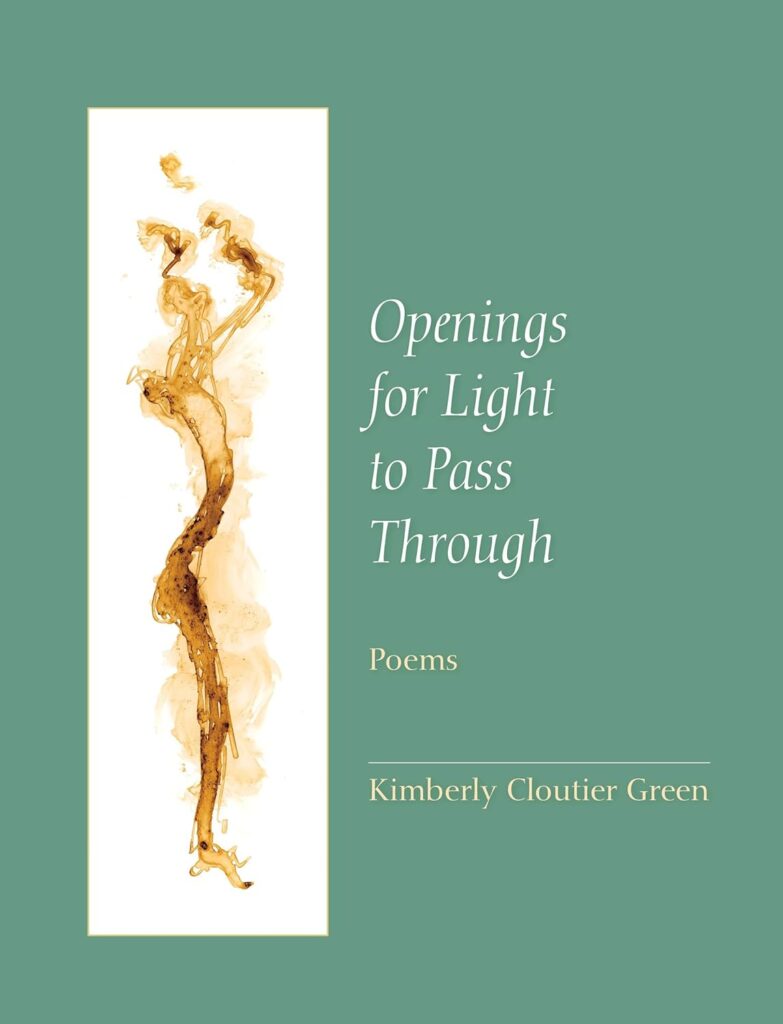
Openings for Light to Pass Through: Poems,
by Kimberly Cloutier Green.
Bauhan Publishing, 66 pages,
paper, $18, ISBN: 978-0-87233-390-1
To open her second collection of poems, Kimberly Cloutier Green offers a prayer of thanks. The title, “Shefa,” comes from the Hebrew for flow and abundance, which are contained in Green’s litany of life’s “inwoven / syntax and structure,” from “cradle and huppah” to “love’s spoken word…/ its tune and bright thunder.”
Green often draws on memory. In “Back then there were at least,” she glories in the freedom of youth, of riding her bike at night “for scent on the wind / of honeysuckle, sweet / heat of the sneak / down streets overhung / with summer catalpas.” It’s a time of innocence, of being “unchecked and unkissed.”
Another memory comes up in “Artifacts That Might Be Maps,” this time a family road trip. Smells again preside: “let’s say it’s your dad up front, / his Old Spice aftershave and cup of black coffee / braiding with the warm summer winds.” Here, “orientation’s a mystery” and the speaker keeps still, “not asking when will we get there.”
Parenthood comes to the fore in “Ultrasound.” The image of the fetus—a “nebula”—leads to a meditation on a new world of responsibility.
Longed-for babe, little rivet,
you fasten us to the hurly-burly
dress all our devotions
in new rags
The music in Green’s poems can be awe-inspiring. “Mother: Source & Slant” is a bravado riff on “s” words that starts in a dream, “a single syllable root,” and ends with a “whispered phoneme,” a hushing sound. Sibilance is also found in the prose poem “Reunion,” which transcribes the thoughts of a woman who has undergone a mastectomy. Her new flatness brings to mind how, as girls, “we shimmied all summer like snakes on our bellies, / no breasts, no hips, just the long cool rub of grass and its stains.”
Humor and warmth mark certain poems. In “like sky,” the speaker’s partner rolls over on her in his sleep, awakening her to the prospect of shimmying out from under or transforming herself into a door. “Playing Stick” describes the dynamics of the give and take of a game of fetch with a dog, “all slobbery flews and whiskers.” In a similar richly imagined manner, “Otherworlding” conjures swimming in a quarry, “rib bellows heave-breathing the sudden air” as the diver emerges on a far bank.
Other stand-outs include the seven-part “Homing,” which carries a note at the top, “to the voices of women incarcerated at the Strafford County Jail”; “Pear,” with its sense of wonder at this “little planet” that contains “the elegant code for roots, trunk, limb and white flower”; “Choosing Hearts,” which reminded this reader of some of William Carpenter’s surreal narratives; and “Waking Room,” a lovely recollection of mother-daughter bonding.
The book’s title appears in the final lines of “Stranger” prompted by a newspaper photograph of a figure holding a young girl in a war-torn place on a “ravaged night.” Whether “to see reflecting bodies as openings light could pour through” is a “trick of the eye,” the observer holds her child with the same intensity—much as we hold Green’s formidable poems.
-–Carl Little