


Don Byrd
Don Byrd: is a poet, sound artist, and Professor of English at SUNY / Albany. In 1984, his chapbook, Technics of Travel, was published by Zealot-Tansy. His first book-length poem was Aesop’s Garden, (North Atlantic, Plainfied, Vermont) and his second book-length poem, The Great Dimestore Centennial, is published by Station Hill. His Charles Olson’s Maximus is published by Southern Illinois University Press and his important The Poetics of the Common Knowledge is published by SUNY University Press. In his lifetime, he proposes to complete one-hundred volumes that will complete a set which he refers to as The Nomad’s Encyclopedia.
Dwellers in the House of the Lord: A Poem
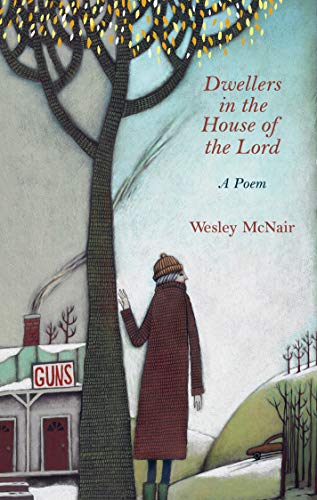
Dwellers in the House of the Lord: A Poem, by Wesley McNair.
David R. Godine Publishers, 2020,
66 pages, paper, $16.95,
ISBN: 978-1-56792-663-7
When Maine Governor Janet Mills reads Wesley McNair’s poem “Seeing Mercer, Maine,” part of Maine Poet Laureate Stuart Kestenbaum’s “Poems from Here” Bicentennial video series, you feel like she knows the world and people he describes:
Would it matter if I told you
people live here — the old
man from the coast who built
the lobster shack
in a hayfield;
the couple with the sign
that says Cosmetics
and Landfill; the woman
so shy about her enlarged leg
she hangs her clothes
outdoors at night ?
And Mills does know this world: she comes from western Maine and has ridden those backroads where life is hardscrabble and fragile. McNair is a master of evoking that rural existence, right there with Baron Wormser, Elizabeth Tibbetts, Dawn Potter, Kate Barnes, and other poets who’ve lived in the back of beyond.
But in The Lost Child — Ozark Poems (2014) and the book under review, McNair moves into more personal, non-Maine territory, focusing on his kin with the same empathetic eye for those living lives “of quiet desperation,” as Thoreau put it. This time around, in a three-part narrative, he looks in on his younger sister Aimee.
McNair offers a devoted brother’s wrenching portrait of a woman — “a soldier against losses,” he calls her — suffering the indignities and cruelties of bad marriages and the shallow assurances of a megachurch offering “the five keys / to material happiness.” The course of Aimee’s life is jagged, ranging from the abusive — a husband who threatens to throw a hair dryer into the bath she’s in — and the suicidal — she leaps from the fourth floor of a building and survives — to the hopeful — two loving daughters — and the promising, a church where she feels born again:
I couldn’t help it, Wesley — Amen for the man,
and Amen for everybody around me in this church
out in nowhere, which felt like a loving mansion, too!
McNair also provides a portrait of Aimee’s husband Mike, a racist, gun-selling Trumper who nonetheless gains some redemption later in life. He “softens,” admits to having been an asshole, and becomes a lover of cats, which, according to his daughter Sophia, gives him “the permission to feel.”
Throughout Dwellers in the House of the Lord, McNair points out the villains. “It took only ten years for the new K-Mart Lawn / and Garden Center at the mall off route 89 to destroy / the nursery business my stepfather and my mother / had built,” he writes, highlighting the big box store scourge on small communities. He also presents the ugly rhetoric of Trump, who fuels the pall of hate that covers the country and seeps into his sister’s life. Referring to the president as “the damaged maestro / of nobody loves me enough,” the poet describes him showing off one of his executive orders “like Vanna White on a game show.”
In mid-July, Ted Kooser ran a six-line excerpt from McNair’s poem in his American Life in Poetry column:
I, too, am confused. I reach out
to the Mike who calls me
Buddy, the Navy name
for friend, and in every secret
phone call, I reach out also
to my sister, bereft and alone.
Even with the context provided in Kooser’s introduction, the lines seem somewhat random and hardly an engaging tease to reading the full poem. And yet they represent a central theme: a sense of confusion that the poet — and we — feel at the way the world careens, the severe ups and downs, the changes of heart, good and bad, and the judgments of the times.
The cover bears out the truth of the classic admonition of not judging a book, etc. It’s somewhat misleading, a kind of Barbara Cooney / Will Barnet-blend vignette by Robert Brinkerhoff showing a woman in winter garb standing by a tree with a gun shop off to the side. It represents a setting in the poem — Aimee’s husband Mike’s place of business — and also illustrates an especially loving passage in the poem:
Then I see Aimee, standing by herself
in a cap and overcoat under the high, leaf-filled
branches of her favorite tree, a study in
winter and faithfulness, waiting, like me,
after all these months of her struggle, to be held.
McNair has always managed to insert some humor in his poetry, not LOL but a kind of wry eye for our foibles (a favorite example is “Hymn to the Comb Over.”) There’s little of that in Dwellers in the House of the Lord. While we might miss it, the times, the poet seems to say, call for a more sober approach.
Different stanzaic forms, including couplets, three-liners, and longer blocks, help propel the verse and the story. Other writers are no doubt shaping accounts of this era in their own fashion. They might look to McNair to understand how one can present with personal passion lives in the “arc of the hope of belonging” in an unprecedented moment in American history.
— Carl Little
House of Sparrows: New and Selected Poems
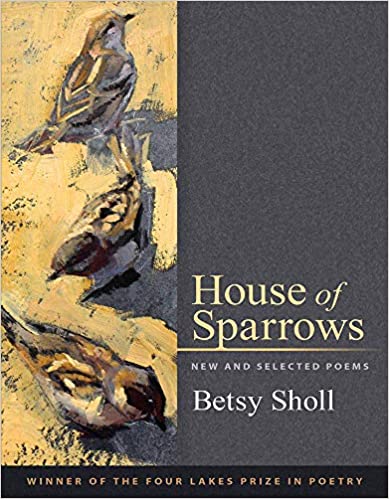
House of Sparrows: New and Selected Poems, by Betsy Sholl.
University of Wisconsin Press Poetry Series, 2019,
176 pages, paper, $18.95,
ISBN: 9780299323042
The regard with which Betsy Sholl and her work are held within the Maine literary community was evident at the book release event for House of Sparrows: New and Selected Poems (University of Wisconsin Press, 2019). Longfellow Books in Portland was so packed that evening that I stood in the back with friends to listen to Betsy read. That’s right — standing room only at a poetry reading! Not only that, but the crowd included recently inaugurated Governor Janet Mills. Putting aside the beautiful thought of a poetry-loving elected chief-executive, consider what it says about a poet and her work that she has the ear of such a person.
A New and Selected Poems is a big deal for any poet. Sholl’s is an outstanding entry into a significant body of work. Reading these poems from start to finish (which, as is often the case in a New and Selected, means new poems followed by selections from previous collections in chronological order) it is easy to get a sense of the continuity in Sholl’s work. At the same time, just looking at the words on the page shows the increasing precision and control with which she is working: there is more space in the more recent poems. These poems approach nearer and nearer the clarity of figure flickering in all truly great poems.
Eschewing closed forms and closed ideas, Sholl’s poems often furl multiple subjects, and the images, feelings, and thoughts associated with them, into skillfully braided meditations. One of the new poems that seems emblematic in this way is “Walking Paradise Blues.” In three sections, each with four three-line stanzas and a final couplet, the poem combines references to Dante, anecdotes of Chicago blues musician Walter Horton, and reminiscences of the poet’s grandmother into an expanding exploration of all that lives within the African-American- originated term, blues.
These poems do expand, even when their focus is narrowed. The opening poem, “Apple,” begins, Frost-like, in an orchard: “Crisp press of ladder rung on instep, / tree sway and dappled light, then stem twist / and the weight of apple in hand — . ” From here it moves immediately into the kind of question Sholl poses in poem after poem: “reaching through that leafy green, did we ask / what else we were after ? . . . ” In nine short stanzas, the poem plucks and samples the ripe and contradictory symbolism of apples, before it ends in a morally ambiguous anecdote about a family dog chewing up a perfectly formed wooden apple and being banished to the yard, “as if once down the stairs / he wouldn’t happily enter that bright world / of rock and dirt, nuthatch, beetle, squirrel.”
Many of these poems ask questions about justice and responsibility, as in the newer “Making Dinner I Think About Poverty — ” or the older “Back with the Quakers,” yet they are not “political” poems. What is the proper descriptor for that human substance and force that is deeper than, yet drives, social action ? Spiritual seems too thin and marketable. Moral too mentalizing. Religious too external and artificial.
Soul is the right word, I think. Many of Sholl’s poems mention musicians and songs. Jazz and blues and gospel seem to be touchstones for this poet, and that makes sense. In “A Song in There,” Sholl, who is white, even calls “the old bluesmen” “my heroes” and “my mentors.” Hers are not confessional poems, but Sholl makes passing references to a childhood and family where feelings — and the ways we express them, including with words — were kept locked away. The music of those old blues and gospel artists is the antithesis of such repression. To give artful voice to the full range of one’s humanity seems the essence of soulful musical expression — and of these articulate, soulful poems.
While recently reading Martin Luther King, Jr.’s “Why We Can’t Wait,” about the tumultuous and pivotal year in the Civil Rights Movement, 1963, I was reminded of the wonderful term “soul force.” Derived from Gandhi’s philosophy, “soul force” draws power from what is deepest and best in our humanity in order to confront, and overcome, violence and injustice. Is not poetry itself a form of soul force ? When it comes to Sholl’s work, at least, the term is apt. Her poems express something alert and hungry and hurting and wise. They brave the clarity of truth. They are open to the world. They probe the mysteries of joy and despair, of light and / in darkness. They are the work of someone considering what it might really mean to love your neighbor as yourself.
As she writes it — to conclude that poem about Dante and a Chicago bluesman and a warmly resilient grandmother —
Soul, I’m talking about, what big Walter
blew through bent notes, lonely so you know
somebody’s been down that road before.
Lord they sang. Wore out how many shoes —
one eye fixed on the grit, one on the stars.
— David Stankiewicz
Persephone’s virtual book launch event
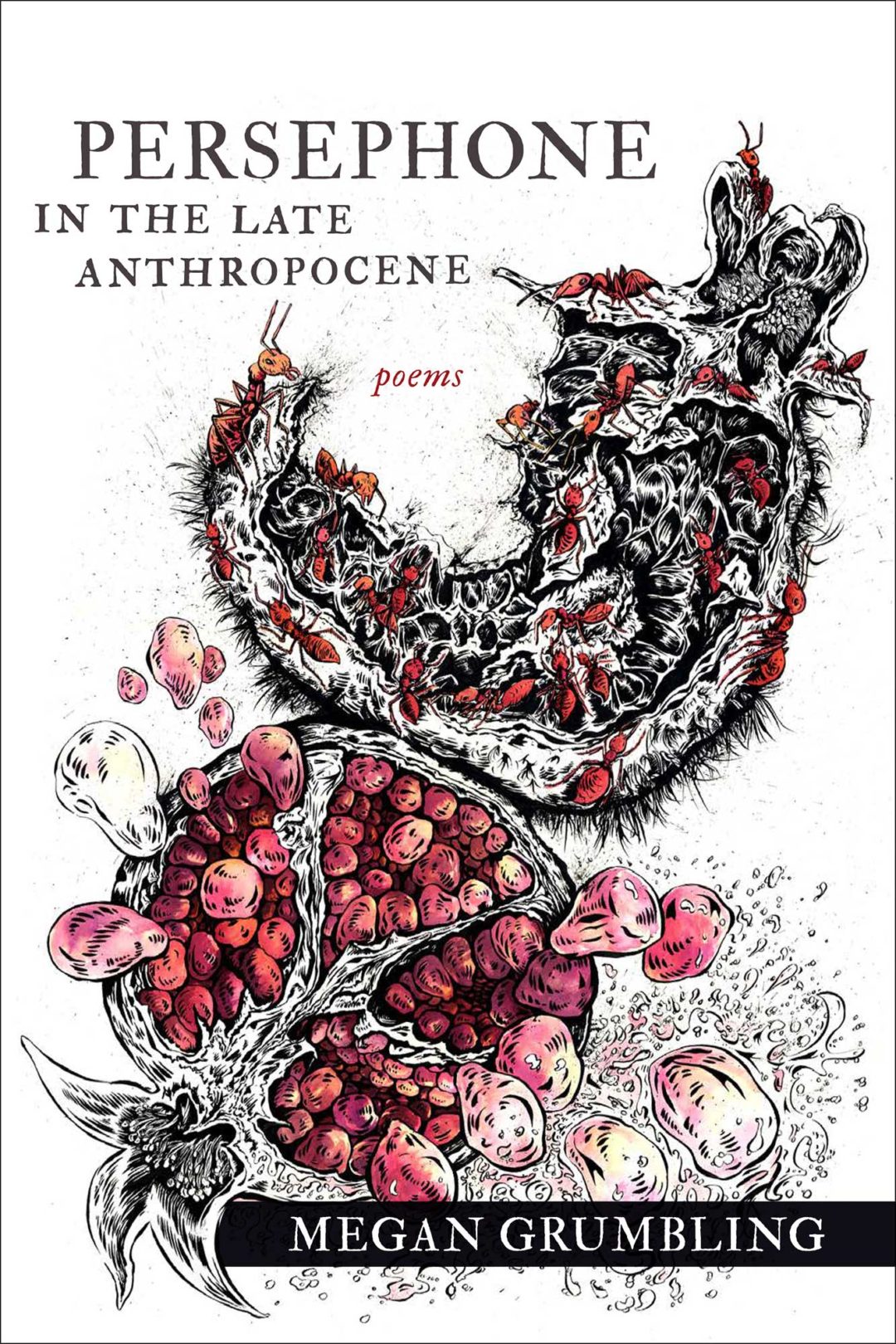
Please join us for our Review Editor, Megan Grumblings Persephone‘s virtual book launch event, on Thursday, October 15, at 7 p.m. — on Zoom.
The event is co-hosted by SPACE Gallery and the Maine Writers and Publishers Alliance, with the support of the Maine Arts Commission. Here is the link for more info and to RSVP (the event is free; SPACE just asks that you register in advance): https://space538.org/event/persephone-in-the-late-anthropocene-virtual-launch/
In keeping with Persephone‘s interdisciplinary origins, this book launch will be a multi-medial experiment, and will include film elements made with a variety of collaborators, plus music from a new recording of Denis’s original score, recently recorded at Acadia Recording Co.