


Michael Estabrook
Michael Estabrook: is a retired baby boomer child–of–the–sixties, freed after working 40 years for “The Man” and sometimes “The Woman.” No more useless meetings under fluorescent lights in windowless rooms. He has been publishing poetry in the small press since the 1980s. He has published over 20 collections; most recently, Bouncy House, edited by Larry Fagin (Green Zone Editions, 2014) and The Poet’s Curse, A Miscellany (The Poetry Box, 2019).
Neeli Cherkovski
Neeli Cherkovski: is the author of many books of poetry, including From the Canyon Outward (2009), and The Crow and I (2015). He was the coeditor of Anthology of L.A. Poets (with Charles Bukowski) and Cross–Strokes: Poetry between Los Angeles and San Francisco. He wrote biographies of Lawrence Ferlinghetti and Charles Bukowski, as well as the critical memoir Whitman’s Wild Children (1988). His papers are held at the Bancroft Library, University of California, Berkeley. He has lived in San Francisco since 1974.
Charles Cantrell
Charles Cantrell: has poems in recent or forthcoming issues of Mudfish, Confrontation, Rumble Fish Quarterly, Mobius, Citron Review, Seven Circle Press, West Texas Literary Review, Appalachian Heritage, Pinyon Review, and Miramar Poetry Journal. A book of poetry, Wild Wreckage, was published by Cervena Barva Press in 2019. Over the past 30 years he’s been in residency several times at Ragdale and the Virginia Center for the Creative Arts.
A Rising
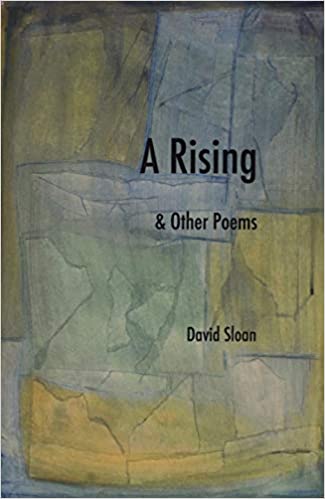
A Rising, by David Sloan,
Deerbrook Editions, 2020,
101 pages, paper, $18,
ISBN: 978–1–7343884–0–4
There’s always something to lose.
Not just reading glasses
or disposable lives; our way
in the darkness,
self–respect, heart, the little screws
that hold utility knives
and space shuttles together,
a sense of humor.
These lines, from David Sloan’s poem “Dylan Had It Wrong,” summarize Sloan’s latest collection of 59 poems spread across four sections and 80 pages. These poems highlight the difficulty of loss held together by humor and a Thoreauvian “attention to minutiae” (as he notes in “Muddying the Waters”).
The title poem, which opens the book, combines specific references to Maine’s Acadia National Park — Cadillac, Little Hunter’s Beach, Otter Cliff — summoning images of whales and “baritone breakers . . . / A tenor chorus / of polished pebbles.” The poem itself develops the images of hard–consonant “rocks,” to the softer sounds of “stone,” then “pebbles,” ending with “boulders” that turn into “loaves.” With this as his poetic mission statement, Sloan sets out to feed the multitudes on poetry with each reading and re–reading.
In one of the more darkly humorous and politically conscious poems in the collection, “Teacher Packing,” Sloan, a veteran teacher himself, conjures an instructor with a Glock gleefully imagining how he might use it to instill a little more discipline in the classroom. While increasing numbers of school districts arm teachers, this poem serves as a warning. Sloan hits the target with lines like “my students will feel / the comfort // that comes from knowing I hold them all / in my arms // and in my sights.” The teacher shows up again in “Deer Teetcher:” about a “book retort on Gilgamush.”
Addressing death, Sloan’s work becomes more poignant. “Why I Scattered My Best Friend’s Ashes at the Ballpark,” “How I Scattered My Best Friend’s Ashes at the Ballpark,” and lines like “you slip away, / breath by shallowing breath” (in “Printless”) highlight the experience of losing friends and family. Sloan’s consciousness of mortality surfaces in “Threshold Choir” and “Taking My Car Keys Away,” poems that explore transitional moments, losing independence, dying.
There is also a sharp focus in the reflections on marriage, where we see
four decades on,
your left leg thrown over my right,
as if in casual intimacy,
but nothing these nights
is thoughtlessly done.
Or in “Kindling,” where splitting wood is “precise work, unlike marriage, / . . . where being alone / together is a constant state, // sanctified by those who survive it.” Sloan balances these somber tones with humorous scenes in “Holiday on Ice,” “A Moderate Hike,” and “Tandem Bike,” in which an older couple faces their own aging with determination and a wry chuckle.
This collection moves between thoughtful reflections to lighter poems, though there are a handful of places in the book where two or three poems in a row touch on the same theme. There are also 10 ekphrastic poems, ranging from a poem about Richard Avedon’s portrait of Ezra Pound to work by Winslow Homer and Isamu Noguchi. “Couple,” after the photograph “Graduation Dress” by Ansel Adams, is a striking example of these poems. Drawing inspiration from the 1948 photo of a young woman in a white dress beside a large tree in Yosemite Valley, Sloan considers her today, “nearly ninety now, still” with
lucid moments when she swears
her husband’s hands cup her face in bed
like a potter centering clay on a wheel . . .
Her vulnerability would be vexing
but for the giant oak at her side.
It comforts and fortifies her — us as well.
And this is a collection that fortifies, comforting in its gentle humor, consoling as we too grieve our losses, while reminding of the pebbles, boulders, and mountains begging to be noticed.
— John Reinhart