


Olio
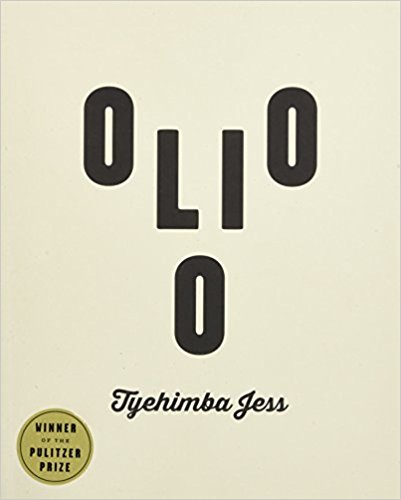
 Olio,
Olio,
by Tyehimba Jess, Wave Books, 2016,
224 pages, paper, $25,
ISBN: 9781940696201.
The word olio has three definitions, as Tyehimba Jess lays it out for us on the first page of his extraordinary book of the same name: it can denote a “hodgepodge” mixture; a miscellany of musical or literary pieces; or act two of a minstrel show, the now-notorious 19th century entertainment that featured, among other diversions, comedy routines between two “end men” in blackface. An ambitious, formally ingenious, exquisitely crafted collection of poems — and the winner of the 2017 Pulitzer Prize — Olio simultaneously inhabits all three definitions of the word, as it explores, interrogates, and honors the complexities of ragtime music, minstrel shows, and the black artists who wrote and performed them.
In addressing issues of power, performance, appropriation in this music, Olio compiles a wealth of artifacts, poetic forms, and voices. We encounter news clippings, lists and diagrams, a how-to blackface manual, and engrossing transcripts of interviews conducted by an invented black ethnomusicologist named Julius Trotter. Olio’s readers are instructed to “[w]eave your own chosen way between these voices,” to jump between lines, read out of order, and even to cut out pages and manipulate them into new forms.
The primary voices Olio interweaves are first-generation-freed musicians, performers, and artists. There are twelve of them, from John “Blind” Boone, a sightless musician with “prodigious memory, perfect pitch, and a particular partiality to piano,” to the half-Ojibwe, half-Maroon Edmonia Lewis, a sculptor and “expatriate artist at age 20.”
This scope is formidable and exhaustively researched, but Jess orients us generously, with the waggish voice — the puns, hyperbole, and alliteration — of a sideshow barker. In his introduction to the book’s characters (whom he pointedly refers to not as the “players” or “dramatis personae” of the olio, but as its “owners”), we learn of Henry “Box” Brown, who escapes
slavery in a coffin and “got carried away — crate-wise.” We learn of conjoined twins and performers Millie and Christine McCoy, who were displayed in sideshows. We learn how theater-makers Bert Williams and George Walker (“stars of Sons of Ham and our dear homeys from their play In Dahomey” ) find fame “delivering duets of blackface delirium” even as they “grind ash into laughter to smear over scars.”
Moving between characters and modes, the voice of Olio ranges from the punchy and colloquial to the raw, lyrical, and mythic, and it executes, as it does, death-defying gymnastics of dialect, allusion, and tone. “My bliss is wry,” pronounces “Box” Henry, and Olio, too, often sings with a bracing dark-comic ambivalence. In the sequence titled “All Coons Look Alike to Me,” Jess turns a list of “coon songs” of the minstrel era — many of which were written by black performers — into “A Chant of Merry Coon Song Melodies,” with a barker-like epigraph that promises: “GUARANTEED! ALL TITLES HISTORICALLY ACCURATE!” The juxtaposition of that barker’s tone with the horrific and often bizarre song names (“Coon With the Big Thick Lips,” “Coon Schottische,” “The Phrenologist Coon”) is unnerving, and Quotations from the black author of the song “All Coons Look Alike to Me” itself, Ernest Hogan, further complicate the musical phenomenon: That infamous song, Hogan says, “caused a lot of trouble in and out of show business, but it was also good for show business because at the time money was short in all walks of life.”
Black music, throughout Olio, proves a complex and ambivalent means of myriad kinds of power and ownership. We hear characters bemoan the appropriation of ragtime into coon songs and jazz. We hear about the masks and “doubleness” involved in blacks performing for whites. We hear music limned as both salvation and currency, “each tongue,” as one performer ruminates, “spinning spirituals into tens and ones.” In one prose poem, performer Eva Shoe remembers black minstrel and opera diva Sissieretta Jones and muses, “What is a coon show, anyway, but one poor devil putting on a mask another devil willin to pay to see?” And Blind Tom sings of music as animate, elemental, a primal force to be harnessed for cultural work: “Jangle up its teeth,” he says of the piano, “until it can tell / our story the way you would tell your own: / the way you take darkness and make it moan.”
Formally, Jess’s storytelling is wide-ranging, beautifully wrought, and breathtakingly inventive — Olio’s forms span prose poems, “apparition” haikus in various musical keys, and “Jubilee” sonnet spirituals that honor the era’s innumerable burned black churches. Especially impressive are his “syncopated” sonnets and ghazals, each of which includes two adjacent poems, in two voices, that can be read in multiple ways. In “The Bert Williams / George Walker Paradox,” for example, Bert’s “nobody” and George’s straight man enact a syncopated ghazal: the two columns of the form’s couplets and refrained words can be read individually, back and forth between the columns, diagonally, or circling back up from the poems’ last words, mid-phrase, to their beginning.
This “syncopation” device allows Olio to present its own subversive takes on the minstrel show’s “olio” trope, the “end men” duo. And when, in the book’s lively, very readable Appendix, Jess calls for getting Bert and George “out of the minstrel box” and the “two-dimensional postulates of blackface fate,” he doesn’t just mean it figuratively: he encourages us to “cut thru the dotted perforation to free the comedians from the medium of two dimensional tête-à-tête,” and provides diagrams for new, three-dimensional reconfigurations of their words — into a cyclical “torus,” into the twisted infinity of a “Möbius.” Jess’s many syncopated, entwined, re-dimensioned voices — of conjoined Millie and Christine McCoy, of Blind Tom and Mark Twain, of Scott Joplin and composer Irving Berlin (rumored to have stolen a Joplin tune) — highlight both these characters’ juxtapositions and their inextricable entanglement in the cultural fabric.
And Jess constellates Olio’s many voices not just between lines on the page, but inter-textually — that is, across the canon. In his remarkable sequence of “Freedsongs,” Jess takes on John Berryman’s Dream Songs, in which Berryman appropriated the minstrel show’s “end-men” trope as an internal dialogue between the (white, middle-aged) speaker, Henry, and his alter-ego-in- blackface, “Mr. Bones.” In the “Freedsongs,” Jess’s own Henry — “Box” Henry — “liberates him(self) from literary bondage”: Because it’s now time, as Jess puts it, “for old lit sins to get bent.” In the opening “Pre / Face,” syncopated between excerpts of Berryman’s “Ol’ Henry” and Jess’s “Box” Henry, the escaped slave speaks for himself: “I ache / my / love for / . . . those left behind. / . . . Berryman can’t talk for them, / can’t tell my tale at all.” The “Freedsong” sequence proceeds to recast nine of the Dream Songs, riffing on and even rhyming with Berryman line for line. Jess executes all this with meticulous formal agility and dazzling brio, and the sequence builds as both a brilliant re-appropriation of minstrel tropes and a pointed manifesto for cultural inclusion:
Once, with his black-face worn, John was glad
all at the top. And he sang.
Here, in this land where some strong be,
let Box Henry grow in every head.
What Jess achieves with all these devices and modes is dizzying — it’s moving, beautiful, often zingingly funny, and unfailingly engrossing. And even with everything going on in Olio — the formal innovation and inventions, the barker-ish punning, the carefully interwoven voices, and the hands-on poetical geometrics — Jess still lays down simply, timelessly gorgeous lines of verse. His music is clarion and his imagery an exquisite marriage of the elemental and mundane, as in this opening to “What the Wind, Rain, and Thunder Said to Tom”:
Hear how sky opens its maw to swallow
Earth? To claim each being and blade and rock
with its spit?
Or here, in these enjoining, rousing first lines of Fisk Jubilee Proclamation, the entrance poem of Olio:
O, sing . . . undo the world with blued song
born from newly freed throats. Sprung loose from lungs
once bound within bonded skin. Scored from dawn
to dusk with coff le and lash. Every tongue
unfurled as the body’s flag.
There’s both violence and salvation in those lines, and in what Olio shows us of a past with living, breathing roots and limbs. “The fact is,” says “Blind” Boone to interviewer Trotter, “that the minstrel show is only a grin or a shuffle away from any living Negro trying to tell his own true, full story and survive in the world.” Olio raises that music’s story and people to the light. To behold, hear, and honor it there is crucial for both our moment and the ages.
— Megan Grumbling
Inquiry into Loneliness and Hourglass Studies
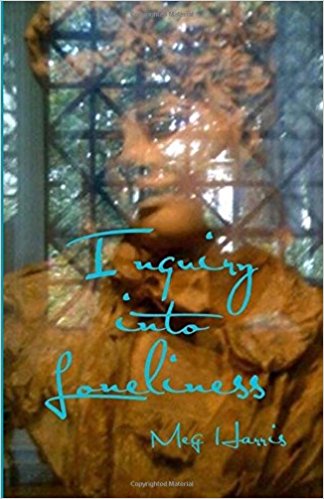
 Inquiry into Loneliness,
by Meg Harris, Crisis Chronicles Press, 2017,
26 pages, paper, $7, ISBN: 978-1-940996-45-5.
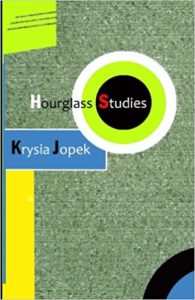
Hourglass Studies,
by Krysia Jopek, Crisis Chronicles Press, 2017,
26 pages, paper, $7, ISBN: 978-1-940996-46-2.
How do we invoke the divine in ourselves, or others? Meg Harris might know, as she is a divine dweller / searcher, finding and evoking what is both holy and mundane in a fine collection of new poems, Inquiry into Loneliness, published by John Burroughs of Crisis Chronicles Press.
These are not necessarily religious or faith-based poems, unless one can conceive of loneliness as a new pathway into consciousness or perhaps stillness, but still, some of Harris’s poems do seem to enter into spaces we might have overlooked, as in “Apnea,” when she writes, “This poem is technical yet angelic, / the word apple is in it / and something about the blush of sleep.” This isn’t the kind of angel imagery of an enlightened being, but more of a humble observer of human relationships, and quite surprisingly she leads us to the inevitable and maybe even unwanted state of loneliness by which all of us are nearly always confused or disturbed.
She writes, in “Sloth,” of “days when stillness, like a death, is the place where / I’m suspended. There, sometimes for hours, I hang.” Of course, her intention in “Sloth” was to write a sestina about these slowpokes of the forest, yet instead, she’s composed a wonderful meditation on the lulling words of “sleep, bough, suspend, hermit, nocturnal and sloth.” By the end of her inquiry, we’re much more in touch with what sloths and humans have in common, especially if one has entered the world of the recluse, as Harris has.
So, we are a “mythology . . . of aliens and angels . . . almost nothing.” Yet her collection is a celebration of light and airiness, though her poems take us into a world of loneliness that opens, not closes, our hearts to sorrow and grief, but equally to keen insights into how these moments of tenderness can teach us how to embrace, and not shy away from, what we’re often troubled by when loneliness visits. Her book isn’t a testimony, but rather a wonderfully engaging journey into “the un-certainty / of the happy yes of loss.”
Philosopher-poet Krysia Jopek brightens the world with a mind-gazing new collection of poems, Hourglass Studies, just released from John Burroughs of Crisis Chronicles Press. Her new collection of high energy twists is the culmination of poetry studies that began with her interests in fusing the abstract with L-A-N-G-U-A-G-E poetry, and, as a result, the poems are challenging to the mind, a heartfelt exploration designed to appease even “the most stubborn philosophers” (V:4).
To orient the reader, Jopek has composed twelve prose poems, with each of the twelve “studies” including twelve mind- whoppingly pensive prose fragments. What she offers for us as readers is what few of us ever have time for — the opening of the mind into unknown crannies, where new speculations can help us see the evolving world of language and language-oriented possibilities.
From section XII:3, Jopek offers us the key to her collection: “The hourglass flipped the conversation over. How to end when one doesn’t recognize the beginning?” Exactly. If we have been flipped by these terse ideograms / epitaphs, then we can learn to set aside narrative theories for sheer speculation on the nature and function of experimental poetry. Readers hoping to find connections between these hourglass studies might have to rewire their synapses, in order to balance the disconnect between one unit of poetry and another. But that’s what’s refreshing about Jopek’s collection.
Hourglass Studies will challenge, with its words shaped into fiery syntax, but after a few readings, the reader will start to make sense of what might first appear nonsensical. Here is I:9: “Reflecting abandoned cities, the train flows past. A mathematical problem deferred [like [an] Echo.]” Readers who love and expect words to flow and connect in conventional ways will be tripped up by Jopek’s unconventional constructions. Instead, we can simply take delight in the fusion of unpredictable meditations. Let III:9 set the mind in a new direction: “A poetics can be given, poorly explained summarized only at / one point: a permanent transition, a steady fraction-glimpse, / delicately spun.” It’s that delicate spin of language that makes Hourglass Studies a challenging puzzle, or escape, or conundrum — depending, of course, on the orientation of the reader. If one is familiar with experimental language poetry, these meditations amplify what all poetry needs as a jolt from the norm. So, to fully appreciate Jopek’s reflections, one might start by simply ignoring the importance of narrative or lyricism, and instead just enjoy her wildly imaginative juxtapositions of images and cognitive somersaults. Jopek playfully helps us to see such unknowns in X:i: “Sentences drag luminous solitudes into the sea at dawn / dislocating ______________.”
We might feel dislocated in reading her synaptic leaps, but perhaps we can also feel that dislocation is a way to open ourselves to what we’ve not been able to see before, especially as in XII:11: “[if space is hollow or open].” It’s the space of language that Jopek hopes we’ll consider, and after looking at space for so long in the same way, I’m ready for some new lenses.
— DeWitt Clinton
Happy Holidays!

Happy Holidays from all of us at The Café Review!!
Charles Bernstein at International Poetry Nights in Hong Kong and Mainland China
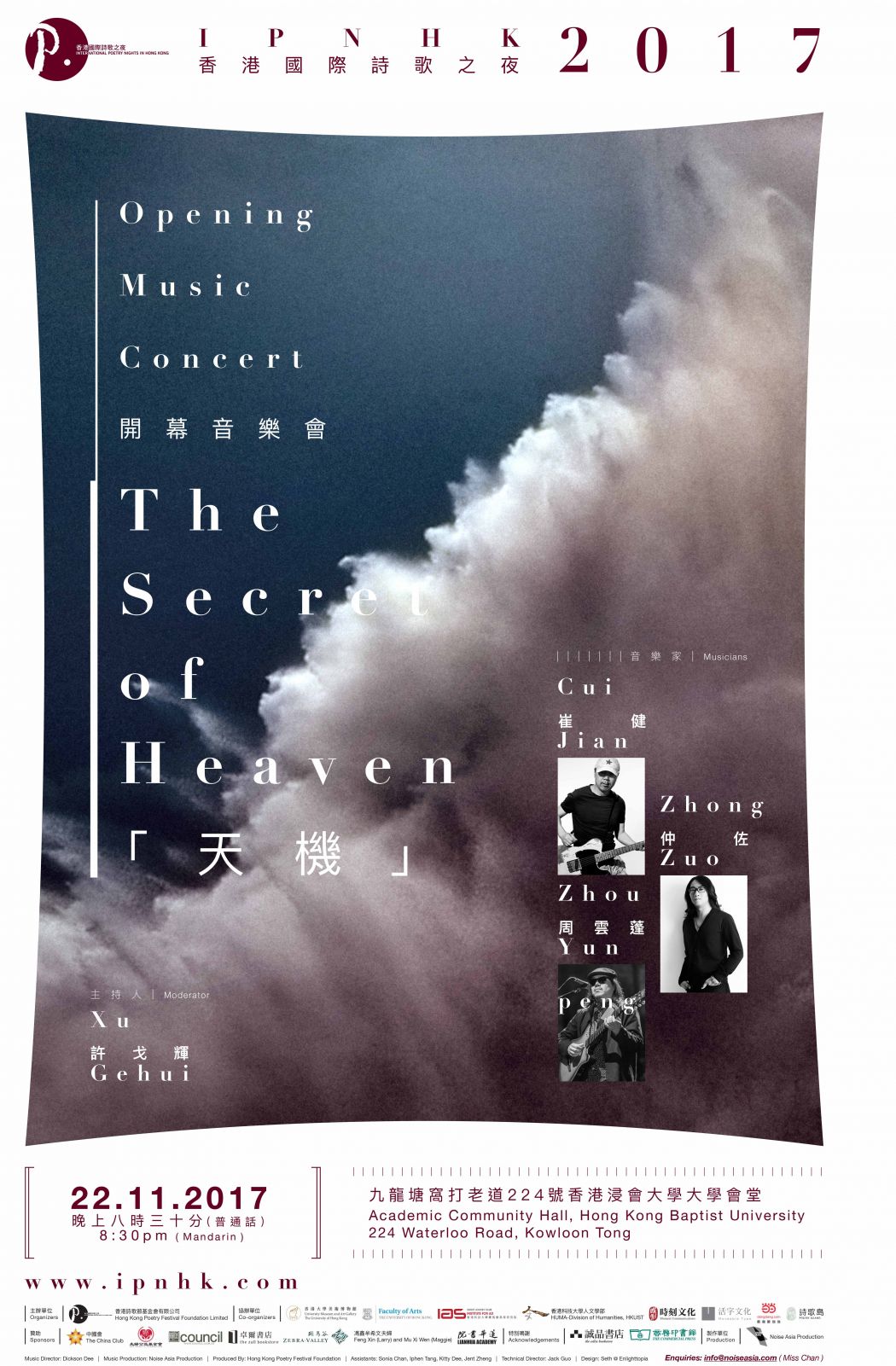
Poet Charles Bernstein will be joining poets Maram Al-Masri (Syria), Gabeba Baderoon (South Africa), Javier Bello (Chile), John Burnside (UK), Chan Chi Tak (Hong Kong), Chen Dongdong (Mainland China), Chen Xianfa (Mainland China), Chow Yiu Fai (Hong Kong), Lorna Crozier (Canada), Julia Fiedorczuk (Poland), Hirata Toshiko (Japan), Agnes S.L. Lam (Hong Kong), Moon Chung-hee (South Korea), George Szirtes (UK), Mark Tredinnick (Australia), Anja Utler (Germany), Dmitry Vedenyapin (Russia) and Haris Vlavianos (Greece), Syrian poet Adonis and Japanese poet Shuntaro Tanikawa at the International Poetry Night in Hong Kong on 22-26 November 2017 and in Guangzhou, Hangzhou, Nanjing, Wuhan, Xiamen 27-29 November 2017.
For more information, check out this link from the Hong Kong Free Press: https://www.hongkongfp.com/2017/11/14/event-china-rock-pioneer-cui-jian-renowned-poets-adnois-shuntaro-tanikawa-feature-intl-poetry-event/
We were fortunate enough to publish Charles Bernstein’s poem, Anaesthetics, in our Fall 2016 Issue which you can view here: http://www.thecafereview.com/anaesthetics/