


Interview with Carl Dennis
Interview
with
Carl Dennis
conducted by
Kevin Sweeney
via email on July 17, 2017
KS: Marlon Brando famously posed a question many of us have pondered: I “could have been a contender instead of a bum?” Is that a theme we find in Carl Dennis’s poetry? The life that might have been, but there’s this one instead? “The God Who Loves You” is an obvious choice as a poem with this theme, but I can think of others.
CD: I do muse about alternative lives, but not out of any feeling that I missed my big chance. It’s more that we live only one of the possible lives that are open to us after we have been given our place and time, our parents, and our teachers. I think it’s useful to give these ghostly alternatives some kind of acknowledgment in order, first of all, to consider the role of accident, of luck, in our lives. If we think we are living the only life that it was ever possible for us to live, we are less capable of seeing others as ourselves in other circumstances, less able to realize that we could be them and they could be us. And it can lead to regarding all our blunders as unavoidable, which is a tempting but dangerous fiction, the temptation of determinism, which cripples serious retrospection and serious reflection on the kind of future we want for ourselves.
KS: Your poem “New Year’s Eve” is such a great illustration of Thomas Nagel’s essay “Moral Luck” and the role of chance in our lives? Was the poem inspired by that essay? Do you know if he’s read the poem?
CD: This poem raises the question about alternative lives with reference to someone whose life is like our own but whose fate is very different. We skid into a snow bank, while someone else, going no faster on the same turn, kills a pedestrian. The difference between being harmless and being harmful may be a matter of accident. Thomas Nagel’s term “Moral Luck” is one way to describe this situation, and I do know his essay of that name, but what he is describing has an ancient pedigree, a variant of the thought, “There but for the grace of God go I.”
KS: Would it be wrong to ascribe a Whitmanesque quality to many of your poems? I’m thinking of “Boys at Play” about the three black boys who play with you and your brother one afternoon in St. Louis, the poems about a roofer, soup kitchen workers, a librarian, the prisoner John Hemmers whom you wrote about first in “Twenty Years” from The Outskirts of Troy and again in “Words From John” in Another Reason.
CD: I’m very glad you find a Whitmanesque quality to my work. Whitman is one of my heroes, a hero that I address directly in a poem included in my new book of poems. I can’t claim that my poems contain the multitudes that Whitman provides us in Leaves of Grass, but I do believe that one important function of the imagination is to put enough doors and windows in a poem to allow the poet to enter the lives of people beyond his or her own experience, at the far edge of the circle of one’s acquaintance.
KS: I remember it as an expression of great respect to call someone a “poet and philosopher.” I believe that would be a good description of you given how the “examined life” is a central concern in your work and the number of philosophers about whom you’ve written. Socrates, Nietzsche, Hegel — no surprises there — but Bishop Berkeley?
CD: I would like to think that my poetry handles some of the big questions philosophy deals with — what can we know, how shall we live, what gives a life meaning. But philosophy strives for an impersonal perspective, whereas the poet’s perspective is personal, that of a particular person speaking on a particular occasion in a particular mood. Like the philosopher, the poet has to turn away from the world of action into a realm removed enough from the noise and bustle of the day to think without interruption. But the place of retreat for the poet is usually not so far from the flow of life as the philosopher’s. Instead of retreating to a tower, poets tend to camp by the roadside for the night, and then take to the road again in the morning. “Shoulder your duds, dear son,” says Whitman’s bard, “and I will mine. . . . . / Wonderful cities and free nations we will fetch as we go.”
This middle perspective is also evident in Wordsworth’s more sober formulation of poetry as “emotion recollected in tranquility.” The poet needs to get some distance on raw experience, but what he or she works with are the feelings stirred up by direct contact with the world. The distance provided by the “tranquility” helps to lead him to find in the local and passing something universal and lasting. This process is what Aristotle means when he remarks that poetry is more philosophical than history, when he says it is not interested so much in what has happened but in what might happen or should happen.
KS: Some American poets, as they age, produce rather gloomy poems. Stephen Dunn and Charles Wright are two examples.
Is it that they see the end coming — annihilation, the end of consciousness. I’m not sure I see the same thing in your later poems. In fact, your most recent volume has what could be seen as an optimistic title, Another Reason. Am I missing something?
CD: I think I would distrust an older poet whose work isn’t gloomy now and then. It’s not simply that if we love life we must be sorry to leave it, but also that living a long time means that many beautiful things have been taken from us, many projects that we thought lasting, many people who by rights should have been allowed to live longer than the short time they were allotted. I can’t do better here than to quote Yeats’s lines: “Man is in love and loves what vanishes, / What more is there to say?” And yet there is more to say, beginning with the observation that the desire for what is vanishing not to vanish seems to be eternal, as is borne out by the history of poetry through the ages. As for the title of my last book, “Another Reason,” I intended it to face two ways. On the one hand it can be read ironically, with reason offering just one more justification to do what we usually do, one more excuse to give us cover. On the other hand, it can be read to announce another way of getting at the truth, to enlarge reason with the imagination in a way that frees us from the purely private point of view, that lets us get at something we all share.
KS: Time is a topic that keeps popping up in your poems. You’ve called it “too weak a god to worship” and in “A Sect,” from Callings, you say that those hopeful about the arrival of a new year are about to learn “It will swallow them up with all they cherish.” Anything new you have to say on the topic?
CD: This question is another way to talk about the double movement of poetry I just mentioned. Time is the medium that all living things dwell in, and it keeps giving and taking away. When we’re young we notice what it brings us — all the things we talk about through the analogy with the vegetable world: growth, budding, flowering, flourishing. When we’re older we tend to notice more what it takes away, how it replaces health with frailty and replaces an open, spacious, mysterious future with a small, confined, and predictable one. The challenge as we grow older is to be comforted by the thought that the world will go on without us. Consider Whitman’s pleasure in addressing his readers far in the future. It stems from his hope that he can understand us and encourage us.
We too can work for the values that he has worked for in his best moments. The political implications of this hope are obvious. However gloomy we may be about the present moment in America, however thoughtless and ignorant we seem to have become, we need to believe we still have enough time to come to our senses.
KS: The philosopher Julian Baggini said that immortality would be boring? That sounds like it could be the subject of a Carl Dennis poem. Any thoughts?
CD: To wish to be immortal is to wish not to be a human being whose only medium is the medium of time, who can only live a life with a beginning and an end. It wouldn’t be you who lived forever; it would be someone else. The only way to talk about immortality that makes sense for us mortals is by adopting the notion of an eternal return, an eternal reincarnation into the particulars of the life we have already lived. Nietzsche views the ability to wish to live one’s life again and again as the test of the complete human being, of the hero who can cast out all remorse and embrace all that has happened. He calls this wish an expression of amor fati, love of fate. Speaking for myself, I can’t see this wish as a possibility. I would want to make some changes. I deal with this issue directly in my poem “Eternal Life,” in Practical Gods.
KS: An old friend once told me the title of a book he was writing: When the Lights Inside Us Turn On. I think I often have that experience when reading a Carl Dennis poem, such as “Adventure,” the poem about a Chekhov character, or “Bill of Rights,” both from the book Meeting with Time. Am I failing to credit you with what one American philosopher called “fashionable nihilism?”
CD: I am very glad to hear that some of my poems have made you feel that they turned a light on. I don’t think that this is the same thing as providing an affirmative view of life. The two poems you mention, “Adventure” and the “The Bill of Rights” are not particularly cheerful. When I’m moved by a poem, I feel that an intractable human problem has been treated fully and sympathetically. When poetry works, it offers evidence that the reader is not alone, that someone else has felt and thought what the reader has felt. When this happens poetry proves itself the most intimate kind of writing, in which one person speaks to another directly, without the mediation of a narrative.
KS: In Poetry and Persuasion you assert that for a poem to be “convincing,” the poet has to “construct a speaker whose company is worth keeping.” How can we describe a prototype Carl Dennis speaker? What makes for “convincing voices?” How do your speakers exhibit “certain virtues that win the reader’s sympathetic attention?”
CD: I don’t want to give away any secrets here. Rather than talk about my work in particular, let me end here by focusing on poetry in general. The premise of my book on poetic rhetoric is that the character of the speaker is the central fact in explaining how poems move us, that poems succeed to the extent that they make us feel that a particular person is standing behind every line, a person who cares about what he or she is saying, who has thought long and hard about it, and who can connect the subject at hand to subjects that at first seem far afield. To find that a poet speaks to us is to enter into a creative dialogue.
Combed by Crows and Lesser Eternities
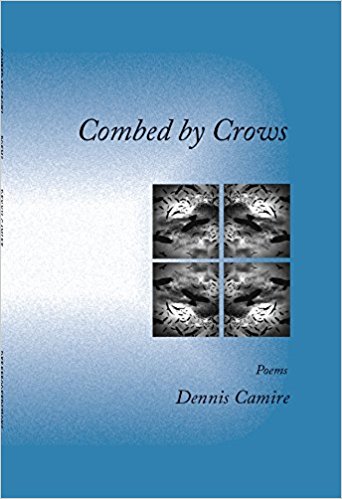
 Combed by Crows,
by Dennis Camire, Deerbrook Editions, 2017,
96 pages, paper, $17.49, ISBN# 9780997505160
Lesser Eternities,
by Jim Glenn Thatcher, Deerbrook Editions, 2017,
122 pages, paper, $17.95, ISBN# 9780999106
Infinities, earthly woods and gardens, and human language are some of the realms explored by Maine poets Dennis Camire and Jim Glenn Thatcher, both of whom have long been known by many in the Portland poetry scene (including myself). Their books, Camire’s Combed by Crows and Thatcher’s Lesser Eternities, both recent releases of the Cumberland press Deerbrook Editions, move between the boundless and the infinitesimal, and they find, in the balance, a reverence.
Trout streams and gardens prove rich archetypal settings for pleasure, contemplation, and empathy in Combed by Crows. Camire revels in the comfortingly tactile language of lures and fish stories: a “burly” fisherman is “lured to cast / The ‘fat bodied balsa b crank bait,’” and then to seek solace for the death fishing-loving dad, to find words “as soothing // As whispering ‘Williams Wobbler,’ / ‘Quick-sinking Hopkins Shorty,’ / Or ‘Stanly flat-eye, soft-skirted jig. . . . ’”
In the garden, meditative odes abound — to scarlet runner beans, earthworms, and gardeners’ widows; and such is the power of shoots and tendrils that the poet is moved to wonder, in “Ode to Lettuce, or the Secret Life of Lettuce,” “[j]ust who / Raised Who.” The process and results of cultivation are acts of creative love and spiritual expansion. In “For The Giant Pumkin Growers,” men carve their harvest into child-size doll-houses and dories, nurturing hopes to let all see that
. . . joy and fascination is what grows
The heart’s own gourd-like organ
To expand so high and wide that, like the
Fascinated October child, you dream, too,
Of crawling inside and, for a while,
Making it home while standing at full height.
Gardening provides just one realm for Camire’s ebullient stylistic whimsies — for the personification, puns, alliteration, and big similes — that course through this book. He anthropomorphizes US regionalisms of “Southern collards” and “Waspy, sweet corn” in “Observations on the Garden, Fourth of July,” and proclaims climbing peas to have access to “our much praised / Upward mobility.” And in “Upon Hearing that ‘Bread is the Way Sun Enters the Body,’” he punningly riffs: “I feel this need to knead on my knees. . . . ”
Sound, indeed, is a playground for Camire; he revels in music both subtle and extravagant. In “Trophy Lake Trout,” as fishermen consider the “metaphysics of bag limits,” they ponder the “apostle fishermen” and “the crucifixion that wasn’t supposed to slip their sweet Jesus into / The slick creel of eternity.” And abundant alliteration riddles his odes to letters of the alphabet. In one he acclaims the letter G’s “GQ visage / And garrulousness / So ingratiate / That we deem him / Congenial and gentrified.” In another, he lauds a shape, sounds, and ethos: “We shape O / Into a perfect circle / And make him the soul / Of ‘cosmos’ and ‘holy’. . . . ”
Just as Camire moves from a small written shape to a vastness of space and feeling, so does he balance limits and infinity, cosmology and stone walls, disability and unexpected transcendence. In the book’s opening poem, “Ode to Teenagers’ Hairdos in June,” crazy-color dye-jobs turn the mother of a “Down Syndrome child” to tenderly think on how even in his fifties, her boy will “Still seduce her into this world’s strange beauty. . . . ” And in “Watching the Man with No Arms Teach the Boy with No Arms How to Fish,” the speaker watches in awe to see how, “when the / Bobber dimples / Under with fish,” the fisherman “sets the hook with a karate kick,” then how his toes “Tip-toe / Down / The bass’s / Throat.”
This particular fishing poem, like many of the poems in Combed by Crows, lands clearly and tenderly on compassion, empathy, and praise in the face of fragility, on a “we” that realizes a “sudden wild sense // Of gratitude and reverence. . . . ” Here, as throughout the book, Camire conjures an uncommon communion in his conclusion that all of us,
like the boy, hope
We can learn to reel in
Such a beautiful
Frightened being.
Praise of creation and fragility, both the infinite and the humble, are also the realm of Thatcher, as he explores the beyond and the body, nature and language, cosmos and selves accrued by story, line, and syllable. The book’s title poem, Lesser Eternities, places we humans on “an infinitesimal planet” within “eons of endless emptiness”; he muses how, on the “semi-verdant skull of Earth, / consciousness rises slowly, in dim patches / — for how few millennia now?”
Early in the volume, his speaker mulls on naming, how “words rise from our nature to make the world legible, / struggling toward meaning through the stutter of being. . . . ” And he is, he knows, part of a lineage of namers. Alone in Athens, he feels within him “the urgent, inexorable rise / Of a teeming procession of spectral humanity. . . . ” Through encounters with wolves, constellations, and fireflies, his experiences in nature shape his sense of place in the vastness. In “Consciousness,” out in the snow under a full moon, the speaker “smiles at the joy of being an infinitesimal speck / in the world’s mystery. . . . / finally triumphant for having lived at all.”
Thatcher conducts these meditations, often, via a third-person speaker (a habit he meta-poetically acknowledges in “Different Waters Flowing”: “The third person: He realizes again / how he likes to think of himself this way, / knowing it’s a ruse. . . . ”). His natural imagery is often striking and precise, as when he describes “[t]he stark pall of still another late November; / grey half-light on dim-shadowed snow, / skeletal trees leaching black veins into a dead sky.” Or here, finding these signs of spring, in “Waiting for Persephone”: “The droop of catkins / forming in the aspens, the red haze / gathering in the maples, / a deepening blush in the birch-tops.”
His explorations are also rich in epic mythic imagery and archetypal figures of literature and lore. His docents and traveling companions are Gilgamesh, Li Po, Calypso, Hesse, Beowulf, Atlas, “Neanderthal and Buddha, algae and Christ.” His travels range from the Lethe to the constellations of Perseus and Cassiopeia. He writes of a “no-thing” that forms “one atom, the egg of existence,” which in turn forms “the Ur-Word; the primal noun.” In “Ancestry,” he finds his own material origins in the mythic:
My life is mind, is matter,
Is dry bone and wet flesh,
Labor of love and dance of death,
Mandrake root in Eden’s sod —
. . . ash of Adam and horn of Pan.
It is by such epic influence and by poetry itself that he navigates both the cosmic and the humble trajectories of a man’s life and understanding. What Basho, Dante, and Quixote have given us, he says, “are gifts of self / and longing — bright flashing moments / when brief shimmers of meaning leap like salmon / above the currents of our unknowing.”
Thatcher’s speaker finds himself dynamically involved in these creative forces when he takes to the page, when he “hurls himself onto it — becomes the page itself; / gets this line down, lets it take him where it will, /. . . alive again in the fury of becoming. . . . ”
And finally, in “Understory,” he imagines those who will find the leavings of his creative acts, of his becoming, noun by verb by line. What these forebears might find, he muses, is “a runic hand-scrawl / scratching itself into granite, sand, leaf, bough, fin, fur, / feather, claw; the commonality of blood and bone and branch — / Histories of a self gone Other.” It is a legacy in which Thatcher includes all who reckon with our strange presence in the vastness, includes all of us who seek to give it names.
— Megan Grumbling
Trust Rust: Poems
 Trust Rust: Poems,
by Will Lane, Middle Street Bindery, 2016,
40 pages, trade paperback, $10, ISBN# 9780692030820
Awhile back, I was ruminating in emails with a Café Review editor about the phrase “great poetry,” whose use has, well, expanded in the last fifty years. Over that span an enormous amount of technically competent poetry has
been written (we agreed) that is nonetheless not distinguishable as “great,” or “great-great” in the editor’s pinpoint honing of the idea. To quietly accommodate this situation, we’ve long since dropped comparisons of our verse to Shakespeare or Wordsworth, and seem to be relinquishing mentions of debt to Dickinson, Whitman or even masters within living memory like Elizabeth Bishop.
Arguing out this viewpoint would require evidence from a detailed study of postwar American prosody that no one, I believe, has yet troubled to make. But I will say that competence and incompetence with the language are detectable by well-read eyes; after that, judgments about great or great-great poetry start receding into the mists of subjective experience. Like, for example, the preference for sociopolitical topics conveying certain moral dispositions — aka “activism” — that are currently in high vogue. Or a preference for particular subject matter, such as nature, or painful personal pasts, or meaninglessness. Etc.
So to disclose pieces of my own matrix, Will Lane’s collection Trust Rust was steered my way by a friend who thought I would appreciate his observations on the natural world and find his skill with the language a bit sharper than competent. My friend was right. This is a collection of poems that are not great, but are well-made and well worth attention.
Lane’s world comprises rural Pennsylvania and a wide-ranging knowledge of Western literature. The book’s opening poems cover wood-splitting, a library, a huge snapping turtle, “Owls in Winter,” and a cat’s unseen night work, concluding: “Can you smell that cool light? / Can you smell the tiny souls hardly worth eating?”
Further on, we’re plunged into playful allusions and observations on our literary predecessors: “Visiting Emily: a review of a book cover,” “The Death of an English Major: for Doug, lost on 9/11/01,” and “Myth of the Orchids” whose phrasing and “larger mind” point strongly toward Wallace Stevens. “For Anne at the Winter Solstice” appears to be a playful inside-outing of Robert Graves’s iconic White Goddess poem “For Juan at the Winter Solstice.” And there’s a quite beautiful evocation of Thoreau’s relation to the natural world and our relation to him, in “Thoreau” (the last five stanzas here):
Walking the ice,
axe in hand, at ease
with the depths
of Walden mapped, and twice
alive now
with tumbling clown clouds
scribbled down
in a notebook, rich
in loons learned,
in citizens sized,
in farmers and farms,
thought through, sparkling
now on the lean ripples
of the well-written pond.
Sharp imagery, wry summation of Thoreau and his discontents, and a nice enveloping allusion to the ecology of words.
And on the language, note the subtle but quirky diction where only a stanza break gets us from “in farmers and farms” to “thought through, sparkling” — what it is that’s sparkling is hypnotically uncertain. These quirky twists of syntax show up here and there, unobtrusive until you look more closely at the sentence than you might normally think to do; these licks of natural unnatural language reflect, apparently, exactly what he means.
This is not great-great poetry, but it’s well-made and projects a certain spirit that is agreeable and livable, glinting when you settle into it, puzzling but not inscrutable. Worth attention.
— Dana Wilde
Float
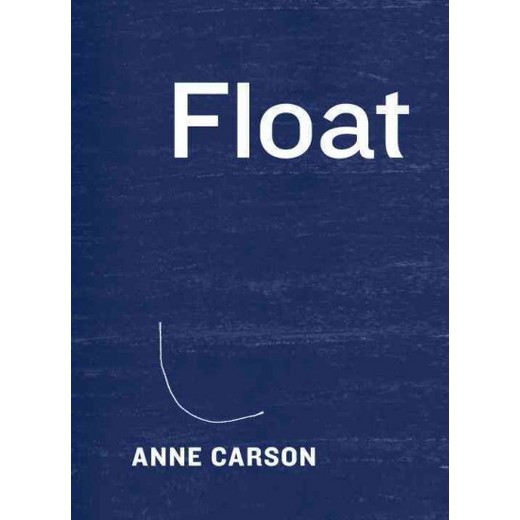
Float, A Collection of Tw enty-two Chapbooks Whose Order is Unfixed and Whose Topics are Various,
by Anne Carson, Knopf, 2016,
272 pages, paper, $30.00, ISBN# 978-1-101-94684-8
Reading Anne Carson does things to my body. I’m not sure I can fully explain it, but there’s a freshness to reading her like a sharp blade between ribs — “a thin edge that appears where no edge is scheduled” — and I’m either laughing at the brilliant reflection within this entry, this art, or I’m scrambling, grappling with meaning, trying to hold on to something that’s undoing itself in front of me like a building collapsing in slow-mo. You know that kind of laugh you get when you suddenly see yourself ? Ha. The whole theater played out before you like a giant pile of glittering dust. So much opened up, so much exposed, and then a cave-mouth smoking out its frank and welcome air. Which is all to say, Carson is one of our most restlessly — relentlessly — experimental poets. She always seems to be driving with her hands off the wheel, magically keeping the whole thing in motion.
Carson is trained as a classicist and teaches ancient Greek for a living. Her previous essays and poetry are peppered with sharp feminist analysis of those foundational Greek myths that still ground and torment us. This collection contains such references, and also reveals how much she has worked with other artists in collaboration or on commission — Roni Horn, Laurie Anderson, Tacita Dean, members of the Merce Cunningham Dance Company, novelists Joan Juliet Buck and Will Aitken, to name a few. You can tell she finds rich ferment in these dialogues and intersections. She also seems to know a whole lot about art. The short piece “Eras of Yves Klein” had me rolling in the aisles with its sly presentation and savvy critique. The piece echoes with meanings. But the works are not only for those in the know — you might have to do a little research, but reading “Merry Christmas from Hegel,” for example, simply lets you in on the atmosphere she encountered while reading Hegel, one that led her to “snow standing” one lonely Christmas Day after her brother died. It’s an exquisite prose poem. You don’t have to know Hegel to get it, but it adds another layer.
The first piece in the collection that took my breath away is “Cassandra Float Can,” a “lecture in three parts . . . [that was] accompanied in performance by images of the works of Gordon Matta-Clark shown as slides and on large posters carried about the room.” Moving swiftly from Cassandra, whose prophecies were beyond belief, and the “tautological” arts of prophesy — “they reason in a circle” — to questions of translation, she notes both translation and prophesy cut through surfaces “to a site that has no business being underneath.” What does she mean here? You have to follow her mind through the text and its accumulation of provocative ideas and things — Edmund Husserl’s 30,000 pages of unpublished Bavarian shorthand, the rate of thought as compared to that of speech, the question of an original surface, veils, the Romantics, and the notion that compared to the domestication of a sentence, a text might remain “wild,” cut free from use. This brings us to the cuts of Gordon Matta-Clark and his “retranslations” of space. It’s a magisterial gaze that absorbs the finest lines of thought and, through layering, brings us to a very “thin edge of seeing.”
Another chapbook, “Stacks,” works in layers. Prophesy reappears, and so do cuts and edges. This series is comprised of lists and re-orderings — re-viewings — of material. Jezebel, the false prophet who is thrown out the window to the dogs by her own court for her transgressions, inhabits these poems. In “Shame Stack,” which contains a working out of the difference between shame and guilt (shame requires the eyes of others), we are told:
No one could
relax around Jezebel. Psychoanalysts say that
shame ruins your capacity for reverie by making cracks
in the mind where it is dangerous for thought to wander.
And into this crack pour poems: a list of seas on the moon, a “Stack of Definitions of Stack,” five “Thunderstorm Stacks” that thrash through the chapbook asking to be heard. Did you know that “Bronte” means “thunder” in ancient Greek? Various initial poems (“Stacks”) are subsequently “re-stacked,” re-tooled, fleshed out and counted. It’s fun and funny and also full of rage. Carson is exorcising demons from within the words. She pushes her language to the edge of meaning and asks us again, where lies the edge of belief ? Who decides whose prophecy is heard?
This poem seems to offer a playful methodology for reading the entire collection. Turn it over, shuffle it and re-stack it. The pile of chapbooks can get unwieldy — it slips out of its plastic case, off your lap, and disorders — but this seems to be exactly what Carson wants: for her reader to find a new order, to flesh out fresh connections between things. And, it may in fact be this fresh kind of seeing that most impresses the reader.
“Variations on the Right to Remain Silent” is an astounding essay on art and the art of translation and those places where language “falls silent” and refuses to mean, refuses to be translatable. Odysseus, Joan of Arc, Francis Bacon, Hölderlin, and Paul Celan are our guides for this essay that falls apart into a raucous series of playful mis /translations by its end. Each of these figures exhibits a genius answer to cliché — each of them exhibits a kind of “catastrophizing” of language and meaning, a refusal and resistance to the everything-already-said:
We resort to cliché because it’s easier than trying to make
up something new.
Implicit in it is the question, “Don’t we already know what
we think about this?”
Her point is, perhaps we don’t. Or we shouldn’t. To read Anne Carson is to enter a mind at work, follow the swift movement of thoughts and things in order to reconstruct meaning — or to unravel it. And it’s always unexpected, always something new.
— Julie Poitras Santos