

Marie Howe: New and Selected Poems
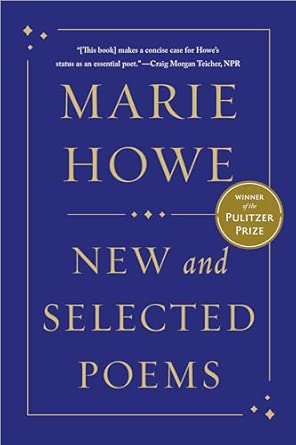
Marie Howe: New and Selected Poems
W.W. Norton & Company, 2024,
178 pages, paper,
ISBN: 978-1-324-11767-4
To Marie Howe’s New and Selected Poems collects work from nearly forty years and includes twenty new poems, in addition to selections from her previous four volumes. Awarded the Pulitzer Prize in 2025, Howe is a poet who has nurtured her community through teaching for many years. I was (full disclosure) Howe’s student at Tufts in the late 80s, and I know I am among many lucky poets who have received her alert attention to their early work (she currently teaches at Sarah Lawrence College). In a fast-paced world where many of us feel great pressure to produce at a rapid clip, what is striking is the spareness of Howe’s oeuvre, and the steadiness of her production. Howe has published her work at a pace of about one book a decade, poems of considered tenderness and attention.
Marie Howe’s work is lyrical and autobiographical, and the books speak from different stages and transformations of life, through an often-surprising confluence of the spiritual and the everyday. In 1989, Howe lost her brother John to AIDS-related illness; and in the years following she edited, with Michael Klein, In the Company of my Solitude: Americans Writing from the AIDS Pandemic (1995). In interviews, she has reported that this loss completely transformed her aesthetic. Her second collection of poems, What the Living Do (1998), marked this shift to a more direct use of language. Reading this volume of New and Selected Poems makes the evolution of her poetry across decades legible in a more comprehensive manner, clarifying her steadfast interests in the metaphysical and temporal experiences of living.
It makes sense, then, that one of Howe’s consistent obsessions is describing our experience of time. Indeed, as much as her poems often suspend a reader in those sudden life-changing events that still our consciousness, she also articulates a struggle to remain present in daily life. In the new poem, “Another Theory of Time,” for example, when her daughter admonishes her to “Think about Now,” the speaker “think[s] about the moment I want so much to leave / —how small it is sometimes, this Now— / how constricting…”. And in another new poem, “The Maples,” the speaker asks rhetorically “How shall I live my life?” and later replies,
Stand still, I thought,
See how long you can bear that.
Try to stand still, if only for a few moments,
drinking light breathing.
Equally, her new poems consider the larger time scales of the planet, and our mortality in the face of hastening realities of climate change. In “Advent,” an “approaching horizon” appears that we realize we knew was coming, but “[b]y then we could not remember the before / before it had the after in it.”
In a moving earlier poem, “The Gate” from What the Living Do, the speaker remembers her brother who has passed. It begins: “I had no idea that the gate I would step through / to finally enter this world // would be the space my brother’s body made.” One imagines this entry is made more fully into life and into the present, a painful outgrowth of grief. The speaker describes how her brother would say “This is what you’ve been waiting for….”
And I’d say, What?
And he’d say, This — holding up my cheese and mustard sandwich.
And I’d say, What?
And he’d say, This, sort of looking around.
In the beautiful first poem from her first book The Good Thief, “Part of Eve’s Discussion,” also collected in this new volume, Howe puts us on the threshold of what we imagine is about to happen but has yet to occur: “It was like the moment when a bird decides not to eat from your hand, / and flies, just before it flies….” The language suspends the reader in anticipation, and the images layer and accrue and acquire momentum—”as when / a hundred starlings lift and bank together before they wheel and drop….” The poem moves forward with increasing tension as all entities pause and hold—
very much like the moment, driving on bad ice, when it occurs to you
your car could spin, just before it slowly begins to spin, like
the moment just before you forgot what it was you were about to say
—and the language compresses; it collects itself in this unknowing moment and catches there, holding us—
it was like that, and after that, it was still like that, only
all the time.
—Julie Poitras-Santos