

The Ends: Poems
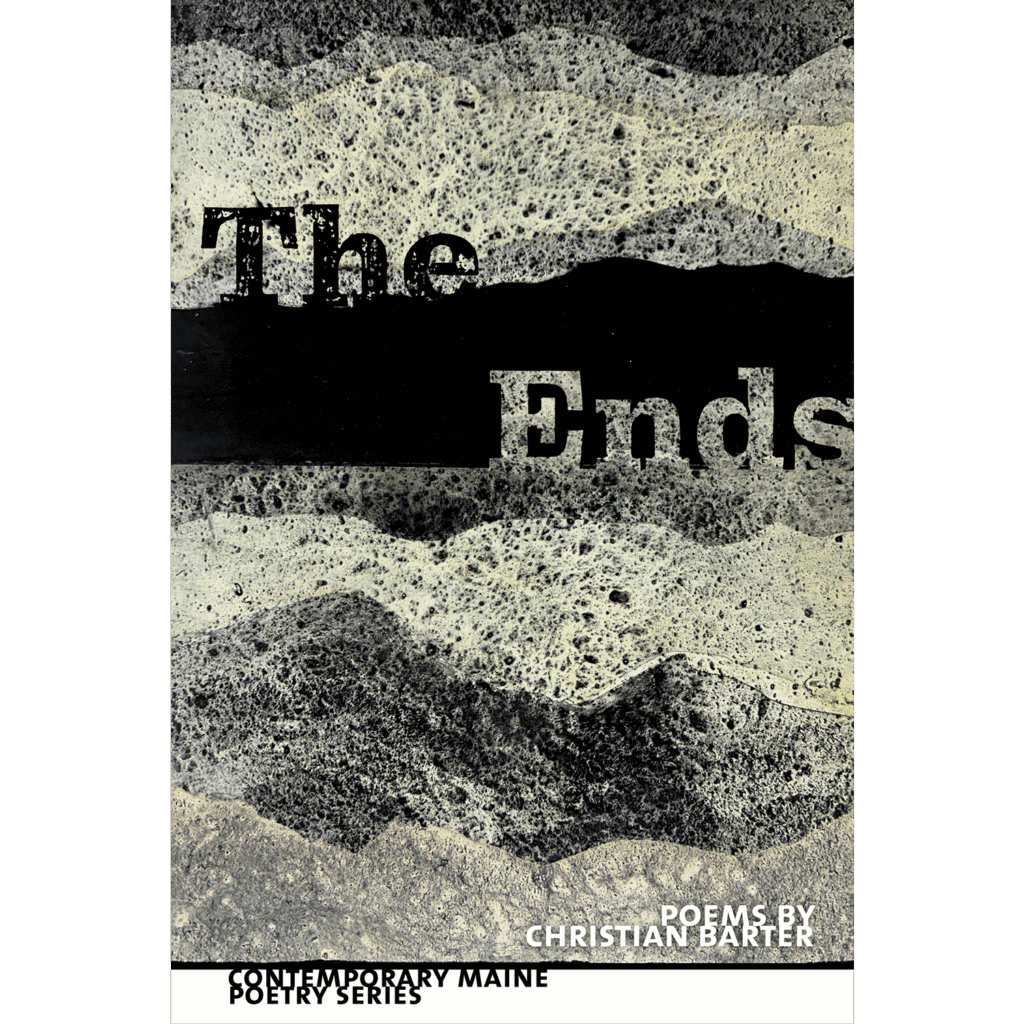
The Ends: Poems, by Christian Barter.
Littoral Books, 100 pages, paper, $20,
ISBN: 979-8-9917891-3-4
In a Café Review interview with Kevin Sweeney in 2020, poet William Carpenter mused on the people who work in, and with, nature in Maine, including “lobstermen, boat-builders, landscape painters, farmers and guides and park rangers and photographers.” Then he offered an example: “One of the best poets in Maine, Chris Barter, is a trail boss in Acadia National Park.”
The Ends: Poems, Barter’s fourth collection, bears out Carpenter’s appraisal and then some. A winner of several prestigious poetry awards, this Maine-born, Bates College-educated poet continues to offer us words and images that give off sparks.
Elegy provides a through-line. Barter writes movingly of late friends like Brad, with whom he once played R.E.M.’s “Driver 8,” and Michael B., a drinking companion who could “scab / an old starter onto an old Falcon.” He also eulogizes Christine McVie of Fleetwood Mac, revisiting her biography, haunted by her vocals on “Songbird.”
In the elegiac “Ruth’s House,” Barter conjures the home of Ruth and Denis Vibert of Sullivan, famed for their hand-glazed pottery. He thanks Ruth for showing his sister and him love when they lived in a place “where the dog-fighting violence of a rigid poverty / sometimes boomed through the night.”
The collection’s centerpiece is a series of 34 sonnets addressed to Mariah. Barter considers his lot in life, his surroundings, aspirations, regrets. In so doing, he spins brilliant lines like “My house can’t shake its cold, like a student debt” or “we are all of us old exes here, / Our pearls built on the grit of one another.” Addressing “M” at the end of #29, he states his fate:
We’ve been, the world and me, M, codependent:
I’ve built an ego calling out beautiful wrongs
and the world has kept supplying me with them
like a father pouring drinks for an upset mom.
“Champlain” and “Acadia” date from Barter’s time as poet laureate during the park’s centennial in 2016. The first begins from the French explorer’s perspective, with a momentum that brought to mind Gordon Lightfoot’s “Canadian Railroad Trilogy.” The poem turns personal half-way through—“I guess I’m looking for my own bearings / in the world such as it is”—and ends with an evocation of the French Jesuits who came to the island “to bring / to their eternity the souls / already here.”
“Acadia” is an impassioned call to conserve the island. Barter repeats the invocation “May we” throughout, involving all of us. “May we trust ourselves / against the common rhetoric that land is to be ‘used,’” reads part of his rallying cry.
In addition to the cover and interior art by Nancy Manter, The Ends features a bonus track: an interview with Barter conducted by poet Kate Kearns. He answers questions about specific poems, like the leadoff “The Errand,” a brilliant villanelle. The poem, he says, “explores the idea that in order to have true ownership over all the joy and excitement of setting out, we need to work toward the completion of the beginning.”
Answering a question about his homage to James Hampton, Barter expresses kinship with the outsider artist famed for his tinfoil creations. “I always wanted to explore that extreme impulse to have your only relationship be with your work—and what that leads to—which is tragic, and in many ways also beautiful and glorious.” On the evidence of the writing in The Ends: Poems, Barter is a committed and exceptional explorer.
—Carl Little