

The Kerosene Singing
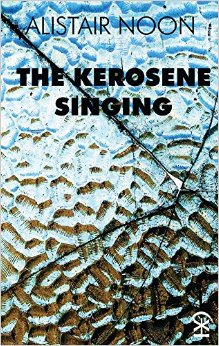
 by Alistair Noon,
Nine Arches Press, Rugby, U.K., 2015,
64 pages, paper, £9.99,
ISBN: 978-0-9931201-6-9
Buy the Book
Alistair Noon is a native Brit who has lived mainly in Berlin for the past twenty years or so, and along the way mastered not just German but Chinese, Russian, and good bits of several other languages. His poetry, as his recent collection The Kerosene Singing reveals, is a product partly of a deft sense of logopoeia — or “dance of the intellect among words,” as Ezra Pound instructed us — and, moreover, a masterful skill with the musical properties of words, or melopoeia, and the dreamlike states music coaxes from reality.
Noon’s subject matter covers, in a British ex-pat idiom, the gist of the postmodern sensibilities of this era: the relationship of personal to sociopolitical life; the ironies of power, especially in foreign lands; the strangely meaningful emptiness of the everyday; and the general ridiculousness of practically everything.
These subjects are bound mainly into little narratives that tend to start out as some kind of a foreign excursion, journey to a friend’s apartment, or shuffle home. At the outset of “Riding Home with Michel Foucault,” the speaker is on a train platform peering at its surrealistic announcement board. Then:
I run for the doors
to take my temporary seat
and read the origin of laws.
The books beside me speak:
“Where are you now on the market?”
“Are you sure you’re on the right diet?”
This State is my life, it asks me
to ride and read by night . . . .
Here, and often in Noon’s world, the everyday is permeated in dreamlike ways by sociopolitical pressures. In “Ode on a Bottle of
Maotai,” the packaging itself becomes a wry, ironically nightmarish figure of a Chinese communist approach to the politics of marketing:
Rip off the red plastic, friend, unscrew
that top! Now pour. Downstream of the Dam
the engineers have raised their toast,
a hint of vomit in its scent and taste:
Oh hold your drink and don’t fall down.
Likewise, “Khakassian Masks” takes us on a dreamlike journey through Central Asian history, with all kinds of implications about the Russian present. “Dream,” he writes, “and the narratives arrive. / There, in the smoke, the souls rise.” No coincidence here, either, that one of Noon’s explicit guides in poetry and politics is Osip Mandelstam, whose poetry he has translated.
The tenor of all this is conveyed in exquisitely wrought sonic patterns. In the lines from “Riding Home with Michel Foucault,” the slant rhymes in “seat”/“speak” and “diet”/“(life)”/“night” form a sonic thread. These assonances also are not accidents.
The best example of Noon’s music from The Kerosene Singing might be “An Update on the Status of Frost,” in its entirety:
Windows make fine translators
in cold, white morning light.
Gingko leaves, barbed wire lines,
rivers when viewed from space.
About our future, I would say:
the management of forests,
new languages of frost,
the constant labour of status.
The slant rhymes “light”/“lines,” “forest”/“frost” are immediately chordant on the ear, and a subtler thread is the assonant long A carried across “translators”/“space”, “say”/“status” (in the British pronunciation). These patterns shape the melopoeia that, in Pound’s words, creates “the bridge between consciousness and the unthinking sentient or even unsentient universe.”
Despite these poems’ persistent ironic humor, it sometimes feels like history is the proverbial nightmare from which the poet is trying to awake. But he says the emphasis is in the opposite direction: “I am slowly trying to emulate Mandelstam’s futurism, in the widest sense,” he has said, in response to a question about history and poetry, “and redirect what I write that way out of the present, if possible.”
The Kerosene Singing is well worth looking into, as are his previous collection, Earth Records (Nine Arches Press, 2012), and his chapbooks, like Swamp Area and Across the Water (Longbarrow Press, 2012), Out of the Cave (Calder Wood Press, 2011) and Some Questions on the Cultural Revolution (Gratton Street Irregulars, 2010).
Story & Luck
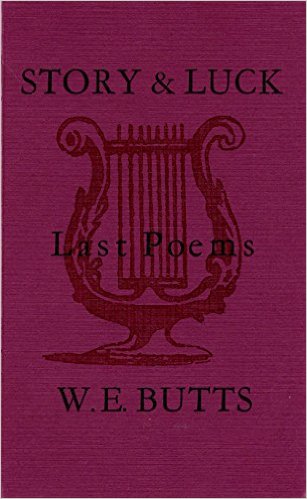
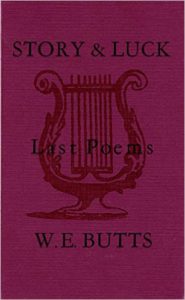 by W.E. Butts,
Adastra Press, 2015,
26 pages, paper, $17,
ISBN: 978-0-983-82387-2
Buy the Book
“W.E. Butts understands . . . what the great jazz man Charlie Mingus meant,” writes David Allan Evans, “when he said that ‘anybody can play weird, but what’s difficult is to be simple.’”
Fundamentally sound, a poet of immense depth and consideration, Butt’s work is primarily informed by two seemingly different eras. One influence is the post-WII period, with its well-earned nostalgia for home life and its attachment to honest living, dignity, and tradition, which makes for a poetry highly reflective and quietly infused with the language of his Catholic upbringing, ever reaching at earnestness, and given over to a lower-case truth-telling. A second influence is the 1960s, with its inherent tensions, upheavals, and mad rush into experiment and text-distrust, resulting in a heightened engagement with the world, more questioning, and even some strands of ambivalence and disillusionment — though all of it tempered by a Near-Eastern economy of gesture and preoccupation with the thought-ordinary image, this idea of writing-as-practice or inquiry, and an almost noir-ish nod to the past with a loosening up of his diction and lines.
Eventually, he would combine the two strains into a lyric-narrative hybrid that is remarkably thoughtful and wise, clear-eyed and urgent, and mightily concerned with humanity and its shaping, ongoing push towards the ideal. Regardless of what stage in his evolvement, Butt’s poetry is always unfailingly devoted, ever-measured and studied, to the rooting out of one’s voice, the perfecting of form, and the demands placed on us by being: the self-made-poet.
So it’s fitting that Story & Luck kicks off with this house brand of mysticism from another great jazz man, Fats Waller — “One never knows, do one?” — with its makeshift narrative, this strut of sorts, trained as best as it can on uncertainty, fate. While still interested in the same time-tested matters of his earlier work, Butts’ delivery feels even steadier, more determined, as he knowingly metes out this wisdom that, while modest, risks being dismissed by a younger audience seemingly addicted to the slickest of skill sets, power pointed-ness. Unlike the mass of writing today that opts for either stylistic overkill, cleverness (for not even cleverness’ sake . . . ) or these lists making much too much of one’s (you must forgive me . . . ) listlessness, he can always be counted on to meet not only memory, and all it asks of us, but his readership, more than halfway. Butts does so from the opening poem, “Primary”— a short and rarified briefing on politics, both local and not so, that draws more from the natural world than it does from the humanly legislated (“Weather reminds us / we too will settle”), its final gesture more bent on firming up and abiding-in, bringing to order, than it is about resignation, putting desire to rest — to the last, “James Wright’s Horses” which signs off with a familiar blessing still essential even when stared down by a battery of ailments (“There are certain words / that will transport us / to that other, flowering self ”), a benediction not only in mind of the words but the breaths that go into it.
Yes, grief figures in some way, in all of these poems, how the letting go of things, living, is both sired and resisted in the telling of it. But while the mood is meditative, tenderly voiced, its cast is democratic and masterfully commanded, whether it be the near-metaphysical trek of “The Cabin” with its half-imagined
gaining-on (“ . . . the higher you go / the cooler the air, the more / you feel elemental / and necessary”) or the tenaciously summoned reminiscences of loved ones in “Story”:
You look at the photograph hanging on your wall,
the one your friend took after a snow storm
of you and your wife, alone on the street, remote,
dark figures
that could be anyone, and above your heads
the Rosa’s sign in red script glowing against a
colorless sky.
Butts also gives numerous shout-outs to art — to music (“Some Small Blessing”), sculpture, photography (“In the Hand of a Graveyard Angel”), and, not surprisingly, literature. It is here where Story & Luck gains its hardest thought insights, its final
three poems registering one’s first and furthest initiation into that most noble of start-ups, where our words are forever working their way out from the dark:
First, “Lucky Deer,” a poem, which Walter’s wife S Stephanie explains in the Introductory Note, was “inspired by his grand-daughter Catherine, and his reading aloud a book (Brothers of the Senecas, which was actually written by Walter’s uncle Walter E. Butts Jr.) to her and her sister Chloe.” He reads the poem reverently, stirring to the line “Because history holds us to who we are,” before retiring, after several beddy-time misreads, with “The story changes, but it is always ours.”
And next-to-last, “Learning Williams,” in which a teacher’s animated lesson sells him on that most lyric of doctors, leading to this sermon-like moment: “I had come here an outcast, a kid in trouble but / one who loved / what words could do, how they silenced poverty / and shame, / and showed me things for what they truly were.”
And then, finally, “James Wright’s Horses” where that earlier seed-planting pays off with a wealth of what is most pressing.
And so, let us all say it now. With new meaning: Suddenly I realize / That if I stepped out of my body I would break / Into blossom.
— Mark DeCarteret
The Penny Poet of Portsmouth
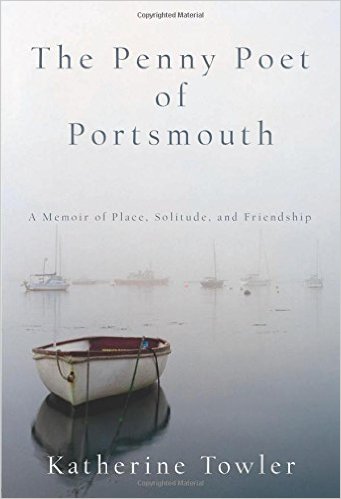
 by Katherine Towler,
Counterpoint Press, 2016,
282 pages, paper, $16.95,
ISBN: 978-1-61902-712-1
Buy the Book
In the hands of the most gifted memoirist, (seemingly) ordinary lives are shaped into extraordinary lives; their subjects becoming through the telling of their stories larger than life — perhaps even mythical — when taken in full context, to include post-scripted entries made during those immediate years after the subject has passed away. You’ve heard of The Great American Novel? Well, this is The Great American Memoir, one that does not have to depend upon hyperbole and invention to make it a compelling read.
The Penny Poet of Portsmouth is not simply an amassed collection of anecdotes and stories about Robert Dunn as told by the author. Dunn is very much alive and speaking throughout the entire memoir in his own words via actual spoken dialogue between he and Towler, between the quotation marks. If but one sentence spoken by the man himself defines his destined purpose on this earth, it would be from page 200: “Without poetry, I do not see that life is worth living.” Towler’s relationship to Dunn could arguably be defined as the role of Zen student to Roshi master.
Towler manages also to reveal to us the full spectrum of how a writer must live in order to produce a lasting and valuable body of work, the daily balancing act of securing the critical alone time to write while having to accomplish the necessary mundane chores and still find the time for spouse, family, and community friendships. It should be stated here that Dunn, though an amazingly gifted poet and genuine fey presence in his own right, was not a saint. He could at times be very demanding and passive aggressive, and that in turn imposed an ongoing burden of guilt upon Towler, who was not only a friend but took on the role of errand runner and caretaker to Dunn during his last few years, as his health began to rapidly decline. From the notebooks of Robert Dunn:
The most hideous moments of the last judgment might be the
discovery that I had barely tolerated people who are much
better than I. It would be such a loss not to delight in the
differences. People are strong and weak, wise and foolish, here
and there.
Towler’s memoir (she is also a novelist and poet) is almost as much about the growing pains in the evolution of Portsmouth, New Hampshire, from circa 1990 to the present day, as it is about Robert Dunn, a recognizable fixture who could almost daily be seen strolling the downtown streets or sitting on a public bench. Dunn was a throwback, a modern day Basho, and a Luddite of sorts. Though physically diminutive, Dunn was a cerebral titan: “He was able to read French, German, Latin, and Greek, though he never studied any of these languages, except perhaps briefly, in school.” He composed each of his poems in his head over a period of two to three months and was able to recite all of his poems from memory. He committed a certain number of poems to paper in the form of small handmade books to sell for a penny to his friends (hence the book’s title) or to send off to literary magazines. One can only imagine how many poems died with the man, poems that were never captured on paper. Dunn was amazingly tough as well, having stoically survived through COPD, a collapsed lung, pneumonia, a broken hip, and congestive heart disease before passing away in 2008 at the age of 65. The Penny Poet of Portsmouth includes many excerpts from poems, complete poems, and notebook entries. Here is one poem in full, and typical of most all of Dunn’s poems, untitled:
Walking by day through the
Historic District you feel uneasy,
as though someone was trying to
tell you something, and that untrue.
But at night the whispers tell
how Flash Charley passed out right
in Pig Turd Alley, and what
Gimlet Alice said to the piano
player before she and everyone else
stopped being.
For those who wish to obtain and read a well-edited selection of Dunn’s published work, one need go no further than to pick up a copy of his 2016 Selected Poems, One Of Us Is Lost, from Hobblebush Books.
— Wayne Atherton
Literature for Nonhumans
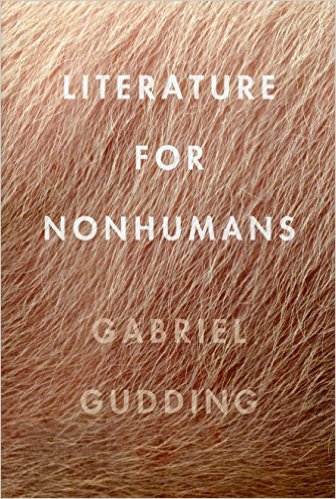
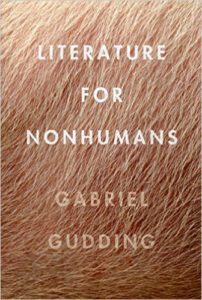 by Gabriel Gudding,
Ahsahta Press, 2015,
144 pages, paper, $22,
ISBN: 978-1-934103-63-0
Buy the Book
I was born in Chicago, “the great bovine city of the world,” “the historical city of the slaughterhouse,” as Gabriel Gudding aptly refers to it in Literature for Nonhumans. I was vaguely aware of Chicago’s, and all of Illinois’, slaughterhouse history, which Gudding examines shovel load upon encyclopedic shovel load, but like so many of us, I buried that knowledge deep in the back of the mind, where I conveniently don’t access it very often. That history is in the not-so-distant past; also in the not-so-distant past are my many years of vegan — and vegetarianism. Once the young man who stocked barbeque tempeh (“it’s not that bad, right!!!?!!?”) in
his parents’ refrigerator, now I count myself among the masses of lapsed vegetarians. There are many of us out there, plugging the holes in our conscience with organic sliders and free-range beef pups. As Gudding writes in his stunningly direct and spare Afterword, “the very thinkers who love animals and grow disturbed by their mass slaughter still eat them . . . still tell themselves it’s possible to humanely slaughter.”
I am among the guilty, and let it be said that I feel appropriately shamed. And yet, this is a poetry review. And Literature for Nonhumans is supposed to be a book of poetry, though it doesn’t always feel like it. I brought the book to the first day of my creative writing class, and we played “the novel game” with it, even though it isn’t a novel. For this game, I read the book’s back cover to the class, and then they tried to write the first sentence of that book. I’ll explain more of the game later in the review. However, after reading the book’s back cover to my class, I could tell I’d lost them. Eyeballs rolled back in heads; sighs escaped with obvious force. One young man laughed uproariously like he’d just heard a great joke: “Wait, wait . . . no, seriously . . . seriously . . . what did you just say? What’s this book about?”
What indeed is this book about? I told my student it was about slaughterhouses and animal rights. “Cool,” he said, but I could tell he wished it wasn’t about that. In retrospect my answer was rather stupidly reductive, but I chalked that up as yet another failed moment in the teaching of poetry. What can we do? This book is about many, many things. As the blurb on the back reads, it “links rivers, slaughterhouses, cars, buffalos, geology, churches, corn, defecation, piglet management, zombies, watches, sex. . . . ”
But mainly, it’s about nonhumans (meaning animals) and why we shouldn’t kill them. It all comes back to this refrain, though I couldn’t help but think that if, as the title suggests, this is supposed to be literature for nonhumans, wouldn’t my dog choose something a little more straightforward, a bit simpler, than this? Maybe something like . . . Hemingway? I could imagine my dog pointing to Gudding’s book in a bookstore, saying, “That’s a great book.” Then he’d choose All the Light We Cannot See.
Gudding is a seriously skilled poet. For example, take this passage from the section “Rivers for Animals”:
the sea is such an immense, babbling reservoir of urine . . .
sinking bags of organism, hull bottoms, dead children, ions,
and over it lolls the solar ovum banging through a park, the
south trees of a park, and there it goes getting onto a boat
under a river.
I love the galactic leap from “dead children” to “ions,” and then I really love the assonance that butts and smooths together “ions” and “over it,” and then the satisfying switch of the tongue to the roof of the mouth for the three “l”s in “lolls,” echoing that again in “solar,” and finally returning to the ghost of the assonance with that banging ovum. All ova will forever bang for me from now on.
Gudding’s prose (though I even feel forced to call it that) is far from prosaic, and I’d also not say it’s prose poetry, but more a poetic prose, wave upon wave, and it washes over you with the rhythmic lapping and sometimes crashing of history, economics, philosophy, and ethics: prose as a letting go of syntactic sense. “Rivers — their reason.” Poetry, its own reason.
But that’s not to say Gudding lacks a sense of humor in the midst of his vegan river rage. Body parts and functions litter the text, but I suppose one would have to find these funny, as I do, to consider it humor. I mean, how could you not think “Tart smell of farts over river water” isn’t a little bit funny? He also manages to use “anus” three times (unless I missed one), which prompts me to ask, how many times can one use “anus” in a book? Three times? That too much? Each one causes puckering.
But I have a feeling that this is exactly what Gudding is going for. He wants us attuned to our bodies so that we cannot so easily dismiss the bodies of our nonhuman brothers and sisters. Sometimes, he hits us with a moral slab of tofu: “We can feel comfort and love while eating a turkey while collectively denying the turkey’s wish for comfort and love, her desire to play and live.” Even with the syntax slightly off, the line hangs heavy, and feels less like poetry and more like polemics. That, indeed, is exactly the line this book walks. In fact, Gudding distances himself from a-ethical — ethically neutral — poetry that possesses a “performative indifference” to things like animal slaughter. Such conceptual poetry, as described on the Harriet Blog by K. Goldsmith and quoted by Gudding, “wouldn’t dare make the presumption that it has the power to affect the world for better or worse.” Indeed, that is the stuff that gives poetry a bad name.
It’s this sense of anguish, sometimes rage, that fills the book. When I finished reading it, I felt like I’d finished a novel, albeit one that moves primarily on one plane, ranging out widely to touch its topics. The book pulses with energy. In a highly entertaining and informative section about clocks and pocketwatches, Gudding writes:
Praised be the escapement, a device which through repetitive
mechanical motion regulates the running down of the
[e]motive powers. [reviewer’s creative emphasis]
This quote applies to Gudding’s entire book, which is a device to regulate and distribute the significant emotive powers at play. It feels measured in its passions because it needs to be. Otherwise, primal rage rarely sways a reader.
To end this review, I return to “the novel game.” As my students wrote their first line attempts, I copied down Gudding’s interestingly spaced first line (“The plan ets are old co l ore d platforms, almost porches.”). Then I collected all first lines, shuffled, and read them aloud, mixing in the real first line, and asked my students to vote. Surprisingly, no one voted for Gudding’s poetically unique opener; instead, a line about Hogwarts received the most votes. A professional hoop dancer in the front row, after hearing the real first line, said: “Yeah, I heard that one, and thought about it, but then I decided it was the worst of all.”
“No, no, wait, give it a chance,” I said to him. “It grows on you.”
— Jefferson Navicky