

From the New World, Poems 1976 –2014
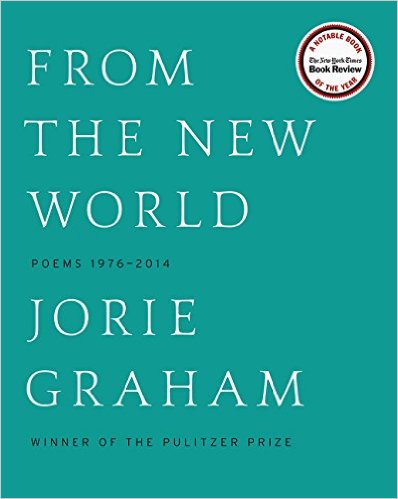
 by Jorie Graham,
Ecco / HarperCollins Publishers, 2015,
384 pages, cloth, $29.99,
ISBN 9780062315403
Buy the Book
This is the heat that seeks the flaw in everything
and loves the flaw.
— Jorie Graham
In 1923, Marcel Duchamp referred to his work, The Bride Stripped Bare by her Bachelors, Even as a “delay in glass,” much like a “poem in prose” or a “spittoon in silver.” Suspicious of words and yet enamored with them too, Duchamp literally suspended an image in space and time; creating a “delay” — of arrival, of meaning, in relationship to representation, in relationship to an “indecisive reunion” as Calvin Tomkins named it in 1996. The amount of time you wait for something that is held back, a period of time in which something is postponed or slowed down, this delay in Duchamp’s work, as in the poet Jorie Graham’s, creates the conditions of desire.
The occasion of Graham’s new selected poems, From The New World, Poems 1976 – 2014, tracking nearly four decades of the Pulitzer Prize winner’s work, provides an eloquent opportunity to regard the specific obsessions and investigations, and the aesthetic and ethical development, of her work. The collection creates a new trajectory through her eleven volumes, and is rife with “delays” of the best kind: gaps and lulls and flaws that seek mending or to be knit, that seek connection and dialogue. Graham moves from using language to describe delay and its accompanying desire in her early work, toward creating the conditions of a delayed arrival for her reader in the structure of the poems themselves in later work. The later poems elicit a breathless haste in their desire to arrive at new meaning.
An early poem, the third in this collection, “The Geese,” from her first book Hybrids of Plants and Ghosts, takes place in a yard in Murray, Kentucky, where the speaker is hanging out wash beneath the migrations of geese, while spiders imitate the paths of the geese above “to no avail: / things will not remain connected, / will not heal.” In this gesture, “the world thickens with texture instead of history, / texture instead of place” and the longing to connect is a desire to help things “recover their meaning”:
There is a feeling the body gives the mind
of having missed something, a bedrock poverty, like falling
without the sense that you are passing through one world,
that you could reach another
anytime. Instead the real
is crossing you,
your body an arrival
you know is false but can’t outrun. And somewhere in between
these geese forever entering and
these spiders turning back,
this astonishing delay, the everyday, takes place.
In many of Graham’s poems throughout her oeuvre, the shuttle moves back and forth across these kinds of delays; the poems are filled with metaphors of weaving, stitching, and sewing, making a fabric of the page we navigate and the ideas and images she provokes. For example, in “Girl at the Piano,” the speaker says of the daughter:
. . . Your sleep beside me is the real,
the loom I can return to when all loosens into speculation.
Silently, the air is woven
by the terribly important shuttle of your breath,
the air that has crossed
your body retreating, the new air approaching.
In the poem, “Self Portrait as Hurry and Delay (Penelope at Her Loom),” from Graham’s third collection, Penelope enacts delay as a strategy for fending off suitors, weaving and unweaving the story cloth daily, doing and undoing, effectively suspending time, and holding the story — her life — in place. The poem unfolds in a series of twenty-three numbered sections that provide occasion
for breath within the poem, pauses within the unfolding narrative. They also begin to employ a layering technique that becomes more nuanced in Graham’s work over time, creating a stratigraphy and accumulation of meaning. In this poem, she begins to ask readers increasingly to fill in the gaps, to enter the text and engage the delays, to engage in the stitching and unstitching themselves. Graham asks, “Oh but is it wide enough to live on, immaculate present tense, lull / between wars, // the threads running forwards yet backwards over her stilled fingers,” and later, “Yet what would she have if he were to arrive?”
“Le Manteau de Pascal,” the poem at the center of her sixth book, The Errancy, and located at the center of this new collection, regards René Magritte’s 1957 painting of Pascal’s coat, the Surrealist image of a coat full of holes hovering in the night sky above a distant urban horizon. In the endnotes Graham says, “One presumes it represents the coat in which Pascal was buried, and in whose hem or sleeve or ‘fold’ the note containing the ‘irrefutable proof of the existence of God’ is said to have been stitched at his request, unread, by his sister upon his death.” This poem, too, unfolds in a series of sections, including excerpts from Hopkins’s journals and Magritte’s notebooks. The breaks between sections, and the leaps in content and meaning, again create the conditions for great intimacy and exchange within the text. As Graham notes, “The sky can analyze the coat because of the rips in it. // The sky shivers thought the coat because of the rips in it. // The rips in the sky ripen through the rips in the coat. // There is no quarrel.”
The final page and a half of this poem are tightly packed with phrases previously uttered in the eight-page poem. Through this sudden dense layering of lines, an accumulation and acceleration through material investigated before, a kind of “learning” occurs for the reader that creates an uncanny experience of déjà vu. Increasingly, Graham’s poems illicit a breathlessness as they careen toward their end, layer upon layer, at times creating a sort of panicked haste, a desire to encounter meaning, to arrive, to become “real.” As the poem ends, she notes, “ . . . floating in the air before us with stars a test case . . . I saw clearly the impossibility of staying.” The poem draws tightly in on itself like a jacket, across the gaps and holes, but the wind — the sky, the reader — can still move through it.
Acceleration in the poems is created through techniques such as listing and anaphora, and structurally, through the shape the poem takes on the page. Towards the end of this collection, the poem “Lull” creates a visual stratigraphy composed of long phrasal layers interspersed with a “core sample” of very short lines that run through the right side of the poem. Navigating both the horizontal of extended thought and the penetrating depth of rapidly moving, layered short lines, the poem deftly navigates the forest’s edge where a fox has come out into the open and stares at the speaker. The speaker contemplates “the dream / of ownership”; “How much / did you think you / could own,” the poem asks. The fox replies as the world is given voice in Graham’s poems:
— fox says
what a rough garment
your brain is
you wear it all over you, fox says
language is a hook you
got caught,
try pulling somewhere on the strings but no
they are all through you,
had you only looked
down, fox says, look down to the
road and keep your listening
up, fox will you not
move on my heart thinks checking the larder the
locks fox
says your greed is not
precise enough.
Through all the poems, there is an impulse to look with greater precision, deeper and longer, to not look away, but to engage war, climate change, our mortality, our gods and, too, to question our very presence on the planet. In this dialogue — this discourse — between self and other, real and metaphor, between known and unknown, history and the present, between fox and heart, geese and spiders, there is a constant desire for connection and to stitch together meaning, some kind of a garment we can wear, even if full of holes. And that garment seems to be made of language. Graham reminds us that this dialogue is where we connect, after all, and that “desire / is the honest work of the body, / its engine, its wind.”
— Julie Poitras Santos
Heliopause
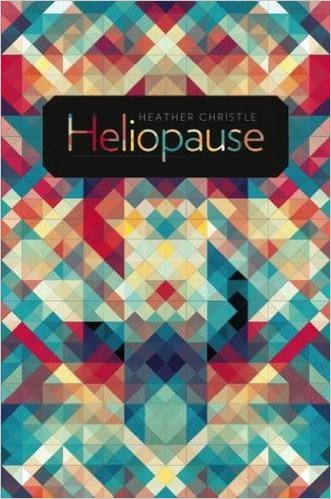
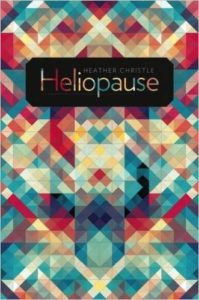 by Heather Christle,
Wesleyan University Press, 2015,
112 pages, cloth, $24.95,
ISBN 978-0-8195-7529-6
Buy the Book
Heather Christle’s new book, her fourth, takes its name from a zone of transition: the edge of our solar system, where the Sun’s area of dominion shifts into interstellar space. As the book notes, the public was recently reminded of the heliopause when the Voyager spacecraft crossed it in 2013 on its way to deep space. The metaphor of a transition zone remains a striking presence throughout Heliopause, in which, against the backdrop of a dismantled space program, Christle makes record of personal and national loss.
Heliopause situates itself in a post-9/11 landscape that is not, in fact, very post- at all. The collection is organized around several sequences; the first, “Disintegration Loop 1.1,” is a compelling ekphrastic response to William Basinski’s September 11th footage and “decaying pastoral loop.” Drawing on the concept of challenging reflexive loops for conflict resolution, Christle wrote each morning for several weeks alongside Basinski’s video. The resulting sequence is a fascinating meditation on fear and falling, as well as the limits of structure and structures. In this procedure, “every morning the diminishing returns” and light is tempered with the trace of darkness.
Throughout the collection, Christle’s formal movements emphasize the repetition and randomness of loss. An erasure from the transcripts of the first moon landing, “Elegy for Neil Armstrong,” presents text in white against a black page, compressed into short articulations of presence. One of Christle’s gifts is the ability to express even the most abstract pain as personal, oscillating between a collective “we” and a personal voice to address Armstrong. “Neil,” she writes, “I’m with you / (garbled).” The epistolary “Dear Seth” reaches across a long-distance friendship, as does a poem for the late Bill Cassidy: “Hey Bill / where you are / do you see letters.” In each poem, Christle explores the use of language to frame each shifting circumstance of being, a tool to “consider” or “confess”:
Dear Seth
There is fear the baby
when it arrives will be wrongly
or poorly loved
that the world is no place
for helpless things
You will see
reading this through your good beard
how neatly
I have left myself out
though I understand
come spring
such grammar tricks
will no longer work
Christle’s striking honesty is tinged with the eeriness of public consciousness; a choice of movie times is driven by calculations of the likelihood of mass shootings, and even the lights themselves tremble. Each line asserts itself with a subtle elegance, reminiscent of Rae Armantrout, and an openness that allows the simplicity of life to be reflected in the lines: this morning worthy of significance as readily as meditations on the nature of mortality. Both life and language are bare and painful in Christle’s composition, and this precision allows us access to the speaker at her most vulnerable, and often most charming, moments:
in the winds
just remnants of the storm
that wouldn’t stay
I have thought
to run away from what I own
Who hasn’t
but what else do I have
Where would I go
The sky is everywhere
at once like a big movie
and though I think I know how
it’s going to end
and with what music
there is uncertainty enough
to hold me still
As the book progresses, the sense of complete envelopment in the “pathless field” is remarkable; Christle writes, “It’s the same problem / in any direction.” Yet despite the speaker’s assertions of her own “dumb” responses, what emerges here is a bright and thorough meditation on what it means to be inherently irresolute. With sincerity and intelligence, Christle’s book bravely seeks connection amidst chaos; in doing so, she offers a model for how to find meaning in the impossibly brief and immeasurable. Rather than seeking to dampen the impact of fear, these poems offer a nimble portrait of its daily iterations. In a time when we are distinctly aware of the limits of human intelligence and empathy, Christle’s Heliopause gives voice to an essential plea: “touch me / touch me.”
— Kate Partridge
Translations from Bark Beetle
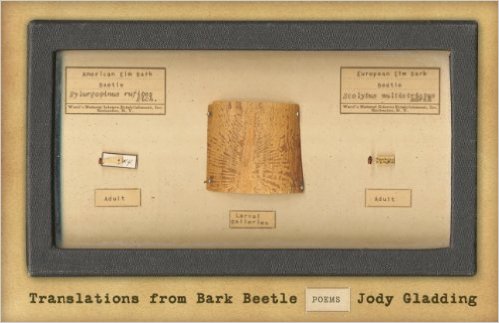
 by Jody Gladding,
Milkweed Editions, 2014,
96 pages, paper, $12.40,
ISBN 978-1-57131-455-0
Buy the Book
We like to write on things. It’s what we do. Mostly on paper, but . . . I once got in a bit of trouble in college when I got a little carried away while chalking the campus quad for a student activist group. Maybe it was my inner Jody Gladding coming out. Whatever it was, I now regret my callow chalk self, but in that dusty moment of chalking, there was such a rush to write upon the unexpected. I think Jody Gladding knows what I’m talking about.
The poems in Translations from Bark Beetle are playful, limited and desperate. Let me explain.
In the book’s second poem, “Spending Most of Their Time in Galleries, Adults Come into the Open on Warm Sunny Days: Translation from Bark Beetle,” Gladding says, “•’ve learned through wood / yo• can only travel in one direction.” The dots are explained as translation challenges, but I just ignored them and read on, and with Gladding as guide, I too learned through wood, and stone, ice (melted), tea bags, fear (!), and liver scans, among many other things (photos in the back of the book).
I couldn’t help but feel how fun this all was, especially when I read the poem written on the icicle, which, by the time it was photographed, had melted. Gladding’s poetry is a radical mark making. These hark back to the declaratory act of chalking a sidewalk, such a physically satisfying medium, the concrete page, and then the poems transform the pedestrian into the poetic, surpassing my petty college act and moving into the realm of art. What Gladding is doing is devilishly fun, and more than a little subversive.
Such an experiment also feels necessarily limited. We place confines around us to give us structure with the hope that within restriction we find freedom, and thus surpass our limitations. This doesn’t always happen for me in reading these poems. When one is writing a poem on /in a change-of-address form, there’s literally only so much space to move around (pun intended). Sometimes these experiments feel epigrammatic and easy to dismiss. And yet, sometimes these limitations allow for true flights of beauty well beyond the physical. “Swallow,” written on a tongue depressor, is one of these:
swallow
the words
he said
we
don’t
want
them
all over
the map
of
your
tongue
and if
they
burn
the roof
of
your
mouth
we don’t
want
them
jumping
to
safety
That poem crackles. It’s fast and dangerous. “Seal Rock,” written “on split slate,” is another such poem that takes a halved stone to create one of the most beautifully sparse and lovely marriage poems I’ve ever read.
I most feel these poems are an act of desperation. It’s something I continually felt as I read the book. From “roc”: “but what if / the invisible is / simply / the unseen.” One can’t ignore that this poem was written on a feather, both a flimsy relic of flight and the archaic instrument of poetry. Gladding, in these poems, wants to bring the invisible onto the visible, to make tangible the ethereal. How could this be anything else but a desperate attempt to make sense of a cruel, dumb world? Poetry as insurance against overwhelm. What else has poetry ever been in the history of the word? What can poetry do when “we [drive] our inflated cars to our box stores and [fill] our giant shopping carts”? Jody Gladding takes our collective desperation — and my chalky regret — makes it hers, and gives it substance.
— Jefferson Navicky
Citizen: An American Lyric
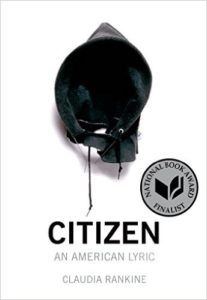 by Claudia Rankine,
Graywolf Press, 2014,
169 pages, paper,
ISBN: 978-1-55597-690-3
Buy the Book
It is the late 1970s. Our family has recently moved to a four-bedroom home amidst the tree-lined community of Palmer Woods on the outskirts of Detroit, where doctors, lawyers, and college professors of color have resided for many decades. My father, a college instructor and real estate broker, uncharacteristically wearing blue jeans and a sweatshirt, is seated on a bench facing the backyard gardens, smoking a pipe. Three middle-aged white men, who work for the company he has hired to repair the leaky lawn sprinkler system we inherited, are surveying the landscape. After they have made their assessments, one of the men walks up to my father, clears his throat and asks: “Could you find Mr. Donaldson and tell him we’re ready to give him our estimate?”
This is the kind of racially-charged verbal slight that Claudia Rankine, who was born in Jamaica, an island of varied nationalities, explores in her recent poetry /prose collection, Citizen: An American Lyric. The book is the first to be nominated for two categories for the National Book Critics Circle Award, poetry and criticism. Rankine’s literary style is indeed diverse and boundless, weaving poetry, essay, dialogue, visuals, as she creatively documents the psychic damage to people of color caused by daily life insults, unconscious or intentional, uttered by white people. Through her words, we learn how words, spoken in the classroom, in the supermarket, on television and the radio, and in corporate settings, define a person from outside the color of their skin.
“Poetry allows us into the realm of feeling and it’s one place where you can say, ‘I feel bad,’” says Rankine, who is the author of four previous books, chancellor of the Academy of American Poets, and a professor at Pomona College. She elaborates:
Certain moments send adrenaline to the heart, dry out the
tongue. . . . Haven’t you said this to a close friend who early in
your friendship would call you by the name of her black
housekeeper? You assume you two were the only black people
in her life. Eventually she stopped doing this but she never
acknowledges this slippage. And you never called her on it
(why not?) and yet you don’t forget. . . . Do you feel hurt
because it’s the “all black people look the same” moment, or
because you are being confused with another after being so
close to the other?
Rankine’s writing about such painfully visceral situations is often beautifully fluid. Though primarily focused on racism against African-Americans, it is possible for, say, women, gays, the disabled and the aged to visualize themselves in similar scenarios. “These tales of everyday life . . . expose what is really there: a racism so guarded and carefully masked to make it all the more insidious,” wrote poetry scholar Marjorie Perloff of Citizen. Rankine describes ominously ordinary moments in her academic’s life:
You are in the dark, in the car watching the black tarred street
being swallowed by speed; he tells you his dean is making him
hire a person of color when there are so many great writers out
there. . . .
Sitting there staring at the closed garage door you are
reminded that a friend once told you there exists the medical
term John Henryism — for people exposed to stresses
stemming from racism. They achieve themselves to death
trying to dodge the buildup of erasure. . . . You hope by
sitting in silence you are bucking the trend.
This poem in its entirety takes us well beyond a simple awkward moment. These are experiences unique to black people and occur largely because of their skin color. It tells us that a racial divide persists in American culture regardless of how close relationships may be. Rankine also alludes to the psychological confusion and frustration created in the minds of the recipients by these seemingly thoughtless words and actions. She speaks of the accumulative stresses that bear on a person’s ability to speak out, perform, and maintain emotional health.
The media does their ample share of perpetrating color divisiveness. The acute insensitivity and obliviousness of many whites is illustrated in her essay about tennis players Serena Williams and the late Arthur Ashe, when sports commentators praised Williams for “growing up” and Ashe for being “dignified and courageous,” when they rose above the blatantly racist onslaughts they had encountered. The implication is that being angry about racism is somehow immature and ungracious, and that the best way to confront injustice is to do so without emotion, and certainly without making a scene that embarrasses white people.
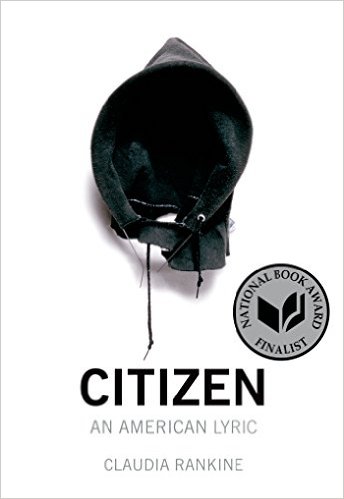
The title Citizen: An American Lyric is not accidental. “Our addressability is tied to the state of belonging, as are our assumptions and expectations of citizenship,” Rankine argues. Her book is a muscular confirmation of the effects of racism on both the individual and our collective society in a so-called post-racial country, and yet it still exudes optimism for a better world. The cover itself, a 1993 piece of artwork by David Hammons, depicts a hooded sweatshirt reminiscent of the “hoodies” that became an iconic protest symbol of the Trayvon Martin killing. A black and white photograph of a suburban sub-division with the street sign “Jim Crow Road,” taken by Michael David Murphy, speaks volumes.
Though making sense of racism is not the goal of this collection, it does give us warnings signs about the danger of merely accepting racism as a given in American culture, to the extent of passively doing nothing to change destructive mindsets. “If that rude shopper finds himself in a position of power — i.e. on a jury, organizing Katrina evacuations, or if you arm that fear and call it policing — then you’re going to get these explosive events,” Rankine asserted in a recent PRI radio interview.
Her book of meditations on racially charged encounters reminds us of countless current events, including when politicians and other public figures have made outrageously offensive statements about people of color and, instead of acknowledging the tragic
history, as well as their own culpability behind their affronts, they
either dismiss the action or merely apologize for upsetting a perceived over-sensitive, politically-correct group of individuals who can’t take a joke.
When my father was confronted by the lawn sprinkler man, he turned and walked into the house, then later returned dressed more formally to go to his real estate office. “I understand you’re looking for Mr. Donaldson. I’m Mr. Donaldson,” he said. The expressions on those three faces made a perfect tableau of a wake-up call. Because of my father’s forbearance and sense of humor, those men would continue to work for him over the years. Together, they bridged an ethnic chasm. Citizen: An American Lyric is a collection of extraordinary social commentary that helps us see our lives more clearly through the suffering we both inflict and allow, thereby making it possible to see a path toward reform.
— Leigh Donaldson