


The Gorgeous Nothings
 by Emily Dickinson,
edited by Marta Werner and Jen Bervin with a preface by Susan Howe,
New Directions /Christine Burgin, 2013,
hardcover, 272 pages, $39.95,
ISBN: 978-0-8112-2175-7
Buy the Book
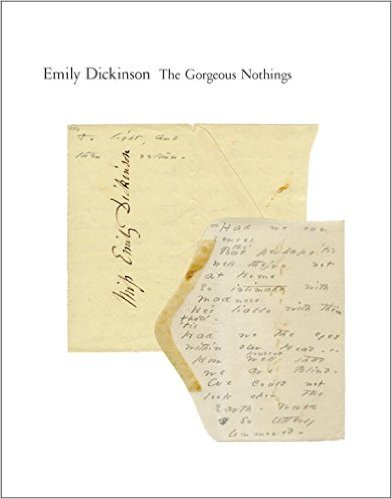
The Gorgeous Nothings volume finally collects the poems that Emily Dickinson wrote on the backs of envelopes. This effectively presented text holds myriad clues for present day readers, poets, and scholars, as these odd, almost unclassifiable scraps of paper provide an amazing window into the way Dickinson worked.
Building on poet Susan Howe’s insight in The Birth –Mark, that the manuscripts “should be understood as visual productions,” this volume presents a whole new side to Dickinson’s work that has implications for the treatment of other writers’ work as well. Co-editors Jen Bervin and Marta Werner make a key decision to set transcripts of Dickinson’s poems on left-hand pages, opposite facsimiles of the envelopes on which Dickinson first penned them, on the right-hand pages. The volume also includes a scholarly apparatus consisting of a preface by poet Susan Howe, an introduction and visual index by visual designer Jen Bervin and, at the back of the book, an essay, formal listing and bibliographical description of the envelope manuscripts by scholar Marta Werner. If you are a fan of Dickinson’s poems, or a poet, I suggest begin with the presentations of the poems themselves, and only then delve into the scholarly sections to enhance your reading of the poems.
Even if you’ve not read a lot of Dickinson before opening this book, the poems presented in graphic form will convey how Emily Dickinson created her world one poem at a time. For example, the first poem, about an inner shipwreck, unfolds in two dimensions, in text and on paper:
On the text level, the reader can follow Dickinson laying down lines word by word, like a bricklayer, until she comes to a decision point and stack her words on top of each other: The poem sets up a number of oppositions: “havoc” and “damage,” “tale” and “witness,” “mighty freight” and “dread occasion,” “sea” and
“land.” Taken together, they convey states of the human mind as items lost at sea or freight destroyed on land; they express the foundering and despair of the human mind.
On the paper level, you can watch how Dickinson, like a builder, uses the space, folds, and boundaries of the envelope. Wide spaces between lines allow her to stack her word choices, and the envelope’s shape conveys the sense of a closed tomb “that told no tale and let no witness in.”
Even though Dickinson would never have suspected that her envelopes would be read by her readers in this way, The Gorgeous Nothings presents her work with such simplicity and intimacy that the reader feels almost as if Dickinson were there at the same small table, allowing the reader to look over her shoulder as she drafts. I’ve only found a handful of books that let you have this kind of close contact with a poet actually in the act of drafting. Curtis Bradford’s Yeats At Work is one, and The Gorgeous Nothings is another. The co-authors Marta Werner and Jen Bervin deserve enormous credit, as does poet Susan Howe for her thoughtful introduction. New Directions editor Christine Burgin, in association with Granary Books, has produced a thoroughly agreeable volume that yields new surprises every time the reader opens the covers.
Once the reader has made these discoveries in the poems themselves, there is time to turn attention to and admire the generations of scholars whose work lies behind this volume, the Amherstites vs. the Harvardians, and how eventually good sense prevailed to share with the world the folder that the first scholar had labeled Dickinson’s “scraps.” The backstory shows how easily these poems could have been lost.
In bringing these poems to light, with well-conceived layout, design, and scholarly context, Bervin and Werner allow the reader a sense of Dickinson’s process in finding “the certain slant” and choice of words that make each poem arrive at and convey its present moment. As the Danish poet and scholar Niels Kjær has written, this presentness is the hallmark of Dickinson’s
work, and The Gorgeous Nothings lets us experience it up close. Such intimacy makes this work not only a scholarly tour de force, but the freshest presentation of Dickinson’s poems to have come to us in a very long time.
— Mark Schorr
Churches
 by Kevin Prufer,
Four Way Books, 2014,
paper, 96 pages, $15.95,
ISBN: 978-1-935536-43-7
Buy the Book
Many of the poems in Churches, by Kevin Prufer, are full of fire, smoke, and broken glass. Their speakers often find themselves in a world figured as a womb of violence, forced to face — without the solace of religious abstraction, and often under the harshest of conditions — human mortality. Out of these wombs is born, for the reader, a necessity to contemplate the role of faith in our attempts to survive and understand the harm done to us by circumstances, or by others, but also to consider that the harms we suffer are often of our own doing. These poems frequently illustrate the failure of the coping mechanisms that we have come to rely upon in a post-Nietzschean world where religious faith is either absent, or, even worse, destructive.
The opening poem in Churches, titled “Potential Energy is Stored Energy,” highlights this question of faith. A porter lying in the snow, a victim of the explosion of a bomb planted on board a train, thinks of the infant son he and his wife had lost to fever. Neither the porter, now approaching death, nor his wife, in his memory of their son’s passing, voices the supplications a reader might expect. Rather, it is the anthropomorphized bomb that utters its prayers, ominously, to heaven, just before its stored energy is destructively released: “I give this to you, Lord, /in a wisp of smoke, in splinters /scattered in the wind and love.” These final words of the bomb are set beside the porter’s last moments in which present and past have become one, and his wife’s words to their fevered infant are now applicable also to himself: “Oh breathe, breathe, his wife was saying, /while the great unmelting snows concealed his eyes, /and up to the waiting heavens /this black plume rose.” The God of the poem is the God of bombs (and bombers) and while his heaven may be waiting, it is a heaven that admits only the smoke of wreckage.
If religious faith can no longer be of any consolation, then where do we seek solace against a harsh world? One replacement for faith, portrayed as largely ineffective and even harmful, is the numbing power of medication. The little white paper pill cup is ubiquitous throughout the book, a grail in which the speakers of the poems often seek solutions. That white cup looks bright against a backdrop of black smoke, but it is a brightness, the poems seem to argue, that obscures rather than reveals — its promise of cure seems as unreal, as unattainable as heaven. The poem titled “Paper Cup” offers the constant refrain “Here are your pills” until, in its final line, we are told: “Here are the last of your pills, little white zeros in a cup.” In a world that rains down the pain-killer Lortab like manna, there still aren’t enough pills to cure what ails us.
Churches approaches the existential problem of the death of God primarily in order to illustrate both the insufficiency of our answers and the effects of this failure. Consider the elderly speaker of “Sunday Afternoon in the Park” who, rather than being situated in the scene of the title is, instead, a mere observer, trapped within the linoleum floored world of a retirement home where the orderly’s cry of “Pills, pills, pills” leads the speaker to identify her as “the crazy woman /down the hall.” Such an institutionalized existence pales in comparison to even the quotidian world of people waiting for buses that exists outside the speaker’s window. After making some perceptive observations of the scene, the speaker wistfully, and tragically, declares,
How I love a cool Sunday morning
high above the park
after a rain.
If I could, I would jump
right through this window.
These lines are tragic largely because they illustrate real human potential, struggling, however unsuccessfully, against terms of confinement that, unlike mortality, are not necessary. We don’t have to keep the elderly drugged and shut up in homes, and the poem reminds us that this problem, among others, is man-made. It requires a God neither to blame for it, nor to solve it.
— Christopher Hornbacker
Chapel of Inadvertent Joy

 by Jeffrey McDaniel,
University of Pittsburgh Press, 2013,
paper, 88 pages, $15.95,
ISBN: 978-0-8229-6260-1
Buy the Book
After reading his fifth book of poems, I propose Jeffrey McDaniel as the Louis CK of poetry: He’s sincere and unsanitized, flinging humorously dark insights from a position of middle-aged white-male self-awareness. Like the comedian, McDaniel’s voice makes the recognizable male desires and insecurities seem fresh and relatable, exploring the engaging middle ground between vulnerability and masculinity.
The first section, “Little Soldier of Love,” sets up the themes of lust and infidelity that permeate the text. The book’s introductory poem, “Hello,” deposits the first of many references to Adam and Eve and human failing:
but please, forgive me, because complaining is like sex for old people.
Have you ever cringed with your whole body? Been so filled with shame
you wanted to wriggle out of your flesh, like a serpent in a forest,
like the snake that betrayed Eve?
McDaniel’s humor keeps even loaded passages like the above from turning sluggish or dour. Later, in a persona piece from Eliot Spitzer’s point of view, McDaniel asks, “Lord, /swaddle me in a blanket dipped in smallpox,” and expresses a desire to “open my mouth and bite /into the snake’s Adam’s apple.” Again, playful language buoys the dark content.
Sexual desire, from both the male and female perspective, as a means both of alienation and validation, is a primary concern here. In “Track of Now,” a virile voice experiences “what it feels like to have sex with the universe,” as he imagines that “each woman in Tompkins Square Park /eats her ice cream just for me.” The self-assured male voice reemerges in the later poem
“A Brief History of Immorality,” which features a twenty-two year-old man strutting through Manhattan after a sexual conquest.
McDaniel explores female desire as well, in poems like “Happy Marriage,” which describes a woman’s urge to break free from the monotony of married life:
You’re sitting on the sofa. Your husband
is upstairs, your child sleeping. There are dishes
in the sink with your name on them. A dark sedan
pulls up to the curb of your mind.
This feminine yearning sets the stage for the book’s second part, “Reflections of a Cuckold and Other Blasphemies,” wherein a number of male voices react to the infidelity of their wives. While sometimes heartbreaking, these poems crackle thanks to McDaniel’s imaginative and precise language:
so years later, when your wife stumbles home
with that glazed, seen-god look in her eyes, the sweat
of his trigger-happy fingers still greasing the white
napkin of her thighs, you can settle into that moment,
ask her how it was, if you can witness next time.
The last line here reflects the acceptance that many of these male voices arrive at as the cuckold poems continue. They are defeated in the way that the men in “Track of Now” and “A Brief History of Immortality” are victorious. McDaniel does some of his best work in describing the emasculated male.
In “The Cuckold in Autumn,” an older male voice watches a young couple trying to start their truck:
He shuffles towards me, mumbles
something about a jump. My loins
ignite like a furnace. Welcome
to my world, I think, attaching cables
under the sprung hood, revving the juice.
This mindset reaches a crescendo in the poem entitled “Middle Age.” In it, the speaker explains how his “testosterone feels like watered-down lemonade,” and how he couldn’t even “impregnate an awkward pause.” All of this is in stark contrast to the younger male self, the one who walked next to a pregnant wife feeling so masculine that he imagines “being a crop duster / filled with semen and pollinating all the women /passing in springtime dungarees.”
All of this sounds rather pessimistic, these poems about the fading power of the aging man, unable to maintain either an erection or a relationship. But McDaniel’s cumulative effort reveals the modern male as master of the universe, neutered cuckold, and caring father all at once. He ends the collection
with its uplifting titular poem. In “Chapel of Inadvertent Joy,” the speaker urges us to savor the good moments, whether that’s
“a white horse in a sunlit pasture at the end of summer” or when a “garden hose slips out of your hand /and sprays you in the face,” or simply watching your “wife and daughter lollygag in the grass.” McDaniel’s voice, capable of portraying all this with wit, empathy, and metaphorical pyrotechnics, is one we would be wise to savor as well.
— Michael Christian
I See Hunger’s Children
 Selected Poems 1962–2012, by normal,
LUMMOX Press, 2013,
111 pages, paper, $15,
ISBN: 978-1-929878-80-2
Buy the Book
My favorite poem in this book is “green buses,” set in Newark, 1963, when men began thinking of ways to flunk their draft physical. The narrator shows up as: “98 lbs / pigtailed, silver fish ear ringed / gold lamé coat.” He recalls, “crew cut guys yelling / ‘sweetheart! hey sweetheart . . .’”
but I was naked
& my dick was average
your typical run of the mill medium sized Jewish dick
Asked what he does for a living, he responds “imam jazz poet.” The sergeant says, “section 10 — GET THE HELL OUT OF HERE!!” Soon the narrator is laughing with an old friend, also “section 10,” who wore “. . . a sandra dee skirt / an annette funicello hairdo / & a joan crawford dinner jacket.”
This poem captures the nascent counter-culture / anti-war movement from the perspective of a streetwise Jewish kid — part Allen Ginsberg, part Lenny Bruce — laughing back at the unenlightened macho boys. He already knows it’s better to make love not war. This poet understands how the world works — or at least how America works. In “American Child,” “the baby is diced up in dinty moore stew” and “the newspapers are shouting from sea to sleazy newspaper sea . . . from the sands of sam’s club to the halls of home depot . . .” His poem “awakening —1967” has this epoch-defining passage:
the summer of love saw all the brylcream
boys I used to play chess with go to
viet nam & go to my lai & come home
in body bags & throw bricks thru the
windows of 7-11s & take hideous lsd
trips & have satoris in front of the
tasmanian devil pit at the san diego
zoo —
Although the collection opens with the seven-page title poem, I prefer the shorter poems like “at the end of the beam with mick and lou,” the story of a twenty-three year friendship between two construction workers, one of whom gets cancer. There’s a Philip Levine-like setting with Richard Price-like dialogue. Not long ago, Tony Hoagland wrote a piece for Harper’s about “imagining a renewed role for poetry in the national discourse — and a new canon.” This poem, which shows us the awkward ways men, especially working class men, try to be friends and express feelings, no matter how inarticulately, would be a contender for my list.
In the introduction, publisher RD Armstrong calls normal a spoken word (italics his) poet before the phrase existed. Some of the longer poems in particular would seem to fit this description. However, in my experience, many of today’s “spoken word” poets could afford to spend a little more time with the written word. Spoken word or not, no one can doubt that normal is a reader. One of the delightful details in this volume is his choice of epigraphs, from Brecht, Camus, Lorca, and Vallejo to Sri Rama Krishna, Gandhi, Thomas Merton, and Bob Kaufman. (“Crossroads” is a wonderful poem about him and Kaufman listening to jazz and getting high together.)
It would be easy to typecast normal as another post-beat iconoclast tossing barbs at everything coarse, crass, and greedy about America, but this volume also contains some very tender and compassionate poems. In “luna and the late sun” he writes of the relationship between his dog and his neighbor and how much he enjoys watching them cavort in his yard:
luna is last stages middle age
plump almost hairless no make-up
lost 2 kids — one to cancer
one to aids
luna is single & what she calls
a “late in life lesbo”
quiet no money torn gray parka
shuku loves luna almost as much as
shuku loves me
This tough guy from Passaic can do more than shoot salvos. Bio notes tell us he’s spent 35 years as an RN. He has a heart too, conspicuously on display in a poem dedicated to the late singer Suzannah McCorkle, “where the songbird sang”:
last yr I heard you killed your
self —
something about depression & that
empty void where the songbird sang
i would gladly have flown into
that void & filled it with
my own singing
This is not the voice of the grizzled survivor, the unbowed cynic, but the caregiver who, in “The Request,” says, “God asks nothing more of a poet / Than to chart the rain.”
I did a double-take at “Appalachian Cabin.” The title is so different from “don’t rape the singing bird,” the bucolic locale a bit far from “upstairs at the hotel dante” (the first line of “the shooting gallery”). It concludes:
The place has survived:
A supreme testimony to the
Genius of a hammer —
Long ago, when the world was
Still trying to live a simple life.
This poet has seen a lot, most of it not very simple. Readers of this book are the benefactors.
— Kevin Sweeney