


Gabriel: A Poem
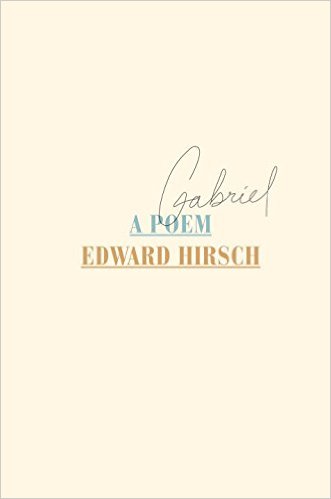
 by Edward Hirsch,
Knopf Doubleday, 2014,
96 pp, hardcover and paperback,
ISBN: 978-0-385-35373-1 (hardcover) and 978-0-8041-7287-5 (paperback)
Buy the Book
Poetry has replaced religion for me as a sustaining force in my life. Often when I go to the Grolier Poetry Book Shop on a Friday night, there are flashbacks to the Chicago synagogue that sustained me through my eighteenth year. Poets like Marge Piercy and Ed Hirsch — not the synagogue or the Bible — are now the places that I go for spiritual refreshment. Thanks to poets like the aforementioned and my focus on poetry, I have come to believe that there are high tides and low ebbs in every spiritual tradition. All should be respected, and none should be taken for granted.
Gabriel: A Poem, by Edward Hirsch, has taught me more about the unconditional love a parent must always have for a child than I thought I had learned while teaching and raising children. Full disclosure: I graduated from the same small college as Ed, who is about ten years younger, so he has always been in my rear view mirror. We’ve had many good conversations. I’ve known about his son Gabriel’s unconventional life and the diagnosis of Tourette’s that never quite fit the actual case.
Since hearing a few vague details of Gabriel’s death, I had not been able to fathom the pain that Ed must have been going through — that is, until I read his masterful poem. The poem is so powerful that I can write to Ed again, and say, I think I understand. Even though you have a broken heart, you are a fine father. You will never stop caring for the world’s children and writing poems that care for them. I can say that his poem is completely accessible to any parent who has reached, with a child, impasses that can be overcome with unconditional love.
While Gabriel was very much alive and full of promise, Hirsch wrote a chapter on elegies, “Three Initiations,” that appears in his now classic How to Read a Poem and Fall in Love with Poetry (1999). Much of this chapter gives clues to how to approach Gabriel: A Poem, Hirsch’s own heart-rending elegy. So I use Hirsch’s own words to guide me through.
In the book-length poem, Hirsch mourns and looks for solace in
the act of writing. He does, he says, “what Freud calls the work of mourning, ritualizing grief and thereby making it more bearable. . . . ” He “turns loss into remembrance”:
I peered down into his face
And for a moment I was taken aback
Because it was not Gabriel
It was just some poor kid
Whose face looked like a room
That had been vacated.
Again, I turn Hirsch’s own words, from How to Read a Poem, to what I hope has happened for him in Gabriel: “The elegy opens up a space for retrospect (‘I see now’), for overwhelming personal feeling, and it drives a wordless anguish toward verbal articulation.” Again the parent at his child’s bedside, Hirsch gains that tender view:
But then I looked more intently
At his heavy eyelids
And fine features
The elegy also “establishes a precise relationship” between Hirsch and his beloved son. Hirsch reaches the point he describes by immersing himself in the poetry of grief. In this process, he passes through a white-hot intensity, out of which comes utter honestly about his loss, which finally brings him to — for this reader, and fervently I hope for my friend — a true “richness of feeling” for his departed son.
He had always been a restive sleeper
Now he was weirdly still
My reckless boy
By praising Gabriel as “My reckless boy,” Hirsch also names the most recent of his son’s dysfunctions and arrives at some sort of understanding.
Another clue of how Hirsch feels for his son comes in his glimpse back to the Humanities class in which a young Grinnell teacher named Carol Parssinen led him to discover the healing power of The Iliad. Homer’s epic “opened up a space in me that made it possible to name what I would feel. . . . ” His descriptions of Gabriel are infused with much of that power:
Dressed up for a special occasion
He liked that navy-blue suit
And preened over himself in the mirror
Hey college boy the guy called out
On the street in Northampton
You look sharp in those new duds
Hirsch says that he loved how “unflinching” Homer was: “I recognized [the Iliad’s] demonic power, its outsize emotion and epic grief. I was wounded by its truth. And I was also healed by it.” Finally, we can only hope that what Hirsch learned about that ancient poet’s poetry — “I was also healed by it” — is also true today about his own words to Gabriel.
— Mark Schorr
No Girls No Telephones
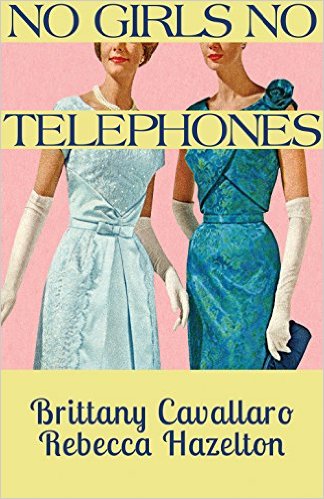
 Brittany Cavallaro and Rebecca Hazelton,
Black Lawrence Press, 2014,
28 pages, paper, $8.95,
ISBN: 978-1-62557-999-7
Buy this Book
Probably the finest essay on poetry I’ve read this year is Matthew Buckley Smith’s “Why Poems Don’t Make Sense,” which can be found here in 32 poems. In it, he explains what sense is, how it differs from logic, and what nonsense entails, while illuminating the concept of theory of mind in relation to poetry. It’s a smart, accessible, and important piece.
I start there because at the time I first read Smith’s essay, I was also in the midst of reading No Girls No Telephones by Brittany Cavallaro and Rebecca Hazelton. A collaborative chapbook of paired poems that take their shared titles from lines of Berryman, NGNT comes with an author’s note at the end that I’ll reproduce here in part, as it’s necessary for understanding how I’m coming at this review:
Authors’ Note:
Brittany had the idea of writing an opposite imitation of a
John Berryman Dream Song, and suggested that Rebecca write
an opposite of that opposite. It was a strange game of literary
translation.
Simone Muench blurbs on the cover that the poems operate as a game of telephone to filter the sense of poems by John Berryman through Cavallaro and Hazelton. The authors’ note explains the process whereby noise was added to the system, so to speak, with opposites of opposites reflecting off one another to introduce distortion. As you might expect, just like in a game of telephone, the message at times becomes garbled well beyond lyricism, crossing into true nonsense. I tried all the usual ways of maximizing the poems’ content: reading aloud to myself, reading to someone else, reading out of order. Nothing worked. And yes, there’s a natural pleasure born of unexpected and unexpectable constructions, but I kept thinking about Smith’s essay and my native distaste for nonsense.
So, brief aside, what’s wrong with nonsense? To me, it smacks of a writer who, though having nothing to say, nevertheless seeks an audience. And was that what was happening in NGNT? No, but I was having a hard time figuring out what was happening. While I’m only marginally familiar with Cavallaro, Hazelton’s poems are not merely sensible but frequently profound. The meaning had to be in there somewhere. Berryman may be ethereal or even transcendental but he isn’t nonsensical, and the best games of telephone retain echoes of the intended message despite the accidents of flawed transmission.
Then, once I saw it, how had I not seen it? There aren’t just structural parallels between the paired poems; they are like transparencies to be laid one over the other. I suspect my initial blindness to this came from holding too tightly to the game of telephone concept. I kept trying to understand it through that lens, however figurative, despite my deepening frustration. While I can certainly see how it was relevant to the composition of the book, it put me on false footing to assume this would be the most fruitful way to read the poems.
This misstep was admittedly my own fault. That the method of composition does not imply the method of interpretation may be self-evident to others, but this was a learning moment for me. Anyway, what was genuinely captivating about the book was how two strophes of nonsense, on opposing pages, would give rise to something sensible if non-concrete, “sense without reference,” when considered simultaneously, and that this sensibility resonated as authentically Berrymanesque. It’s not the intuitive way to read poems, and it’s not exactly easy, but it taught me something. Not in the way of aphorism or analogy, or any of the pleasant methods through which I expect to encounter a lesson in most poems, but by frustrating my understanding and then composing sense in a manner I had never before experienced.
The last thing I want to get into is how Cavallaro and Hazelton play with opposites throughout NGNT. I’m fascinated by opposites, not so much in the antonymic dark / light, land / sea kinds of couplings, but when we think, for example, of the opposite of a park. The first thing that comes to my mind is wasteland, but what about office the opposite of park? This way of thinking can work as a lever for the imagination. For instance, what if the opposite of plant is not animal, but something that thrives on moonlight and vodka? The opening lines of the poems “Mission Accomplished” demonstrate this effect to highlight a mode of seeing and thinking that is acutely poetic:
Her inner life was left on a marked tree
And its opposite:
Our outer hearts are found in an unmarked grave
That’s just for the flavor of what’s happening. Overall, my experience of reading NGNT was non-recreational but rewarding. I don’t know that it’s exactly avant-garde, but for me it expanded the possibilities of nonsense in ways far more sophisticated than the attempts made in the vast bulk of conceptual poetry I’ve come across. And it has me thinking I perhaps ought to mail my copy to Mr. Smith.
— Andrew Purcell
Wolf Centos
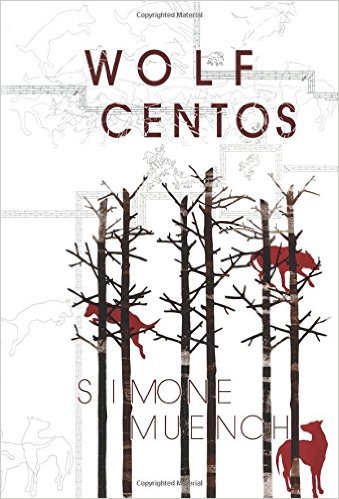
 by Simone Muench,
Sarabande Books, 2014,
66 pages, paper, $14.95,
ISBN: 978-1-936747-79-5
Buy this Book
The ancient form of the cento provides a beautiful excuse for us to revel in the poetic line and in the craft of our literary forbears: named for the Latin word for a patchwork cloak, the cento calls for its creator to piece together individual lines from the works of other poets. In Wolf Centos, Simone Muench assembles an entire collection of these patchwork poems, all in service of one common, evocatively wild object of meditation: the image and symbol of the wolf.
Muench draws upon a pantheon of greats for her lines — from Akhmatova to Yeats, Atraud to Jake Adam York — and a natural first instinct is to try to identify each author, to deconstruct Muench’s cloaks back to their original fabrics. (“Sans teeth, sans eyes” — Shakespeare. “I shall speak not of myself, but of geography” — Neruda.) Soon, though, we come to focus less on the source of each line than the textures, colors, and music for which Muench chose it, and she’s plucked some striking ones. But the cento’s real art lies not just in choosing individual lines, but in arranging them: we look for the flow or leap between lines, for resonance or juxtaposition, for how the assembled pieces build and sustain meaning and momentum. Do the patches not only create a new whole, but transcend their piecemeal sum? At their best, Muench’s stanzas turn with luminous, startling clarity:
I take a wolf ’s rib & whittle it
into little months, little smokes
& oblivion.
And here, relish the tinged tactility of Muench’s piecework:
The theory
of light is broken: the room dark
as black mullein, a clutch
of burnt paper. Every face a stain.
Muench wisely breaks up her volume of centos — each of which is titled “Wolf Cento” — into four sections. The first section’s epigraph, from the screenplay of The Doors, is delivered with a playful deadpan directed at Jim Morrison’s wife (“All the poetry has wolves in it, Pam.”); the next one is from T. S. Eliot: “These fragments I have shored against my ruins.” Her use of Eliot suggests that such an archaeological act as the crafting of a cento is not just creative, but survivalist.
Over the progression of her four sections, Muench offers a range of variations on what the wolf might mean to us. Wolves seem sometimes to represent an inner human strength, something ancient and feral: “In the space of a half-open gold door / your body’s animals want to get out.” Other times, the creature is a strange Other that we both fear and envy from a distance: “We: spectators, always, everywhere . . . / we wanted to be wolves.” In or around the wolf there is also a human love, a lust (“Eros is a wolf, Caesar”), a loss. The wolf reminds us of our human limitations (“More & more I see the human form, / a nothingness which longs to be the sea”), but Muench also reminds us of the possibility for communion, and for transformation thereby:
“I have lost my being in so many beings.” Finally, the wolf presents the possibility of salvation, a way to save our wildness in the face of loss, civilizational clutter, and time: “Shrewd wolf of dark innocence, / rouse us from blur. Call us.” We are encouraged to consider the wolf in the spirit that Stevens asked we consider the blackbird: “The question of the wolves turns and turns.”
In a project of such singular focus, some missteps and weaker moments are inevitable. Given dozens of “wolf” lines culled from the canon and beyond, some are bound to court wolf-cliché (“we licked the blood from our paws”), and Muench’s lines sometimes just feel like a patchwork of good lines. And, over time, despite the pacing device of the section titles, the book’s momentum flags a little, and it isn’t helped by the continually reiterated “Wolf Cento” at the top of each page.
But at its best, Muench transcends the centuries and continents she spans. Reading Wolf Cento offers not only myriad gleams of beauty and strangeness, but also the comforting sense of submerging in a rich collective consciousness of what we’ve written. The result is sometimes diffuse, dizzying, not to be read for literal coherence. Read these poems instead like meditative mysteries, as one reads the cumulative couplets of a ghazal. Delight in this evidence that our works and days — and our best lines — can be woven and rewoven into so tangible a pleasure. Praise the luxury of inheriting so many good ones.
— Megan Grumbling
Parallax
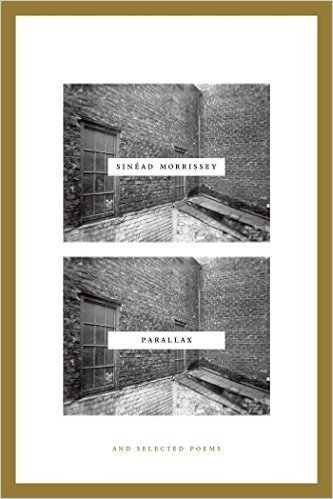
 by Sinéad Morrissey,
Carcanet Press Limited, 2013,
69 pages, paper, £9.95 ($15.56 USD),
ISBN: 978-1-84777-204-6
Buy the Book
Hold your finger out in front of you, close one eye, then quickly open it and close the other. Rapidly switching back and forth, you will see your finger shift from left to right and back again. This displacement, or shift in apparent position of your finger seen from different points of view, is parallax. Parallax is measured by the angle of inclination between these two points of view and the object. Astronomers use the principle of parallax to measure the distances to closer stars, and photographers know parallax error as the difference between what is seen through the viewfinder and what is captured by the lens in a single-lens reflex camera. It is this reference, to the shifts that affect optical perception, that is initially most applicable to the poems in Sinéad Morrissey’s extraordinary collection Parallax, the winner of the 2013 T. S. Eliot Prize.
Inspired initially by the discovery of a trove of 1911 plate glass negatives of Belfast’s slums taken by Alexander Robert Hogg, Morrissey’s poems use ekphrasis to confront the radical possibilities of seeing and not seeing, of truths and lies, and of looking at and looking away. The poems are replete with photography and film, with television screens and early viewing devices, with blindness and light. In “The Mutoscope,” early motion picture viewing devices rattle to life for the singular viewer:
Only for you do the two mute girls on stage
who falter at first, erratic as static
in the synaptic gap between each image,
imperceptibly jolt to life —
grinning, tap-dancing, morphing into footage,
their arms like immaculate pistons, their legs like knives . . .
It lasts a minute, their having-been-written onto light.
Morrissey’s use of internal rhyme punctuates the poem as it, like the mutoscope, picks up speed. This rhythmic coming to light, and to life, is repeated throughout the volume, often in contrast to a reciprocal darkening. In “Home Birth,” as in “A Matter of Life and Death,” the arrival of one person eclipses another. In the latter poem, the actor David Niven flickers across the 1946 film of the same title, ascending a giant stairway to heaven as the speaker in the poem gives birth and recalls the recent death of her grandmother.
The poems navigate these exits and entrances, and questions of perspective, through masterful poetic form. In “Fur” we discover Holbein’s famous anamorphic skull, appearing as “driftwood / up-ended by magic from the right hand-side / of the tesserae carpet” in his 1533 painting, The Ambassadors. And even as the speaker in “Photographing Lowry’s House,” a persona poem imagining the experience of photographer Denis Thorpe, recognizes the effect of erasure his photographs simultaneously have on the artist’s life — as breath has on drawings of fawns in the caves of Lascaux — other actors in the poems engage in more willful concealment and erasures. For example, “The Doctors” imagines photographic alterations in Soviet-era Russia before Photoshop: “With scissors, / nail files, ink and sellotape, he has been vanished — / alongside other party operatives who touched / his sleeve.”
Throughout Parallax, in addition to poems that regard photography and film, there are other poems that explore Russia from differing perspectives. The sonnet “Puzzle” responds to a popular 1950s Soviet book of mathematical puzzles, and “Shostakovitch” imagines the composer writing under the restrictions of the Great Terror. Metaphorically and philosophically, parallax can also be considered a literary tool by which an author presents the same story from different points of view.
From one man’s sudden onset of blindness, to wanting to look away from flies on a dead rat, to a speaker’s observations in the poem “Shadows” that they “retract [ . . . ] back like drowning soap,” the interdependent play of light and darkness is revealed, and the double nature of light leaves its mark: “Shadows of candles on church walls at Evensong / manifest not as flame, but as smoke.” In “Lighthouse,” the speaker’s son lies awake at ten in the waning light of late summer solstice,
a lighthouse starts its own nightlong address
in fractured signaling; it blinks and bats
the swingball of its beam, then stands to catch,
then hurls it out again beyond its parallax.
Here, counting “each creamy loop” and “each well-black interval,” the boy enters a world that is only partly visible, “partly seen.”
Because our eyes have different and overlapping fields of vision, parallax is what allows us, through stereopsis, to perceive the world in three dimensions. This effect is what the poems in this volume full of electricity offer us: more seeing, more revelation and doubt, greater depth.
— Julie Poitras Santos