

Bright Scythe, Selected Poems

 by Tomas Tranströmer,
translated by Patty Crane,
Sarabande Books, 2015,
240 pages, paper,
ISBN: 1941411215
Buy the Book
Sweden’s great poet, the 2011 Nobel Prize winner, Tomas Tranströmer (1931–2015), produced a relatively spare and exquisite oeuvre over the course of his life. He published his first works at age 23, and proceeded, with great regularity, to produce numerous slim volumes of poems over the following fifty years. During that time, he balanced writing with his work as a psychologist and his family life. He also found time to become an accomplished pianist (playing concerts and recording a CD) and an amateur entomologist. In 1990, Tranströmer suffered a stroke that left him paralyzed on his right side and impaired his ability to speak. He continued writing, with great and increasing difficulty, publishing two more books of poems and a memoir, and trained himself to play piano with only his left hand.
Tranströmer is a poet of borders, boundaries, and thresholds. Always crossing and re-crossing, his was a restless intelligence that challenged supposed dichotomies of space and time, the conscious and unconscious, penetrating barriers and rendering them much more murky and mysterious than previously assumed and, in a sense, less clear and more gray, in the way we know life really is. The poems contain countless occurrences of dreaming and waking, thresholds between life and death, and boundary markers in the human and natural landscape: the edge of a forest, a half-open door, a window. Vehicles in the poems transgress and move through these boundaries: trains, cars, vans, and boats carry the speaker and reader through liminal spaces.
Translation, too, is a process that crosses spaces and challenges borders. And much like Tranströmer’s poems, it permits us, notes Edith Grossman in Why Translation Matters, “for a brief time to live outside our own skins, our own preconceptions and misconceptions. It expands and deepens our world, our consciousness, in countless, indescribable ways.” Translation allows us to experience the “otherness” within ourselves and in our own lives, not unlike the uncanny otherness that Tranströmer cultivated in his poems. And nowhere is that understanding more prevalent than for the translator herself. “I felt as if I were discovering a third language where English and Swedish intersected,” says Patty Crane, “And that language is mirrored in the poetry itself, where the boundaries between inner and outer landscapes — the psyche and the world — seem to shift, open and somehow merge.”
One of Tranströmer’s first poems, published in 17 Dikter (1954), is “Stones.” May Swenson translated the poem in 1972, Robin Fulton’s translation of Tranströmer’s entire body of work was first published in 1987 (and updated in 1997 and 2006 subsequently), and Patty Crane has again translated the poem here. The differences between these translations are not small, and have to do with when and how the action is occurring — verb tense — as much as with sentence construction or word choice. Swenson’s translation begins: “Stones that we have thrown I hear /falling, glass-clear through the years.” The opening line of Fulton’s translation begins, “The stones we threw I hear /fall, glass-clear though the years.” And Crane’s: “The stones we have thrown, I hear /fall, glass-clear through the year.” Fulton’s phrasing seems to direct the throwing of specific stones to a very specific time, whereas Swenson’s and Crane’s choice of the present perfect locate the action in the unspecified past. In all cases, the speaker continues to hear the stones “glass-clear,” a hybrid word chosen by all three translators, taken from the Swedish word glasklara, meaning “crystal clear.”
One of the real delights of the Crane translation is the accompaniment of the Swedish text on the facing page. It allows the reader to note the poem’s original shape and form, and to recognize relationships between the two languages. It allows us to see that the rhythm and repetition in the Swedish “trädtopp till trädtopp” and “bergstopp /till bergstopp” can be carried forward in the English “treetop to treetop” and “hilltop /to hilltop” (Fulton) or “mountain-top/to mountain-top” (Crane). Other significant differences in word choice between the translators of “Stones” include how the “confused actions of the moment” (Fulton and Crane), are “made mute” (Swenson) or “become silent” (Fulton) “in thinner air”; while they are “quieting /in air thinner than now’s” in Crane’s version. In a sense there is a difference in the agency of the air itself — air “made,” “becoming,” or “quieting” — that affects the movement and energetic arc of the poem. Crane’s deft solution allows the rhythm and tone established in the first lines to continue.
To my ear, Swenson’s is the most wooden of the three, incorporating what feel like too many excess articles and conjunctions — “in thinner air than that of the present” (my italics). But often this sort of complication belies a fidelity to the text, a direct translation. Crane’s translation seems to avoid this awkwardness while maintaining fidelity to the form. And while Fulton’s rendering of the poem falls more firmly in the past — and his translations are widely considered the most literal — Crane’s translation allows the poem to remain more temporally open, suspended in the in-between, through the use of gerunds — “quieting,” “gliding” — until the final, ending lines, “Where /all our deeds fall /glass-clear /to no ending /except ourselves.”
In longer, more complex poems, Crane’s translations remain spare and seem tightly cleaved to the form of the original Swedish. In the beautiful longer poem, “Vermeer,” Tranströmer imagines Johannes Vermeer’s studio shares a wall with the raucous world of a lively tavern; “No sheltered world . . . ” it begins. Crane’s translation moves more “comfortably” for the English reader, with phrases such as “The great explosion and the delayed trampling of rescuers, /boats swaggering at anchor . . . ” in contrast to Fulton’s: “The big explosion and the tramp of rescue arriving late, /the boats preening themselves on the straits. . . . ” Crane’s is less searching, and more directly conveys meaning. While the “making strange” — or of language may serve to engage a reader in productive tension, the contents of Tranströmer’s poems contain enough strangeness to keep us more than engaged: it is paradoxically the spareness and linguistic concision in his poems that lets us float in the wonder of his borderlands.
In “Vermeer,” the thin wall that separates the private painter from the noise of the world becomes one of the insurmountable walls in our lives; we must pass through it, yet with excruciating difficulty. And then, in the beautiful, transcendent last stanza, translated identically by both Fulton and Crane, he surprises us:
The clear sky has leaned against the wall.
It’s like a prayer to the emptiness.
And the emptiness turns its face to us
and whispers
“I am not empty, I am open.”
It is often said that a great poet deserves many translators. Tranströmer welcomed the differences his translators brought to the poems. When John Deane brazenly wrote Tranströmer regarding his impressions that previous translators — Robert Bly, May Swenson, and Robin Fulton, among others — were unsuccessful, the poet replied encouragingly and challenged him to do better. (See his translation of For the Living and the Dead.) It is my impression that through multiple translations, a community of readers learns a poet and his poems, deepening our understanding of the qualities of a unique intelligence. Through this collective project, the translations get better. Each new word choice, each grammatical moment challenged and fussed over, brings us closer to the meaning inhabiting the work. And yet, as with Tranströmer’s poems, the closer we approach, too, the further away we become. There is no “one text”; there are many texts overlapping in murky territories, these boundaries that so often falsely divide us that Tranströmer sought to transcend. Patty Crane worked closely with Tomas Tranströmer and his wife Monica for three years to craft the meaning in these carefully selected poems. Bright Scythe is an invaluable contribution to our understanding of Tranströmer’s concise and penetrating body of work.
— Julie Poitras Santos
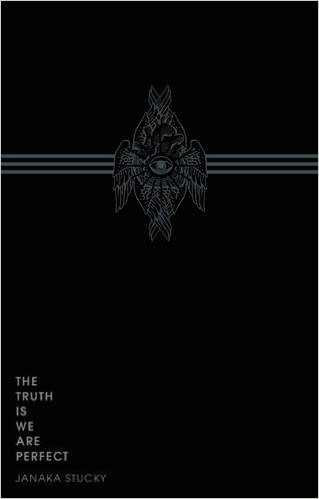
The Truth Is We Are Perfect
 by Janaka Stucky,
Third Man Books, 2015,
76 pages, paper, $15.95,
ISBN# 978-0-9913361-1-1
Buy this Book
“The Art of Loss Is a Lost Art,” reads the title of the third poem in Janaka Stucky’s volume of poetry, The Truth Is We Are Perfect, recently published by Third Man Books. Unlike Bishop’s infamous poem “One Art,” the narrator in Stucky’s collection does not concede to loss nor accept prescribed stages of grief. Instead, he approaches loss as a spiritual initiation through which one is broken open and transformed. More ecstatic dirge than “grief poetry,” the verses are tough, unpredictable, and spare.
The aforementioned poem* sets the tone for the first section of the book, which preludes and sets the tone for grief as does death itself. The poem opens with ritualistic images, the speaker vacillating between acceptance and denial:
Because I love a burning thing
I made my heart a field of fire
In this way I own nothing
Can lose nothing
The first stanza speaks to the impermanence of love and life itself; the image of fire in the chest is stunning in this metaphor. Reading the second stanza, with its “I own nothing / Can lose nothing,” I think, I’ve met this guy before; he wants to make himself insusceptible to hurt. But as the poem carries on, he can’t defend himself against the pain of love lost, admitting, “The mooncake you fed me remains / A ghost upon my tongue.” As the poem ends, we see just how vulnerable the speaker has become:
I make with my mouth
The hour of your arrival
Again and again
In my indefinite sleep
Many of the poems end with stark images that seem to encapsulate the felt sense of loss in the body yet remain stubbornly mysterious in their literal meaning, the effect of which can be quite awesome. For example, “I’m a Fool Who Are You” haunts with visceral images that give the reader just enough to feel the hurt:
When you begin my world buckles into
Jagged invisibles
Your skin glows like a sidewalk in the dark
Your mouth an alley with my murder inside
The longing and betrayal evoked in these images are at once wonderfully real and dreamlike. Certainly when one loses a loved one, a part of himself or herself is lost as well, but the author takes this cliché and exaggerates it to the extreme wherein loss means murder, a cutting off of the part that was connected to the loved one. By embodying the absence of the lover, the speaker is transformed and becomes something else entirely.
Similar tropes used less effectively in some of the shorter poems in the collection feel more like rough sketches than finished drafts. For instance, “Suicide Balm,” puzzles rather than intrigues:
Your lipstick strapped tightly to my chest
I run into a crowded restaurant
And plug it in
While I appreciate the imaginative figuring of lipstick as grenade, the unfortunate pun in the title does not help clarify what the speaker is hypothetically doing when he plugs in the tube of lipstick. Assuming that a clip must be removed from a grenade, rather than plugged in, in order to explode, is the speaker imagining himself blowing up the restaurant or plugging into an electrical socket?
Luckily, though, these missteps are the exception to the rule. The transfixing elegy in the last section of the book exonerates all previous sins. Because each poem is titled “Recreating a
Miraculous Object,” this group reads like a series but also feels like one long poem. The most surreal and wild section of the book, it contains short pithy poems, long chants, and non sequiturs. Whether reckoning his entrance into the world from the belly of a whale, chanting “I perish in amazement,” or bolding declaring, “I want to be a part of all / Things I am a part of,” Stucky ultimately asks us to wake up to our own broken hearts. In a culture in which we are given infinite means to numb out rather than engage, it is not only refreshing but pertinent for us to follow suit and begin to “unlearn ourselves.”
*Janaka Stucky reads his poem “The Art of Loss Is a Lost Art” at
https://soundcloud.com/thirdmanrecords/janaka-stucky-the-art-of-loss-is-a-lost-art-live-at-third-man-records.
— Kristen Stake
Ellery Street
 by David Ferry,
Grolier Established Poets Series, 2015,
36 pages, $25 for the benefit of the Grolier Poetry Book Store,
ISBN# 978-0-98899352-3-5
Buy the Book
Bewilderment is the title of David Ferry’s last collection before his latest book, Ellery Street, and Ferry uses “bewilderment” to enact the language not only of old age, but of our entire human condition.
For example, consider this snippet of Ferry’s nearly completed Aeneid translation, parts of which were published in Bewilderment, which describes the soldiers coming out of the Trojan horse to disorient and overwhelm the city at night:
And then they enter the city that’s deep submerged in wine
and unknowing
sleep. . . .
Here, again, is the language of bewilderment in one of Ferry’s poems, “At the Lake,” in which he describes the lake not only as susceptible to climate change but also to emotional change:
It is a summer afternoon in October.
I am sitting on a wooden bench looking out at the lake
through a tall screen of evergreens,
Or rather, looking out of the plane of the lake,
Seeing the light shaking upon the water
As if it were a shimmering of heat.
Yesterday, when I sat here, it was the same,
The same displaced, out of season effect.
Seen twice it seemed a truth was being told.
The pitch-perfect ear that picks up something out of joint is now carried forward into Ferry’s new compilation, Ellery Street. In the preface, Ferry’s longtime friend and colleague Ifeanyi Menkiti describes some of these poems that have haunted Menkiti for half a century:
A lapsed awareness, or elapsed memory, will often come
back with your life, as if
the poems were saying that we are not yet done with our
days, that something else
is around the corner.
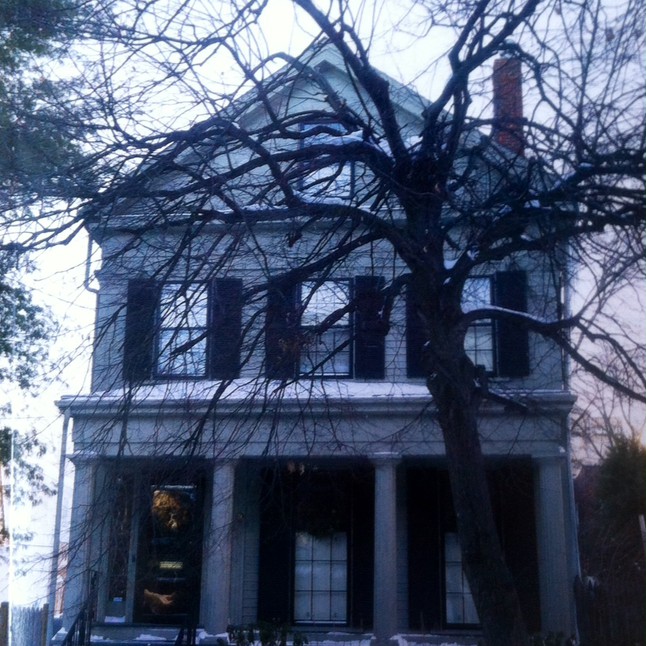
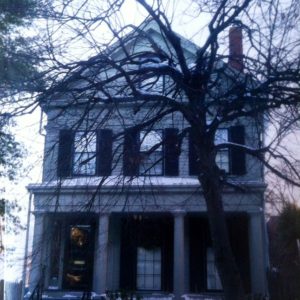
This compilation becomes an extended metaphor for and meditation on living in a place for a long time. That place, an historic house in which Ferry lived for over half his life, is the focus of this consciousness of living in a place.
Ferry and his late wife, Anne Ferry, were not the first poets to live there. Ellery Street was a house in Cambridge where Margaret Fuller had once rented a room, and where Emerson came to visit. But in this collection, the house is permeated by Ferry’s language of actual living, rather than any vestiges of Fuller or Emerson.
Beginning it in the reading room (isn’t it nice to have a room in your house that you call the reading room?), the poems move through a succession of vantage points, from the rooms to the street to the garden — often encountering neighbors and strangers walking around. The whole collection retains the view of living in a house next to others in a neighborhood, and perhaps even more interestingly, the poems in the collection become the rooms in the house and the areas surrounding the house.
Once we are thoroughly at home with the place of Ellery Street, inside and out, Ferry invokes classical figures — for example, Eurydice at the bus stop or Lazarus in his makeshift backyard camp — and thereby integrates ancient and modern figures into everyday roles. These allusions and translations, far from being off-putting, bring us more deeply into the life of the place and its surroundings.
A poem that brings together all the aspects living in Ellery Street is “Lazarus,” Ferry’s portrait of his homeless neighbor.
The dogheaded wildman sleeps in the back alley,
Behind the fence with bittersweet adorned,
In the corner of the garden over near
Where the viburnum flowers or fails to flower,
Depending on whether or not we water it.
Many times over again it has survived.
The leaves are homely, crudely rough-cut, with
A texture like sandpaper, an unluscious green,
Virtuous in look, not really attractive;
Like Kent in Lear plainspoken, a truth-teller,
Impatient with comparison as with deceit. . . .
The peaceful portrait of Lazarus sleeping among the viburnum blends perfectly with the poems that precede and follow it; it is at the center of Ferry’s universal care and understanding. He invokes Kent in King Lear, “plainspoken, a truth teller, / Impatient with comparison as with deceit.” The final image of Lazarus sleeping among the detritus of Ellery Street centers these poems.
This is in fact a perfect collection of poems, culled from Ferry’s other fine collections (Of No Country I Know: New and Selected Poems and Translations and Bewilderment). I say “perfect” because if the goal of poetry is to remind us what it means to be human in a certain place and time, then Ferry’s extended metaphor, Ellery Street, perfectly succeeds in this function.
— Mark Schorr
Cartographies of Scale (and Wing),
 by Anca Vlasopolos,
Avignon Press, 2015,
91 pages, hard $16.95/paper $8.95,
ISBN# 978-0-9962920-1-6
Buy the Book
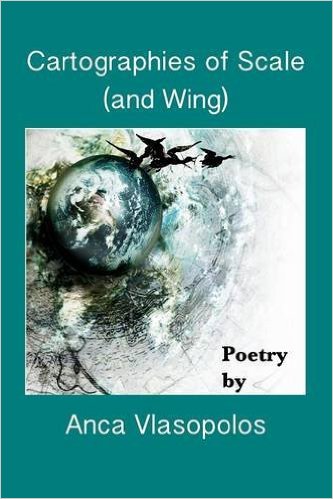
Cartographies of Scale (and Wing), Anca Vlasopolos’s third poetry collection, is an unnerving book — a warning. Her resounding concerns are with what humans do to the world, in our quest to explore, to conquer, and to exploit. For that, the thrust of this collection makes clear, is what humans have done through time: discovered new worlds, and then systematically destroyed them.
In the opening sections of her book, the poet writes to and about the scientists Gerardus Mercator (the creator of the Mercator projection map) and Samuel Bowditch (whose Bowditch Navigator revolutionized ocean navigation). These are, in her estimation, the men whose work enabled man’s conquering of the world. Yet Vlasopolos circles her subjects warily: Could these men have known what their work would lead to? She hints at this in “Mercator Makes Maps,” when, wondering how he came to his “geometric genius,” she asks:
was it a grape
you squashed
under
as you walked
pondering
the sphere
The violence Mercator has perhaps done to the world by metaphorically flattening it for the rest of human exploration becomes more obvious as Cartographies widens in scope. Vlasopolos writes of what the world has lost as humankind willfully tramples it underfoot. In “That and We,” the speaker, “exploring a stone’s throw / from a four-lane street,” reflects upon a progress which appalls her, with people who
hacked
cut
marked
chopped
sank dead posts
bound
kept out
The natural world of insects and birds with which the speaker has a natural affinity has been displaced, then lost. The poetry touches upon dwindling monarch butterfly populations in “At Water’s Edge”:
this year bereft of butterflies
these three
tatters
are left from plenty’s tapestry
It is the language of both beauty and despair, the plenty set in juxtaposition with the tatters left as the butterflies disappear from their habitats. Vlasopolos also writes of dwindling and extinct bird species, such as in the tragic “Empty Spoons,” where a southeast Asian family which formerly lived on birds caught for food now starves, as those birds’ habitats are replaced by “abandoned concrete walls.” The imagery of this collection is meticulous and ruthless.
Interesting, as well, is Vlasopolos’s use of white space in the structure of her poetry. So many times, in pieces such as the aforementioned “That and We,” she places lines on the page in ways that echo both the exploration and exploitation of the world about which she writes. Willful destruction is emphasized by short, hammering lines, pounding human constructions into the ground, or into the reader’s head. Gerardus Mercator, in “Mercator Makes Maps,” exists in lines that are snapped to the margins, much as he attempted to snap the world to lines of latitude and longitude, when he
nail[ed] to the wall
the shimmering
dress
of this
our
little globe
now emptied of loving roundness
left
naked
to probing
anatomizing
yet
to come
In nailing the lines to the margin, the poet makes more horrifying the metaphorical and subsequent rape of that “little globe.” In contrast to these left-justified lines, symbols of the natural world, such as the icebergs in “ID Denied,” float across the sea on the horizon:
four ice floes no
small icebergs maybe iceberg tips
moving west in blinding line of winter sunset
Structure, for Vlasopolos, is a favorite tool to support meaning; the readers get the that sense that for her, the world is open, save for when human progress closes it down — and for her, the danger of the world closing down entirely is imminent.
Mercator and Bowditch, Vlasopolos argues with layer upon layer of painstaking detail, opened the world for us. But rather than marvel at the wonders, we have destroyed them, and, as a result, are destroying ourselves. We are, she implies, blind in our arrogance, and in this collection, the poet (always the messenger who is scorned, or worse, ignored) hauntingly warns readers that
so much depends in each of these (to us) invisible links
upon our
staying
our hand.
— Anne Britting Oleson