


Down
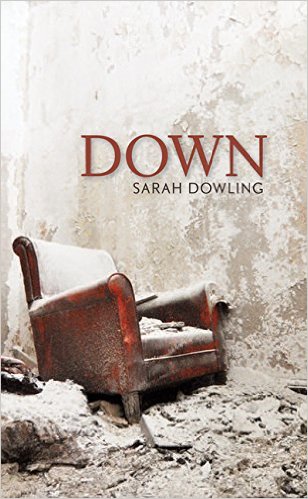
 by Sarah Dowling,
Coach House Books, 2014,
88 pages, paper, $17.95,
ISBN: 9781552452981
Buy the Book
Sarah Dowling’s Down ends with a process note, which is where I began reading. Dowling offers up her source texts, which include songs by the Temptations and Aaliyah, Frank Ocean’s coming out letter, Frank O’Hara’s poem “Morning,” and an interview with Andy Warhol, among others. Because these sources were unfamiliar to me, I went searching for the original texts to better understand the ways that Dowling “flattened” the language as she worked through the project. The research became the poems as I read O’Hara’s “Morning” while listening to Ocean’s “Lost,” unknowingly also hearing a recitation of O’Hara’s poem overlaid on the song. This is how I can best describe these poems: the words morph into one another to create a new narrative — sometimes familiar and sometimes disorienting. They contain threads of love and danger; they feel new at the same time as they feel known. These are poems to live with until they are in your veins, like songs.
Dowling’s explanation of her process helped me to see the complexities of thought that create these poems’ form. Thinking about process took me into the making of a book, which includes the finishing. Here, Coach House delivers a book as well-crafted as the poems on the page. First, I am taken by the texture of the paper and the texture of words and space. The text creates a sense of wandering into the gaps between intimacy and secrecy.
The poems speak to the reader in low tones, call us “Honey” and “Baby,” get down to the birds and the bees from the beginning. “Sunshine Honey” immediately creates an intimacy between reader and poems — we are connected by the familiar song, the sex and the sexlessness, the distance and the longing for some other feeling. Except that we don’t really know who this “me” is — it’s like having sex on a first date. We are feeling and being with the body of the poems, but we haven’t had many conversations, so we’re not sure what this narrative is all about. It takes a few readings to delve into the depths that Dowling offers us in Down, but it’s worth the exploration. She asks:
What could make this aesthetics. What could make me feel
that. Make me many. Make me better. What could make me
sexless and sexual. Make me feel we. Make me feel made.
Make me feel us. Make me feel matter. Make me feel this,
for one. What could make me feel this commotion, this
relationship to energy. What could make me feel this way.
The poems teach us how they “make this aesthetics” — they layer what is familiar with what is completely disorienting. We come through the first section of the book feeling a little bit wooed by the words. This is a fragile kind of adventure. We want to keep feeling this way, so we turn the pages over and over, keep being that somebody who is reading. We get sentimental. We get dreamy. We want to tell someone else how we feel. And so do the poems.
Later, the book moves into darker spaces. The text juxtaposes sunshine and beaches with house fires and graves. The spaces between words create more deliberate disorientation. The feeling of not knowing where you are, where the burial is taking place, comes over you. This crescendo peaks with the poem “Starlight Tours”:
winter taken screaming he on
night out bitterly outskirts
bitterly kneel
on him last cold on the
seen nights river
cold of cold and
winter November
The poems in Down settle us firmly in the hinterlands, in the “waste fields around ports and airports,” in the “locations of secret pleasure and concealed terror.” Dowling takes us into warmth and desolation, speaks to us sweetly in a language that we do not quite yet understand.
These poems will keep you company at night, and remind you simultaneously of our interconnection and our isolation. Down offers intimacy and asks you to do the work that is required to maintain it. This is a book of relationship and revelation, surrender and devotion. These are poems you’ll want to keep near you as you the weather transitions. Read Down — let it sing to you.
— Cathleen Miller
Jesus Was a Feminist and other Poems and Same Old Story
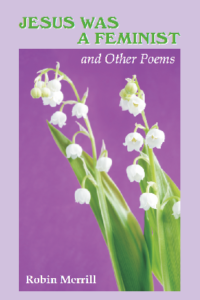 Jesus Was a Feminist and other Poems,
by Robin Merrill,
Moon Pie Press, 2014,
36 pages, paper, $12,
ISBN: 978-1-4951-0361-2
Buy the Book
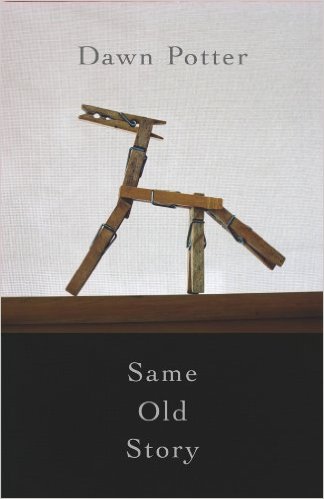
 Same Old Story,
by Dawn Potter,
Cavan Kerry Press, 2014,
87 pages, paper, $16,
ISBN: 978-1-933880-40-2
Buy the Book
Earlier this year, poets Dawn Potter and Robin Merrill both came out with new books. They write very different poems. But because they both write about rural Maine, about the tough lives of those who live on the margins, and about the place of women in a predominantly male culture, they are an excellent study in the difference between spoken word /slam poetry and formal lyrical verse.
With a slam poet — and Merrill is one of the best — the pace of the poem rushes forward as if it can’t delay, and, if it does, the race is off. She uses, as any skilled public speaker, a range of rhetoric techniques to heighten the intensity of the poem and to press it toward its conclusion. In a poem “Hello Wagon,” about getting sober, she spills out her feelings using anaphora and parallelism. Notice how quickly these lines read:
I don’t care what those dastardly demons put in our path
what hurdles, what cliffs, what fire-breathing dragons. . . .
I don’t care what ghosts pay me a visit.
For Potter, in contrast, in her poem “Son-In-Law” about a ne’er-do-well young man, the poem thrives in the delicious hesitations, the gradual building up of a sentence, even the break of a stanza, so that it can spring open and release. Her parallelism is used to set a scene:
. . . while she was emptying last year’s freezer-wizened beans
into the chicken pail, while she was counting
cans of juice and packages of pork chops.
Here the two subordinate clauses are packed with elaborate details and with activities that ask us to dwell on an image. In the third-person voice, the poem lets us watch the woman interact with her son-in-law and, by the exchange of words, we find that he’s still like “The boy he used to be, / the one she recalls at summer Bible School, / pouring Kool-Aid on her little girl. . . . ” There’s no rush to the startling, painful conclusion of the poem. Like a fine musician of words, she lets each word note sound its distinct tone to create its full harmony.
But when Merrill introduces love in “Louisiana Sharecropper’s Chapel,” we’re flung immediately into a moment with a sentence that runs everything together:
And often, I’d only be across the aisle, my tongue so far down
Steve Davis’s throat that I could taste the black licorice he’d snuck
the night before.
Full of lovely sensual details, these lines leap into sexuality with him “unbuttoning that thrift store dress” and her, in church, “calming [her] breathing lest the deacons think” she’s “been touch by the Spirit.” With humor and directness, we experience sensuality with no brakes on. Potter, however, lets the love moment unfold itself line by line, the sentence pulled apart so every move is distinct and gradual, as in her poem “Letter to Will”:
Last night he
Ran his hands
Through my hair,
Down the nape,
Of my neck,
Kissed me between
The shoulder blades,
And so on.
Her words aren’t in a rush. They linger over an image, as in “Dog in Winter” where the phrasing delays in revealing the subject for four lines: “Up the boggy headland, frozen now, where a stone fence / submerged in the snow and earth-sink hints at pasture / so long vanished that the woods are convinced / grassland never existed, two bodies climb. . . . ” Her poems relish delays.
But that does not make Merrill’s poems any less forceful. It’s just that the demands of spoken word, the way the format of a slam is set up — you have to recite in a minute or three minutes a poem that will grab the attention of the judges — delays and hesitations are the death knell of a poet. You need to get their attention and, in quick order, set up a situation, a narrator, and some tension that, after some elaboration, can be resolved quickly. So her poems tend to jump at you the way a salesman on the phone launches into a spiel.
Potter’s poems invite you on a leisurely walk on an unfamiliar pathway where, much to your surprise, you find, as in “Cinderella Story,” a dove:
She crouches, hogging the feeder tray,
pebble-eyed and jaunty despite the ice cube
that, for two arctic days, has encased her pink left foot
like an elegant cement overshoe.
Such description, finely hewn, is filled with delight. Yet Merrill, too, has a delight that is wholly refreshing, as her “Jesus Was a Feminist,” when she takes on organized religion and slams the self-righteous men who choose to use scriptures to censure women:
But as for this woman? I know that:
It was a woman who followed Jesus around, sleeping in caves.
It was woman who stayed at the cross when the men grew faint.
And it was women who returned to find an empty grave.
The spoken word demands that the poet grab her audience and speak to the point. And Merrill does. The lyric poet can take her time and weave her web of words around you so that you feel as if you’re rocking in them, carried away to places you’ve never been before. And Potter does. They both have much to offer the reader, and, in comparison, much to tell of their different poetic forms.
— Bruce Spang
Otherwise Unseeable
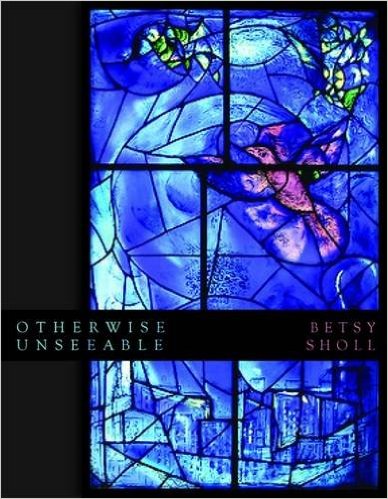
 by Betsy Sholl,
University of Wisconsin Press, 2014,
78 pages, paper, $16.95,
ISBN: 978-0299299347
Buy the Book
How can we properly cherish the beauty in the world while also embracing its harsh realities? In Otherwise Unseeable, Betsy Sholl’s eighth book of poetry, the author investigates this paradox in both personal and political narratives, with a hungry lyric that could only come from someone who’s survived much. Whether re-writing a Brothers Grimm fairy tale, painting a portrait of a burnt-out gambler, or reconciling feelings over the loss of a parent, Sholl offers a rich tapestry of insight and humanity.
Sholl’s mastery shines in her ability to show us a well-known idea from a new angle. This is most evident in poems that take on fairy tales, as in “Rumpelstiltskin,” “The Woodcutter,” and, especially, “Frog to Princess” which retells the Frog Prince story from the perspective of a frog with no ambitions of becoming royalty:
Yes, I’m a croak cloaked in green slime,
a bulging gullet, a mouth full of mud.
But with great quads, Princess, and a tongue
quicker than flies. If you kiss me you’ll taste
where life comes from, its quagmire scum . . .
. . . Not your marble halls and canopied bed . . .
With great music and humor, Sholl introduces us to a re-envisioned frog who is proud of his slimy grit and has come to teach the princess a lesson, noting that her “world paves over what it needs most.” The frog is the gut, the instinct for telling “whether the world’s going on or out.” He warns: “Without me and my kind, Princess, no pond baubles bubbling up new life.” Wishing for a handsome prince is actually the princess’s downfall, because she is waiting for something better to come along while ignoring the muck of life. The frog insists that the princess’s dream of the prince is “a curse, the world’s hearse. I’m what you need . . . the world’s wettest sex, green putty — right here — in your hand.” With this retelling, Sholl asserts that we need to not only accept life the way it is, warts and all, but also to seek to understand the messiness. By wishing for something else — a different lover, a bigger bank account, what have you — we miss the chance to create our lives, with “green putty,” in the often-grimy reality in which we exist.
Another element consistently present in this collection is that of wind as a visceral image to depict life itself and its never-ending changes. From the “voice of mist” that enters in “Alms” to the tumultuous currents that create music in “Wood Shedding,” “Bass Flute,” and “The Aging Singer,” to an exacting characterization in “The Wind and the Clock,” one cannot read this book without becoming roused by “its little eddies.” In particular, “Vanishing Act,” a poignant lyric on the looming reality of death, starts quietly:
Over the phone we’re already bodiless,
though remember, Love, sound has a source
and even a kiss made of mist
can touch a cheek and lodge in the mind.
But the lyric soon builds. The kiss of mist demonstrates how even a whisper can make an impact and set off a flurry of thoughts and emotions, and as the poem continues, the speaker frets over whether she or her partner will die first:
I can’t help fretting about our next porous
existence, which one of us
will go first, last breath disappearing
in a crowd of molecules,
while the other is left alone
with a closet full of empty clothes.
The porous existence extends the wind/air metaphor, depicting death as a process of evaporating into another dimension: That imagined last breath that vanishes into molecules might as well be a crowd of ghosts. But to land, finally, on the image of empty clothes makes the speaker’s fears heartbreakingly solid.
Later in the poem, she states plainly: “Until it’s our turn, what do we really know?” It is a haunting truth of being human that we don’t know what death and beyond will be like, and yet we have to live with this ominous unknown, and what’s more, accept the end of our beloveds. However, the speaker continues to say that “even despair . . . is good,” and can inspire us to live more fully, even “cause a woman / warming herself under five skirts / to throw back her head and sing.” With great skill, here, Sholl gets at our fear of death while still managing to invoke hope. It’s another version of the message from the frog in the swamp: Sholl challenges us to stop resisting and step into the difficult feelings that hold us back from actually living.
But to limit the value of these poems to their spiritual message would be a disservice. It’s Sholl’s ability to withhold sentimentality, execute dynamic language, and to choose images strategically that make her poems powerful. What’s more, this book inspires the writing of poems — what could be a better gift than that? Amongst the many images burned into my memory — a deaf woman pounding the side of her head, a tramp stamp tattoo in the shape of a dog, a fragile parent in form of a tea cup — the simple image of a gold finch seems most apt at describing the poet herself: “How fragile genius is, anxious, always ready to leap from the sill, always an eye out for the informer.”
— Kristen Stake
Cactus Body
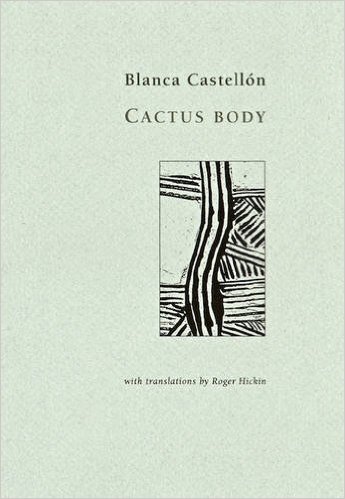
 by Blanca Castellon,
Translation by Roger Hickin,
Cold Hub Press, 2014,
44 pages, paper, NZ$19.50,
ISBN: 978-0-473-26533-5
Buy the Book
Blanca Castellon’s slim Spanish and English chapbook, Cactus Body, is one I’ve returned to regularly this past year, thanks to New Zealand poet Roger Hickin’s eloquent translations. Castellon, from Nicaragua, manages in the eleven poems collected here to be both political and lyrical. Mario Vargas Llosa has said that, in the western world, “to be a writer means, generally, first (and usually only) to assume a personal responsibility,” but that to be a writer, in at least some Latin American countries (Nicaragua makes his list), means “to assume a social responsibility.”
Blanca Castellon certainly gives us the personal in Cactus Body. In “From B. to B.” (with the parenthetic subtitle “When I lose myself ”), she writes a poem about herself addressed to herself. If someone at an open mic prefaced the reading of a poem with such a description, I’d head quickly for the doorway, but Castellon pulls it off, sounding neither narcissistic nor solipsistic. Of her absent self, she says:
I guess you’ve used
your wings
and risen
to the clouds
you like so much
. . .
Blanca, come down
I need you
and a sudden breeze
brought tears to my eyes
One suspects it’s her muse she misses (“Dear Blanca / I haven’t seen you of late”) though the wistful rather than urgent tone suggests inspiration might soon return.
Inspiration comes up again in “Vademecum,” another delightfully personal meditation in which she identifies poetry as a calling without regard to place or time, and tells us that stereotypes of the poet should be ignored.
To be a poet
the main thing is to be a poet
no matter if you wear
a moth-eaten overcoat
a beret
an earring
or tails
…
to know by heart
the best route to take
to the great beyond
and back
This poem is not about calling out poseurs and poetasters; it celebrates a universal vocation, “be it dust in love / you breathe / or Marilyn Monroe you invoke.”
Yet Castellon does not fail to do her Latin American duty. “Outside Times Ten and One Within” is a political poem of 11 sections, which in Hickin’s terse translation evokes Juan Gelman’s poems about Argentina. In Part IX, Castellon tells us:
The poor come back
to die in traps
there’s hunger
and a closed horizon
there’s dust
bones
and a welter of bodies
in a common sky.
Those last lines recall Gabriel Garcia Marquez’s discussion of how many people have died because of political tyranny in Central and South America. The sense of menace here is amorphous and not identified with any one war, coup, or despot, but in Part IV she writes:
field on field
Of lamentation
there’s Washington
Iraq
Somalia
Haiti
Yet the volume does not end with the sense of defeat that Carlos Fuentes once identified as a distinctly Latin American affliction. In “Anonymous Tree,” her nature poet’s heart leaps up as she observes a tree which “beckons lovingly” and is “utterly green / and lush with mysteries.” In “Sometimes However Earth Is Affectionate,” she seems to be writing about some imagined setting where the earth is fecund, friendly, and evocative of joy. There is no repression or imminent violent death in sight.
Appropriately, she concludes with a poem called “Birth.” What’s being born is a poem whose “cactus body” she tells us, “stores water, for days of thirst.” Castellon’s poems, thanks to Hickin, have been a source of sustenance for this reviewer, who hopes to keep drinking, and to hear from both of them again soon.
— Kevin Sweeney