


Translations from the Flesh
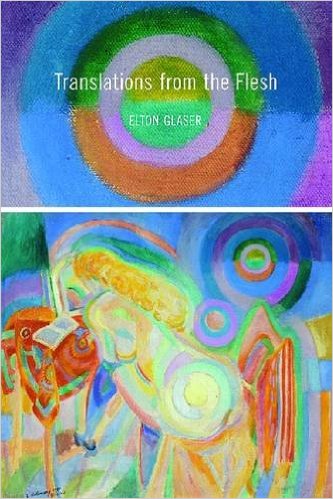
 by Elton Glaser,
University of Pittsburgh Press, 2013,
$15.95, 85 pages, paper,
ISBN: 978-0-8229-6234-2.
Buy the Book
The first time I stumbled across Elton Glaser was in the Fall 2011 edition of the New Ohio Review. I was hooked immediately by the fervent and didactic tone of “Solo in the Skeleton Key,” a voice that spoke with seemingly ageless experience and authority on the subject of love. “Translations from the Flesh” is Glaser’s seventh full-length book of poetry, and in it I found a poet completing his mastery of wit and seduction. Glaser speaks with a voice that is both pondering and affirmed by its purpose, alternately resigned and vigorous. Surprising and intricately paradoxical, his poems express vivid and ecstatic prophecies and musings that develop the concepts of love and transcendence.
A longing for both metaphysical fulfillment and erotic satisfaction pervades many poems, and none can summarize it better than a passage from “Unrequited Dialogue by Moonlight”:
I’d like a few answers that would
Make the missionaries trade their Bibles
For a jukebox and a sharkskin suit; that would
Convince me to walk this earth
In the only serious position, on all fours,
Like a hound sniffing out the backside of paradise.
Glaser crawls through the dirt on all fours in search of these answers, proselytizing as he goes. The voices of his poems roam through risqué subjects with cheeky expressions and illustrative analogies. Glaser speaks in a contemporary voice that uses luscious language without becoming verbose: each poem is filled with hooks that will catch in the mind. “A Contrecoeur” is a keen example of the natural and colloquial prose that makes this collection so memorable:
Sometimes I feel afraid for it, my heart
like a mouse in a windmill,
in an avalanche of grain.
While many of Glaser’s inconspicuous metaphors and analogies are playful, they often belie the yearning and urgency that constitutes much of this collection. The sultry “95% of Love is Half of What You Want” spins the reader onto the dance floor with sexual kinesis, and “Pitching Woo” speaks with confident assertions but the nagging precognition of loss. As I delved deeper, I found myself wondering what else could inspire these stormy lines other than a private life filled with disaster, and additionally, what else could be more provocative and engaging?
The title of the book serves aptly to introduce the recurrent association of the intellectual and the physical spheres. No poem more aptly epitomizes the title as well as “Solo in the Skeleton Key,” a raw and evocative ode to passion and the damage of time:
Love’s no trick of ecstasy, no lightening strike in the mind.
Each new child
Struggles out, bloody and stunned, one more last chance to
get it right.
For the reader seeking ideas of universal order in poetry, the gravity of this stanza is especially poignant. Glaser’s thesis on the human condition is a tribute to the labors of his lines; throughout the book, he translates from “this stony ground” a host of reflections that relate the struggle of the heart as “winter withers the stalks” of youthful deviance, ardor, and enthusiasm. I found great beauty in his tenacity in the face of the inevitable.
Eventually, Glaser’s roaming quest leads him into dark places. Underneath the masking stoicism of “Downloading the Meltdown” and “Not Dead but Deading,” which asserts, “There’s no unified theory of the heart, only fiction and flesh,” there lies a plaintive soul at odds with reality, resurfacing again in “Coupling on the Edge of Entropy” where the speaker exclaims, “What’s one man against the laws of a raucous universe?” In a book full of intrigue, Glaser eloquently frames the questions that haunt the pensive mind so that the answers are unnecessary: pondering the questions is itself enough.
— Andre Demers
As Long as Trees Last
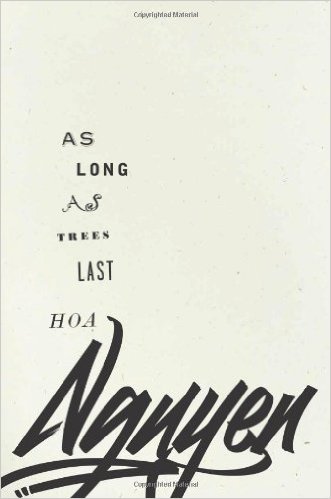
 by Hoa Nguyen,
Wave Books, 2012,
69 pages, paper,
ISBN: 978-1933517612.
Buy the Book
Next time I’ll crack
more pepper also knead
more cheese in there
(insert an involuntary
psychic activity)
— “Bread”
In her third full-length collection, As Long as Trees Last, Hoa Nguyen is still challenging expectations of the lyric voice in poetry. This last phrase, offset as parenthetical, provides a distinction between the initial voice and the aside, a kind of internal monologue or stage direction, adding another layer and complicating the speaker(s) therein.
In these poems, Nguyen prefers multiplicity over a single authority, the demotic over the omniscient, and incorporates an uncensored world, clunky and inelegant as it can be. With an unorthodox syntax, Nguyen creates her own space. Often, she arranges a poem on the page as a beautifully set pillar, using minute and irregular spacing. In her poem “Unused Baby” she writes:
I tried to glue the ripped
paper back to the religious
art but it doesn’t work
Making a mess of it
Here, the mystery is more provoking and perhaps more central than any answer. Her sound at times is dreamy, timeless, while she still appropriates today’s diction: phrases such as “asspatched jeans,” “SpongeBob SquarePants Band-Aid” and “Charlie Sheen” appear in this collection. The zip and immediacy of this public
and often commercial language adds levity to her serious, theoretical meditations. In the poem “Stimulus Drive
Bulge,” Nguyen writes:
2001: Three point three trillion
2009: Seventeen point three trillion
“It’s simpler now to retire —
you just die in the office”
This last phrase closing the poem is offset as a quotation, making it, perhaps, a phrase overheard, one that cannot be unheard or forgotten. This quote’s placement, separate from but following corporate language, is striking; it addresses the reader directly and with resonance.
Nguyen, engaged with the world, is interested in poetry of warning. Her ecopoetics begin with language; though she writes of contemporary events and the concerns of a consumer society, her style challenges ownership and authorship, and makes the reader question who, exactly, is the voice? In the poem “Intimate,” she writes:
(intimate) I know where the meat comes form
my blah blah boring day blah
Blunt my appetites for today
In these poems, questions and thoughts self-interrupt. What’s omitted, what’s confusing, and what remains silent are just as important as what is present. Nguyen’s poetry is not closed, nor does it explain itself away and thus lose itself to meaning. At times, the poem is in the leap between stanzas, as in “The Soul They Say”:
The soul they say has no
gender
Unemployment
estimated at 20%
This leap is another way to make meaning. Charles Olson wrote in his essay “Projective Verse,” 63 years ago, of poetry’s capacity for invention, and of poetic forms’ openness and availability to the writer. In his words: “There it is, brothers, sitting there, for USE.” Here, form is indeed explored in experimental ways. In “Words You Should Know,” the reader is presented with what seems an erasure of an abecedarian poem. The poem “Us” (or “US”) is a palindrome. The poem “I’m Stuck” reads as notes from a to-do list:
What it means to be
out of work:
Write a crime novel
Work at a food bank
In As Long as Trees Last, these short poems manage to be multi-tonal, commanding, strange, full of verve. They force the reader to listen, to question, and to pay attention.
— Lauren Hilger
Colony Collapse Disorder
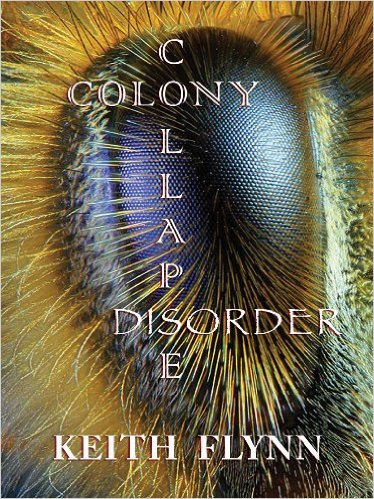
 by Keith Flynn,
Wings Press, 2013,
$16.00, 103 pages, paper,
ISBN: 978-1-60940-294-5.
Buy the Book
Keith Flynn is a direct heir of the Beats in that he questions surface realities, often harshly, yet also creates empathy within readers for human frailty. There’s nothing cheap or facile about his questions; they provoke the reader and disturb with musical phrasing and stark imagery, as in the following lines from “Easter in Palestine”:
On the face of it, the landscape bore
an astonishing nostalgia for lies.
The tapestries cried; the gates of Paradise
opened and shut like the jaws of a shark
in the frenzy of chum.
With an intuitive heart, Flynn takes us all over the world, back and forth in historical time, and uses as his pivotal metaphor the sickness and disappearance of almost half of American honeybees, and the death of bees rapidly spreading to other countries. Instability is a given, Keith Flynn’s poems tell us. Labadee, Haiti, “fat and warm,” a navel in the world, is changed during an earthquake “like a woman slowly dropping her slip from / one shoulder as she slides away.” Unwanted immigrants ride the bus in Berlin, men shoot at pillows and glass window panes even after the war ends in Kosovo, people wander Atlantic City, “where the prelapsarian middle class of all rotted / American Dreams comes to be fleeced / and calls it fun,” and in Dothan, Alabama, things are also not well. Here are a few lines from one of the strongest poems in the book, “Alabama Chrome,” about people whose only sin is “proximity to poverty.”
Handsome warlocks, strapped to strip
malls, and mauled by the perfection
drop poison pellets from their
raven beaks onto the lips of sun-streaked
Meth-pocked blondes in the windy
parking lots of ritualistic pawn shops
and close-cropped itchy trigger teeth
gritted in the Marine recruiting station,
whose volunteers choose grief over
nothing
An elastic, fluid language permeates each poem, often with staccato bursts like a trumpet solo pointed towards the stars. But Flynn takes a quieter mode in several of the poems; deeply reflective, willing to look long and hard for a hidden shaft of light, a clue from a fragmented history that will speak to him. In “Coffin Not Included,” he says “The walls / between this world and the next / are leaky as an old rowboat.” For “The Seven Islands of Izu,” short stanzas push forward like an oar through cold, ancient water. The tone of the poem is like gray brushstrokes on a scroll, and the reader can almost feel clouds above, or gusts of wind. And one of my favorite poems in this book is “God Gives Us Each a Song.” Here’s how it ends:
The worm’s tiny groan as it pops out
of the apple’s skin and finds itself
alone, filled with the right
of the Spirit to be known.
Not every poem in Colony Collapse Disorder rises to this brilliance. “Present at the Revolution” falls flat, the Parisian fashion designers in “The Resurrection of Haute Couture” seem superficial, and Andrew Jackson’s persona in “Old Hickory Gets the Bends” is ponderous. A little pruning would have helped, or perhaps two or three poems eliminated and others substituted, without affecting the book’s basic strength and structure. And truly, the book’s greatest strength is that raw voice that speaks so honestly to us, intimate as a low, hoarse train whistle late at night.
For me, Flynn asks the big questions. He can’t completely answer them — no one can. But he asks, How can I be whole as a man, on this damaged planet? And also, Why do people hurt each other so badly? In “The Exile,” a short, sweet poem, the narrator says “I’ve tried to rope the world in countless / ways and have
done the best I can, / with tangled prayers and no reprieve.” And if this echoes Richard Hugo, that also seems like a blessing: compassion for wounded souls, such as Hugo’s Mrs. Jensen, can never be learned or faked. Keith Flynn is like an EMS worker in the world of poetry: risking the deep places, and born to heal.
— Sharon Olinka
Look Back, Look Ahead: The Selected Poems of Srecko Kosovel
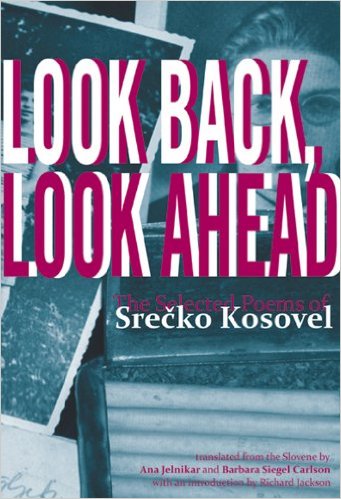
 by Srecko Kosovel,
Translated from the Slovene by Ana Jelnikar and Barbara Seigel Carlson,
Ugly Duckling Presse, Brooklyn, NY, 2010,
220 pages, paper, $17.00,
ISBN: 978-1-933254-54-8.
Buy the Book
Most English speakers have probably not heard of Srecko Kosovel or hundreds of other poets who wrote in their native tongues, who spent their lives struggling to bring light and justice to a primarily imperialist world. It has been the work of translators to bring these voices into our hearing and our hearts, re-building them carefully and gently so that poets like Kosovel, a Slovenian, live for us again. As the translators say in their notes:
. . . we came around a dirt road to a high stone wall with a
fig tree on the other side whose high branches were laden
with fruit. One of us climbed the wall and, balancing just
so, reached up for a few plump figs and handed them down
to the other. So it has been translating Kosovel’s poetry: to
be given this sweet fruit born of what we can never wholly
recreate, and handing it down as best we can. (xxi)
While this is not the first collection of Kosovel’s poems, it builds on previous collections and offers previously unpublished poems by a young poet who wrote with a tenderness and ferocity beyond his years, as in “Who Cannot Speak”:
Who cannot speak
has no need to learn.
You look for a new word —
today it’s unclear
which word it is.
You must wade
through a sea of words
to arrive in yourself.
Then alone, forgetting all speech,
return to the world.
Speak as solitude speaks
with unutterable mystery.
Kosovel had published only some 40 poems at the time of his death, but he left approximately four thousand poems and fragments, more than a lifetime’s work for many poets. Kosovel died in 1926. He was 22 years old. Growing into his voice at a turbulent time in European history, he wrote in a wide range of styles: traditional pastoral poems that evoked his deep ties to his homeland, political poems that stoned the impenetrable walls of nationalism, experimental work that included mathematical symbols, unorthodox word placement, and other avant-garde experiments, while including stunningly lyrical moments. Here is the voice of a poet coming of age at an earth-shaking time. His work spins on a wheel of changing politics, social upheaval, new technologies, and alternative spiritualities. Kosovel gave voice to an age even as he stretched his work to include all these changes. His vision was local and global, personal and universal.
The work of Carlson and Jelnikar in bringing these poems to us feels like the recognition of poets for a lost friend’s work. They bring examples of Kosovel’s varied voices, yearning or strident, challenging or fearful. Their translator’s notes help us understand the extreme attention demanded by the work of carrying the complexities of sound, rhythm, and underlying levels of meaning of a poem while attempting to be true to the voices of both languages and the poet. Poems are chosen to represent the whole body of his work, not merely the comfortable. The introduction, by Richard Jackson, and the afterword, by Ana Jelnikar, give us windows into Kosovel’s life and times and provide us with some historical context for his writing. A contemporary of James Joyce, who was living in Trieste as the young poet was lighting the torches of his poems, and Rilke, who was writing his elegies nearby in the castle at Duino, Srecko Kosovel has been called “the greatest Slovenian poet of the twentieth century” by Tomaz Saluman. It is only the work of dedicated and sensitive translators that allows us to hear him. They deserve great thanks.
Often the task of a reviewer is to make judgments based on his or her personal response to a poet’s work. In this case, I can only say that I feel fortunate to have spent some time with the translators in Slovenia a few years ago and the beauty of the place is deeply haunting. Through these poems I will return there again and again:
One Word
I wish I could say one word
just like the spring wind
softly enters your heart.
I wish I could say one word.
But look, I have nothing else,
my heart is an altar cracked in half.
My words are like wounds,
each one of them bleeds.
Dreams don’t vault into this dark,
only black walls’ rough edges
rise like memories of old times
into the deserted terror of the night.
But still there is, there is still
one word — one word at least!
Come, you night – wounded man,
So I can kiss your heart.
This collection is your opportunity to hear a voice that could have been lost. Do not walk away.
— Michael Macklin