


Fabric
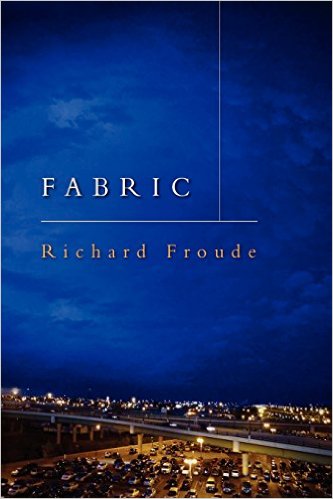
 by Richard Froude,
Horse Less Press, 2011,
120 pages, paper, $15.00,
ISBN: 978-0-982989-60-9
Buy the Book
“Yesterday, aged 29, I bought a dustbuster.” Such declarative sentences fill Richard Froude’s Fabric. The “I” of the book is a likable fellow who buys dustbusters, likes a good wheeze (albeit while staying up all night rewriting the dictionary), and likes to eat cold grilled chicken from Ziploc ® bags. He possesses a willingness to participate that beguiles the theoretical complexities that vie for supremacy in this hybrid of poetry /fiction /memoir.
At first glance, the book is arranged in prose chunks, possibly termed poems, that each take up roughly a half page. A reader may smell poetry leaking through the pages, but Froude shies away from such a moniker: “The word ‘poet’ makes me uncomfortable.” And one sympathizes with him, as Poets come to mind, dressed in all black with well – placed berets atop boozy breath.
In fact, Froude shies away from most gestures of qualification, but he does so in a paradoxical way. His quick, direct sentences give a reader the sense that he is telling straight facts, but this definitiveness quickly undefines itself as a reader realizes that what Froude is saying is anything but explanatory. Froude mentions that “fiction is revealed to be the most popular form of immortality.” So perhaps there is an element of ambition, of immortality here (can it ever be very far absent from any writer ? ), but Froude immediately follows this statement with: “I don’t think I’m going to explain this any further.” It is this theoretical push, and then quick retreat, that characterizes much of the book, and one almost begins to feel that Froude is too modest to fully explain himself, or even to fully acknowledge the ambition of the book. He is even more likable as an author because of this modesty, which feels genuine as opposed to a false – bred modesty.
The book is really a book of transitions. How a reader is able to experience and follow these transitions determines the level of enjoyment extracted from the book. They are quick turns, fast theoretical yanks of the wheel to accommodate such drivers as Deleuze, Jabes, and Barthes, and to be honest, I didn’t follow all of them. But that’s not so surprising; I rarely ever manage to do this. As a reader, I sometimes feel my driving /reading skills are more attuned with my inner grandmother, who perpetually drives ten miles below the speed limit. But this did not inhibit my reading pleasure of Fabric. And in fact, Froude at one point says: “I do not understand the transition. I hold you until you disappear.” It’s a pleasurable, if fleeting, embrace.
Some of these transitions are more successful than others. From page 33 to 34, Froude elegantly moves from a beautiful poetic sequence about constellations, blood and cities into an anecdote, on page 34, about a family trip to Orlando and on to the invention of the stadium wave (I told you the transitions were fast). However, on page 35, two prose sections are linked by the clunky transitional phrase, “That is,” signifying to this reader that this particular turn felt a little forced. In a book with so many fast turns, a few slack ones only feel inevitable.
In order to really appreciate the denseness of Fabric, a reader must have a certain postmodern / New Prose appetite for theoretical acrobatics that can, at times, feel like they exist for their own sake. I enjoyed Froude’s anecdotes over his aphorisms, small narratives about Jackie Robinson’s rookie card or the detonation of the 29 – kiloton nuclear device named “Apple II.” It is a heady mix of trivia and history mixed with a high – pedigree of abstract poetics.
Towards the end of a piece about Richard Brautigan’s A Confederate General from Big Sur, Froude mentions Erik Satie: “reading (as well as writing) can exist as a practice of measurement.” This feels appropriate for Fabric as well. There is an exactness to Froude’s exploration, a writer’s scientific reveling in history’s ephemera. One constructs an image of the author joyfully sifting through the spilled contents of an enormous Ziploc ® bag that had contained not cold grilled chicken, but fact after theory after fact, and all of it awaiting the dustbuster of his pen.
— Jefferson Navicky
Happy Life
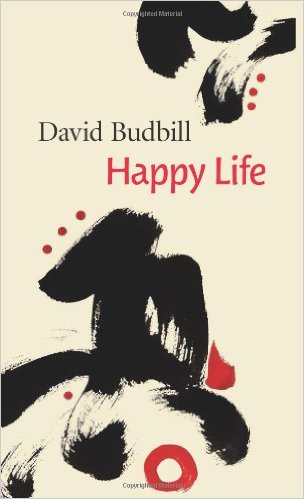
 by David Budbill,
Copper Canyon Press, 2011,
119 pages, $16.00,
ISBN: 978-1-55659-374-1
Buy the Book
It seems that the title of David Budbill’s latest volume of poetry tells the truth. It is not a sardonic commentary on life in the twentieth century. It is rather a collection of warm and accessible poems that grow out of the poet’s experience and his meditations on who he is and how he found himself over the last forty years. What keeps these poems from being just another man’s reflection on aging and vanished hopes is Budbill’s clear language, his wry, self – effacing humor and his humble recognition of all the poets to whom he owes his poetry. Oh, and it also includes verse dedicated to chainsaws, sex and ambition, and an over – riding arc of stillness in the face of natural beauty.
So what happens if you take a working class boy from Cleveland with a love of jazz and a penchant for Zen poetry to the woods ? Something like the poem “A Day Off,” which, after an opening of spring planting and endless work, work, work, opens its second stanza:
until, that is, I hurt my foot and now
I’m so lame I can barely stand,
which means, I have to spend the day in bed
with tea, the history of
Sung Dynasty poetry and the life of Yang Wan-li—
Showing once again how
misfortune
sometimes brings the opposite.
This is not to portray Budbill as out of the loop of current events. One of my favorite pieces in the book is the terse poem “Cynical Capitalists”:
Privatize profit.
Socialize loss. (40)
After listening to endless social commentary on the radio, it is comforting to read such a pungent distillation.
While to some these poems may seem uncomplicated, even simple, they have the feel of a thing made, filed sharp until the rough edges run smooth, then oiled until the words slide across the page. Too often I think contemporary poems run to the jagged and fractured, the overly complicated and dense. Sometimes the simple thing is all we need, and belief is all the poem asks of us. This is a lesson Budbill has learned in his forty years in the woods. It is not the only lesson, but it is an important one.
At times among these poems, we get to go to the city, as in “Three Days in New York: A Blues in B flat.” The poet wanders the city eating freight cuisine, pondering wonders of the non – European world at the Metropolitan Museum and musing: “Who told us Europe discovered the world ? ” But it is the final stanza of this longer poem that pictures the poet as he is:
And here I am this old white guy all decked out in my
yellow, orange, red, black, blue, and white dashiki
and my blue and gold African mirror hat playing
Japanese bamboo flute and ropes of bells from India
And a gong from Tibet, with these far – out, crazy
jazz musicians what come in how many different
shades of flesh and nationality, and me right here
on the Lower East Side in New York City reading my cracker,
woodchuck, honky, ofay, green mountains,
ersatz Chinese wilderness poetry.
Whatever David Budbill is, he is in the middle of it. Whether as an observer diving into his dreams, as a jazz musician, a poet, a playwright, a wood – cutting monk, or a scotch – drinking old man with his cheeks to the wood stove, he is all in. If we all went that far, wouldn’t it be a happy life ?
As he says in the sixth stanza of “Three Days in New York”:
Polyglot Gumbo Masala Stew
Hybrids Bastards Mutts All of us
All sloshed together Ain’t it grand ?
I, for one, need to be reminded of that.
— Michael Macklin
N.B. A Happy Life is the third in a series of books which also includes: Moment to Moment: Poems of a Mountain Recluse (1999) and While We’ve Still Got Feet (2005) published by Copper Canyon Press. Each of these is part of the chronicle of Budbill’s journey which involves spending nearly forty years on the side of a mountain in northern Vermont.
One With Others
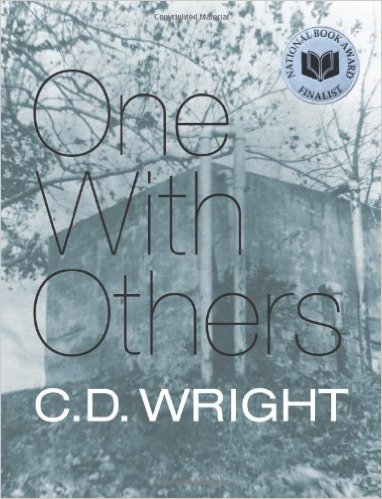
 by C.D. Wright,
Copper Canyon, 2010,
168 pages, paper, $18.00,
ISBN: 978–1–55659–388–8
Buy the Book
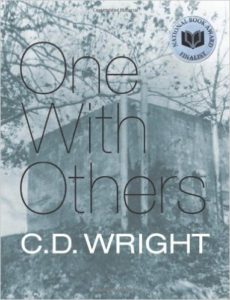
C.D. Wright’s One With Others, her portrait of one spitfire white woman in Civil Rights – era Arkansas, is not, she advises, a work of history: Rather, it is a “welter of associations,” a “report full of holes.” In this riddling of documentary, memory, and meditation, Wright returns to her native home as poet, investigator, and witness, to conjure her old mentor and friend V, an iconoclastic firebrand for literature and civil rights who in 1969 crossed the color line to join a civil rights march, and was driven out of town forever. Through interviews, news clippings, and her own recollections, Wright has crafted a book of verse with the momentum of fiction, by turns elegiac, slyly funny, and horrifying, in homage to V, a vibrant moral and cultural anomaly of her time and place.
That time and place is provincial Big Tree, Arkansas, smoldering with racial strife at a time of similar conflagrations across the nation. Wright calls it up through the words of radio ministers and the local veterinarian, with jokes and Dear Abby columns. She evokes it in its smells (“The faint cut of walnuts in the
grass. . . . The pulled – barbecue evening.”); its grocery prices (“A Whole fryer is 59¢.”; “Two pounds of Oleo, 25¢”); and the headlines (“Los Angeles enters its sixth day of rioting, 32 dead.”) She interviews the black man, a former state senator, who was beaten “by the sheriff who kept a man’s testicles in a jar on his desk until the word got around.”
As a woman and a homegrown intellectual in this world, V is fierce and ever – seething: “She woke up in a housebound rage, my friend V,” Wright tells us. “Changed diapers. Played poker. Drank bourbon. . . . Yeats she knew well enough to wield as a weapon.” V emerges through an array of recollections. From a friend: “Dragged her sewing machine to the porch because she did not want to have to look at it.” An old neighbor: “Oh yeah, I remember her, she celebrated all her kids’ birthdays on the same day.” Wright on her talk with another neighbor: “Flat out, she says, She didn’t trust me and I didn’t trust her. / Then she surprised me, saying, She was right. We were wrong.” The act that shunt V from much of the white community was to join a black organizer Wright refers to as The Man Imported from Memphis (aka “The Invader”) in The March Against Fear, a decision that got her her own headline: “WHITE WOMAN BACKS NEGROES, LOSES FRIENDS.”
Wright reveals V’s story and that of the March through a range of voices — friends from before and after her banishment, activists, and observers. Her storytelling is vertiginously non – linear, in fragments, verse, and prose poems that zoom in and out of time, that circle and refrain. The name of a movie playing in a segregated theater is forgotten one moment, but remembered some pages later; a radio preacher is possibly misheard (“Now get in that goddamn water and swim with the rest of them.”) Wright’s work is rich in changing tenses and shifts in narrators; her own voice withdraws for a time, then returns with an intimate lurch. Here, telling of V’s car blown up after the March: “She had just begun to drive, I mean she just learned to drive and she had many miles to go. Then whoa, Gentle Reader, no more car.” Wright’s piecemeal, circuitous narrative evokes the very shape and rhythm of memory, and the investigation of memory.
That investigation sometimes lands in a searing philosophy of the South’s ills. On the nature of institutionalized bigotry: “King called ‘it’ a disease, segregation. [sounds contagious] / It’s cradle work, is what it is. It begins before the quickening.” And on the emotional contortions of the regularly wronged:
. . . those so grievously harmed, who do the forgiving, do
so, that they not be deformed by the lie, must call on
reserves not meant to be tapped except for a
once – in – a – lifetime crisis. .. . .
But in this case, the reserves are needed every day, every hour of every day, because the warp is everywhere. . . . It is, in fact, the law.
By a gradual accumulation of glints and fragments, Wright also reveals a culture and V over time, the grown children of Big Tree and V ever – rebellious in 2004, on her deathbed in a one – room Hell’s Kitchen apartment. In these moments, there is the temptation to find relief in the contemporary, in having caught up in time to a saner, reason – driven present, the after to the before. But in Wright’s magnificent, important “welter of associations,” in the jukeboxes, radio, and people she hears in today’s Big Tree, there is a stark reminder that history’s shifts, its remembering and forgetting, its outrages, are inextricable from a modernity that’s anything but finished:
Sound of the future, how close
to the sound of the old. . . .
— Megan Grumbling
A City of Angels and How to Carve an Angel
 A City of Angels,
by Ben Mazer,
Cy Gist Press, 2011,
36 pages, chapbook, $9
How to Carve an Angel,
by Peter Fulton,
The Seventh Quarry Poetry Press, 2011,
44 pages, paper, $16.90 (with CD of original musical compositions),
ISBN: 978–095674570–5
Because of the number of channels increasing every day on cable and computers, almost every person now has access to a video store in the house. In that position, like many couch – bound reviewers, I am confronted with the simultaneity of many — too many — works of art at my fingertips. In such an embarrassment of riches, it is refreshing to shift our focus to verse plays, which drastically limit our number of channels to the language of the poem in front of us, and to the music and voices that support that language. A renaissance of verse plays, revived in small theaters, and even café and home performances, could be a balm to our age.
When I started reading poetry in high school and college, verse plays were elusive to me, until I realized that I could simply suspend my disbelief and enjoy the language as it unfolded. Recently reading and seeing three successful verse plays performed confirmed how the form makes the language of lyric and narrative poetry even more accessible — and without elaborate productions.
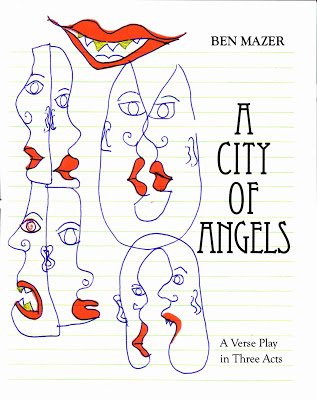
In the case of Ben Mazer’s play, the channels are subtle and subjective: Nineteen – forties’ British dramas, Frost, Camus are the three I picked up, along with a hint of the Dudley Fitts translation of Oedipus. Which isn’t to say that a full scale tragedy ensues. The figure of interest is a young man, a tragic figure, who returns home to his destiny, which is to live the life of imagination — in this case to propose a play that no one can quite understand, but still they believe in him. The young man comes back with dreams that probably won’t be realized, but any tragedy is unnamed and depends upon each individual imagination:
. . . . Say this for the new drama:
It bought you fully to the edge of sense
where evils are met with indifference
and love has power to launch a new surprise,
intelligence communicated by the eyes
ignites the fire of activity
in the calm ticking of the calendar
released into the night’s ethereal
and blessing cognizance.
One can reread this verse play multiple times and experience the pleasure of the play building cyclically though the shape of “the new drama,” and the voices added to the voices that shape it. The cast consists of John Crick, who is the son of the best friend of John Wells, the president of a college. Crick returns to this college to propose a course in a life – defining “new drama,” but encounters the resistance of another group of townspeople. In addition, a family feud has broken out between the Cricks and the Crosses, and Crick’s father has been killed. Crick, then, is both a Prodigal Son and a Fisher King rolled into one. Likewise, many of the main characters, including Mary Wells, John Wells, and John Cross, are more archetypal than realistic:
CRICK: What keeps you at this place ?
MARY: The sound of the bells
Is like no other. The edge of the city’s walls
Instill a strong remembrance of things past.
I don’t know. I was a little girl here . . .
The minor characters function brilliantly as a chorus, supplying details that eventually coalesce into a lyric resolution, becoming part of the larger poem.
For that reason I would love to see this play simply read at a cafe by a dozen strong voices. No fancy production is necessary. I believe it would help an audience to have a brief sampling of each character’s voice, followed by some artful repetitions. Each stanza unfolds part of the action — but not all of it — so that you’ll want to read multiple times, each time finding more. A sophisticated young troupe with an ear for the musical play of dialogue could have much fun with these lines.
In the shadow of Dylan Thomas’ home town, Swansea, Wales, a number of verse plays were performed this year at the first Swansea Poetry Festival. Peter Fulton’s play “How to Carve an Angel,” Swansea’s production of which I watched on DVD, spends most of its energies in lyrics suggesting the inner weather of the sculptor protagonist:
They cannot imagine your revisioning
bursting thunder pinwheel’s cortex
skulling light reels of recollecting
No tick across your stoic mask
features your revelations’ revolt.
More of the scene is filled in by Fuller’s italicized stage directions that add precision, and the simple staging of Swansea’s low – fi production worked in service of the verse. The moving figures of the dancers firmly control center stage. Stage left, the characters are frozen in a tableau vivant. The reader and fiddler hover around the opposite edge, adding just enough to focus the audience on the complicated internal rhymes and the rising action: an angel sculpture being born. By the end of the play, the sculpture is firmly envisioned in the mind’s eye. The simple staging helps the audience focus on lines given to the Angel:
Did ignorance and want
ashame me into illusory seclusion
Are these torments my world’s
scrap of chips carved away:
everything that is not
my sculptor’s pure creation.
I could see both Mazer’s and Fulton’s plays having second lives as opera librettos. If that happens, my hope is that production values will not outstrip the words. And the form itself of the verse play, whatever its next incarnation, should not be overproduced. Nor should it be overwritten. It is tempting for a playwright to add more back story and to fill out the characters’ lives, but the verse play calls forth the gods of metaphor and synesthesia — the art of presenting one modality in terms of another.
Fortunately, both plays under review keep their focus on the language. Years ago I went to see a production of Amy Clampitt’s verse play in which she attempted to shine more light on the life and work of Dorothy Wordsworth. But the dramatic form was too elaborate, and at the end of the evening Dorothy was still overshadowed by William and the other Romantic poets. Clampitt had pointed out to me that each of Dorothy’s journal entries begins with a “weather tag,” like “A fine mild day.” However, in that night’s performance, Clampitt did not follow her own special insight into Dorothy’s language. Clampitt’s subject would have been better served by a less complicated play that focused entirely on her journals.
This leads me to formulate a rule of thumb for verse plays: Any production should not exceed the number of channels that the poetry supports. Start with The Poetry Channel. Then add in The Sculpture Channel or the Place Channel — not the other way around.
That is why I believe these two verse plays, whether on the page or minimally produced, are successful in their current forms. In this age of overproduced operas and music videos, here’s hoping we will see more ad hoc small companies form from these original productions. The Swansea group, including fine work by Peter Thabit Jones and John Dalton, is taking their verse plays to small but significant venues in America such as the Frost Farm in Derry, NH, and the Grolier Poetry Shop in Cambridge, MA. The first scene of Mazer’s “A City of Angels” first appeared on Eyewear (http://toddswift.blogspot.com/2010/08/ =verse – play – by – ben – mazer.html). If more small companies take such initiatives, more plays and scenes will be coming to a small playhouse or a cell – phone near us soon.
— Mark Schorr