


Transistor Rodeo
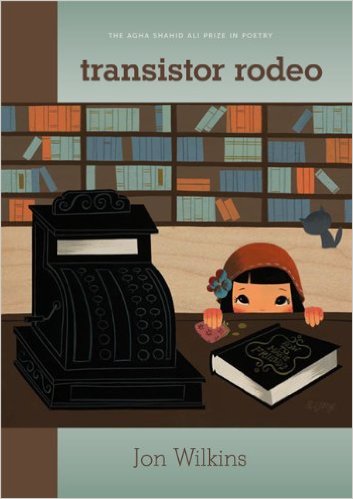
 by Jon Wilkins,
University of Utah Press, 2010,
69 pages, paper, $12.95,
ISBN: 978-1-60781-002-5
Buy the Book
note regarding the following review: Transistor Rodeo won the Agha Shahid Ali Poetry Prize sponsored by the University of Utah Press; Zoo in 2010 and Rodeo in 2009.
If what you are looking for is poems that surprise, let me mention this unassuming mother lode. Try these lines from “Love Song”:
Words leapt from your mouth then
like a gymnast on the moon. You were so
lively and full of pockets.
Don’t worry, I am not giving away secrets: There are a number of poems entitled “Love Song” in this slender volume. But I would use this opening stanza as a description of what Jon Wilkins, the poet, does. Using the same title for each of a series of poems, he sends words zipping and zinging through our senses like a knife – throwing magician, then ducks behind the nearest title for a new and completely differently balanced set of knives:
Always assume it is your lover
who stands you said at the end
of every tunnel and is waving
a scarf or an axe. . . .
Leap to the next “Love Song,” and so on. But Wilkins is not just fast or flashy; he prays, catalogues, theorizes. He does these things by himself in the loneliness of space, or else naked and drunk after the prom with William Carlos Williams in his own Mean – Joe – Green – meets – the – boy – with – the – Coke version of “Kenneth Koch’s Unfinished Sestina.”
In the section called “Prayers,” Wilkins uses the titles to place us in a specific time, physical space, and attitude, i.e. “7:34 am, styrofoam cup, metal table / Prayer”:
Still too early
for beautiful
people. Just
the dust
mask / leaf
blower who
may / may not
regret former
truancies and that scar.
His prayers are bright, twisted pieces of cellophane that wrap the everyday in what feels like the mathematics of modern meditations. He uses slashes to turn his short lines into fractions, as though he were working out the balance necessary to prove his theories on God / world. He ends this prayer, “Lord, make me hot as coffee, / and I’ll melt this world like sugar.” Wouldn’t we all like to believe that of ourselves?
If I had been taught prayer or mathematics by Wilkins, I might have stuck with them. Not because I always agree with him, but because he would keep me fascinated by what was coming next. His ability to keep us off balance and interested is uncanny. As he says in “Please don’t hate me because I’m perfect”:
God, I wish I had a nickname like Rabbit.
I wish I’d spent more time swimming as a kid.
He leaves us wishing as well.
— Michael Macklin
In The Human Zoo
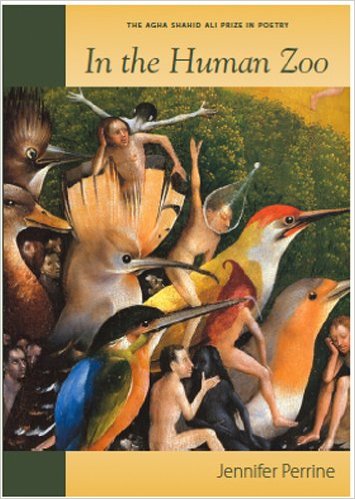
 by Jennifer Perrine,
University of Utah Press, 2011,
88 pages, paper, $12.95,
ISBN: 978-1607811442
Buy the Book
note regarding the following review: In the Human Zoo won the Agha Shahid Ali Poetry Prize sponsored by the University of Utah Press; Zoo in 2010 and Rodeo in 2009.
How long has it been since you’ve felt sucker punched? I’m talking about having to put In The Human Zoo down after a first read, weighting it under a rock on my desk, and going out onto my porch to see if the stars were still where I last saw them. They were there, but my heart was still slamming about in my chest. On first impression, these skillfully crafted poems click shut at their ending like jewel boxes full of wasps. Even afterward, one swears they are waiting for the next innocent victim.
There is little in any of these poems that is not fraught with danger, whether speaking of human origins, the light of fireflies “waiting to scoot their lemony asses / right up to my skin,” “crows unfolding a possum’s / skin,” or how to deal with lemons: “cut your teeth on the rinds. . . ..” Each poem presents another path through ordinary days filled with edges, stingers, “pain wedged on the salty rim / of your face.” Hence the rock. Though we live in a dangerous world, it is rare that we are reminded in such an elegantly brutal way.
Jennifer Perrine might also be a verbal alchemist, given the way she has me reaching for my OED. Her language is by turns common and esoteric, scientific, and surgical. This is language used for its original purpose, to edge words as close to the bone of truth as possible. Having read a lot of poets who seem to want to impress with weighty vocabulary, I was relieved to feel included in digging through the word bins. Once I researched fritillus, spathe and spadix, spirulina, and mammatus, I found she was precise in their use and conscious of their music as well. Her lines are compelling. My limited vocabulary has been expanded by her invitation.
These are not poems of despair. They are survival lines. Perhaps the only way to help you understand is to give you a sample from “Walking Home After the Graveyard Shift”:
. . . I grow talons of housekeys
that slash the August air, that sad frotteur
that pushes against my shirt. Its little huffs
of damp wood and mud pour a fluvial
soup between my breasts. Behind me the owl
whistles its come – on, and I snap my legs
open and shut, a switchblade in the dark.
These are poems that will keep you alive — not necessarily comfortable, but able to fight or flee as you must.
— Michael Macklin
Tocqueville
 by Khaled Mattawa,
New Issues, 2010,
paper, 71 pages,
ISBN: 978-1-930974-90-6
Buy the Book
It is with not a little irony that Khaled Mattawa, the Libyan-born American poet, titles this volume after the famous French observer of 19th century America. In this sweeping, often cynical, sometimes daunting collection, the culture at hand is a modern one, one in which American influence has gone global and viral in matters political, economic, and military. At once condemnation and lyric, both worldly and intimate, Tocqueville takes on this global order, its horrors, and the problem of how to at once inhabit, observe, and tell of any of it.
Early in the collection, in “On the Difficulty of Documentation,” Mattawa addresses an enduring quandary: making art of others’ torment. The poem describes beautiful photos of Palestinian refugees, in which, the speaker rhapsodizes, light-bathed village women “carry the moon on their heads.” But then, he writes,
I recall: Such people have no time for beauty.
I recall: Beauty is one of the great conversation stoppers of all times.
Punctuated with gleanings from Bertolt Brecht (“what beauty does is almost a crime”) and the 16th century poet Thomas Wyatt (“But why do / they flee from me / these beauties / that sometime did me seek”), Mattawa worries here and elsewhere over this beauty, and over the implications of lyricizing what one observes.
Of course, observation has myriad modes and products — photography and therapy, film and foreign policy — and accordingly, Mattawa charges this volume with audaciously varied forms, styles, and allusions. The title poem alone, twenty-seven pages long, reels back and forth between a dozen or more different voices: There are first person narratives of wartime atrocities (a man recalls being forced to place his baby in a cassava-mashing mortar and bludgeon it). There are letter excerpts that muse on the role of the classics in the face of wealth disparity and poisoned water sources (“You only have to see the present to realize how false the past can be”). At one point, Edward Said weighs in on the hypocrisy of Tocqueville, who famously criticized treatment of Native Americans and black slaves, when it came for him to address France’s actions in Algeria. There are dialogues between therapist and patient, and between two anonymous operatives whose conversations are sometimes ominous, sometimes positively vaudevillian (their routine on Condoleezza Rice’s “Electra complex” particularly deserves a rimshot).
Some sections are almost inscrutably fragmented, but cumulatively the volume does conjure a dizzying, absurd, often nightmarish landscape of global capitalism and militarism, much in the style of cinematic montage. Indeed, Mattawa freely employs film script directions, too, and even that most dreaded modern weapon of associative assault, the Power Point sequence. The form plays out ad absurdum in “Power Point III,” in which are embedded a series of matrices. These charts describe four unnamed figures, or “Cases,” each of which is presumably somehow emblematic of the modern era. In the squares of each matrix, the Cases are variously described by way of cryptic, sometimes grave, often snarkily funny crossword puzzle-esque clues. This all may at first be off-putting to the formalist, but the Cases can also be increasingly addictive to compare and riddle out (no one likes a spoiler, so suffice it to say that they include a Russian politician and a former U.S. President, and Case #1 is so obviously Anna Nicole Smith that I’m really not spoiling that much). Across one matrix’s row, labeled “Synthesis,” the text spills freely through all the Cases’ columns, an interesting attempt to “synthesize” these four odd representatives of modern culture into one archetype.
If such exercises sometimes feel a little glib, intellectual, and/or outrageous, it’s equally clear that beneath the cynicism and outrage of Mattawa’s poems lies a deep, searching compassion for dealing with this problematic culture. Take “Trees,” which appears late in the volume. This poem limns trees lost and found — a maple, a eucalyptus in a long-unseen homeland, invasive buckthorns, trees once seen bearing bodies — as invested with memory, hurt, and multiple narratives. How we live with them, the poem suggests, is how we live with history, itself a living thing, and how we tell of them remains a puzzle:
Should I name them to their stories —
tree that hides the stop sign in summer,
tree where I once shot a bird,
tree I planted to cast a shadow on her grave?
“Yes,” Mattawa writes elsewhere, “the need for lyric persists.”
— Megan Grumbling
Tiny Sabbath
 by Helene McGlauflin,
Finishing Line Press, 2010,
27 pages, paper, $12.00,
ISBN: 1-59924-675-9 / ISBN: 978-1-59924-675-8
Buy the Book
The word-music in Tiny Sabbath hums like a tuning fork; the vibe’s pitched low, nudging McGlauflin’s subjects center stage, where they play on a Mozartian scale. My first impression, however, recalled the words of a rock music critic, who was comparing my beloved BeeGees to the Everly Brothers: He asserted that both groups produced “harmonies so close they could only be produced by siblings.”
I say this because on the back of Tiny Sabbath, there’s an extensive blurb from the poet’s sister, Marita O’Neill — an esteemed friend and colleague — author of Love Dogs and Evidence of Light. While this close a blood-bond could produce a skewed assessment, Marita ably plucks the major chords. Her blurb begins by quoting Emerson: “Here we find ourselves suddenly . . . in a holy place.”
It’s apropos. An unabashed fervor ends McGlauflin’s “To the Medieval Christian Mystics,” the final couplet echoing Marita’s fusion of the historical and the mystical: “May I offer you a damp cloth for your face, a cold drink for your thirst, / and sit by you a while silently in the sun?” At times, not wholly consoled by the devout “vocal colors” of, say, a Pavarotti singing “Ave Maria,” McGlauflin displays a dissonant relationship with Catholicism, in poems infused with telling colors or the absence thereof. In “White Carnation Club,” she revisits a Mother’s Day rite in which, after Mass, pink blooms were sold to those with living mothers, while those with deceased matrons were obliged to choose white:
I was forty when my turn came to lift a white
carnation from the basket, join the club. Standing in
the inevitable rain at her grave I was unaware of my
status until my bubble of self-absorption popped,
and I turned to see that cluster of black umbrellas. . . .
As mother, teacher, yoga instructor, and counselor, she intuits that the jangling chaos of Today will — someday — make us all yearn for the “snows of yesteryear” (to translate the French bard Villon). The poem “Sirens” exemplifies McGlauflin’s wisdom; she acknowledges the angst one experiences, applying mindfulness to past and present:
In my girlhood
we stopped everything for prayer
when we heard sirens. Our sister
would put down her chalk, wipe dust
from her delicate hands and begin:
in the name of the father, son, spirit
we pray for the care of the afflicted.
Who were they? Where did sirens go?
Note the “accuracy” of the metaphor in this snippet from stanza two:
. . . Now empty of prayer
I still stop to wonder where sirens go
what hand gave the roulette wheel a spin
what chance allowed my marble to fall
in a winning slot at this moment
allowing me to stand whole beneath
a clear September sky.
Quoting half this poem demonstrates its effective, breathless enjambment: For when I hear “clear September sky,” and (later) “tomorrow may be my day to lose,” I immediately flash back to 9/11: the cloudless sky smudged — far-away — by high-jacked jets deployed as missiles.
We “rural” Mainers can give thanks we’re not the bulls -eye of
al – Qaeda (remember? — two terrorists flew from Portland early that day!), yet her apt roulette metaphor reminds us that all our prayers can NOT eliminate Chance, whether it’s (in the words of Bush Junior), “for us, or against us.”
McGlauflin’s credo, expressed in her second poem “Companion,” is alone reason enough to buy this book. Here are the final lines,
a consolation to those who answer — sometimes reluctantly — to the persistent demands of the Muse:
. . . Oh, there are days
you may want to run away, hide in some dark quiet place,
but she will call for you, search for you, find you, hold you.
— Peter Manuel