


The Giving of Pears
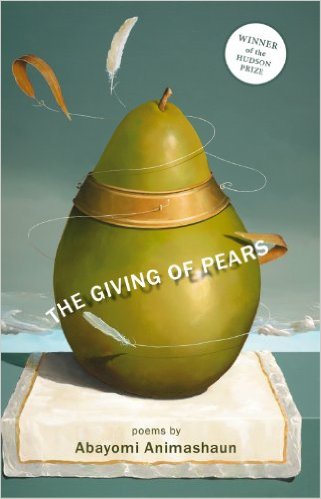
 by Abayomi Animashaun,
Black Lawrence Press, 2010,
82 pages, paper, $14.00,
ISBN: 978-0-9826364-3-5
Buy the Book
The Giving of Pears is an utterly refreshing book of poetry. These delicate and often fanciful pieces are populated by a mélange of ghosts, unborn children, snippets of village life and culture (the author is a Nigerian émigré), and magical tunings. Some of them resemble mystical puzzle boxes, crosses between koans and philosophical conundrums, hearkening back to author Abayomi Animashaun’s study of mathematics. They are clever, sad, amusing and straightforward, without succumbing to pretentiousness. They contain a haunted music and a vigorous imagination, as exemplified here:
I have no words in the machinery of my soul
For how you’ve just pulled me to you.
Released my belt and, now, steadying me
Across the blue flood into the new country.
Divided into six compelling sections, the poems form a colorful travelogue of the psyche, their overriding themes of loss, continuity and hope underscored by an often plain but poignant syntax. In the first section, “Going to School,” Animashaun explores doorways into other worlds, a technique that might quickly become trite; in his hands they have a fresh deftness, as demonstrated in this excerpt from “Tomato”:
Push slowly and enter
A village with its own silent physics.
Its own reddened curvature:
Yellow is the face of the newborn.
Green, the tired hat of the old.
Here sand is red,
And goats lead their shepherd
Through a narrow yard’s edge.
The “Lagos” section acts as hymn, requiem and memoir. The poem “Sunday Mornings at the Barber Shop,” in this section, explores myth, death, superstition and loss through potent imagery entwined with matter-of-fact depictions. This seamless way of braiding the extraordinary with the ordinary is one of Animashaun’s personal hallmarks. Rather than resulting in forced or overly weighted lines, he manages to dance solemnly yet lightly along the edge:
On Sunday mornings
When services begin,
The angels hang their wings,
Abandon their temples,
And come down for a haircut
And nice shave.
“The Unseen” is devoted to ghosts, the unborn, lost loves, and how these beings, whether real or imagined, speak to us, the poetry they engender and the mysterious ways they continue to come and go. “The Other Testament” is an unsettling set of humanistic reinterpretations of religion and figures such as Noah and Mohammed. Animashaun creates an immediacy in these reimagined tales through the use of disjointed phrases, forming a shuffled sense of time in which the present and the ancient become merged. The elegiac musings of “The Tailor and His Strings” form the final section. In “If, In My Next Life,” Animashaun conjures an abstract vision of immortality:
If, in my next life, I have a say
In the molding of clay around
My soul, I’d let my heart be sown
With the sun’s light and traces
From the blue in Cezanne.
Then, geese would find home
In my hands. Birds seeking
Shelter from storms would
Be unafraid to gather and arrange
Twigs on my skull. . . .
The book ends appropriately with an evocation of Rilke, whose imagistic explorations of spirit and time — along with C.P. Cavafy and Kahlil Gibran, and the paintings of Cezanne — guide the poet’s aesthetic journey.
These poems bring to mind Federico Garcia Lorca’s aesthetic of Duende, which often refers to a spirit of evocation, a soulful poetics, an emotional response to music. Christopher Maurer, editor of In Search of Duende, a collection of poems and essays by Lorca, identifies “irrationality, earthiness, a heightened awareness of death, and a dash of the diabolical” as elements crucial to Lorca’s vision of Duende. Such terms also serve to describe Animashaun’s mesmerizing voice.
— Annie Seikonia
Snow Chairs, With A W/hole In One, How The Crimes Happened
Snow Chairs,
by George V. Van Deventer,
Snow Draft Press, 2009,
27 pages, paper, $6.00
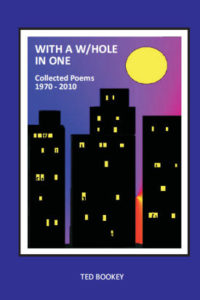 With A W/hole In One: Collected Poems 1970-2010,
by Ted Bookey,
Moon Pie Press, 2010,
82 pages, $10.00,
ISBN: 978-1-4507-7
Buy the Book
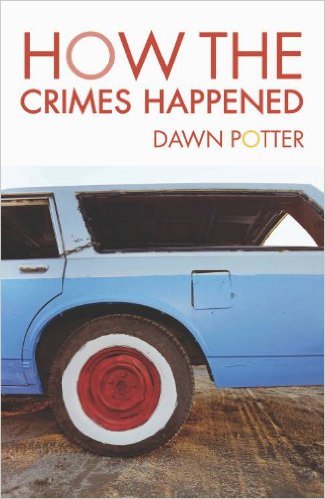
 How The Crimes Happened,
by Dawn Potter,
2010, CavanKerry Press,
93 pages, $16.00,
ISBN: 978-1-933880-17-4
Buy the Book
Recently at a state park campground on Long Island, as night came on I heard the different campers who staked down their tents talking around their campfires. Although, for the most part, they spoke English, its shape and form — the vowels and consonants — changed drastically depending on whether I was listening to a Hispanic or Asian family, or a family from New Jersey or New York City. I was struck with the musicality of our language, how the words we use resonate in our mouths, and how that resonance not only reflects our heritage, but also shapes our consciousness of our world.
In rhythm and tone, the three poets whose books I review here are as varied as those campers I heard.
Take George V. Van Deventer, in whose new chapbook, Snow Chairs, he tells of summer nights when “families share each other’s stoop / mixing English and Italian like water to grape.” He writes of how, as a boy growing up in Newark, New Jersey, he danced behind “the organ grinder with his parrot,” how he would hang out “under a lamppost / next to a fire hydrant . . . within shouting distance of home . . . and play kick – the – can, ringalario, drifting through / the freight year.” His language has the earthy immediacy of a street kid who knows that, beneath the rough world, he could survive like a fox, its eyes “blazed wild.” He remembers a fox being killed, the hunter whacking it between the eyes, and it then being reincarnated as a stole that his Sunday school teacher draped over a chair every Sunday. He speaks plainly about his remembrances: “The winter . . . coming / the sky . . . fat and heavy / grey and close in a chilling wind.” I can almost see him by the refracted light of a Coleman lantern, telling his stories to his grandchildren.
If I turn my head, I can also hear the rich, distinct tones of a Brooklyn accent, which fills Ted Bookey’s new book, With a W/hole in One: Collected Poems 1970 – 2010. Listen to someone who delights in words and word play in his poem “Reflections on Hmslf”:
Sufferin’ Reeee – jetionals!
FEEEEEErocious Barars!
Also two moles and of which
One cuts shaving.
The other on the elbow —
Picked at, grows.
& can’t stop smoking enough.
Lucky he’s not a mouse.
His distinct voice — a combination of playful engagement with words and deft shifts in pace and tone, along with his willingness to poke fun at himself and, by extension, many of us who are absorbed with appearances — makes his poems delightful. He has created a wonderful character, Yekoob, who ruminates about the absurdities of world — from Original Sin to loss, aging, and, alas, the falling off of sex. Yekoob is like a camper who enjoys staking up only one side of the tent so the other side flaps. He sets us up to think that he is talking about one thing only to deliver, like a good comic, a contradiction that makes you think twice about what you just heard:
No time left for you to lose
You’d try to find, but knew
How again you’d only gain
One more thing for you
To use again.
But this book is particularly special because it collects Ted’s previous work, all within a lovely cover designed by his wife Ruth. His earlier poems, many about his family, are among my favorites. Textured with his unique blend of angst and humor, these poems charm and challenge us, take the agonies and transform them into hilarities, yet, as they do, never let us forget how much harm and love sleep in the same bed. They clip along at a quick pace, so we have to keep alert to all the shifts and turns. But I could sit by a campfire and listen to them all night. In his poem, “Oral Family History with Heavy Enjambment,” he used the disjunctive quality of enjambment to create his zany family history:
Your father married late in life a women broke his
heart he was young and lost his head I helped him screw it
back we had money how much don’t ask! Easy street we had
a limousine & a maid . . .
A RODENT!!!
fell in a plate of soup and drowned. . . .
Finally, if I turn again, just within earshot of Ted is another voice, one that I must listen to carefully: A woman, who is sitting by her husband (their two young sons not far off, confabulating in their own tent) is speaking. It is the poet Dawn Potter. Her voice has such nuance and range that I fear I am missing any of her precious words. Her new book, How The Crimes Happened, also makes for good campfire reading. It pokes fun — and equally reveres — the rural life in Maine. It encapsulates the exhausting demands of being a mom. It captures the sweet paradoxes of being loved and loving. And, as if sometimes tired of this life, it shifts to Fiends and Goddesses who have it no less easy.
She uses language so carefully and adeptly that listening to her poems makes me feel her reverence for the word. She can sling out beautiful similes, one after another, each building on the previous one, using lovely alliterative riffs like “clinking ice cubes,” and then, with a cavalier shift in tone, toss in a line like: “yes, we did, / even if our attainments were admittedly half – assed and fraught with unexpected chickens / flapping home to roost.”
This tonal shift is always perfectly timed and intentional: It grabs your attention and forces you to see that under the guise of rhetoric, she is actually spinning, slightly under the surface, another tale that finally bubbles to the surface and changes the whole direction of the poem.
She can talk about her son playing in his B – string boy basketball league with what appears to be a cynical edge, describing the spectators as “heavy – set / mother and fathers, parkas unlashed, tired haunches, / roosting on the narrow benches,” as the
“eighth – grade girls cluster in a corner / sucking up Mountain Dew,” as if she is a bystander, separate from them. Then, in the middle of the poem, as her boy’s team is being routed by the opponents, she realized that each parent wants his or her son to do well, and “the very air begins to smell of love — / not just for their own sons, but for every clumsy, familiar / body on the floor, for every boy who ever built Lego racecars.” By the end of the poem, we too are transformed into fans, knowing full – well the boys will lose, but not caring because “they belong to us.”
She can speak as a mother, as a wife, as a lover, as a friend, shifting and changing the tone and shape of her poems to fit the point of view and the subject. In a poem about her hometown, Cornville, she imagines herself as a woman driving along a road, looking at the “for – sale lineup / not of corn but of flat – bellied pumpkins, and her son listening to Joe Castiglione, the voice of the Red Sox, and then manages to weave in Cinderella’s godmother, Grendel, Oedipus, Home Depot, and a Rottweiler, his “head thick as brick,” and bring them together in the final stanza. It is stunning. But she does it again and again. In poems about the Fiend (Satan) and Paradise Lost and in poems about loving her husband, which are both tender and ironic, poems that any of us who have loved someone over decades can fondly identify with, she manages to walk the delicate line between her urge to belong and the inevitability of loss. In the poem “Eclogues,” she turns to her husband, as she notices how “sweat rises from [his] sunburnt neck, salt and sweet,” and then proclaims:
My love. Marry me, I say. You cast
an eye askance and shrug, I did.
She ends the poem musing that
the maples redden,
shrivel, and die.
Nothing needs me,
today, but you,
sweet hand,
cupping the bones
of my skull. Alas,
poor Yorick, picked clean
as an egg.
These are poems that force us to look at the night sky and see in it its majesty, its beauty and its darkness. Our humanity is not a solitary enterprise — she knows it, Ted knows it, and George knows it. They are poets whose voices, although distinct, remind us of the paradoxical, absurd, and yet loving nature of our world.
— Bruce Spang
The Stranger Manual
 by Catie Rosemurgy,
Graywolf Press, 2010,
94 pages, paper, $15.00,
ISBN: 978-1-55597-547-0
Buy the Book
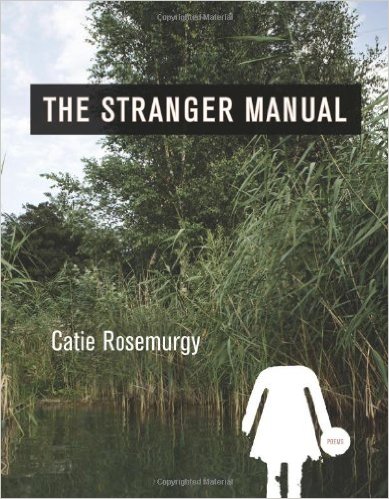
In The Stranger Manual, Catie Rosemurgy writes odd, strangely thrilling poems like bite – size morality tales that mock their own relevance with a slyly caustic grin. Her voice is as alive and electric as Saturday Morning Cartoons, back when they were still good and worth worshipping.
There is exuberance in these poems, and a kind of willful naïveté in the tone that renders ironic the cynicism in the content: “At the base of my wet brain — whatever, / of all brains, all allegedly intricate human brains — / a smallness lies tangled in the roots / of largeness, the one interesting secret is lost / inside the big idea. At least I, in my red socks, hope so.” Rosemurgy steps nimbly from the intimate to the ultimate in those dainty red socks, dancing giddy circles around serious issues. With equal parts wit and whimsy, Rosemurgy comments on the human condition, such as it is, and such as she sees it with all of its contradictions, customs, and confusion.
Rosemurgy tickles the essence of things with pointed description and cutting metaphor, shifting easily from cancer – serious to puppy – playful and back again as needed. “Miss Peach: The War Years” begins with this:
She’s been lobbed,
and like other grenades
can’t help but like
the deeply American ache
where the pin used to be.
She is a squat,
angry seed that blooms
into absence, into big flowers
of what was, a trick fruit
that creates its own mouth,
a wild eye that blinks
its own face away.
This “Miss Peach” is her only named character, yet she defies definition despite being the focus of many of the poems. This is because Miss Peach lives mostly in the titles, intentionally wordy bits of exposition that twist whatever content follows in the body. One title reads: “Miss Peach Imagines She Is an Aging British Rock Star and Considers Bipedalism While Responding to a Beautiful Woman Who Has Just Said ‘I Love You,’” and here is another: “The Monkey Whose Job It Used to Be to Sit on Miss Peach’s Shoulder Takes Up Olde Timey Music.” Any attempt at clear, linear story – telling made by the titles is gently sabotaged, and rightly so, by her playful resistance to what is expected.
Rosemurgy is fascinated with relationship expectations, social taboos, and dating etiquette, and she adds to the discussion in a way that seems fresh despite the high traffic this topic has received. Reading Rosemurgy is like talking to a girl at a party, realizing that she’s a bit on the nutty side, and not caring, because she is the fun kind of touched that wakes you up, slaps you around, tickles you stupid, and in the end, probably has the healthiest perspective around.
There is a playful sexuality bopping around within this book, an impish urge to increase the friction between sweetly disparate images and somehow use that energy to fuel the blowing of your mind.
— Todd Perry
The Lilac Thief
 by Young Dawkins,
Sargent Press, 2009,
48 pages, paper, $10.00,
ISBN: 9780615322018
Buy the Book
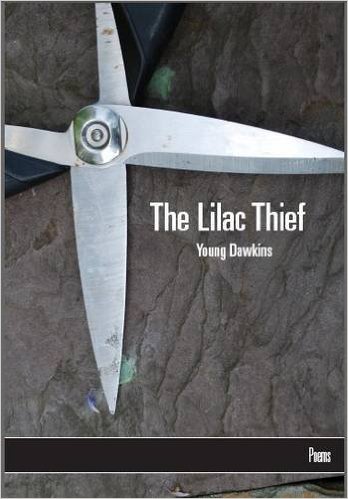
Reading Young Dawkins’, The Lilac Thief, feels like the struggle between remembering and understanding. As if we are walking backwards, Dawkins’ poems are both a look back and a progression. We see the dark faces of past lovers, past lives that seem disjointed and disconnected, and yet are essential for the journey we call experience.
In “What I Know About Women So Far,” the forgotten romance of routine turns into a complicated mixture of violence and sustenance: “Our sex / is like shrapnel and oranges.” Dawkins continues to work with similarly pitted images, like “spectacular train wreck marriages,” to understand the “long and dark” bodies of women who invite the narrator to
come inside and witness
the collision and drift
of ancient continents,
watch the dinosaurs die,
and be warmed by the very first fire.
And always,
and always,
the inevitable rise of civilization,
the ambitious yearning of man.
But she is in the kitchen now,
Happy with her new oil
and olives and cheese.
And I believe it has always come to this,
here
in the lowering light.
By the end of this remembering, this musing on love and sex, comfort and necessity, we are still unable to tell the difference between love and lust. As the narrator enters into new relationships with new women — “dancing / in the early / ballroom of desire” — we know love and lust exist intertwined, as separate and essentially linked as all humans seem to be.
There are moments in these poems where Dawkins, a poet from New Hampshire who generally creates in the performance and beat genres, allows his poems to struggle in their own creation. These poems waver between the sonics of beat poetry and the lyric emotion of his landscape of ex – lovers; this conflict seems to mirror the narrator’s struggle to understand his own experiences. And for all the trouble that beat, performance, and slam poets get when they try to translate their work from the stage to the page, Dawkins has succeeded.
Reading along with these poems, I forget the sound bite – driven language that often dominates the way we speak to each other today. The reward Dawkins’ poems provide is a vacation from fractured, polarized interpersonal communication. A gift of prolonged engagement, these poems invite a deeper understanding of the more intimate and complicated “collision and drift” between us all.
— Mark Rice