

Radha Says
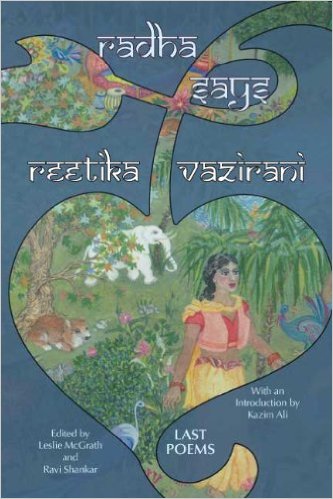
 by Reetika Vazirani,
edited by Leslie McGrath and Ravi Shankar,
Drunken Boat Books, 2010,
86 pages, paperback, $14.95,
ISBN -13: 978 – 0 – 578 – 01465 – 4
Buy the Book
These last poems by Reetika Vazirani, written before her death in 2003, are meditations on transience and impermeability. Her language is free; lyrical, playful, bittersweet at times, rich in scholarly references, and with an ability to soar and dive within mere syllables. Now, that’s her language alone. What’s under the surface, the bedrock of her poems, is a different story. Barriers are Saturnian, impossible to navigate without pain. Ancient ghosts and guardians loom over us, the readers. Women can share the fate of their own mothers, often unwillingly, ground down by menial chores and misery caused by a father, lover, or husband. And absolutely no one is a god or goddess on this earth.
This is Vazirani’s warning, even as the poems lilt and sparkle. The contrast between her exquisite language and negotiations with shadows create poetic tensions that are powerful, impossible to forget. It’s what Federico García Lorca called “duende”: an urgent dance on the edge of danger, being gripped by primeval forces. Add to this the way Vazirani speaks of cultural or political barriers, their complex negotiations, and we feel an authentic, hard – earned voice.
The “Radha” of the title — she is the mythical Hindu Radha, beloved consort of Krishna — comes in many guises and personas within this book, alternately vain, ambitious, and ambivalent: a bored guest at banquets, a foil for the fickle and elusive Krishna – like man frequently mentioned, and even, in one poem, Doris Snyder, a hat – check girl on Radha Street. While the poems’ narrators often glimpse divine energies, as in “Nuptials” and “Territory,” they rarely realize wholeness completely. Sharp questioning and fragmentations intrude in “Born,” which concludes the book:
I say god to be wed to the dream
of an avatar what could be worse?
listen it could be if god sent no money
Like an illustrious predecessor — the 16th century poet Mirabai, from Rajasthan — Vazirani alternates praise and complaints within her poems. She is done with worldly vanity, as in the disillusionment of the narrator in “Swamp Green,” and in these lines from “Born”:
forget every bit of floral lace lipstick and any other
buffer between glamour and being done for
And even in the achievement of long – held professional dreams, in a contemporary setting, comes the realization that the world for Vazirani’s poetic narrators can be full of cruelty, envious rivals, and hypocrites. A line from the title poem, “Radha Says,” makes this clear:
the suburban stepinfechit smiles
of realtors laughing at your tribe
Surely for Vazirani, an immigrant who was born in India, this aspect of the American dream was painful to live deal with. Yet using the “stepinfechit” metaphor makes it clear that she knows the lackeys of culture, money, and power to be more insidious than all of us even know. All of us, especially women, can turn lackey, as in the narrator from “Born” who says bluntly that “he’s a god and I’m errands” or in the last two lines of “Ambient:”
mother what you lived I learned
smiling at the list of chores
Reading these poems, however, I became increasingly disturbed by the Radha persona. It is like a mask that cannot be removed, with its crimson and gold paint turned toxic, its scholarly allusions useless in a world of fragmentations and harsh choices. I was reminded, more than once, of Muriel Ruykeyser’s “The Poem as Mask,” with its cry of “No more mythologies!” and how it once entreated poets to reject anything that blocked telling their own real experiences. When Vazirani speaks of the life of a single mother, the details themselves, such as a visit to a public health clinic in “Born,” have true clarity, are authentic and compelling enough without the lure of a myth.
In conclusion, what is Vazirani really saying to us? The same thing Rukeyser told us — No more masks! — but with her own painful truths. May a new generation of poets arise, particularly women poets, who really do not need or choose the old masks in any way whatsoever. That’s still my wish.
— Sharon Olinka
Rain Inside
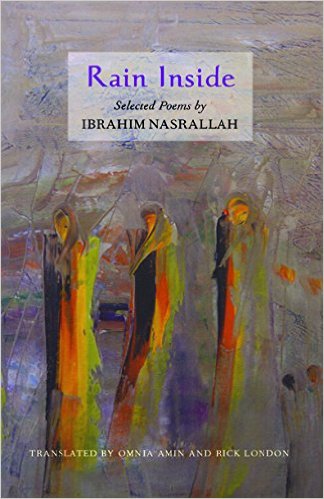
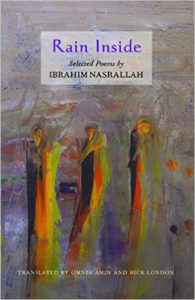 by Ibrahim Nasrallah,
translated by Omnia Amin and Rick London,
Willimantic, CT, Curbstone Press, 2009,
120 pages, paper, $14.95,
ISBN: 978 -1- 93189652 -1
Buy the Book
What little I know of Middle Eastern poetry comes by way of reading translations of Rumi, Hafiz, and Yehuda Amichai, but from the first glance I was drawn into the poems of Ibrahim Nisrallah. “Windows are a first step into the world, / a song on a spacious cloud, / a departure, a rose . . . (3). Suddenly I am in the heart of this poet and those of all the makers with words who reach out and out to understand who they are within.
With a preface by Dr. Omnia Amin that quietly and succinctly gives us a sound base for approaching Nasrallah as a poet and a context for understanding the undercurrent of sorrow that seeps through the poems of a Palestinian man, we step to the window with him. In America it has become common to speak of the poetry of exile as it relates to the distance between our materialistic culture and the country of maker – poets whose voices often go unheard. Through Nisrallah’s poems we understand more clearly what it is to lose home, family, history, and still to yearn for all those things. His poems become a hymn to that desire.
Think for a moment of your first thoughts, stepping into the daylight from your porch. Here is the opening of Ibrahim’s poem, “A Beautiful Morning:”
A beautiful morning
is one that passes and I am not killed.
A city street following the sun at sunset
is obstructed by a roadblock and soldiers.
Another street runs after her
and never returns.
A beautiful morning . . . (44-46).
For all the tension and fear that comes with reading some of these poems, I cannot help but be drawn into the stories of a life that strives to find love and beauty even hanging from the barbed wire. The language is simple, concrete, and purposeful as though taking the step of writing down one more word gives impetus to the hope that he will write another.
This collection was selected by the poet from among a number of his works. Omnia Amin reminds us that his short poems are similar to Japanese Haiku “as they work on awakening philosophical insight by means of an everyday event or insight.” Nisrallah writes a series of poems on chairs:
End
Our ribs break loose like the chairs
from which
we watch the sea at sunset
Isolation embitters the day
A bold grief lies behind our smile
Being with people implies escape
Our legs sink into the dust like chairs
left in a garden after war (62).
This series of poems and others based in concrete things like chairs, hours, tents, and playgrounds anchor themselves in the everyday while evoking deep sorrow or other more complex emotions. It is as though the poet learns himself through the eyes of things. Part of the joy of finding a poet who is new to one’s experience is the way his or her voice reminds of other poets from around the world. Reading Nisrallah, I thought of Francis Ponge and his oranges, Neruda and his Book of Questions, Bachelard’s attics and cellars. Each of these strives to understand who they are in the world while examining the tiniest details of the everyday and using them as the eyepiece of a telescope to bring the work of their hearts into clearer focus.
The medium length poems in this book often speak to his experience as a Palestinian man trying to find a way to bring that life into the world in a way that honors it while exposing those of us who have never known hunger or exile a clearer picture of the experience. The poet himself says, “Writing is our best
opportunity to understand ourselves clearly; therefore, the secret
of writing resides in the fact that we become whole in the act of writing, unlike any other moment in life” (xv).
Ibrahim Nisrallah does not confine himself to writing poetry, but also writes on literature and the arts. He has written ten novels as well as being a photographer and painter. It is easy to find the visual references in his work as well as the communion he holds with human beings everywhere, the need for home family, love, and the freedom to do our work, whatever that is.
The Rain Inside is a wonderful introduction to English – speaking poets of the work of a gifted and sensitive poet. His translators have brought us his work in a caring and evocative way. Understand that this is not a book for the faint of heart, but rather a chance for each of us to explore who we are and how we will live together.
— Michael Macklin
Elegy for the Floater

 by Teresa Carson,
CavanKerry Press, 2008,
84 pages, paper, $16,
ISBN -10: 978 -1- 033880 – 07- 05
Buy the Book
Suicide is never easily handled whether in life or in art. While Teresa Carson titles her collection for the section she demarcates as the “Elegy” portion of the manuscript, much more appears in these pages — it reads as a chronicle of how the experience of her brother’s suicide culminated in an exploration of family history. She doesn’t flinch when turning the sharp edge of her short, blunt lines upon her brother’s psychosis, her mother’s crippling depression, her father’s infidelity. Neither does she spare
herself — her own risky choices (drugs, hitchhiking, affairs) are exposed alongside her family’s failings and dysfunction.
Because she is so forthcoming, Carson makes a space with this manuscript where humanity is the prized possession: it is the thing you must admit to before proceeding. “Stop” (11), the last poem in the “Elegy” section — is a confessional where Carson whispers her relief at her brother’s death. This admission launches a reader into a world where her desire for her mother’s praise in “My Mother Said” and her pleasure at her rapist’s painful death can be gazed upon in close proximity and because it is handled so frankly, a reader can watch the story unfold without judgment, instead standing in Carson’s place as she orients you to the darkest moments and questions that have followed her all of her life.
At moments, the collection seems disorganized, but the order is definitely by design — Carson has made the collection into an echo chamber, details and themes from disparate poems bouncing off one another, adding layers of meaning at each point of contact. A string of poems near the middle of the book address sexual experiences that occurred during her adolescence and young adulthood. In “Kathy 1969” (29), Carson writes from the perspective of someone blithely confident enough get entangled with a married man who’s sleeping with her friend — and in the poem immediately following describes the experience of this same man raping her, “Dog Guards Bed” (30). The genius of the poems is that they stand on their own, but write in each other’s margins and between each other’s lines to add entirely new dimensions and remembrances to the reader’s experience.
Through her brother’s suicide, Carson is able to put a point on so many other experiences of her own that this collection ends up blurring the line between poetry and memoir — poemoir,
perhaps — in a most essential way. These poems may have been difficult to unearth in the honest and lucid way in which they are presented, but they are readily admitted and no less arresting for the effort, emerging unfaded, even after years and several lives lived, from the connective tissues where pain and memory are stored.
— Meghan Cadwallader
The Great Hunger
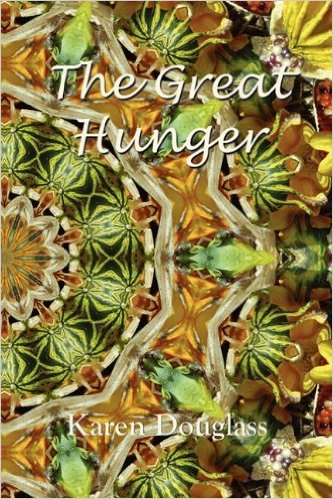
 by Karen Douglass,
Plain View Press, 2009,
81 pages, paper, $13.46,
ISBN -10: 0 – 9818731- 6 – 6
Buy the Book
In her preface to her book of poems, The Great Hunger, Karen Douglass says, “We are eating ourselves and the world to death” (7). Her poems are windows on the ever – lengthening food chain to which we are shackled and they lead the reader from everyday views of our own kitchen tables and farmers’ markets to vantage points we may have trouble accessing — the plight of the undocumented migrant worker in the fields and or the picture of the entire world from above in which the poet traces the paths our food takes from field or pasture to our tables.
While she’s angry at Monsanto (22) and at having to “[forage] for crumbs from the wide vests of CEOs” (15), she acknowledges her own role — in fact, most of the collection rings with a shame at her own complicity in the processes she decries. While she appeals to our shared experiences, evoking the industry and connectedness one feels at a farmer’s market in, “Thirteenth Street Market” (64), even then there’s a desperation mingling with that sense of useful participation in a community: she’s not shopping just for her own table and her own salvation, but for ours as well — the health of the world and its citizens rests on the purchases she makes that Saturday morning. This fear of judgment marks her observations in “Bloodline” (14) as well as she considers how a processed existence is colorless, transporting the speaker further from nature. Here she leaves the end of the poem unpunctuated to suggest the unknown of what kind of an earth will be bequeathed to the next generation; eyes that see “the underside of things” are sealing the bloodline in a continual circle, not wishing to betray the white existence that began the poem.
This kind of thoughtful layering marks many of Douglass’ poems. “Dear Trout” (25) begins with a self – absorbed request to be fed and concludes just seven lines later with a supplication to the same fish she would have eaten, now asking him to teach her how to swim, acknowledging the natural world has much to tell us about living responsibly, usefully — encapsulating the concept in the economical, deliberate way she presents the poem. Although some of her language is a little shopworn,“gold coat[ing] the many roads to hell” (67), Douglass has other instruments in her arsenal to move her poems along as in “Value Added,” where the line breaks create a playful pace at which to trip through abstractions and images. And she is happy to use ironic humor to lighten the grim picture — in “I Want to Eat” (33), she writes that she wants “one raw carrot.” The reality of how unnatural the process by which she comes to that carrot is raw in itself and we continually encounter wordplay wrapped in a very alert conscience in these poems. But beyond her own sense of responsibility, Douglass displays both an uncertainty and thankfulness in “What’s Here” (69) that doesn’t appear in her other poems, illuminating yet another facet of our complex relationship with food.
The joy of this collection is in its variety — the specificity of salsa, the generality of supermarkets and mass -produced products. It is playful in its movement between subjects, but careful in its contemplation of the choices we must make, shedding a new and glaring light on how to decide what’s for dinner.
— Meghan Cadwallader