
Crucifixion in the Plaza de Armas
 by Martin Espada,
Smokestack Books, 2008,
66 pages, paper, $7.95,
ISBN: 978–0–9554028–1–4
Buy the Book
Whether the Ponce uprising, or Rosa Park’s simple act of remaining in her bus seat, it seems every rebellion takes on its own momentum and personality. Crucifixion in the Plaza de Armas by Martin Espada, is a book of courage, beauty, tribute, and rebellion. Espada says, “. . . rebellion / is the circle of a lover’s hands / that must keep moving / always weaving.” (51) Puerto Rico’s people and heritage is palpable in Espada’s work, his gritty voice folding a culture textured with slavery and foreign occupation into the faces and voices of Puerto Rico’s ordinary and extraordinary heroes, many his family.
In 1898, during the Spanish American War, the USA invaded Puerto Rico and never left. Martin Espada is an “independentista” (7); a group who believes in a free Puerto Rico from USA “occupation,” and his poems of Puerto Rico’s persecution resonate like a clanging bell calling us in from the school yard for a history lesson to examine our own behavior. With incredible clarity and example, Espada shows the struggle for freedom and the brokenness that struggle creates, both politically and personally. These two characteristics he cannot separate. Love and rebellion may sound like the antithesis of each other, but not here, not in this work.
Espada paints the invisible bars visible around a still captured Puerto Rico. In The Lover of a Subversive is Also a Subversive (55), Espada shows it best: “When the beach chilled cold / and the bright stumble of tourists / deserted, she and the FBI man / were left alone with their spying glances /as he waited calmly / for the sobbing to begin / and she refused to sob.” (56) His political tribute to Nationalist poet Clemente Soto Velez in the poem “Hands without Irons Become Dragonflies,” (59) a long, passionate poem, somewhat didactic in nature, gives poignant background to Puerto Rico’s history of rebellion.
In 2008, while visiting Tuamgraney, County Clare, Ireland, I walked around graveyards full of Celtic crosses and generations of O’Grady’s; my people, my heritage pulled from the arms of Ireland under British occupation. I was amazed how strong my reactions were visiting this land where names and customs were kept alive by my family in Pittston, Maine five generations past the “Great Hunger.” Evolution might well have changed the curve of our backbone, but not the curve of our human nature.
I felt an unexpected sense of beginning and belonging; and yes, resentment when being introduced to an English owner of pristine Irish coastline overlooking the spectacular Ring of Kerry. For a nanosecond, I felt unexpected ire, remembering that we lost our land and heritage enslaved in our own land, too. Can occupation and persecution pervade the very soul of a collective people? I can hear “James Connolly bellowing insurrection to the Citizen Army of Ireland” (48) shout a resounding “yes!”
Espada’s poems are rich word–portraits of the Puerto Rico people and the culture covering them: the religion, coffee–bean brown land, the lush smell of papaya, and those displaced to Carolina, or New York City, dreaming of mountains and puff–cloud skies. In a poem for his father Frank Espada, he writes of how he, “. . . saw the mountains / looming above the projects / overwhelming Brooklyn / living by what I saw at night / with my eyes closed.” (14) Espada’s poems create a collage of face and place that is sometimes transparent, lost or clearly displaced, yet strong even in its changing. He throws a patchwork quilt over these pages as he allows each name of town, person, image, event to become his country.
In The Rage of Plantation Days, one finds the same vivid imagery and emotive language typical of his work, “Utuado at nightfall / darkness the ink of an octopus / staining the sky between mountains / . . . the shouting over money or a woman /. . . lamp splintered by machete . . .” Espada shows us bodies dragged through the plaza . . .” and a boy / with a broom on the church steps / who once sobbed when he killed a lizard, watching.” (18) This is such a vivid, and unfortunately universal, image; the loss of innocence through violence.
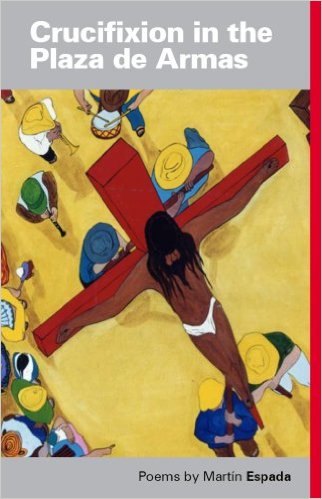
Perhaps the book cover “Dias de Cristo” by Frank Dias Escalet best explains Espada’s passion to stand free. The cover is a black Christ hanging in a central plaza courtyard of de Armas (weapons). Under the cross, gay sombreros and children, festive donkey carts and trumpeters go about their daily business of life in a celebration, while their black Christ suffers their destiny above them, both past and future. Poems in the collection repeatedly call out in one way or another, that “this stripped and starving earth is not a grave” (59), yet Espada’s quest to separate as a country, body and soul is pervasive. He even extends this separation to the persona of Christ; the black Christ of Puerto Rico and the white one the Yankee’s brought. It’s as if, by the single power of his words, he can keep Puerto Rico’s core identity from dispersing and blowing off into the winds.
— Claire Hersom
An Apron Full of Beans: New and Selected Poems
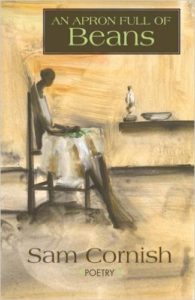 by Sam Cornish,
CavanKerry Press Ltd., 2008,
179 pages, paper, $16.00,
ISBN: 978–1–933880–09–9
Purchase Book
As the first Poet Laureate of the City of Boston and the author of six previous volumes of verse — in addition to his many other honors and awards — it is surprising, indeed, that Sam Cornish is occasionally omitted from the discussion of the Black Arts Movement, as his voice is just as resonant and sincere as any of his contemporaries. Thankfully, his new and selected poems An Apron Full of Beans is a splendidly comprehensive and eclectic collection, which not only affirms Cornish’s role in the American poetry of the previous century, but also demonstrates the raw force of his work today, here, in the electric pulse of now.
In his brief yet poignant introduction to this collection, Dr. James E. Smethurst argues that Cornish’s poems are remarkable for their distillation of so many period styles — particularly those of the Beats, the Black Arts Movement, and the Black Mountain School — yet remain distinct, complete, and authentic in their rhythms and sense of language. It is a point worth repeating. Cornish is just as comfortable with the short, terse lyric as he is with that wild animal called the prose poem, as we see in the collection’s moving final inclusion, “Elegy,” and it is rare that one feels the dust of age upon the older poems in the book.
Another striking quality of Cornish’s poems is the depth of craft they display page after page. There are plenty of poems here that reveal Cornish’s adept skill with necktie–skinny narratives full of plain–spoken, enjambed diction running twenty lines or fewer, such as the clipped minimalism of “Ebony:”
My father labored
in the mine his
hands blacker than
his face
face as black
as
coal his hands
darkest
coal dust
my mother
a fair skinned
woman former
schoolteacher
worked at home
read the Bible
and prayed &
I became
a Communist
But the deeper one gets inside Cornish’s universe of barbershops, broken families, and runaway slaves riding the rails of hope, we see that this style is a conscious commitment to form rather than the result of a limited range. This clearly evident in Cornish’s longer poems, such as “Woman in a Red Dress,” which shed their colloquialism and understatement for a denser, more lyrical register: “If she could count past her fingers / About her body / The words she would find / If she could read / She gathers
water / Like sounds in her head / She kneels / Like a slave / In church / Like a slave preparing / To dance . . .”
While the jacket flap for An Apron Full of Beans claims the collection is “an African–American sequel to Walt Whitman’s Leaves of Grass,” one wonders if such a conceptual framework is applicable or even necessary. Time and again in these poems, Sam Cornish trespasses the accepted borders between public history and private experience by evoking the voices of slaves, sharecroppers, and historical figures such as Frederick Douglass in one large cultural conversation that is self–sustaining without the added burden of arguing against Whitman’s vision of nationhood. Moreover, the questions that result about race, power, love, and loss are more relevant in this strange new century of ours as they’ve ever been. Some of the best voices in America today, such as Kevin Young, Natasha Trethewey, and A. Van Jordan are following in the footsteps of Cornish not merely because he is an indispensible African–American voice, but because he has the courage to turn his interrogative gaze upon our savage and beautiful past without casting his eyes away. Ultimately, though, An Apron Full of Beans doesn’t belong on your bookshelf as a relic of inspiration. It just belongs on your bookshelf.
— Adam Tavel
Café Review 2016 Fall Issue
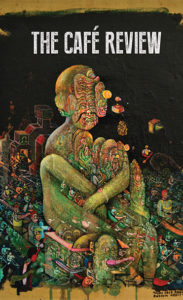
Fall 2016
Our Fall 2016 Issue is now available featuring poetry by Charles Bernstein, Wm. Howard Ellis, Jack Foley, Larry Goodell, Hedwig Gorski, Carol Hamilton, Clara Hsu, Trevor Joyce, Deirdre Kessler, Cormac Lally, Suzanne Langlois, Daniel Lusk, John Macker, Shiv Mirabito, Margaret Randall, Chris Souza, George Wallace, Merryn Williams, Peter Lamborn Wilson and John Yau with artwork from Andrew Abbott and Bill Cass. There are also reviews by Wayne Atherton, Marc DeCarteret and Dana Wilde.
On the road with The Café Review