


I Was the Jukebox
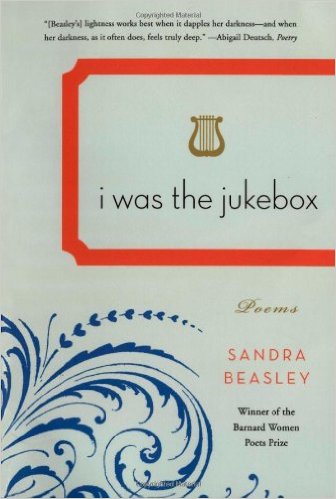
 by Sandra Beasley,
W.W. Norton & Company, 2010,
90 pages, hardcover, $24.95
ISBN: 978-0-393-07651-6
Buy the Book
In a poem from Sandra Beasley’s I Was the Jukebox, the poet offers an epigraph from conceptual artist John Baldessari: “As soon as you put two things together, you have a story.” Beyond merely name – dropping the visual arts, it seems that Beasley has accomplished in this book what so many of us have tried to do: She has found a way to make sense of the visual world, not by forcing a personal narrative upon it, but by allowing the mind to make its own connections, and this flexibility of thought and creativity has led to an astonishing and thrilling result.
The poems of I Was the Jukebox give voice to the mute and the inanimate — the platypus, the piano, the eggplant, the long-dead Greek hero on a first date with the narrator — but there are subtle shifts in the tone of these personae poems that keep them fresh as the pages turn. One such poem, “Cast of Thousands” speaks in the voice of an entire set of movie extras “My death is the clip they send to the Academy / later they will kill me in Spanish, then French.” Another utilizes the shape-shifting logic of dreams, allowing the narrator to speak as the eponymous jukebox. In this poem, “You Were You,” the narrator cum jukebox says to the beloved:
I dreamt we were in your favorite bar:
You were you. I was the jukebox.
I played Sam Cooke for you,
but you didn’t look over once.
I wanted to dance. I wanted a scotch.
I wanted you to take your hand off of her.
There is a real challenge in writing poems from the point – of – view of these objects, but on each page of this book, Beasley finds a way to present us with both the newfound perspective of the object alongside the deeply felt pathos or joy of the narrator.
In later passages of “You Were You,” the reader gets a sense of how marvelous it would be to become the jukebox: It glitters and shines and offers up the best of R&B, pop, and soul. And yet, we know that all the jukebox longs for is the partner across the room, seducing another woman.
What makes this collection work so well is not simply the new slant that Beasley gives to the world of experience. She also has a true feel for the sensual details, which makes the universes that these poems conjure as much of a joy to feel as they are to imagine. A particular favorite poem might be “I Don’t Fear Death,” in which Beasley pictures “field after field / of sorghum crisp to my touch.” Later, she describes the clouds, which are “yellow, smelling of / fireworks and salt.”
I can’t help but compare the Baldessari epigraph to Beasley’s first book, Theories of Falling, which was at times autobiographical, but still gave the sense that this poet would never be interested in simple narratives. Experience isn’t worth a thing if you can’t find a flame of desire in each of its moments, the book seemed to say. Here, in this second collection, Beasley takes brave new steps outside of her comfort zone, seeking new meanings, new juxtapositions, and new subject matter.
For some, the consistent disorientation of each newly voiced persona may lose some luster after awhile, but I say: Give it time. This is a smart book, and a well – crafted one. While the book may be challenging to read through in one sitting, these poems are worth many return trips.
— Thom Dawkins
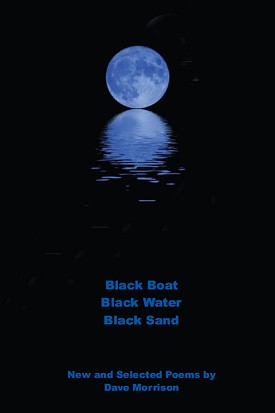
Black Boat Black Water Black Sand
 by Dave Morrison,
Moon Pie Press, 2009,
74 pages, paperback, $10.00,
ISBN: 978 -1 – 61539 – 452 – 4
Buy the Book
Dave Morrison crafts tall poetry with an XL talent and the assessing gaze of an expert onlooker, poems with an all – over texture — part chamois and part steel wool. With an eye for detail and a bottom line that takes language for a ride, Morrison doesn’t keep it level and moving at one speed but guns it, puts it through loops and dives and steep climbs, reeling into witty, often very funny poems full of simplexity, kidding and not kidding at once — I am jealous of the dead for / their reduced workload — as he strives to make sense of life.
Every line feels cared about, really meant, subjected to crash – testing, even moments of heart – rending beauty. If there’s an overriding theme it is that of an Everyman filled with the aspiration for recognition and personal ripening; a drive toward self – acceptance and fulfillment, always wondering how to shake the feeling that you’re always one day late. These poems acknowledge the ever -present possibility of failure, conflicts never quite resolved, the high cost of breaking even, how a howl won’t heal the / scar, but it helps the / bleeding, lights a match, that even if we fail, we must keep trying to fail better.
Morrison’s poems reference a wide range of interest in and knowledge of science, ancient history, music, and pop culture. He’s one of those rare writers who appear to know a lot about a lot, whose work puts a contemporary spin on the classical ideal of poetry as both informational and highly entertaining: serious poetry that doesn’t crush us with high seriousness.
Though many of the poems are political, they’re never the God – awful preachy diatribes that John Keats loathed for their having a palpable design on us. Morrison doesn’t take an
I – know – better – than – you proselytizing tone with us. He never looks down from above.
Too many poets these days seem not to have read much poetry, are unfamiliar with the history of the form and content, and have not absorbed the lessons of the masters — and for that, there’s a tangible hollowness in their work. Morrison has done his homework: Look at this excerpt from his “Care to Join?” — a mordant, satiric take on crowd behavior in all its wonted irrationality worth chapters of sociological analysis.
As the mad group inevitably becomes large and wealthy and powerful and sooner / or later starts to rot from the / inside out, everyone in it
starts to lose their
humanity, starts to get paranoid
and brutal, starts to lose their ability to
recognize bad choices and
repulsive behavior, and starts to think
that they are better than anyone else, and that
anyone not in the group isn’t worth a
damn, and they become this huge slobbering
thing that just eats and shits and eats and shits
and eats, and sooner or later this group becomes like
a drunken sumo wrestler, so that it either topples itself
or is brought down by a smaller leaner more determined
foe, who then begins to eat and shit and eat and shit, and
we never learn anything
and it just goes on forever and makes you lose faith in
the human race, so no, thanks, I’d just as soon not join.
Remind you of anyone? Think Jonathan Swift, his vitriolic disgust for the Yahoos.
Lastly, I want to recommend this poet for the variety of his craft. Morrison is able to write lines that free – fall through history, clutching at twigs of the long – gone and the passing – by to render moments of deep resonance and beauty. There’s something for everyone, every taste: a splendid sonnet, “Unlikely Sonnet;” “Camaro,” a poem in perfect tetrameter; poems that show a fine ear for unobtrusive rhyme; and the wild and surprising wordplay of “Drums Along the Interstate.”
Definitely one of the best new books of poetry, a must read.
— Ted Bookey
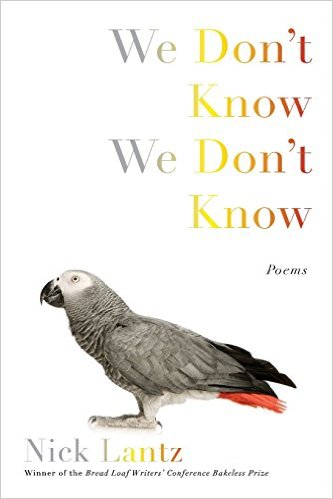
We Don’t Know We Don’t Know
 by Nick Lantz,
Graywolf Press, 2010,
96 pages, paperback, $15.00,
ISBN: 978 -1 – 55597 – 552 – 4
Buy the Book
During the years of Bush the younger, you may remember, verse arose from an unlikely source: Secretary of Defense Donald Rumsfeld, whose evasive rationalizations for the war in Iraq were ironically, angrily circulated as “poetry.” Most infamous was his breakdown of intelligence into three categories: Known knowns, or what we know we know; known unknowns, the things we know we don’t know; and finally, the key to his defense: unknown unknowns — the ones we don’t know we don’t know.
The thing is, from a general ontological standpoint, the man’s right: There are limits to our understanding, so much so that we aren’t even aware we aren’t aware. The outrage of Rumsfeld’s formulation was that he used it to brazenly conceal the truth, rather than illuminate it — used it, you might say, in service to the dark side instead of the light. His notorious quote is one of two epigraphs that preface a fine first book by Nick Lantz, We Don’t Know We Don’t Know, winner of the 2009 Bakeless Prize.
In deeply empathetic poems, Lantz mulls on the confusion, chaos and fallacy that are so often mankind’s lot, and tries to raise them toward the light. In unlikely juxtapositions, he poses the hubris of Rumsfeld against the humility of, of all people, Pliny the Elder, ancient Roman author of Natural History and the source of this book’s other headlining observation, that man knoweth nothing unlesse he be taught. But we can learn our way against the darkness, Lantz thinks. Clear of voice and generous in spirit, We Don’t Know We Don’t Know is a volume both clever and very wise, its title at once riddle, lament, and mantra.
Lantz begins with a chapter of “Known Knowns.” In “Ancient Theories,” he lists “knowledge” dubious or disproved: Aristotle’s theory that frogs / formed from mud; the author’s childhood belief that the world spoke / in code through flashing streetlights. In “List of Things We Know,” he details arbitrary and questionable factoids (Kindness / is correlated / to detached / earlobes) and vertiginous exceptions to rules: Unlike most substances, water expands when frozen, and for this reason / . . . we can / go on living.
But beneath the bewildering fortuities, absurdities, and errors, there burns our persistent urge to understand and explain ourselves — to enlighten — and Lantz treats this desperate instinct lovingly, even as it falls short or fails again and again.
The failures are often ominous. The chapter “Known Unknowns” consists of one long poem called “Will There Be More Than One ‘Questioner’?” — a quote Lantz cites from the 1983 CIA Human Resource Exploitation Training Manual. What follows is a series of obsessive questions directed to an interrogator. Some questions are mundane (Have provisions been made for refreshments?), some are horrific (Will you have an unconscious man dragged past the open door at a pre – determined time?), and some hint at an involuntary intimacy (Will you think of him while you eat dark honey smeared on dark bread in a cafe?).
Haunting the “questioner” are the “known unknowns” of fear, dread, and uncertainty about how he will act and respond, how his prisoner will respond and act, and what will come of their humanity. Ironically, much in those unknowns — Will you risk everything to say [to the prisoner’s wife], He is alive, he is alive? / Will it be true? — is actually within the questioner’s power to decide.
Our very systems of knowing and expressing are inadequate in the chapter “Unknown Unknowns.” Language is insufficient: In “[ ],” Eve laments the birth of words and metaphors, how Adam pointed like a retarded child to name creatures and things. They grow smaller, Lantz writes, each time / she repeats their names. Truth is precarious, an ironic hazard: A verbal tic makes his aging mother preface her lies with in fact, which her parrot repeats over and over as infect.
But we also might know more than we know. To Rumsfeld’s three categories, Lantz adds a fourth: Unknown Knowns. There’s some redemption here, despite so much pathos and futility, as when in “The Sad Truth About Rilke’s Poems,” Lantz assures us that [i]n translation / something / of beauty always dies, but something also is carried over. In this poem, a purer appreciation of that something might call for a simple shift in awareness:
Too many
people close
their eyes to listen to your singing, as if it was the light
of the fire that burns
and not the heat at the heart of it.
The final, promising irony is that in exploring the limits of how we grasp that heat, we might, with a little work and grace, know better.
— Megan Grumbling
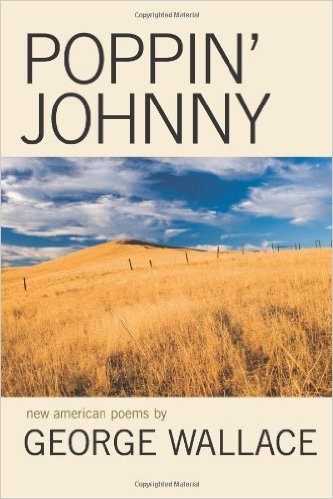
Poppin’ Johnny: New American Poems
 by George Wallace,
Three Rooms Press, 2009,
116 pages, paperback, $15.00,
ISBN: 978-0-9840700-2-2
Buy the Book
I’ve often thought of George Wallace as a sort of psychic channeler, so thoroughly does he inhabit the zeitgeist of this age. Fittingly for a poet well – steeped in Walt Whitman, Wallace writes in the voices of multitudes, a sometimes – risky choice, but one Wallace pulls off with credibility and near – perfect pitch. His characters are not caricatures. Though at times broadly drawn, the people who inhabit these poems are accorded respect, even reverence, by a poet whose clear sight is balanced with a deep compassion for the factory worker, the deli clerk, the bartender; for Sally:
waiting for the number eleven downtown which will take
her from that waitress job which even with tips and
kissing ass it doesn’t cover the cost of rent gas groceries
and electric not to mention a babysitter.
Wallace is not and never has been a “political poet” in the naysaying, finger – wagging, sense of the phrase; neither is he a purveyor of the tiresomely introspective, unstructured work incomprehensible to any but the cognoscenti. He is, in the spirit of Whitman, the quintessential populist troubadour; a culturally rich historical context pervades his poems; a seemingly organic understanding of the times, the times of our parents and grandparents.
This poetry flowers forth from the real world, though sometimes the “flowers” are scraps of trash blowing along in the exhaust fumes and gutters of a down – and – out city street. You can almost hear Tom Waits or even Frank Sinatra as a ghostly accompaniment behind these lines:
This is for the guy on nightshift who never knew
a minute of financial peace just a working stiff
sweeping it all up gum sticks candy wrappers
and white plastic knives sweeping it all up in
the rich american night penniless as the day
he was born smoking too many cigarettes.
With his audacious take on American mythology and the overflowing abundance of his painterly imagination, in his poem “That’s You, Man” Wallace re – contexutalizes characters from American popular culture in the jazziest of recitations:
see that kid staring into the midway lights?
see that farm boy hopping off the greyhound? you! you
you you! you are sexy as a stick of dynamite you are
tasty as a ballpark wiener you got plenty of mustard on
you. you are stronger than demolition dust you are
happiest when closed before striking you are horniest
when your lungs fill up with high grade petroleum
Wallace writes a hell of a love poem, too — his work can be dizzyingly erotic:
i loved you once like a fisherman on the edge of
a river, with his fingers to his lips, tasting the
morning air for salmon. i loved you like man
on a horse entering an undisturbed cove. like a
whaler in his scrimshaw dream of hearts and
flowers. like a ship’s mate who catches first
sight of land.
Wallace’s “New World Love Song” echoes the Song of Songs, with a little Pablo Neruda swirled in:
i am breaking bread with the angels
i am walking in the promised
land and o my love she is
a grove of almond trees
she is exotic she
climbs like a
gypsy wagon
Aptly subtitled, these poems are “new” — so fresh, you can smell the rich, complex soil clinging to their roots — American soil, indeed. Highly recommended.
— Nancy A. Henry