

Hearth
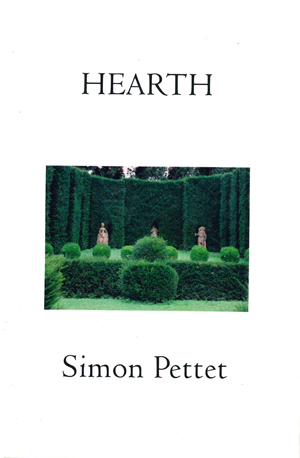
 by Simon Pettet
Talisman House Publishers, Jersey City, New Jersey, 2008,
178 pages, paper, $17.95,
ISBN: 978–1–58498–061–2
Buy the Book
“I’m a madman poet and I / love my psychiatric nurse.” So goes the first stanza of the poem, “Poem.” Many poems in this volume, which, as the poet Alice Notley said, “The complete
works — so far — of contemporary American and British poetry’s most meticulous craftsperson,” are simply titled “Poem,” in the manner of a visual artist who merely names his pieces “Untitled.”
Many poems have an art house filmic quality to them, as if stills from a film without any real defining narrative plot were plucked from the viewer’s memory and projected upon a blank screen, or in the case of Pettet, a blank page. These poems are full of unresolved notions and observations that pique the reader’s interest in how the poem might end or why it might not, drifting off open–ended, waiting for us to surmise:
the music
loud the t.v.
on and downstairs
someone cooking
something
Think of a linear string of non–sequiturs eventually forming a circle to make perfect sense. (I’m reminded of a refrain from a favorite song of mine, Chelsea Hotel, by Alejandro Escovedo: “And it makes no sense / And it makes perfect sense.”) Notice how this happens in this poem: “The telepathic schizophrenic / Who suddenly appears / in Doctor Ehrenwald’s office // Is not the same as the / Tall thin West African / Who rapped upon your door, dear, Tuesday morning // Discoursing on science–fiction haiku / And promising the secrets / of Pythagorian mathematics // (that was someone else).” (10)
There’s a multitude of imagistic gems to be found among these poems, such as this first stanza from the poem, “Two Poems For Frank Sherlock”: “As the lightning bolt strikes the snow, / the little mountain goat (with the bell / fastened around its neck) / rings.”
Most of the poems are short and many possess a haiku sensibility. Take the poem, “The Hermit”: “The elderly, bearded, cloak– / ed figure with the lamp // and the downcast face / moves gingerly / over the stony ground.”
Pettet’s poems are a pleasure to read — full of humor, wit, koanish confoundations, and abundant with a masterful and deft sense of spacing and line breaks. I leave you with some lines from the top left corner of page 55: “In brown smoke stain / I summon the spirit of Paul Verlaine / Crouched at a corner table / Fixated upon an absinthe label.”
— Wayne Atherton
Safe Harbor: Port Veritas Poetry Anthology Volume I
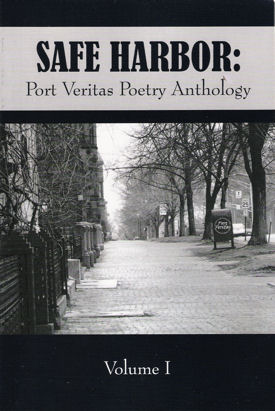
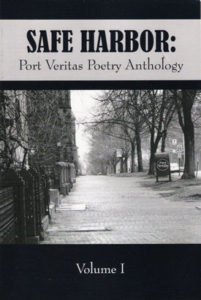 ed. Nate Amadon, Moon Pie Press, 2008,
84 pages, paper, $12,
ISBN: 978–1–60643–187–0
Buy the Book
It is impossible for most poets who teach in the academy, such as myself, to read this volume of visceral performance poetry from Portland, Maine’s vibrant café scene and not feel the old clichés lurking in the shadows. Can performance poetry ever truly work on the page? Does performance poetry need to work on the page? Is an anthology featuring the work of performance poets attempting to serve as an independent volume of verse or as an artifact of lived experience? It is unfair to ask any one collection to bear the burden of these questions, but they are questions worth asking as one reads Safe Harbor, an anthology that never runs short on pathos but occasionally suffers from egoism and a rollicking looseness that mars its weaker selections.
What is most consistent from poet to poet is a damn–the– torpedoes approach that places any subject, no matter how taboo or revealing, under the microscope of poetry. From the bungled wars in Afghanistan and Iraq, to the crippling failure of our public schools, to our draconian adherence to gender stereotypes, the Port Veritas confederacy employs hyperbole and metaphor to great result. Seen in this light, then, these poets are nobly striving to return poetry to its origin as a hybrid of speech and song that, rather than being sanctified, is vivacious, participatory, and didactic. The problem that results, unfortunately, is that other hallmark slam techniques can be so bombastically overused that it becomes difficult to take some of these poems seriously, as is the case with the most cartoonish hip–hop. After all, how many times can a poet rhyme about AK–47 clips in a single stanza?
In the end, though, Safe Harbor is less concerned about aesthetic debates than it is in expressing the range, candor, and tenacity of the Port Veritas community, and it surely accomplishes this and more.
— Adam Tavel
Please
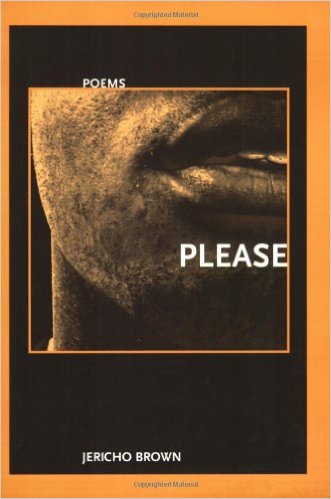
 by Jericho Brown,
Western Michigan University, 2008,
69 pages, paper, $14.00,
ISBN–10: 1–930974–79–5
Buy the Book
In the same way that music hits you straight in the heart, the solar plexus, the guts, Jericho Brown’s poems in Please take direct aim. The poems in this stunning first collection by this talented new poet are risky, beautifully crafted, and deeply felt. At times while reading it, I found myself gasping, or humming, or simply struck profoundly by the emotions.
Please explores the intersection of life where love and violence intermingle. In this exploration, Brown uses the framework of music to spotlight moments in history and culture that surround African American /male identity and sexuality. The use of music works on many levels in this book. The overall organization of the book is that of an album or CD, complete with poems mimicking musical tracks and liner notes at the end.
The sections of the book also reflect a CD player or iPod: “Repeat,” “Pause,” “Power,” and “Stop.” (“Stop” is not an actual section with poems in it, but simply a direction.) And the language itself in the individual poems is lyrical, all adding up to the book’s compelling strength.
Under the umbrella of the musical structure, several themes weave themselves throughout this work: family, love in its many forms, and violence or hurt. While these are not new themes in poetry, Brown’s treatment of them through the lenses of race, culture, and a myriad of voices and points of view give the work a freshness and muscularity.
We hear the voices of various R&B and pop singers such as Diana Ross (“Track 4: Reflections” 11), and Janis Joplin, (“Track 5: Summertime” 19). But besides giving us the voices of the singer, Brown also gives us historical context, as in the Track 4: Reflections Diana Ross poem:
I could hear the sun sing in 1968.
I learned the word assassin
And watched cities burn.
Got another #1 and somebody
Set Detroit on fire. That was power —
White folks looking at me
Directly and going blind
We also hear the voices of grandmothers, fathers, sons, and even crickets and burning bushes. In each of the three sections, Brown also includes the Wizard of Oz’s three famous travelling companions, the scarecrow, tin man, and lion. We hear the voices of the African American culture, of what it’s like to be a gay man growing up and the anguish and violence associated with that.
Complex emotions intertwine throughout the book. In “Prayer of the Backhanded” (8), which appears near the beginning of the book, it describes abuse:
Father, I bear the bridge
Of what might have been
A broken nose. I lift to you
What was a busted lip.
Then near the end, another poem “Like Father” describes the coming out experience:
My father’s embrace is tighter
Now that he knows
He is not the only man in my life.
The poems are gritty, hypnotic, and dangerous, all of which makes these poems incredibly satisfying to read. It is clear that throughout the book, the author’s intention was not to hold anything back. In an interview in Critical Mass, the blog of the National Book Critic’s Circle Board of Directors, Brown articulates this intention. “My only goal is to write poems that take risks in their form and their content. I have always been attracted to work that manages to say what may be thought unsayable, poems that make clear the vulnerability of the poet to his or her work.”
The Jan/Feb 2009 edition of Poets & Writers Jericho Brown is highlighted among 12 debut poets of 2008. At only 25 years old, he’s worth watching, paying attention to, and especially, reading.
— Michelle Demers
A Darker, Sweeter String
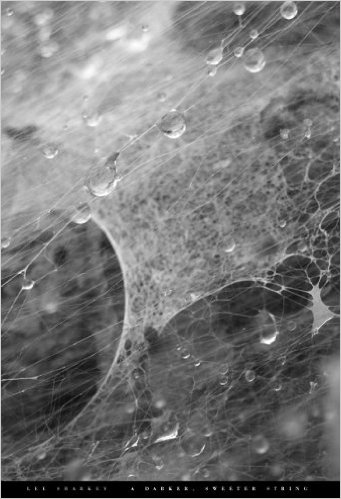
 by Lee Sharkey,
Weld: Off the Grid Press, 2009,
96 pages, $15.00,
ISBN–10: 0–9778429–1–6, ISBN–13: 978–09778429–1–9
Buy the Book
When I think about Lee Sharkey’s A Darker, Sweeter String, the word that comes to mind is liminal. The poems, again and again, occupy that bewildering space between then and now, between present and future, populating the shifting temporal landscape with their characters and critters. Voices seem to speak from these places as an attempt to mark time, the way folding the corner of the page marks my place in the book. The poems themselves also reveal, however, that time cannot be kept in this way. In Sharkey’s poems, deliberate movement from past to present to future is simultaneously enacted and made impossible, not by some fixed boundary, but by the nature of time as Sharkey paints it: layered, the past always a painful pentimento.
In “Where the raven was,” for example, objects and animals — milk, a raven, a stream — mark out the landscape, attempting to delineate a physical and temporal space: “There is a stream there is milk there is a raven / There is a stream of milk there is where the raven was / There was milk there was a stream.” As objects compete to occupy the same spot in time, verb tense shifts — sometimes the milk is and sometimes it was, located in the same space as the stream or where the stream was, but Sharkey goes on to write, “By the stream always it is now,” making the assertion of this past tense deliberately questionable.
Lest we regard the poem — or the book at large — as mere theoretical exercise, Sharkey shows us quickly and clearly what’s at stake, nothing less than “the dead child forever leaving / The new child arriving in a pod of milk.” Perhaps the most accurate and searing revelation here is that if, by the stream, it is always “now,” milk is eternal, but so is loss. In the poem’s final lines, Sharkey writes, “Where the raven was there was a stream the milk was stolen / The stream spills over every body floats.” “Every body” is, here, floating in a stream no longer present, possibly a stream of stolen milk, making stream and milk once more abundant in the current moment, restoring a thing taken through violence and simultaneously — by an act as simple as making “every body” two words — giving the lie to the very notion of restoration.
As evident in “Where the raven was,” with its continuous repetition and revision, Sharkey is thrillingly experimental in A Darker, Sweeter String, arriving at something heartbreaking and necessary by following her own wordplay with what appears a brave and abiding faith. Just as striking are the book’s plain–spoken lines, its disarming moments of pure lucidity. In “Obviously dead,” Sharkey tells us “This is a house where no one owns her body,” and I think she means this house, the one we are living in, where “not a ligament but comes undone.” We are always both the dead child leaving and the new child arriving. When Sharkey writes of “the ghost who’s hungry” leaning in to sip from the lips of the living, I can’t help thinking that we are the hungry ghosts sipping from our own lips, stealing our own milk all the time as moments slip from us, irretrievable, each one swallowed by the next. As a reader, I am simultaneously seduced and unnerved by Sharkey’s strange and ferocious honesty.
There are moments of comfort, though even here Sharkey’s vision is uncompromising. In the love poem “By Moonlight,” the speaker begins by insisting, “One of us will leave the other sure enough / while one of us disintegrates to never having been,” but the poem ends with these lines: “whoever holds the dying other / will inhale one last time in unison // both of us will listen / to the green incessant wind.” And in the long poem “Unscripted,” the speaker intones, “Blessed art thou / suspirer of the Universe / wingbreaker / healer of wings.” The voice here is one of ferocity and tenderness, and it addresses a world that mirrors this mixture of apparently incongruous qualities — the world in which we give birth to sons and watch them die — of disease or in war — and while Sharkey never shies away from this searing truth, there is never a note of resignation in The Darker, Sweeter String. We are never tempted, either, to believe that the layered time she creates in the book — the “always now” — renders the past and future meaningless. This is the true magic, for me — that Sharkey collapses time without ever becoming a historical — history matters all the more in this book for the way in which it infuses this very moment, the future we are making right now a ghost sipping from our lips. Because Sharkey is willing to take enormous risks, both in terms of content and in terms of style, she creates something that is often breathtaking, frightening, and — yes — sweet.
— Melissa M. Crowe