


Nox
 by Anne Carson,
New Directions, 2010,
illustrated, unpaged, $29.95,
ISBN: 978-0-8112-1870-2
Buy the Book
Anne Carson’s beautiful book in a box has already been excellently reviewed in The New Yorker, The New York Times, The Guardian, The Believer, and the list goes on.
And so, despite my excitement at the prospect of writing this review, Nox’s two -inch thick bulk sat on my book pile, and continued to sit.
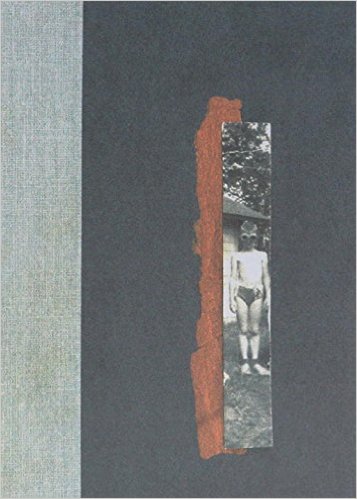
I read it three times, loved it, and it still sat. What could I say that hasn’t already been said, and said much better than I could say? I took it with me to my parents’ house for Thanksgiving. My mother, seeing the cover image of Carson’s brother Michael as a ten-year-old boy in swim trunks, flippers and goggles, told me the picture looked exactly like my Uncle Carl. And so she wanted to read the book, but because of turkey distractions, she did not get around to it. I offered to leave the book with her, but she objected: “You’re the one who has to write the review. Won’t you need the book?”
In my mother’s comment about the cover image is a place to start. The book is essentially an elegy to Carson’s brother Michael, who died in 2000 in Copenhagen. It was, in Carson’s words, “a surprise to me.” Carson’s brother did in fact resemble a ten-year-old version of my uncle, but I have the distinct feeling that many people will recognize this goggled sliver of a boy as one of their own. He has that amorphous quality that radiates from the black-and-white photo, calling out, “I’m cute, and I’m prickly. I don’t want you to love me, but you won’t be able to help yourself, will you?”
Of course not. Such is the energy of the distant and the departed.
Who is this boy? And why am I compelled to like him?
Thus begins the asking. But the asking is not idle, as Carson says. To ask is an action, a moving forward in time until answer. As a child, I asked my mother so many questions — why are there tummies? why door panels? why church Latin? why armies? why flight? — that at times, when the onslaught of questions threatened to overwhelm my good mother, she’d respond, “Why is a cow?” Why indeed. I never knew the answer to this question. It often made me mad. How should I know? It made me ask more questions.
I love the old questions, Carson says. Why go on? Why language? What is a voice? Why is a cow?
This asking is something we carry with us, fashioning it into a thing that carries itself.
An accordion book in a box. A hollow book, and not so easy to carry.
My aunt, when I was a child, had a wall of bookshelves, hundreds of volumes. One of my brother’s and my favorite games with friends was to find the hollow book somewhere in the vast bookshelves that contained not words, but jewels — my aunt’s rings she had kept from her own grandmother’s treasures. My aunt didn’t particularly enjoy this game, but we couldn’t resist searching.
The searching has wings. And as we read Carson’s book, we become aware of all the questions of History, a phoenix, flying above us as we read.
A shadow crosses the page, wings, and in this passing shade we come to see the immensity of the mechanism in which we are caught, the incredible fragility of our own flight of shadows, and we are able to fly because of the motor of our asking. The asking makes our bones hollow.
“The immensity of the mechanism in which we are caught.” Such a beautiful phrase, and Carson uses so many others. I would mention the page number, but there aren’t any. What is this mechanism that catches us?
By far the strangest thing that humans do is history. Herodotus is firm on this, as Carson asserts.
The sad anthropologist was not wrong in saying that history allows the enslavement of humankind. A voluntary enslavement, much more pervasive than television or wireless hand-held devices. “What else can he do?” What else can we do? We, literally, asked for it. Like Herodotus, and Carson, we thus describe and are intoxicated by our efforts.
But this act of history is not grand; we collect “bits of muteness.” From whom? From those who have died? From Carson’s brother Michael, from Herodotus, from my aunt and yours and the others.
Muteness, according to Carson, possesses “a fundamental opacity” that sounds of loss; and the essence of loss is the asking. But, of course, there is no sound to the asking. This book does not speak.
To put it another way, there is something tangible in a lack.
And now we approach the end without really having begun. Dictionary entries of the Greek words in Catullus’ poem 101 on the death of his brother punctuate Nox at regular intervals, giving the illusion of knowledge, the solidity of the parts of speech. They almost function as answers to the asking. But they are only a given structure, empty even in their attractive form, because there is no meaning in suffering. One cannot define it. There is no answer. Carson calls it night, or in Latin, “nox.” On the final page, Catullus’ poem, even if one could read Greek, is blurred beyond recognition, set atop night paper.
Because it is so big and unwieldy, my copy of Nox has taken a beating, corners bent, cardboard ripped like a too -big heart, a too-big book in a small, paperback world. Where does this book fit? On my bookshelf? My apartment doesn’t have enough bookshelves, so we have many little stacks and piles of spillover books. Nox has sat on the top of the one closest to my writing desk for weeks. When I come into the room, it calls to me from its little hill that holds open the glass doors from the kitchen. I’ve been ignoring its call for so long — I don’t do reviews, too chalky — but now I have to start.
I can faintly hear the asking that Carson’s book provokes, questions from my own childhood as a ten-year- old, goggled boy, as well as arcs from the asking of later life, the heavier stuff, some realms I’ve lost, and vaster.
Why did Eric Brokaw die in that car crash? Why did Ralph Walker shoot himself at the old basketball courts?
I have begun to listen to them more closely, and to try to ask questions in return. What else can I do? The muteness has grown too loud to ignore.
— Jefferson Navicky
Seedlip and Sweet Apple
 by Arra Lynn Ross,
Milkweed Editions, 2010,
95 pages, paper, $16,
ISBN: 978-1-57131-434-5
Buy the Book
About a decade ago, as part of a college course on American communal societies, I attended a lecture by Frances Carr, then an Eldress in the Maine Shaker community of Sabbathday Lake. With my strictly textbook knowledge of the Shakers — of the religious sect’s flight from persecution in eighteenth- century England, its strict dictum of abstinence, its devotion to work and simplicity — I was surprised at what struck me most about Eldress Frances’ talk: her sensuousness. As she spoke of her favorite childhood chore, helping make candies for sale in the community’s store, she lingered in loving, luscious description of dipping caramels and figs into warm chocolate. What I heard in her voice, speaking of such simple things, was ecstasy, and in that moment I gained new insight into a religion mostly — and mistakenly — known for its austerity.
The ecstatic worship of the Shakers suffuses the poems of Seedlip and Sweet Apple (Milkweed, 2010), an incantatory debut volume in which Arra Lynn Ross channels the voice and spirit of the Shakers’ founder, Mother Ann Lee. With grace and affection, these poems exalt in the sacredness of food, nature, and the human bodies that receive the word. Ross renders Ann’s spiritual joy luminous, tactile, and present in the commonest stuff, as sung in the creation praise of “Learn to Sing by Singing”:
You are
the loved, my beloved — light in the bone, tender green,
the diner bell ringing; aprons on the line — yellow muslin
and green. . . .
You are
the love, lemon and rind.
Ross guides us through three phases of Ann’s life and work. The first section, “The Word of Life,” is set in the Manchester,
England of her youth, where she felt an early aversion to marriage, buried four children, experienced her spiritual awakening and visions, and was incarcerated by hostile authorities. With a small band of Shakers, including her brother William, a blacksmith, she sailed for America in 1774; in the book’s second section, “The New World,” Ross writes of their arrival in New York City and their resettlement, two years later, on land near Albany. Finally, in the section “Journey of the Word,” Ross moves into the Shakers’ missionary efforts throughout New England, finally bringing us to Ann’s death in 1784.
Throughout this arc, Ross gives equal attention to the mythic and the workaday, conjuring Ann’s first visions with primordial strangeness and intensity. Here, Ann has flown inside Jesus’ lips:
Words swim from our mouth, thwacking hard tails against
teeth; they fall at our feet, and the poor, with bent heads
and dry hands, gather them in woven baskets.
Elsewhere, she lists off the quotidian drudgeries of life in Manchester: “Ten potatoes, six shirts to scrub — and dirty linens, dirty linens are never through — ashes, bread, urine — .” In the same poem, “Bring Thy Gift to the Altar,” she balances that toil with the promise of Ann’s visions, marrying prophesy with common things:
“Joy.” A ewe, an olive grove.
“I will not leave you comfortless.” Blue iris, hyacinth, an
egg under the leaves.
“No more the anguish.” A thing much whiter than an egg.
In the passage above, Ross pairs the words of Jesus, from the Gospels, with fragments of Sappho, and it is exemplary of the rich array of sources and influences she draws upon, from Shaker songs, lore, and written Testimonies to historical accounts and documents. To convey the tenor of Ann’s England, she fills “The World’s Course” with ads from the Manchester Mercury (for “Dr. Lowther’s Specific Powders and Drops,” “A Match of Cocks,” and a runaway apprentice with “a touch of the Evil on the right side of her face”), and in “Manchester Constables’ Log” lists arrests (including that of Ann Lee, for “willfully and contemptuously / in the Time of Divine Service / disturbing the congregation”).
Later, there is the bounty of New World: In “Behold I Stand at the Door and Knock,” common names from a glossary of colonial terms impart the nourishing texture of their life in America, as Ann calls out for communion through things:
Bring me your lanterns, lightings,
your beds of chaff and flock, crocks of jam
and salted pork, your caddis, your holland
and huckabuck, duroy and yellow nankeen,
your hatchel, hackle, heckle and flax,
your warm loaves on the peel. . . .
Like an agile and generous spirit, Ross slips between several characters’ voices as she weaves Ann’s myth. We hear William tell of gifting apples to housewives on missionary trips; of being shy of the young Sisters’ reverence and slipping away to the forge, to the wordlessness of heat and iron. In “Hezekiah Hammond Speaks,” we hear a “winter Shaker” (one who stays only through the hard months) wonder at his sudden helplessness to go, once spring came.
And of course we hear Ann, in both verse and prose poems, speaking to many: Recounting burials and births; telling a parable of hens and plums to a youngster struggling with faith; recalling, in old age, what gave her joy — moss, song, rosehip tea. The result is a work that radiates with the voice of Ann and her fierce, sure, rapturous faith.
Today, Ann’s legacy eases ever more steadily into the realm of art and scholarship. Eldress Frances, now 83, is one of only three remaining Shakers at Sabbathday Lake. More the blessing, then, to have Ann’s story raised in such a joyous and visceral form.
A wise and wondrous exploration of how the spirit lives in the world, Seedlip and Sweet Apple slips us within Ann’s fervent skin, and lets us feel her flush.
— Megan Grumbling
Spirits in Bondage, A Cycle in Lyrics and Phantom Noise
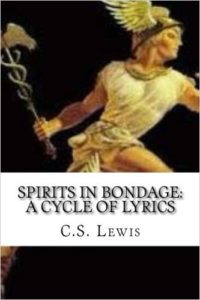 by C.S. Lewis (as Clive Hamilton),
released online by Project Gutenberg in 1999,
Ebook No. 2003, http://www.gutenberg.org/ebooks/2003.
Reissued in print by Cosimo Classics, 2005,
88 pages, paper,
ISBN-10: 1596053720
Buy the Book
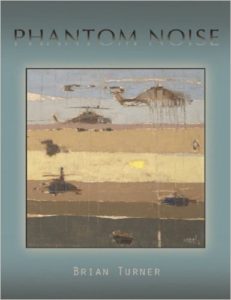 Phantom Noise,
by Brian Turner,
Alice James Books, 2010,
93 pages, paper, $16.95,
ISBN: 978-1-882295-80-7
Buy the Book
If we ever have a true history of the Iraq Wars, it will have come from the slant of poets in the trenches, not from embedded journalists or other official spokespersons.
I was reminded of this when, looking for information on C.S. Lewis’ later fantasy writing, I came upon his 1919 first book of poems, Spirits In Bondage, in the public domain on Project Gutenberg. As a 19 year-old, Lewis was thrown into one of the most horrific battles of WWI, experienced trench warfare in one of the worst tank battles of the Somme, was wounded, saw his best friend killed, and finally returned home to care for his friend’s family. Fortunately, Lewis had one resource that most of his fellow soldiers in 1916 did not have: He could write about the horrors of battle.
In the first poem, Lewis personifies the atrocities of war he has experienced through the personage of Milton’s ruined archangel Satan:
I am Nature, the Mighty Mother,
I am the law: ye have none other.
I am the flower and the dewdrop fresh,
I am the lust in your itching flesh.
I am the battle’s filth and strain,
I am the widow’s empty pain.
I am the sea to smother your breath,
I am the bomb, the falling death. . . .
The poems that follow record young Lewis wrestling with the fallen archangel for nothing less than his soul, and those of his fellow soldiers. I very much recommend this text, a free download from www.projectgutenberg.com. Those interested in following Lewis’ mythological trail might read these poems as a roman à clef of his early career.
The casualties in the Somme were horrific. According to John Keegan’s A History of Warfare, the British Army lost 20,000 men on first day of the Somme, July 1, 1916. Lewis was a part of a battle in which machine guns fired six hundred times per minute and killed a thousand-man British regiment in an few minutes. Lewis’ poems directly absorbed the shock of his experiences of trench warfare, atrocities, post-traumatic shock, and reentry into society.
In the most recent wars, I find the American poet Brian Turner confronting war no less earnestly than Lewis did. Over half of Turner’s poems were written in Iraq, at a time when American casualties were flown home under covert conditions. Turner could not keep the battle events at as much of a literary distance as Lewis could; he works in a very different way than Lewis, the mythologist who clothed his experiences in fantasy and myth. In contrast, Turner is a realist, in the sense of Stephen Crane, constantly peeling away layers of experience until he gets to what is real.
His first book, Here, Bullet (Alice James, 2005) was a shot heard round the world. There is nothing between this poet and the bullet, directly addressed to him. Some considered it the first shot in the peace poetry movement. I did not. Poetry cannot stop wars; it can only get us closer to the truth of them. For a long time after encountering these poems, I read no newspaper and listened to no nightly news. This news from Brian Turner in the trenches was not only the truest news I had of the Iraq War; it was the only news. And it holds up well after three years, preserving the landscape of this unfortunate war with bone – chilling accuracy through the voice of a soldier’s deepest reflections.
Brian Turner’s second book, Phantom Noise (Alice James, 2010), is an even more confident collection. Here, the personal wrestling with war and belief is much more in the foreground than Lewis’ struggle was. The book begins with a series of traumatic flashbacks in the longest poem of the collection, called “At Lowe’s Home Improvement Center.” These flashbacks were well known in my own family because my father suffered shell shocks, as they were then called, after World War II. I recalled witnessing them when I encountered Turner’s description of a flashback in progress:
Standing in aisle 16, the hammer and nail aisle,
I bust a 50 pound box of double -headed nails. . . .
In a steady stream
they pour onto the tile floor, constant as shells. . . .
Turner’s poems shine light on key issues that will not go away. “Insignia,” a poem for women sexually molested by their own superior officers, is both sad and horrifying. The epigraph takes dead aim at the reader and refuses to let us wander from the statistic that “[o]ne in three female officers will experience / sexual assault while serving in the military.” Without letting the reader turn away, the story begins its own unfolding:
She hides under a deuce n’half this time — sleeping
on a roll of foam, draped in mosquito netting.
It goes on to address her terrorizer:
It’s you she’s dreaming of, Sergeant — she’ll dream of you
for years to come. If she makes it out of this country alive,
which she probably will. You will be the fire and the
hovering
breath. Not the sniper. Not the bomber in the streets.
As often happens in Turner’s poems, the one about to assault and the one about to be assaulted respond within the hair-trigger constraints of combat. Lewis, too, has poems that suggest the molestation of civilians by his fellow soldiers. Like Lewis, Turner takes the side of individual human spirits held in bondage by war.
Both poets return to society and more hopeful settings “barred against despair.” For Lewis, the poem “Oxford” describes the psychological space of their homecoming:
We are not wholly brute. To us remains
A clean, sweet city lulled by ancient streams,
A place of visions and of loosening chains,
A refuge of the elect, a tower of dreams.
She was not builded out of common stone
But out of all men’s yearning and all prayer
That she might live, eternally our own,
The Spirit’s stronghold-barred against despair.
Turner ends up finding that psychological space in Olympic National Park:
. . . I put nothing in The Jar of Quiet Thoughts nearby.
Because there is not one thing I might say to the world
which the world does not already know.
Yet both these poets, who have been in harm’s way, have much to say to us.
— Mark Schorr
Parable of Hide and Seek
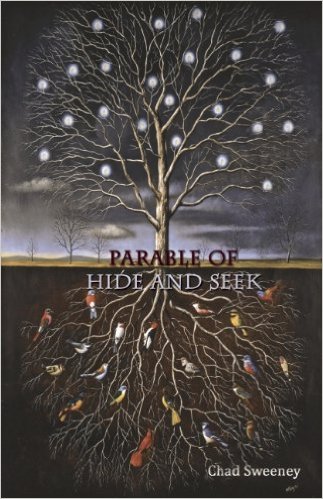
 by Chad Sweeney,
Alice James Books, 2010,
88 pages, paper, $15.95,
ISBN: 978-1-882295-82-1
Buy the Book
If you’ve ever had the good fortune to attend a Chad Sweeney reading, then you already know that these events are rapid-fire rehearsals of the word. It’s a different experience, however, when these poems are found on the page, and we are lucky to have a new collection from Sweeney. Parable of Hide and Seek could be described as an inheritor to some of his earlier work in that it builds large, imagistic worlds out of a very keen sense of perception and metaphor. In Parable of Hide and Seek, Sweeney has pared down the language until each poem becomes something of a koan, or a short Gnostic parable.
What I have always admired and appreciated about Sweeney’s poems is their great sense of empathy and emotional maturity. They are never sentimental, but it is clear from the first word to the last that this is someone who pays close attention to the world, to the names and sounds of things, as any good poet should. An example from “The Piano Teacher”:
A music box wound too tightly will explode,
playing its song all at once.
The practice is to unwind the song slowly.
Think of this when you touch the key of C.
In “The Sentence,” Sweeney is at his absurd and imagistic best, insisting:
The bones of Marcel Duchamp
laid end to end
reach all the way
to the bottom of this hill
where a little slab of concrete bridges one
obscurity to another
We go on to discover that the speaker places Duchamp’s jaw in just such a way that “the oblique syntax of bones / repeats its inquiry / in the language of the world.”
This could very easily be written off as an odd ars poetica, but there is more wishing to be expressed underneath this poem. The specificity of naming Marcel Duchamp, for example — the notion that the artist’s bones can be found and re-purposed — gives the sense that all modes of expression are languages that bring us into relationships, and that each strange relationship is a way of speaking to one another on a level of deep engagement.
If absurdity marks the beginning of meaning in these poems, Sweeney’s objective is far from simply causing bewilderment. As he says in the title poem:
I hid as a bullet fired into hay.
I hid as a system of government.
You were my partner in everything.
I lived for you to find me.
This is the genius of Chad Sweeney’s poetry. These poems only mystify so far as to draw you into them, so that the poems become a communion between speaker and reader.
I have personally walked away from a session of reading these poems (and I can’t help coming back to them over and over again) feeling as if I have just witnessed some marvelously catastrophic event. There is terror and pathos in these poems, bullets and governments, but there is also partnership, friendship, and love. In other words, for every complication presented, Sweeney may not give an answer, but hints thoughtfully at a new direction.
— Thom Dawkins