


Marengo Street: Selected Poems

 by Anna Bat-Chai Wrobel.
Moon Pie Press, 2012,
paper, 89 pages, $12,
ISBN: 978-1-4507-8777-2.
Buy the Book
History slips by us like exits on an expressway — fleeting signs for towns and streets that we will never see since the accelerator is pressed to the floor and we are bent on arrival, getting where we want to be. As a history teacher and poet, Anna Bat-Chai Wrobel knows that too often we drive past what we need to remember. To counter our forgetting, she asks us to go where we do not want to go, and to see what we have conveniently forgotten.
Wrobel tells us of a world that holds the “unholy egg / conceived in Auschwitz,” where “legal minds / split . . . hairs over a definition of genocide.” She writes of a “crushed and ailing humanity” desperately trying to repair itself. We are asked to stop our headlong rush to be something or someone and to instead pay attention to what is happening to us. That is no easy task, since, often, our busyness is a way to avoid the horror surrounding us. And that is the question: How can any of us go on with our mundane activities when, if we pay attention at all to the news — to the violation of our land, of our fellow men and women, and of our children — we might as well throw up our hands?
Rather than throw up her hands, Wrobel embraces the world. In the poem “Rosh HaShana, 1992,” she contrasts fears for the new year with a lovely recounting of a day’s pleasures:
You know when you want that
hot morning shower to never end.
Or the baby to sleep on one
Evermore peaceful dreaming hour.
Times alone in clean rushing water,
Early morning solitude . . .
Soft whistling of
Little loved one breathing sleep.
She then contrasts such solace with the agony of knowing that:
We stand in hot morning showers
gathering splintering bones together.
Inhaling courage with the steam. . . .
And finally, she unites the two emotions: “Wearing anger as an amulet / and mercy as a glove.”
Living with a sense of history requires us to let the “ungloved hand / reach down inside,” to “see [one’s] open heart . . . in the strong slanting rays of / the sun we nevertheless share.” It requires knowing the essential in our lives. In “These Things First,” she captures such moments:
The first thing I have to do is make my bed
so when I return home
it may be unmade
in a ritual . . .
of closing what is open
and opening what is closed. . . .
That is the poet’s task, and it is the charge that Wrobel fulfills in this masterful collection: to let us see what is hidden and to make it fresh, so we can find acceptance — but never resignation — in what is wrong, as we strive to make it right.
— Bruce Spang
Aftermath
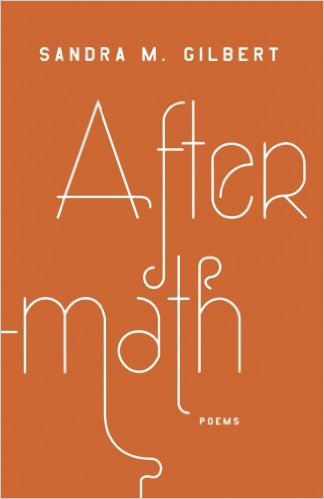
 by Sandra M. Gilbert.
W.W. Norton & Company, 2011,
160 pages, hardcover, $24.95,
ISBN: 978-0-393-08112-1.
Buy the Book
I have to admit, when I picked up poet Sandra M. Gilbert’s ninth volume of verse at first I found it slow going, not because the verse was too difficult or poorly conveyed, but because the first section, “Old Recipes,” struck me as downright dour. I’m very pleased, however, that I admired this writer’s talents enough to stick with it, because as the book unfolds, it reveals territory that could perhaps only have been written by a female poet in her mid-70s. And a rich landscape it turns out to be — elegiac, certainly, but also mesmerizingly blunt, insightful, and humorous.
Gilbert is most popularly known for her academic feminist work, in particular The Madwoman in the Attic: The Woman Writer and the Nineteenth –Century Literary Imagination, written with Susan Gubar. Her poetic output may have been somewhat eclipsed by her literary criticism, but I have been a fan of her poetry since my encounter with her third book of poems, Blood Pressure. The years have not diminished her talents but have deepened them. Her poetry is not obscure, but neither is it plain; under the well-wrought surfaces, one finds deeply considered meditations on loss, departure, nature, religion, time, aging, and beauty — rather what one might expect from an academic feminist. What is not expected are the masterful rhymes wrapped into stunning little sonnets. What is not expected are poems about cataracts, a colonoscopy, dental surgery, and an old cardigan. These poems are not merely funny and wise — they are alive. They bring to mind Donald Hall’s late-career books Without and Painted Bed, written after the death of his wife, the poet Jane Kenyon, and which embody some of the finest work of his career.
Much of the material is centered around the death of Gilbert’s 15-year partner, the game theorist David Gale, to whom the volume is dedicated. However, Gilbert’s grief is expansive and sly, not merely an emotion, but a portal, as in “Grief: A History,” which arcs from a grief that moves from comparisons to a “dull pot at the back of the stove,” “a hurricane with your face,” and “a fog over the harbor,” to a troupe of musicians who “stomped on my glitter / of grief my shards of / rage,” ultimately leading to a “solitude of grief.” Gilbert’s imagery is often startling, and this serves her well, as in the couplet that ends the sonnet “Crochet Hook,” a poem about a life lived in isolation, crocheting in front of the TV, as the world ironically flickers past:
until at last she drowsed in her solitude
and the fallen yarn pooled at her feet liked blood.
In “Question and Answer,” a poem about the Holocaust that takes the deep unthinkable nature of loss to a historical, global level, Gilbert demonstrates her honed ability to depict strong emotion within tightly crafted verse:
And the ghosts
Of bullets disappear in dirty mists,
Of kids in puffs of dust, demented lists.
Not all the work is cohesive — “Scouring” and “Edge of Winter Sonnet” come to mind — but the occasional unevenness is vanquished by the brilliance exemplified in “Variations on an Old Issue of Woman’s Day,” a wryly fanciful commentary on the tragicomic nature of women’s advertising. Where we might expect to find a feminist diatribe, we find something more artful:
Light the oven. Fast.
Note this minute’s
recession of darkness.
Avoid money mistakes.
Hurry up. Unfold
Your flat pale leaves
like the skirts of a dancer.
The final section, “Lei Soup,” is ostensibly a celebration of life, containing remarkable considerations of parasailing, mice, sheep, seals, hearing aids, and other topics. Though they are the most sensual, joyous poems here, I found their cheeriness to be somewhat forced, a distraction from the preceding, more somber themes, although the final two pieces, “Lei Soup” and “Knowing,” return us to an appropriate ending point for this particular journey.
Some might be tempted to classify this book as “women’s poetry,” especially given Gilbert’s background, but it is not. It is a book that does not shy away from the grim aspects of loss, grief or aging, but shapes these realities into a deeply resonant collection. Loss may be devastating, but ultimately it is not antithetical to life.
— Annie Seikonia
Heavenly Questions
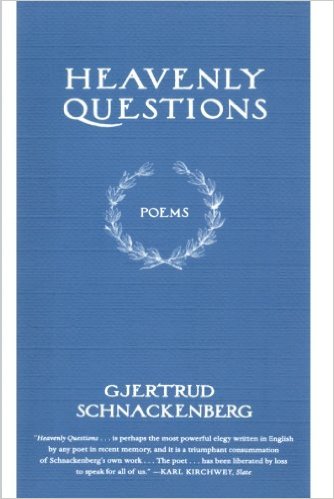
 by Gjertrud Schnackenberg, Winner of the 2011 Griffin Poetry Prize,
Farrar, Straus, and Giroux Paperbacks, 2011,
80 pages, paper, $13,
ISBN: 9780374533045
Buy the Book
Heavenly Questions: Poems Present Yet Outside the Grief
If fortune bygan to dwelle stable, she cesed[e] an to ben fortune.
If Fortune’s wheel spins too many times, it ceases to have Fortune’s power.
— Chaucer’s Boethius
Poetry has a long history of being able to console its readers. After my stay in the hospital last summer, with plenty of illness and grief to go around, I revisited the question of whether a private illness or grief can be shared in a public way through poetry.
Usually, the more regular the verse or meter, the less I feel part of that public grieving. However, with the first poem in Gjertrud Schnackenberg’s beautifully constructed philosophical poems, the regular meter becomes a lullaby that intends to console the patient. As with many lullabies, a story is shared; in this case the subject is Archimedes, philosopher and inventor of ancient machines. She sings:
A visit to the shores of lullabies,
Where Archimedes, counting grains of sand,
Is seated in his half – filled universe. . . .
The rocking, lulling iambic lines mime the first of many heavenly questions that this volume will pose. The cycles of the sand, water, earth, and waves frame a scene that we somehow know is a sickbed or a hospital room:
And all is well now, hush now, close your eyes,
And one . .. . by one . . . by one . . .. by one . . . by one. . . .
The flakes of mica gold and granite – crumbs
Materialize and dematerialize.
Here Schnackenberg uses Archimedes’ work as an extended metaphor for medical technology and its limits, and the effect is like that of a medieval manuscript found in the middle of a modern hospital. The poem partially removes us from the scene of the dying in the clinical way, but it doesn’t yet console any more than the “pastoral services” that modern hospitals still may offer. The patient is only illuminated in an imagined corner of the text.
Eager to find more of Schnackenberg’s work, I did not have to look far to find a beautiful short poem called “Night Fishing,” which opens her selected poems in the volume Supernatural Love. This poem metaphorically embodies the first signs of illness in a muted voice, less heightened than the hospital poems but just as distinct:
Just as a fish lurks deep in water weeds,
A thought of death will lurk deep down, will show
One eye, then quietly disappear in you.
Not since Amy Clampitt’s “A Silence Opens” do I feel so much humanity and tact in poems that hover around the idea of death, materializing and dematerializing it without violating the patient’s privacy and sense of self.
Why do Schnackenberg’s poems console me ? A lot of poems that used to console me do not. I’ve read over Milton’s “Lycidas” and Tennyson’s “In Memoriam” — poems that once consoled but no longer have that effect. The poems that console me these days seem to operate by how effectively they remove us from the scene of grief. Paradoxically, the poet or the speaker, however removed, remains present. Such a poem is Szymborzka’s “A Cat in An Empty Apartment”:
Die ? One does not do that to a cat.
Because what’s a cat to do
in an empty apartment ?
Climb the walls.
Caress against the furniture.
It seems that nothing has changed here,
but yet things are different.
Nothing appears to have been relocated,
yet everything has been shuffled about.
The lamp no longer burns in the evenings. . . .
What more is to be done ?
Sleep and wait.
Let him return,
at least make a token appearance.
Then he’ll learn
that one shouldn’t treat a cat like this.
He will be approached.
as though unwillingly,
slowly,
on very offended paws.
With no spontaneous leaps or squeals at first.
This poem lets me grieve for Szymborska, who died recently at age 88. I can enter her Warsaw apartment through the cat in this poem. The observer, who is located close to, yet outside of, the human scene, personalizes the grief.
“Sublimaze,” the second poem in Heavenly Questions, picks up the bedside vigil in a hospital. Unlike the first poem in Heavenly Questions, which is furnished only with the ancient machinery of Archimedes, the new machines of high – tech medicine are part of the scene:
The door I crazed with knocking reappeared.
A transitory door, lit on the wall,
drenched radiant orange, ablaze beyond the bed. .. . .
In the presence of such machinery, the nurse has “materialized and dematerialized” as the metaphors trace the progress of the disease. This is no mere hospital visit, though. These poems bear witness to an illness and a death in much the same way as Auden’s and Stevens’ great hospital poems visit Yeats and Santayana.
Schnackenberg succeeds in locating herself outside the grief in her final poem in the collection, “Bedtime Mahabharata.” This poem effectively closes off her Heavenly Questions collection not without the possibility of heaven or spirituality, but outside of it. The poem is a retelling of a dog – eared paperback that the poet and the patient have shared in their lives. This final retelling gets outside both the grief and the medieval manuscript that Schnackenberg has lovingly created in the previous poems.
In her retelling, the poet of the Mahabharata speculates on the moment when the writer breaks his pen, and the beautiful exit from story within story. We finally share in Schnackenberg’s grief as the patient squeezes her hand.
In northern India —
He squeezed my hand:
What sentence was he writing when it broke ?
A smile, in such a night, with weeks to live.
Pajamas fever – soaked, trying to stave
Annihilation off another night.
The gentleness that nothing could repay.
I pressed his hand’s blue veins against my lips.
A bedtime story, all that we had left,
And mirror – image towers moving off. . . .
Clearly this retelling suggests no ordinary bedtime story, but rather a final meeting. The poet and the patient become integral to the tale being told.
For all of the above reasons, Heavenly Questions is a book I would freely give to console a patient or a poet. These poems understand that what makes us feel grief is the uncertainty, as how she here suggests but does not describe final moments:
In wars we can’t say where, we can’t say when,
Their stories broken off, the fragments fused
Mid – genealogy, mid – epitaph,
Annihilation gusting nearer, here —
Here the god of writers broke his pen.
— M. A. Schorr
Little Boy Blue: A Memoir in Verse
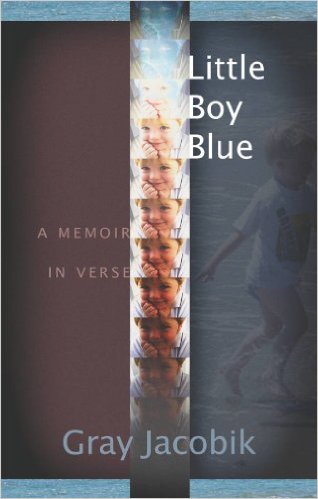
 by Gray Jacobik,
Laurel Books, CavanKerry Press,
63 pages, paper, $16,
ISBN: 978 – 933880 – 22 – 8
Buy the Book
The art of being a parent is often portrayed like a Norman Rockwell painting, an idyllic frieze with a parent looking fondly at a freckle – faced child who smiles dotingly back. It is a well – polished image of what we want parenting to be. When we ask the question, “How are the kids ?” we like hearing how they graduated, have a new job, a good one, and have met someone — a fairy tale with the prince and princess getting married and starting the lovely cycle of life all over again. But that isn’t how it always is.
In Gray Jacobik’s new book, she turns the parenting fairy tale on its head. She reveals not only how she as a parent often failed — failed for reasons any of us would fail — but how her bi – polar son would never live a normal life, would inexorably change her own life, and would lead her to do things she’d never imagined she’d do.
Not often do I find a book of poems that I read from start to finish, but this book moves so furiously forward, taking us from her teenage romance to a pregnancy that her family sought to cover up, from her desperate struggle to parent a child who seemed charged on an Eveready battery to the agonizing slide of her son into mental illness, that I could not put it down. What is so refreshing is how unsparingly she speaks of her own feelings: her not wanting him, her needing him, her being exhausted by him, charmed by him, frightened by him. Her wanting her own life, her seeking men to replace those he wore out. Her wanting to escape. As a parent, I have felt the same way. The wanting out is not a pretty thought, but it’s there like a loaded gun.
For all the agony, however, this book is filled with tender moments of wonder as she discovers who he is:
Hyperactive was the diagnosis.
What, in the ancient world,
would they have said of you ?
Or in Charlotte Bronte’s Spawn
of Dionysus ? Imp ? Hellion ?
And yet such a sweetness
in you too, a tender – heartedness
& sympathy . . . hypersensitive, living
in a culture that had to brutalize
you.
She watches him as he talked to birds, dogs, cats, any small animal and, eventually, with his own radio show, to the air. She recounts the little episodes that made — and make — his life endurable: the over – the – edge jokester as a child and, as an adult, his radio show “The Atheists Hour,” mocking the religious right. She carries us through several marriages — men as lost as her — and how, even after long drives to bring her son home, she takes solace in the little boy who pesters her:
Hey, mom, make a wish. .. . .
In the boy who tells her:
Mom, you’re most like a zebra — calm & flashy.
Who asks again:
. . . Mom, be serious. Make a wish.
And she responds,
I wish I’d never hit you or screamed at you.
Any of us who are parents nod our heads and say, “Yes, yes, we are with you.”
This is a book that will take your heart, but you will feel safe in the hands of a woman who speaks clearly and honestly about what is behind the pretty pictures: our lives.
— Bruce Spang